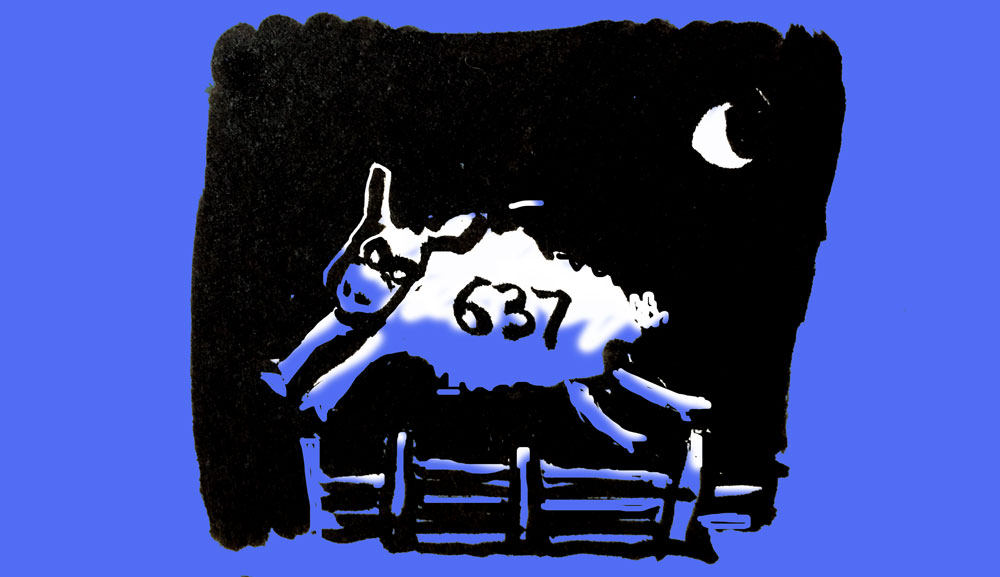
I mean, how hard is it? Close eyes, breathe rhythmically for eight hours, open eyes, get up. I’ve been doing it since the womb.
But no more, at least not for the last decade. I think it started when I turned forty, this business of waking up at 2 am to pee and wander around and eat some cereal and then go back to bed and stare at the ceiling and think about all things that could be wrong with my body and my bank account and then read some more from a book I only read in the middle of the night and then punch the stupid pillow and flip it over and flip the one under it over and then straighten the sheets and then kick them off again and then ask Jenny in a low voice if she’s awake to which she mutters back something inaudible and flips the other direction so I read some more, and then realize it’s eight o’clock and I am late and feel like someone shagcarpeted my mouth and poured maple sauce into my eye sockets, and my Kindle is wedged under my cheek and has debossed a rectangular frame into my face which will last there till midmorning and there’s not really time for a shower but living without one is inconceivable and the dogs are looking at me like I have committed crimes against caninity by making them wait this long for a walk and I know the day ahead is bound to feel like my head is wrapped in a blanket dunked in plaster, but so it goes. At least, thank God, Nighttime is over.
This lovely experience can be mine for the reliving twice a week. No guarantees, though. Sometimes I can sleep perfectly for six days at a time. At others, I hopscotch through a weeklong minefield of insomnia. My doctor said to try skipping caffeine after breakfast — which doesn’t make any discernible difference. My grandfather, the doctor, lived to be 98 by prescribing himself a valium and a shot of brandy before bed every night. I think my mum does something similar. I am very drug averse (see my essay on my time as a junky) so most nights, I just tough it out, and let the hours tick by in the darkness.
In my twenties, I could easily sleep till mid afternoon but that changed when Jack was born. Even if he didn’t stir all night, I would still startle awake thinking he was choking or screaming or all too quiet. and then do the whole staring-at-the-ceiling-thinking-about-cancer-and-the-IRS thing. These days, Jack is asleep on the other side of the country, but my sleep pattern is permanently damaged. I fall asleep as soon as I hit the pillow, then bounce back at the slightest disturbance.
My neighborhood is an asshole magnet. Assholes visit the bars on West 3rd Street and on MacDougal and Bleecker and then they are drawn to the pavement under my building, to sing songs from the ’90s and fight over where they parked the car. Asshole couples make a point of breaking up on my corner. There must be a Yelp review that recommends it as the place to vomit and cry and scream and catalog slights and infidelities, slap and claw faces, pull hair, key cars, and then have make-up sex. Thumbs up!
Current events inspire the assholes too. Any kind of sporting event (football, rugby, ping pong, darts) needs to be celebrated loudly, late into the night, and, of course, on my corner. Last night, after the defeat of the AHCA, an asshole kept screaming, “Obama is still President!” over and over. That’s what woke us up at 2:30. “Obama is still President!” Normally that would be a dream come true. Last night it was a fucking nightmare.
Fortunately, it’s Saturday and I am going to take an afternoon nap on the couch. I need to rest up because tonight I’m going out with friends to some other neighborhood and get really, really drunk, scream a lot in the street, throw up, pass out in the gutter and finally catch up on my sleep.
PS Please don’t leave me any helpful suggestions for how to sleep better. They just make me anxious and inflame my hypochondria. Thanks.
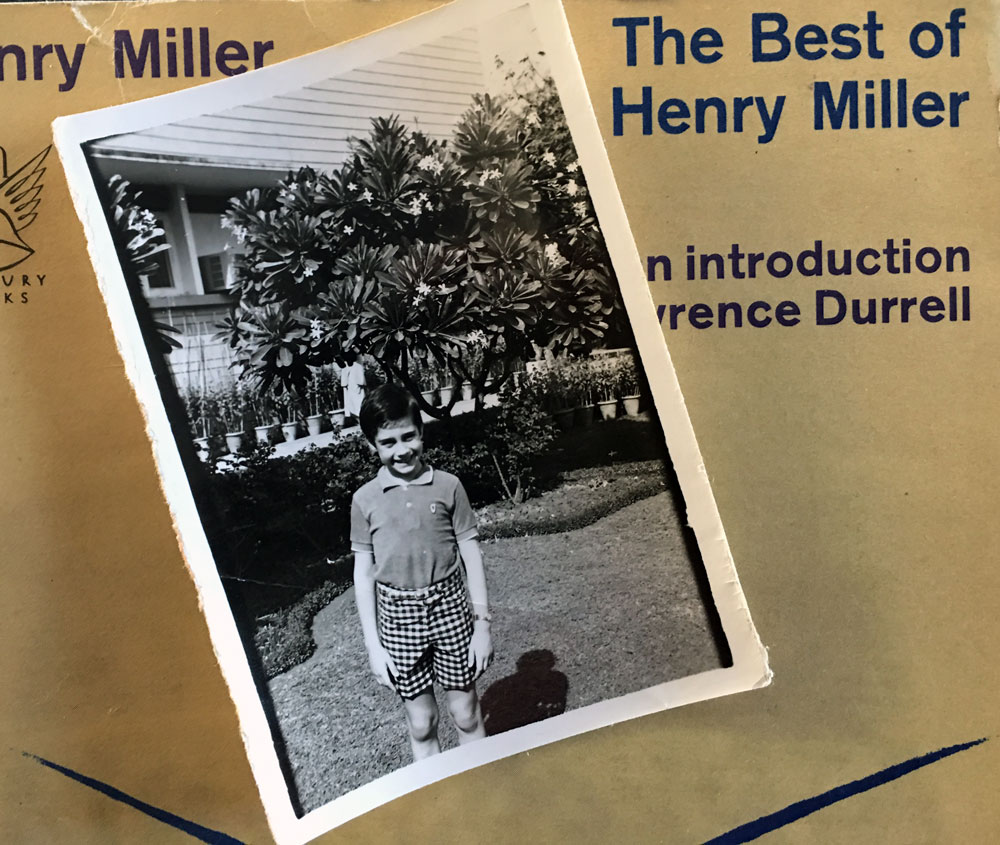
My grandparents had a living room and a sitting room. We hardly ever used the former; it was a long, large cavernous place with my grandmother’s gramophone in one corner and a fireplace we never needed in Lahore’s equatorial heat. The living room was just for occasional cocktail and dinner parties but the sitting room was used every day.
At the end of the work day, my grandparents and their junior partner, Dr. Iqbal, would relax with a gin and tonic and some monkey nuts from the drinks cart and discuss the business of the day. I would have a bottle of 7Up, tall and green with white bubbles painted up its side, and look through the book shelves. They were recessed into an alcove on the right-hand side of the room, teak planks reaching to the ceiling.
When there were adults in the room, I would concentrate on the lower shelves, a row of coffee table books on art and Pakistani archeology, a set of Will and Ariel Durant’s encyclopedic Story of Civilization, various slip-cased editions of the Rubaiyat of Omar Khayyam, and a Punch annual from 1954.
But when the adults were distracted or absent from the room, I would clamber onto the cabinets beneath the shelves so I could study the topmost shelves. There were the ‘grownup books’: fat, sexy novels by Harold Robbins and Henry Miller, chunky bestsellers by Robert Ruark, William Golding, Nikos Kazantzakis, and James Jones. These top shelves were where I first discovered Gerald Durrell, Irving Stone, Richard Gordon, and Paul Gallico. I’d stand on the narrow ledge, my head grazing the ceiling, my eyes skimming back and forth across the spines.
More than forty years later, I still remember all the publisher imprints, ingrained in my skull from staring so hard at the jackets of all those illicit books. Penguins in orange, blue and green, Faber and Faber, yellow jacketed book from Gollancz, Corgi paperbacks, and the gorgeous bindings of the Folio Society.
My grandfather had a second library, in his brown office, so-called to distinguish it from the white consulting room where he examined patients and kept his gleaming steel tools behind the glass-doored of white enameled cabinets.
The GrandmasterThe brown office was a dark and cozy study that smelled of the tobacco he kept in a glass caddy and his row of burled oak pipes. It had two deep leather armchairs, heavily shaded lamps, wooden blinds and walls covered with framed photos from the Maharajahs and Maharanis that he’d treated, plaques and groups photos from his tenure as the Grandmaster of Pakistani Freemasons and the President of the Rotary.
These shelves were stocked with medical books in German, Italian and English, full of plates and diagrams of biopsied organs, tumors, amputations, and the unfortunates who presented with them. There was a series of books with acetate inserts that let me flip through slices of the human body, exposing the skin, the organs, the viscera, the skeleton, with each turn of the page. And there was Gran’s prized possession: a first edition of the collected works of Freud, in German, eleven volumes in stern blue.
As my grandfather worked at his desk, I’d sit cross-legged on the floor and slowly turn the pages of his medical school scrapbook, a heavy, black book with thick grey pages containing deckle-edged photos of his patients and their infirmities. An old woman with a goiter the size of a watermelon. A man with a moustache and no nose. Twins with matching tumors. A young girl with knocked-knees and no clothes. I still own that scrapbook and it still has the power to stir me with its voyeuristic perversity.
I haven’t been in my grandparents’ house since 1970. But I can still remember the sequence of the books, the smell of the bindings, the illicit thrill of reading books I was far too young to understand. The pages of books still provide most of the important experiences and enduring memories of my life.
Dianne wrote to me the other day. She’d never written to me before but I’d made her do it. She said:
Where Are YOU? I’m putting my foot down now. Summer break, ok. The end of the world as we know it, hey, please shine a light. just a wee one. A scribble in a pen that intimidated you, view out the window, your dog’s butt. No pressure, but moments of creativity just feel very important at the moment. My own, and those who are part of my psychic wellbeing. Sorry man, but you blog, you take on responsibility.
I stammered that I’d been really busy, that I was working on a bunch of new things, traveling to film stuff for Sketchbook Skool, and that I’d been doing Facebook live events every day, blah, blah. But I didn’t really tell her the truth.
And the truth is I’ve become hesitant.
This has been going on for a while with me, this impulse to pull back. Instead of sharing things, I amass them, filling up my hard drive with ideas, drafts, sketches, but not going the final step to finish and launch them.
I started this hesitancy last summer when I rented a studio, made a bunch of paintings and was then coy about it all, hesitating to write about what I was doing or share more than a glimpse of the work.
The monkey had a hand in this reticence. He said that none of the things I was doing was especially impressive and that maybe if I kept stockpiling them, their lack of quality could ultimately be masked by their quantity. Of course, that wasn’t true. I never made an especially significant number of bad paintings and ultimately had to just release the results candy coated in some baroque musings about the creative process, as if my handful of Sunday paintings was some earth-shattering exploration to deep wisdom.
Then I started working on a project that had pretenses to be a definitive exploration of the creative process. I did a fair amount of research and took a lot of notes which boiled down to a grubby handful of one-liner bon mots. Each was to be the basis of a short piece, maybe a chapter in a book, then more modestly an epic series of blog posts. then, after reading so much about the demise of blogs, I decided they should be little videos instead and I churned out a handful of scripts, shot them —and promptly sat on the bunch.
Then I decided that the quality of the ideas wasn’t so inadequately that I should make the videos less off the cuff to mask their inadequacy. So I tried making them more elaborate — but still they lurked in a folder. I almost shared them with my wife a few times, but then demurred again.
Then I started doing daily calligraphy videos on Facebook. These were initially fun to do, but then I worried they were no more than evanescent
trifles and stopped after a couple of weeks.
Meanwhile, my absence on the scene began to intensify my hesitation. I felt like I had to do something really cool or far-ranging, some awesomeness to make up for my indolence. That just made it heavier and heavier.
And, while I and my ego and character flaws bear the lion’s share of responsibility for all this balking, 2017 has not made it any easier. For the first time, I have really felt I had to watch what I say online. I have seen so much rage on the internet over the past few months, so much intolerance on all sides, so much fearful obstinacy, that my own tongue has been increasingly tied.
In the past, I’ve always liked to casually toss out the occasional extreme, not very well-thought-out idea, but the consequences for doing so have never felt higher. Sure, a reader or two has deleted me from their feed over the past decade and a half because I took a weird stance on something or other, but these days, it seems like whatever I do could end up on my permanent record. That’s not just self-aggrandizement; I think we are all a little paranoid right now. These are strange times indeed.
But the real fault lies with me. With my surrender to my inner critic and his incessant alarm ringing. With my harsh self judgement. With my short attention span.
So if you wished I’d write more, I think I shall. But I hesitate to promise anything. I’ve rarely live up to those pledges in the past.
I think I need to regain my confidence in what I am, what I have to offer, and in what is important to me and to you.
This post is the first step.
So thanks, Dianne, for the boot in the ass. I hope to pay you back in kind.
Ages ago, someone told me that we replace all of the cells in our bodies every seven years. Every single one. That idea has haunted me since. It seems to mean that I am literally no longer the same person I was seven years ago. Even though I have memories of things that go way further back, they are not the memories of the me of today.
That’s not a completely alien idea; it’s like copying files from an old computer to a new one or making a new printing of an old story. The information is the same but the vessel is new. But somehow when it comes to the cells that make me up, this has always felt different. Because I think of me as this me, this couple of hundred pounds of meat and skin, these scars, this reflection in the mirror. I don’t usually think of myself as a concept, a construction, or as data that can be re-recorded on a new cassette.
I woke up with idea in my head again and as I write this, I’m starting to realize why. The first and most obvious reason is that I am in the middle of organizing all the data files for Sketchbook Skool, 16 terabytes of data stored on a big stack of hard drives. Part of my archiving process is to make clones of each drive so we have backups in case anything goes wrong with the originals. I put an empty drive into a slot in the dock, put the original in the other slot, push a button, lights flash, and soon every byte has been duplicated and I have two identical drives. All those hours of footage, all those conversations, and drawing demos are now in two places.
And somehow, as I do this, my body is doing the same thing. As I watch the blinking on the front of the dock, my old cells, the old me is slowly being copied and then deleted. Old cells are being cast off, exfoliated, dropping onto my pillow, blowing around my apartment with mites of dust, sluicing down the shower drain, peeing into the bowl, crapping out with my digested burrito.
Me shitting me out.
The other reason this popped into my conscious predawn today is that in less than two months, I will slough off the last cell that ever saw Patti first-hand. The last cells that ever talked to her, held her, kissed her goodbye. Soon every part of me will be a fresh clone with no personal experience of her.
In December, Jack and I took Patti’s ashes out of the cookie jar that has contained them since March 18, 2010, and put them in their final resting place. We went to one of her favorite places, just after sunset, and we put her ashes in a place we can always come back to, a private place in a public spot, one she went to every day, where we know she would be happy to be, no matter where we are.
Her ashes are not Patti. They are just dead cells that were burned and preserved, not in amber but in a heavy-duty plastic bag, which we kept in that cookie jar, on a shelf where I could see it every day and gaze at when memories of her became intense. They stood for her but now they no longer need to do that. For she is in us.
The process of burying Pattia was not sad. It was actually slightly comic as Jack and I bumbled our way through it, making a couple of clumsy errors that were pure Patti, pure Hoofy. I don’t think either of us felt sad as we did it. Rather, we felt that she was with us still, that the pain of losing her was a faded memory, and that this was the final thing the three of us would ever do together and that it should be light and silly just as our best times as a family always were.
Patti’s cells are now forever in that one place. Jack’s are now in Los Angeles, three thousand miles away. And mine are here, being replaced with new cells, new cells that look older, more wrinkled and grey.
Many of the hair cells were not replaced. Some of the brain cells did not replicate with all the memories in place. Other cells have less resiliency and vim than their predecessors. And yet they are all still me, they all still bear the weathering of the years, the experiences, joys and traumas that made me and still do.
My memories of Patti have changed with these cells. Some are lost forever. And those that used to take precedence because they were at the front of the line, have stepped back into the mists. I am no longer haunted by thoughts of Patti at the window, of the policemen, of the visit to the coroner’s office. I no longer think of Patti as a woman of fifty, increasingly limited by her disabilities, who didn’t want to grow old in a wheelchair.
Now when I think of her, I rummage through my huge archive of snapshots. I see her in a Polaroid, pregnant with Jack. I see her in a soft focussed, black and white picture dressed up to go to a party, I see her laughing in a bar with friends I haven’t heard from in years, I see her smiling through her freshly cut bob, I see her holding our first dog Frank like a big baby, his long legs sticking up in the air, both of them grinning. I see her looking at me like she did on our first date, saying ‘Mommy’, the gap between her front teeth.
As I think of these memories, I feel old tears well up in my new eye cells. These new cells are never overwhelmed by the tsunami of grief that used to seize me but it’s good to know that those old memories can still effect them, even though I am happy, happy with my new cells, my new kitchen, my new job, my new love, my new wife, my new wife. My new cells make up a new me with all the best bits of the old.
It happens. You ought to write something, draw something, not eat something, but ya just aren’t feeling it. Your New Year resolutions have petered out — less than two weeks into January. Are you a bad person? Worthless? Is the monkey 100% right?
‘Course not. Ronnie Lawlor (who is drawing monster, by the by) and I talk about why not.
I never took driver’s ed in high school. It just wasn’t that important when you were a city kid —at least that was the prevailing wisdom in our house. My mother and my stepfather did have a car, but they felt that if I had a driver’s license I’d just want to drive the car which was their car, not mine. I could take the subway.
In college, I walked or bummed rides and, after graduation, picked my first apartment based on its proximity to the train station. Then, when I was twenty-five, I moved for a year to Jersey City and finally had an excuse to buy a car.
Don’t get me wrong — I love cars, especially the cars that came out when I was a kid. So my first car was a 1965 Ford Fairlane, bronze paint, space-age styling, and gorgeous. I bought it for $800 and then started studying for my permit test.
Jack went through a similar issue. When he was in high school, we didn’t own a car and he had no interest at all in taking driver’s ed. I figured that every day he wasn’t licensed was another day he wouldn’t be killed in a drunken joy ride so I was fine with the delay.
But when he decided to move to Los Angeles after graduating from RISD, there was no more stalling. He took lessons this summer, and then we drove to the Bronx where Jack, full of nerves and self-doubt, nonetheless aced his road test. We drove together a few times in the city after he was licensed, me gritting my teeth as he slalomed past taxis and ground to a jerky halt at each red light.
The question that loomed on the horizon (well, one of a dozen questions about his West Coast transplantation, others to be addressed later) was how would he get around the city once he moved there. I know from my own history in LA that you quickly adjust to never walking anywhere; even two blocks to the grocery store for milk soon seems an impossible effort. One of Jack’s friends suggested Uber, which seemed a ridiculous indulgence. Another said he was going to buy a motorbike because it was cheap. I pointed out that putting steel plates in your head was not cheap.
We talked about buying him a cheap used car but worried it might break down and cost even more in the long run.
Two years ago, when Jenny and I came back to New York from our own LA sojourn, we came in our 2013 Ford Focus. Ever since, it has languished in a very expensive garage on E. 9th Street and we only take it out for a spin once a month or so, and we have been stalling on a decision on its ultimate fate. This July we finally made one. We would give the car to Jack to use in LA.
Next question; how to get it there? I researched car transporters: that’d cost us a grand or so, plus Jack’s plan ticket and shipping costs for his belongings. The obvious solution seemed to be for someone to drive the car there. But who? Jack, with his seven or so hours of experience behind the wheel, wasn’t the ideal candidate for a solo cross-country drive. Fortunately, he has a flexible dad.
So last Tuesday, with rain clouds amassed on the horizon, Jack and I loaded up the Focus and drove out of the gilt-edged garage for the last time. Miraculously, we were on schedule, hitting the road at 6:58 am and driving against the first wave of morning commuters surging into the Holland Tunnel.
I’d had anxiety dreams for the previous week. Frankly, I didn’t trust myself and, of course, I trusted Jack even less.
Would this be my fate?
I had visions of the car exploding in the desert, of searching YouTube for videos on how to change a tire on the edge of rain-soaked highway somewhere east of nowhere. I mentally replayed every road scene in every horror movie I’d ever seen from Duel to The Texas Chainsaw Massacre. I imagined running out of gas, having no phone signal, diarrhea from dicey road food, being assaulted in a truck stop by a maddened alt-Right trucker, bedbugs in a cheap motel, bad radio reception, earthquakes, tornadoes, and wild hog attacks.
Despite the enormous dangers, we made it half way through the Holland Tunnel before an alert went off on the dashboard. We were almost out of gas. I hadn’t thought of this particular scenario, running out of gas and blocking the Tunnel at rush hour. We might even make the local news!
Cousins in Columbus.
We didn’t get on the news or run out of gas, just puttered into a gas station on the Jersey side, then kept going till we were in Pennsylvania. It was a lovely day, lovely ride, and even though Pennsylvania seems to be the most enormous state of the Union and is encrusted with Trump lawn signs, we made it across to the Ohio border by mid afternoon.
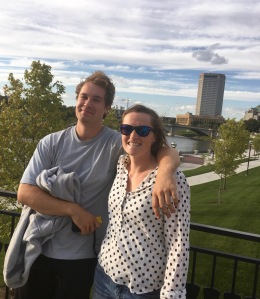
We rolled into Columbus at about 4 PM and made it to my niece Morgan’s house. We met her four dogs, her new husband, and her roommate, then had a nice stroll through Bicentennial Park and a nice dinner at The Walrus. I had one Columbus landmark on my bucket list: Jenni’s Ice Cream parlor. I have made most of the recipes in Jenni’s first ice cream cookbook and wanted to try the real thing. I had a coneful of Goat Cheese and Cherries and it was almost as good as when I made it.
We crashed out on Morgan’s couches then awoke at the crack of dawn for homemade waffles and the next leg of the journey.
The skies were dark and it soon began to bucket down rain. It poured all day. Before lunch, a new alarm went off on the dashboard. Tire pressure low! My heart thundered, adrenaline squirted and I pulled into the next gas station. In the pouring rain, I showed Jack how to use the tire pressure gauge and inflate the two tires that were a little low. It was only the second time I’d ever done that but I handled it okay, I think.
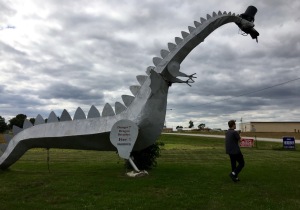
The Vandalia Dragon.
We drove through Indianapolis, then stopped at the Shell gas station in Vandalia, IL to see their fire-breathing dragon. Ten hours and 633 miles later, we pulled into the Comfort Inn in Springfield, MO.
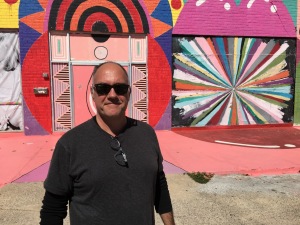
Outside the WOMB Gallery, OK City.
On Thursday, we had lunch in Oklahoma City, which proved to be full of pleasant surprises. We ate some great barbecue, saw some psychedelic murals at the WOMB Gallery, then went to the OK City Museum of Art which has a nice collection of 1960s op art paintings and a Chihuly show.
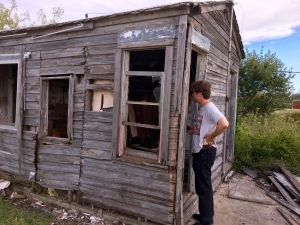
Evaluating real estate in Texacola, OK
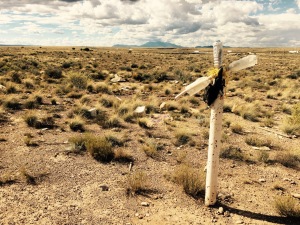
We stopped at Texola, a tiny, crumbling town on the Oklahoma/Texas border and met two dogs and the guys who stand around on the only crossroad.
Jack had done most of the day’s driving, putting another 550 more miles on the odometer. He’d grown more and more confident on the highway, sometimes too confident, grumbling loudly when trucks pulled in front of us, trucks driven by people who insisted on adhering to the 75 mph speed limit. Several times, I had driven my fingernails deep into the armrest as he pulled perilously close to their tailgates.
Finally, we pulled into Amarillo, Texas, the town we were to grow to hate. The sun was setting and we were bushed. We tried to check into one motel but they only had smoking rooms. We secured a decent room in another but had a hard time figuring out how to get into the parking lot.
I walked back to the room and told Jack to pull the car into the last slot, next to a huge pickup truck. Another car was tailgating him, so he pulled to the side to let it by. He was now at a ninety degree angle to the parking spot and way too close to the truck. He inched forward and scraped our car’s fender along a bolt sticking out of the truck’s license plate. He jammed on the brakes and the vehicles locked together. In a bit of a panic, I got between and wrestled them apart.
Once Jack parked, I saw a line across the fender, the first damage the car had ever sustained. I swallowed my agitation because Jack was clearly very upset. It told him it was okay, it wasn’t that big a deal, that if something bad had to happen to us, I’m glad it was so minor.
We went to our room and then, unable to help myself, I started to lecture him, that I thought he’d been driving too fast all day, that he had to be more carful, blah, blah, dad stuff.
I described his reaction and my feelings in my diary:
I see I have scared him with my assault.
He blinks back tears and I feel sickened by my heavy-handedness, adding to his anxiety just to teach him a lesson. It’s the nuclear option and I loathe myself for using it.
I have never ever struck Jack. It’s not something to boast about, though the lessons of my childhood were often delivered by slaps, pinches, fists, hairbrushes, shoes, finger nails, belts. I vowed I’d never do the same. I would never curse or raise my voice in anger. I would rather raise a spoiled, entitled brat than sink into that vulgar, crimson swamp.
But being a parent means wielding great power, as a large person facing down a small one, as an arbiter and authority, and as the one who can give love or withhold it. Learning to wield that power wisely and fairly is an ongoing challenge. Even after all these years, I can let my own weakness carry me away.”
The joy of parenting.
We decided not to drive the car any more that night. We walked past the hotel dumpsters, the Jack in the Box and the Taco Bell, till we reached La Fiesta, and downed a few Mexican beers and picked at our burritos.
Overnight, in my dreams, the scratch grew bigger and bigger, the entire front end of the car became crumpled and undriveable. I tossed and turned, making plans to sell the Focus for scrap in Amarillo and rent another to drive to LA.
In the morning, somewhat refreshed, I went out to reexamine the damage. It was trivial. I told Jack, this wasn’t nearly as bad as I’d thought. He replied, ‘Really? I think it’s pretty bad. How much worse did you think it was?’ I explained that it was limited to one small panel and that he could probably fix it with touch up paint. It wouldn’t affect the car’s performance. Worst case, a body shop could repair it for a couple of hundred bucks. My prognosis was based on zero experience, but it felt reasonable.
I did all the driving that day. It was a short-haul through the rest of West Texas, then on to Santa Fe. We passed through some lovely country straight out of a John Ford Western and our dark moods lifted under the big skies.
Grayson Perry is so clever and funny in his musings about the nature of art and how ridiculous the art world can be, thoughts that came right out of essays I have written on this blog and conversations Jack and I have had many times since he was a teenager.
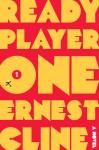
Ready Player One is a novel about the highest levels of nerddom and online gaming, something Jack and I shared since he was little. Jack is far too cool for most people to know this side of him, that he loved to play World of Warcraft and read comics, that he still plays video games with his childhood besties.
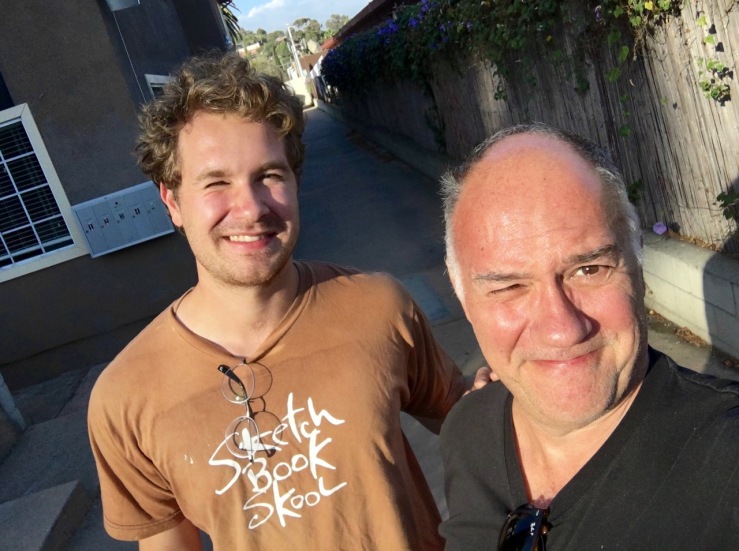
Spending this week sitting 18 inches apart, reminded me of how much Jack and I are alike, how much history we share, how much we have gone through together. There are large chucks of my life that no one will every understand like he does, and vice versa.
But we are also quite different and our relationship makes that even more so. There are times, many of them, when he rolls his eyes at what I say and do. There are times that I cringe at myself for being the know-it-all-dad, swift with pronouncements that I’d be embarrassed for you or my other peers to hear me make, those do-as-I-say-not-as-I-do moments that are an inevitable part of being a parent. Jack isn’t always 100% forthcoming with his feelings, and I am overly self-conscious so I wonder what he thinks of me at times, whether I seem like a complete asshole or if he is actually taking in my priceless wisdom on how to change your oil, look for a job, or brush your teeth.
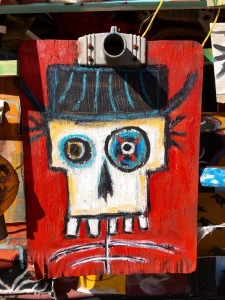
Santa Fe was relief from the long stretches of Texas and Oklahoma. We met a painter who worked in a flea market, we went to some mediocre galleries, we ate some artisanal food. The highlight for me was the Folk Art Museum.
Flea market art in Santa Fe.
Jack said he really liked the town, that it as the first place on the route he could imagine settling. I found it a little precious, the art was pretty mediocre, and there were too many crusty, grey-haired couples wandering around with Merrills and sunbonnets for my liking. I still preferred OK City, which at least had some hipsters under the age of thirty.
Two Guns, AZ.
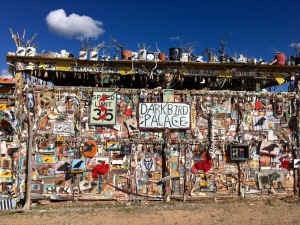
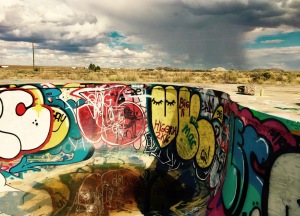
We ate more Mexican food, overdid it with green chiles, and played Casino in the hotel bar. On Saturday morning, we had a late departure and zoomed past Albuquerque, Gallup and the Apache Sitgreaves National Forest. We had to make a quick visit to my favorite abandoned campgrounds in Two Guns, AZ, a ghost town covered with murals and graffiti.
Then onto my mother-in-law’s house in Phoenix. Margie has had a rough summer health-wise and it was nice to have a quiet dinner with her and just sit and play King’s Corner.
Palm Springs, CA.
On Sunday morning, we started the final leg of the trip, six hours on the I-10 . We stopping once, for lunch at a great old deli in Palm Springs where we shared a corned beef sandwich and some dill pickles.
We got to Jack’s new home in Echo Park by midafternoon. Ironically, we ended the trip as we’d begun it, down to fumes once again as we pulled into his ‘hood, barely making it to the Arco down the street.
We made it!
I spent 24 hours in LA, helping Jack get some furniture at IKEA and start to get oriented. On Monday afternoon, he drove me to the Burbank Airport for my flight to San Francisco.
Here’re some snippets I wrote in my journal on the short flight north:
“Is he relieved as I walk into the terminal? To see the back of me and to finally be free to go where he wants, how he wants?
“I think this is why I’m here. Not to work or write blog posts. But to love Jack and Jenny. To love them as they should be loved. To do all I can to make them happy and fulfilled. I don’t do it perfectly but I try to do it better every day.
“I can tell him I believe in him, that I’m proud of him, that I love him — and I do. But those words are just icing on our twenty-two years together. What matters more is that I stand back and let go. That what I think and feel matters less and less to him.
For weeks, I have been telling myself that this trip represents the final chapter in my parental odyssey, that I’ve paid the last bill, fulfilled the last obligation, taught the last lesson, passed on the last morsel of experience, and now Jack will ride off to find his fortune while I wave feebly from a dusty window in the ancestral hovel, then recede into the gloom.
But of course this not the end of the story. It’s just one more chapter in Jack’s life and I shall continue to play a role in it, albeit a new one. I look forward to sharing in what he does so many miles from home because I know he’s not that far, that I brought him there, that his journey is an extension of my own, that we will always be connected in a way that can’t be severed and that neither of us wants it to ever be.
No matter where we each live or work or park or buy egg sandwiches, I shall always be Jack’s dad and he’ll always be my boy.”
That’s a bit maudlin for the wrapup of the trip. Here’s a better ending:
Repeatedly in the weeks leading up to the trip, jenny had told me I should show Jack where the spare tire was stowed in the car and demonstrate how to jack it up and change the tire. I kept meaning to, sort of, but never got around to it.
The fact is, I have only ever blown a tire once. I was driving across the busy Williamsburg bridge and it completely freaked me out. Jenny was with me, she called AAA, and a man in a tow truck came and helped us deal with it. Other than that, I had never changed a tire and my only idea of how to do it came from the movies.
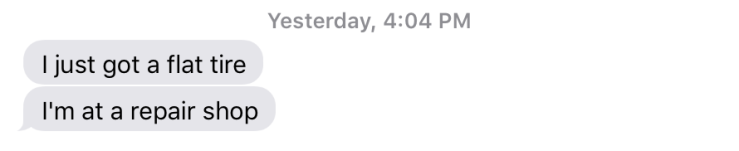
The next day, I saw I had missed a text from Jack.
By the time I called him, he had driven over a nail, gone to a gas station, re-inflated the tire, then, when it went down again, found a place to get it fixed for $15 and was back on the road. He’d dealt with the problem on his own.
Now, I imagine if you are at all a normal person you are scoffing at this story — big deal, he dealt with a flat tire — but to me it was, of course, a symbolic and fitting end to our transcontinental odyssey.
Jack is on his own now. He’s living his life. He’s doing his thing. He’s fixing flat tires. And he’s gonna be okay.
Let me tell you a story. It’s about what change sounds like when it’s kicking down your door. And what you do about it when it does.
Herman was four years old when his country plunged into the war to end all wars. World War I continued to rage on till he was nine, a boy too small to fight or even understand the causes and implications of the destruction all around him. But he soon felt the fallout.
After losing the military war, Germany was savaged by an economic one. Inflation rocketed to historic levels. It was a terrible time for even a canny entrepreneur, and Hermann’s father was born to lose, even in the best of times. He invested the family’s nest egg, the equivalent of $10,000, in a warehouse full of burlap sacks, then turned around and resold it at what would have been a handsome profit. His buyer was to pay him by day’s end, but stalled. By the time he showed up two days later with the cash, a literal wheelbarrowful, the millions of marks would scarcely buy a loaf of day-old bread. The family was ruined.
Hermann and his siblings were sent door to door through the ghetto, hawking whatever wares their father scrounged together. When his older brother, Josef, rang an unfamiliar doorbell and discovered it was a classmate’s home, he dropped his bag of mantle clocks and ran in humiliation. No amount of beating would get him back out to sell again.
But Hermann persevered, hustling, supporting his family however he could. Knowing no one else would ever come along to bail them out.
In high school, Hermann had shown himself to be exceptional; he was clearly smarter and harder working than any of his classmates. His dream was to go to medical school, then to study with Sigmund Freud and become a psychiatrist. It was a preposterous ambition for an underfed boy from the shtetl but he stubbornly pursued it nonetheless.
By the time he completed his studies, the Nazis had decreed that a Jew could not practice medicine and he could not be receiving a doctorate. In fact, they announced, Jews should leave Germany all together. Or else.
While the getting was still good, Hermann went to a relocation office to register for exile. In a long line, he meant a lovely young woman from Koln. Kate said that she too planned to be a doctor. He told her he’d heard that Jews were still permitted to study medicine in Rome and that if she was interested, he would remain in line and send her the necessary information and paperwork. She gave him her address, thanked him and left
Not long after, a pair of SS officers stopped Hermann on a train, demanded his papers, and said that he was under arrest. After some deliberation, they told him that red tape meant they could not arrest him on the train, but that he should continue on to his home and turn himself into the local authorities to be arrested there. Hermann got off at the next stop and secreted himself away on the next train to Italy.
In Rome, dead broke, he began studying medicine again. From the beginning. In Italian. He survived on a single herring a day and water from the Trevi fountain. One day, he met Kate again. She had made it to Rome and was still lovely. In 1936, they exchanged cheap gold wedding rings in City Hall, then exchanged them again with the authorities for steel rings enscribed “Oro Alla Patria.” The fascist government mandated that all gold items be turned in to fund the war effort.
Soon after they finished their studies (again) the Italians decided that they didn’t welcome Jews anymore and that they had to all leave the patria, pronto. Hermann and Kate looked for somewhere, anywhere, to flee. Their families had all left Germany for Palestine but Hermann was pretty sure he had a cousin who owed him money and had emigrated to India. So he booked passage on an eastbound ship, assuring Kate that he would find a haven and send for her.
He never did track down his cousin or the money he was owed, but India seemed like a safe place for a pair of young doctors and so he sent for his wife. They set up a practice in Lahore, ministering to British expats, and gave their babies English names. Hazel was born in 1939 and the next year, Michael. A thousand miles from the chaos of the war in Europe, the little family breathed a sigh of relief.
One morning, Hermann opened the door to several armed British soldiers holding manacles. Four pairs, including two for the babies. The family was arrested for being from a hostile county, enemies of the Crown, Germans, and were transported north to a prison camp. There, Hermann and Kate were assigned to be the camp doctors and ordered to treat their fellow prisoners: German spies and Nazi sympathizers. They began frantically writing letters to anyone who might give them asylum, to Palestine, to the USA, anywhere, but to no avail. Even when the war officially ended, they and their children remained behind barbed wire for a total of seven years.
When they were finally released, stateless, with no passports, they returned to Lahore. More upheaval. A civil war between the Hindus and Muslims cracked India in two. Thousands died, millions were dislocated as Lahore became a part of a new Islamic country, Pakistan.
Hermann and Kate and their family stayed on in Lahore. They worked hard, constantly updating their lab and their surgery with the most up to date equipment shipped from the West. They became pillars of the community, treating ministers and film stars. Herman was elected president of the Rotary, then Grandmaster of all Pakistani freemasons. He wore custom suits and owned 40 pairs of hand-made shoes. Kate bought her frocks in London and wore an armful of gold bangles. They had a large medical staff, a butler, cooks, two gardeners. Their chauffeur drove them in a Mercedes-Benz and they sent their children to British boarding school.
In the 1960s, the German government reinstated their citizenship, made an official declaration of apology to them and held a ceremony in their honor in Oberhausen, the hometown Hermann had fled after his encounter with those SS officers so many years before.
Then war broke out on their doorstep again. Their home was just a dozen miles from the Indian border and, as Pakistan and India locked horns and East Pakistan became Bangladesh, Hermann and Kate felt compelled to pack up their belongings once more and depart for Israel. They bought a home in Jerusalem, among their people at last. A year later, on Yom Kippur, they heard air raids sirens and ran down to their shelter. War again.
But this time, they wouldn’t be going anywhere. Kate succumbed to dementia in her 80s and Hermann died in his favorite armchair at 98. They are still in Jerusalem, buried side by side on Mount Olive, waiting for the Messiah’s trumpet to sound.
My grandparents’ lives were rife with change, none of it their doing. But every time the deck was reshuffled, they survived and thrived. I never heard them curse their luck or complain about their lot. They weathered all types of persecution, unforeseeable calamities, and yet, they never gave up, always looking for new solutions, new ways to make the most of their changed circumstances.
But it wasn’t easy. I’m sure they must have worried terribly; of course, they did. Hermann became increasingly reactionary as he got older, suspicious of Palestinians, Soviets, liberals, intolerant of anybody who was different. He saw antisemitism all around, and who could blame him after all he’d endured?
Kate’s children ended up living on the other side of the planet, marrying gentiles, pulling away, leaving her feeling isolated. She never practiced medicine after they emigrated to Israel, but became a housewife, she who had been served by a dozen servants. Despite all her years abroad, she enjoyed pottering around in her own kitchen, nostalgic for the days when she was still a fräulein in her happy, tidy, middle-class German home.
When I lie awake at night and worry about all the things that could go wrong – medical, financial, presidential, what have you — I remember all that Hermann and Kate survived, how, even when things were scariest, they pulled through.
They lived through a century of rupturing change — lived and flourished. When I suffer some piddling setback, I think of Hermann sitting down to study medicine all over again, in a language he didn’t speak, a meager herring in his belly, fascists all around. When I worry about madmen planting bombs in dumpsters a few blocks from my home, I think of how my grandparents felt every time tanks rolled past their gates or jets flew overhead. When I get annoyed at the bank or the DMV, I think of how he felt when the SS stopped to paw through his papers. When I feel anxious about my son moving three thousand miles away to start a life in California, I think of how they felt when their families disappeared into the fog of World War II, behind the gates of Auschwitz.
Don’t get me wrong. The fact that many of their trials were greater than mine doesn’t wipe away my worries. And It doesn’t trivialize them either. But it does serve to remind me that I come from hardy, resilient stock. I am descended from survivors. And when you think about it, we all are. Whether we know it or not, the world has gone through far worse than we face today, our new fears notwithstanding. We are free from famine, plague, genocide, and, though the world remains a troubled place, it’s still a beautiful one too. We can decide how we will see things, how we will cope with change, how we will survive. We are free to choose to live each day as if we were going to make it through what ever comes up, firm in the belief that we are going to survive to die in our favorite armchairs, many years from now.
When I sit down to draw something, I often start by looking at the negative space, the parts of the picture that aren’t the subject. I draw the sky behind the building, the floor under the chair, the wall behind the person. It’s a way of overcoming assumptions and getting a fresh perspective on what’s right under my beak.
Let me tell you about the negative space that defines the past few months of my life. The things I stopped doing — so I could do what I did instead.
Blogging.
The most obvious decision is that I stopped writing posts here. I had been writing pretty regularly on and off since 2003 and it has been a really valuable part of my process. This blog has given me a place to try out ideas, to get perspective in what I’m doing, to scratch my writing itch, to make jokes, and to talk to you. But.
When I went to summer camp in my tweens, we had to write a letter home twice a week. It wasn’t a suggestion. It was a rule. In fact, these letters home were called “Meal Tickets” because if you didn’t have a letter in a stamped, addressed envelope clutched in your grubby hand, you couldn’t have dinner that day. No one vetted the contents of the letter itself, it could say anything, but you had to show up with it or starve.
Of course, being a snotty pubescent, the letters I wrote grew more and more perfunctory, a simple “how are you? I am fine” and my parents would probably have preferred I saved the stamp money.
When I started to blog, back in the days of coal-powered laptops, I was really only writing for Richard Bell and Roz and a few other pals, and this was just a place to play, to experiment, to record ideas and muck about. I’d write thoughtful things, silly things, fantasies, pseudo-academic theories, advice, and what have you.
But in the ensuing years, while I was playing, blogging became a science, a marketing platform, a job, and I became “a blogger” and felt I had to follow the emerging code.
Earlier in the year, a well-meaning friend told me I must blog consistently and regularly to be taken seriously. She told me I should have a theme for each day so people knew what to expect on Tuesdays, say, and every other Friday.
For a whole I tried this, diligently churning out themed pieces, ripe for sharing. Not sure if you noticed.
Then another friend said I should make quotes in sharable visual form and put those out there. “I tried that too.”—Danny Gregory
Someone else said my blog posts needed to be shorter and pithier for busy people. So I cut back on my verbosity and shelved my thesaurus.
Then I worried I was blogging too much and wouldn’t have anything left to put in my next book.
Then I went through a dark and insecure time of not feeling I had anything useful to say at all but had to write anyway.
Oy.
I know that you, dear reader, are saying ‘what a lot of poppycock and hornswoggle’, but such is the predicament of an aging hipster in skinny jeans trying to remain current. Like it or not, in an age of diminishing marketing support from publishers, blogs and the attendant audience-building have become an essential part of an author’s job. You and I are just working for the Man, making up for the publishing industry’s declining fortunes, by developing a strong bond into which books can be inserted and credit card charges extracted.
I hate to think that this was the purpose of all these posts, to sell stacks of paper and feather executive nests, but such is the reality of life in the trenches.
A friend told me last week that her agent said that thanks to her Facebook following (built on pithy illustrated quotes) she could expect a seven-figure advance for any books she chose to write. What should it be about, she asked? Doesn’t matter, he replied, just see what you can do to get your numbers even higher, then you have carte blanche.
Ugh.
Now, I don’t want you to think that I went on blog strike or anything. My days at the barricades are long gone.
But I did decide that I am going to blog just because I want to and if that means that a lot of casual first-time readers looking for quotes to jazz up their Pintrest boards miss out on a few of my pithier jpegs, so be it. If the sales of Art Before Breakfast–the Workbook are less than stellar because of my principled stand and shirked responsibilities, I will gladly resort to eating day-old bread, shaving with dull blades, and selling one of my dogs. Sorry, Tim.
And if the head counselor has to call my parents again because I have refused to hand in any more meal tickets and my ribs are sticking painfully through my delicate birdcage of a chest, I will hang my head and take the tongue lashing.
By the by, I expected that suddenly vanishing from the scene would cause some sort of ripple, that people used to getting a regular 7 a.m. email of my latest musing would notice the void, but that didn’t happen. Not by a long stretch.
In the two months I stopped blogging, I got a single plaintive message asking if I was okay. Otherwise, radio silence from my myriad ‘fans’. The hordes I imagined waiting with bated breath for every pearl of wisdom that dripped from my keyboard were evidently all out playing Pokemon Go. My moment appeared to have passed.
Tweeting.
Blogging was the one thing on the Internet I occasionally missed. I didn’t feel that way at all about Twitter, which I similarly vacated. I have always found the limitations of 140 characters to be a pointless ball and chain on my verbosity. I realize this platform is an essential one of our age, propelling some even to the gates of Pennsylvania Avenue, but if you want me to write punchy headlines and short body copy, you’ll have to pay my day rate. I wrote thousands of 30-second TV scripts that had to be 72 words or less and I’ll chafe at the limitation no more.
I find reading Twitter posts to be mindless gum-chewing, looking for meaningful insights in fortune cookies. I like language and can take it undiluted. And I don’t care what you think of what someone else said about something else somewhere else all telegrammed in cryptic #s, contractions and acronyms. If you have some thing to say, just say it. At length. Thoughtfully.
Increasingly, brevity is the essence of the halfwitted.
Podcasting.
This spring, I launched a podcast. It was based on my most recent book, Shut Your Monkey. Podcasting has become quite the thing these days, I like to talk, and I have a lot of interesting friends so I thought I’d give it a go.
I intended the podcast to be an ongoing discussion about the inner critic and I brought in a fairly impressive group of experts to discuss with me.
I asked listeners to help turn it into a dialogue, a forum on this all-important subject, an opportunity to swap ideas and experiences. I set up a system for people to record their own ‘monkey tales’ so I could put them on the air. I invited questions and thoughts via email too.
The dialogue part of the effort didn’t pan out. Two listeners recorded messages and one of them was mainly of a dog barking.
Nonetheless, I got quite a lot out of the experience and the discussions and enjoyed much of it.
But over time and as my plate got filled with lots of other things, the podcast became a bit of a Meal Ticket too. Each week I was writing a show, lining up an interview, recording and mixing it, then writing a newsletter and a blog post on dog.com and monkeypodcast.com to explain my experience of the discussion and share other bits and bobs to flesh things out. That in addition to the Skool, my blog, my books, drawing, other projects, navel-gazing and haircuts.
I came to realize that a) the expectations of recording quality in a podcast have gone way up since I had my first go at it ten years or so ago (most of the emails I did get were to complain about my sound mix) and b) that all the podcasts I admired were actually produced by a whole team of dedicated, qualified people doing what I was trying to do alone.
Without explanation, I suspended the podcast and again, heard from no one wondering why. That meant I could chill, not feel guilty at my latest abrogation of duty, and think about other things.
I have material for another half-dozen episodes and when I get around to it, maybe when the evenings grow long and cold, I’ll cobble them together, at least for my own benefit. I have learned so much from all my wise guests and I look forward to listening to all these interviews again.
Another thing I got out of my monkeypodcast experience was the fun of writing a newsletter. It’s quite different from blogging. It feels more one-to-one and more disposable and I found myself writing in a nuttier, more provocative way, tossing off jokes and asides.
What with all the obituaries being written for blogs, I have been thinking replacing (or maaaaybe, augmenting) this blog with a weekly newsletter.
Would you like that?
I’d make it fairly weekly (but not in a meal ticket way), and it would be delivered right to you, in full.
It would mean you would no longer be in the position of saying “Whatever happened to Gregory?” or “I wonder what he’s griping about now.” Instead, you’d know, because it was all there — in your spam folder.
“Newsletter” is such a dreadful term, though. It smacks of Rotary Clubs and dentists and earnest Methodists. And now of “Growth hackers” those horrible, young hard-salespeople who churn out clickbait headlines like “10 ways to immediately transform your sales funnel/diet/credit rating — just sign up for our free newsletter/ebook/infographic…” (I should probably shut up about this. At Sketchbook Skool we sometime resort to this sort of thing and it works embarrassingly well. I’m an old-school brand marketing guy and all this sort of DM, John Caples stuff makes me cringe.)
Anyway, if you think I should do this, I probably won’t call it a newsletter. Maybe , I dunno, a love letter?
What else?
Oh, yeah, Instagram. Most of my artists pals love it and boast of their zillions of followers and likes. It leaves me cold. I’m not into mindlessly thumbing through hundreds of drawings representing thousands of hours of work. It’s too much like Tinder for my liking. And besides I’m married.
Pintrest.
Same thing. Been there, done that, don’t care. Maybe if I was going to reredo my kitchen or pick out a bridal gown, but it feels like too much of a mindless mind-suck for me. One clueless grouch’s opinion.
Facebook.
It’s nice, it’s friendly, but I do not miss it. This summer, Facebook felt like standing on the bank of a broad, fast-moving, and very shallow river. Like wandering through a work Christmas party at a huge company, full of people I sorta know, gussied up, sharing banalities, till occasionally someone has one drink too many and says something honest and embarrassing.
It’s an important place, Facebook, the gathering spot for today’s community, but there’s too much din for me, too much chaff, and I figure if anything important goes on, someone I know in the real world will tell me about it, probably in person.
The exception: the Sketchbook Skool group. I love feeling the creative energy there, a community of people who have gotten to know each other over a long time and through a shared passion and that feels like a real family. So I hung out there some this summer, but even that less often.
Authoring.
I was thinking I’d write a new book this summer. I had two (!) out this year but the wheels of the publishing industry turn slow and today’s notion is 2018’s publication.
I started off with two ideas. One was to write a memoir of my family, an unusual bunch. I’d delve into why my grandparents went from Germany to Italy to India in the ’30s, why my mother got married three times before I was ten, why I went to 18 schools on four continents, why my uncle’s estrangement from the family was on the front page of the NY Times, and other questions.
I also thought about writing some sort of more definitive book about creativity, to go beyond drawing to everything I have experienced and researched about how we do and don’t make things, where ideas come from, how to get better at it, why we fear it, how to encourage a new generation of creators, why society is so ambivalent toward creative people, why there’s so much myth around the whole thing, and why and how the role of creativity in our culture is changing so much right now, from the disintegration for publishing and music to the explosion of startups and technology.
I couldn’t commit to either project yet. The first felt too personal and limited in its appeal. The latter too well trammelled.
I also hesitated because I am unsure about the form. Do I need to write another book? I’ve written ten or so already — what would an eleventh accomplish?
I am resigned to the fact that I will never be Elizabeth Gilbert or Austin Kleon or Julia Cameron or Betty Edwards or SARK or Bob Ross. With no false humility, I know I occupy a narrower orbit. Maybe I lack bravura. Or hair. Maybe I am too prone to beard stroking and muttering into my teacup to be in the pantheon of creative diagnosticians.
So that’s one thing. But also, whither publishing? I had a fairly disastrous experience with the publisher of Shut Your Monkey, a book I expected to be of much broader interest than they were able to drum up. What am I getting for the 93% of my book sales they keep? I conceive, write, illustrate, design and market my books. They print and ship ’em. My editor at Chronicle is lovely but she costs me a lot.
So, should I make more books? Should I just publish them myself? Should they just be digital? How will I sell them?
Or should I put my energy into making courses instead? I have lots of ideas for things that I could teach and talk about in videos and that seems to touch people in a more direct way than books people read once (hopefully) and put on the shelf.
Or should I just blog? Write everything I am thinking here (or in my hypothetical news/loveletter, remember?)and find some other way to buy dog food?
I dunno.
This summer, I had a lot to think about in the negative space. Positive stuff that will help make me more balanced, creative, and happy.
I also realized I do too much. I go in too many directions and not far enough. If I can decided to focus on one thing rather than all the many directions I pull myself, maybe I will discover a new sense of being.
I have lots of plans, lots of dreams, but I have newfound respect and understanding for the importance of empty space, to set priorities among those many ambitions to do the things that I truly care about and enjoy the most.
Life is short, I only have about fifty years to go, so I better get to it. By next summer, things will be pretty different.
Let me know what you think about all this. I really appreciate your feedback.
Meanwhile, my meal ticket is done and I’m going in to lunch.
It’s been a while. The last you heard from me, I was whining about my extraordinary good fortune, that I had rented a painting studio for the summer to share with my son and how challenged I felt by this enormous hot fudge sundae.
And, while it may have appeared on this blog that I had disappeared into that studio and locked the door behind me for two months, I actually was absent because I gave myself an even bigger gift.
A summer off.
It wasn’t a deliberate plan at first. But despite my industrious and responsible nature, I decided to shirk more and more habits and rutware and see what grew in their place. And to see how much trouble I’d get in to for not showing up.
Studio.
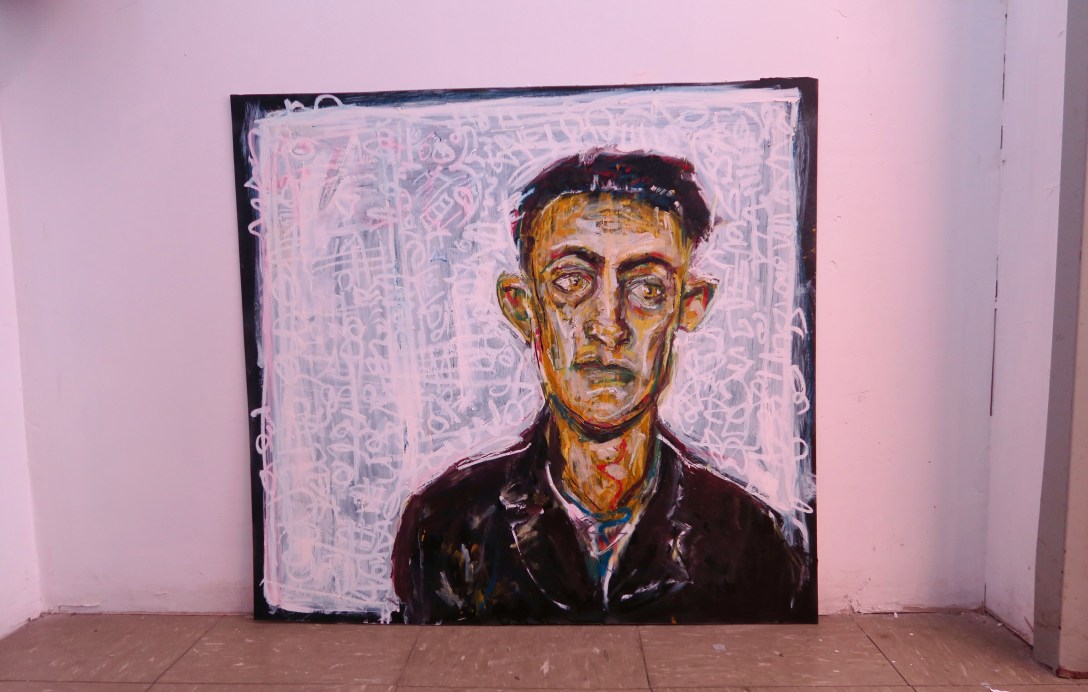
I made a bunch of paintings and some sculptures. Despite my initial trepidation, I let myself go fairly wild with how I made them, experimenting with new media and working much bigger than usual. Most of the paintings were fairly large and the sculptures were all knee high but were installed in various sites as if they were monumental. In a few days, I’ll write a detailed post about what specifically I did and what I learned by doing it, but suffice it to say for now that going to the studio was a refreshing departure that helped me examine and combat a lot of those fears I had expressed to you a few months ago. I drew some but less than normal and didn’t keep any sort of illustrated journal at all.
Reading.
Usually, the summer is a great time to go to the movies. But over the past few years, the cinema has lost its appeal for me. I find most of the films really forgettable. I can think of two I have seen this year that I liked (Hunt for the Wilderpeople and The Lobster) and, because so many of my friends don’t seem to go the movies any more either, even they haven’t been good fodder for dinner party conversation.
Instead, I have watched TV and read books.
I made time to read a lot. I’d get up early and read before breakfast and go to be early and read for an hour every day. I read a fair amount of escapist crap as one should in the summer. I also read some fantastic books, many of them new. Many of these are memoirs and others are novels that feel like memoirs. Here are the ones that have really stuck with me, creating moods and insights that I keep coming back to as the best books do.
We watched a fair amount of TV when staying in the air-conditioned living room seemed the sanest plan. We watched the ABC series Lost on Netflix, a strange and endless tease which I hadn’t watched when it was first broadcast. It took the better part of the summer.
We watched the Olympics, although our initial enthusiasm waned over the two weeks of breathless coverage. Partly because living with a millennial for the summer who doesn’t get the Olympic quadrennial ritual and wonders why we need to watch hours of gymnastics and swimming when there 700 other things on to watch instead. And partly because I started to wonder the same thing.
The Election.
(Note: One thing that I have learned in a dozen years of blogging: avoid talking about religion or politics; it just ruins the party. But I’ll break that rule today to share how I have felt watching the election this summer.)
I like following the campaign strategies, the unfolding dramas, the twists and turns. And, in at least four elections in my adult life, I have felt pretty passionate about one of the candidates running for office.
This election has been a gobsmacking, rubbernecking train wreck but it lacks the usual pleasures. There’ve been no real discussion of solutions, no traditional campaign strategy, and the result, despite the media’s shrill thrashings, has been forgone for some time. It’s like the 1972 Olympics in Munich — instead of watching a match of amazing accomplished competitors, we are watching a highjacking. It’s disturbing that at a time of such change in the world, this important opportunity for discussion has become just a referendum on two individuals. Like a lot of people in this country, I don’t feel much enthusiasm for either candidate, and I am just waiting for it to be over. Nonetheless, it’s hard to tear one’s self away from the spectacle. I just hope I can get back to enjoying the race next time.
Okay, back to more important things we can all agree on, like Sketchbook Skool.
Sketchbook Skool.
We are entering a new phase in the Skool’s development. It may not always be apparent from outside, but we do a lot of thinking and planning and replanning and rethinking about what the future of the Skool should be and if it should even continue at all. What began as an experiment almost three years ago grew into a business. And a passion project became a job. There are times it has been the best job I could imagine. At times, I have felt like I work for the worst boss ever: me.
This year, we had lots of ambitions, tried lots of experiments, and finally came to a maturing in the early summer that has made us all feel both excited and in balance.
We have created a number of new kourses this summer. We released Andrea Joseph’s Creative Lettering klass, one of our biggest launches
ever and people really love it.
We filmed another intensive kourse with Veronica Lawlor that we will be launching later this year. I am in the midst of creating a kourse called “How to Draw Without Talent” that I am having loads of fun with. And we have several new teachers segments in the can for another 6 week kourse to launch in the winter.
Jack and I even made a film (to be released soon) called “How to Draw Your Dog” featuring our two favorite canine mascots, Tim and Joe. We’ll share that soon.
We are also advertising on Facebook for the first time which has been a great way to welcome new people and has made us completely rethink how we present ourselves and what our Skool can be. It has also been fascinating, as a person who created advertising for thirty years, to be marketing my own business, and to be using new tools and technologies that work in such amazing ways. I can’t say I ever knew exactly how any ad I ever write really worked. Now I know on an hourly basis.
This summer we also committed to doing a Study Hall video for every single week of every kourse, a daily blog post that’s useful and inspiring, a weekly newsletter, a weekly video roundup of everything that’s going on in the community and to our first wave of Teaching Assistants, recruited from our alumni.
Our growth has had some pains. We have come to terms with the fact that our platform may not be right going forward and in the next few weeks, we will begin to transition in a hopefully seamless way to a new technology that is faster, more secure, and has lots of new features that will improve the Skool. It’s one of the most essential and most disruptive things we have to do (we changed platforms last year and it was like moving to a new country) and it’s taken many months to finalize the decision but it’s gotta be done.
We are also getting better at doing our jobs. For the first time, we are regularly getting planning and things done long before they are due, sticking to proper production and marketing schedules. And we are being realistic and focused in what we take on so we can get things done, and grow in the way we want to, to accomplish our personal and business goals.
Sketchbook Skool is a great part of my life and the lives of lots of other people, my colleagues, fakulty, and students. Keeping it viable and thriving is challenging but rewarding and this summer has been one of our most important chapters, even though much of that work has gone on behind the scenes.
Advertising.
I signed on to do a three-month project for a former client which will take me through early October. I can’t discuss the deets but it involves a sizable budget and a fair amount of autonomy.
It has been interesting to fire up those sections of my brain that have been under a tarp for three years and see if they still work. They do.
It has also been interesting to see how I have changed in the past three years, how differently I work, how differently I view the processes of big corporations and of the advertising business. I must say I much prefer how we do things at SBS. So much less bureaucratic, more decisive, more flexible — but so it goes. I don’t miss working full-time for the Man but an occasional visit is fine.
Jack.
My boy graduated this summer and has spent a couple of months working to save up for his move to Los Angeles in the fall. It has been great to have him here with Jenny and me but bittersweet because we all know it’s the last time he’ll really be living here. Soon he’ll start his new life, far away, and I am savoring every one of the moments we have left.
At the end of September, I plan to drive with him from New York to Los Angeles to help him get setup in his new apartment and to leave him the family car. Then I’ll fly home and he will begin his next chapter. Gulp.
Cooking.
We spent last Spring having our kitchen renovated and we love the results. Jenny and I have a beautiful, sunswept place to cook now and we are making the most of it, visiting the farmer’s market, ordering mystery boxes of artisanal veggies from Fresh Direct, and having an excuse to buy even more cookbooks. Our kitchen is so big and well designed that all three of us can work in it together, without knife fights or saucepan jousts.
Exercise.
Maybe it’s my demographic, but more and more of my friends and relatives are getting decrepit. They’re spending time in the hospital, struggling to reach their shoe laces, filling drawers with pill bottles. I want to avoid that. My shingles experience last Spring really brought that home. I have been ever more dedicated to working out with my trainer Keith, to avoiding french fries, double dip cones, and the sun’s rays. I am also realizing that I am not meant to be thin but that doesn’t mean I am meant to be fat. I am, however, meant to be baldish, it would seem.
Ideas.
This summer I began a new habit: I start each morning by writing down a bunch of ideas. Each day I concoct a different assignment and write down whatever occurs to me. It pumps my brain with blood, clears the cobwebs, and is a nice habit. Most of the ideas are worthless but the occasional one is worth developing and that’s what I’ll be doing. I’ll share some of those lists with you here, in time.
Workbook.
I have a new book. It just came out at the end of August. It’s called Art Before Breakfast – the Workbook. It is designed to help you develop a creative habit, of drawing and seeing the world around you every day. If you have read Art Before Breakfast, you will recognize some of the content but it has been redesigned and expanded and printed on high quality sketchbook paper so you can not only carry it around with your for inspiration but also draw and write and even paint right in its pages. I hope you like it.
And if you prefer Frühstück to Breakfast, you will be glad to know that the original Art Before Breakfast is soon to come out in German. That will be the sixth edition foreign language, including Spanish, Russian, Korean, Mandarin and I forget the other one. Aussie?
The fall.
Well, I hope you had a great summer too. Do tell me about it.
School’s back in session, I have my new shoes, fresh haircut and sharpened pencils and will be at my workstation, posting semiregularly again. So get used to coming back to this same batchannel in future for more ruminations on all things creative.








 I walked back to the room and told Jack to pull the car into the last slot, next to a huge pickup truck. Another car was tailgating him, so he pulled to the side to let it by. He was now at a ninety degree angle to the parking spot and way too close to the truck. He inched forward and scraped our car’s fender along a bolt sticking out of the truck’s license plate. He jammed on the brakes and the vehicles locked together. In a bit of a panic, I got between and wrestled them apart.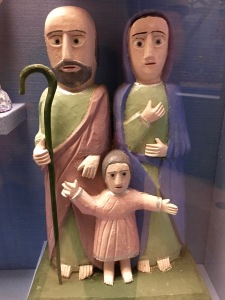


 By the time I called him, he had driven over a nail, gone to a gas station, re-inflated the tire, then, when it went down again, found a place to get it fixed for $15 and was back on the road. He’d dealt with the problem on his own.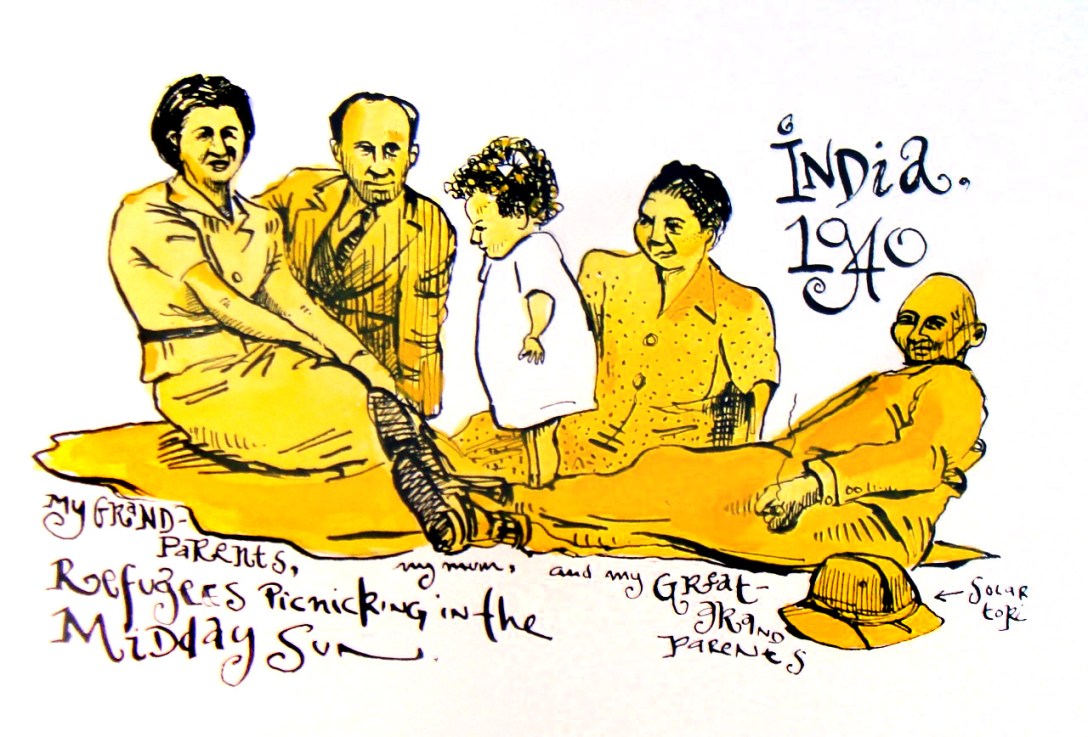
 Danny Gregory