I wanna give you something free.

I love art but there are times I worry I’m doing it wrong. Like when I go to a Chelsea gallery and I am mystified by what’s hangin on the walls. Or when I go to the Met and am absolutely knackered after just half an hour of walking around. Or when I can’t remember whether it’s Manet or Monet. Or when I find myself getting super irritated by the way other people behave in the Whitney, snapping Instagrams and saying inane things about the Biennial.

I never studied art or art history and, truth be told, there are times I feel like I have missed something significant. It’s like drinking fine wine or watching the NFL; I can’t tell what I actually like or have any idea how to discuss it.

It all just seems sort of heavy — unnecessarily so.

That’s why I wanted to use my role at Sketchbook Skool as an excuse to learn more and fill this deficit in myself and my friends. When my pal Bridget wrote a book on the subject, a sort of primer on art appreciation without fear, loathing and manbuns, I thought it would be worth spending some time bringing it to life in an online kourse.

We spend months working on it, turning a book without illustrations into a dozen and a half visually dynamic videos, full of cool locations and special effects and animations to make the ideas come alive.

You’re probably saying, what are you on about? Stop whinging and go to the New Museum like a man.”

You’re probably saying, what are you on about? Of course, I like art, that’s why I even bother reading your stupid blog. Stop whinging and go to the New Museum like a man.”

But the fact is that we rarely talk about art the way we talk about movies or Netflix shows (or maybe I just have the wrong friends).We don’t have the guts or the vocabulary, we feel pretentious, we don’t know how or with who to talk about it. Yes, you too, with your yellowing Art History diploma, when was the last time you just sat around with some pals guffawing about Dan Flavin? Gimme a break.

Any way, let me stop insulting you long enough to ask you to join me on Monday when our new kourse, How Art Can Make You Happy debuts at Sketchbook Skool. It’s less than a latte and a ticket to MOMA and it’ll just take you a jolly afternoon to absorb it.

I really want to hear what you have to say and this will be a safe and fun place to do it.  I hope to see you in klass. Or I’ll snub you at the Gug.

P.S. And, because I love you and really think this will be worth your while, I’ve convinced the brass at Sketchbook Skool to give you a sample lesson, absolutely free. You’ll have to pay for the rest when you sign up for the kourse here.
Pad and i: Part 3. Double X

The summer stretched on. So did my anguish. Despite generating dozens of atrocious eyesores on my iPad, I was still no closer to getting the hang of things. So I made a desperate move: I started watching YouTube instructional videos. That the iPad is perfect for.

After a lot of painful grazing, I came upon a couple of useful resources. James Julier is the Bob Ross of Procreate  — his paintings are mundane,  his voice is soporific and his thumbs are strangely shaped — but he does go step-by-step through many features and techniques and this hour-long video was pretty helpful.

Brad Colbow has several great tutorials — I especially liked Drawing Comics in Procreate from Start to Finish. He’s funny, smart, and anticipated many of the pitfalls I encountered.

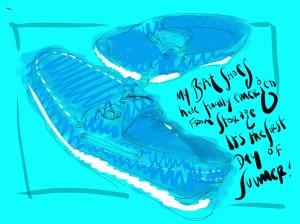
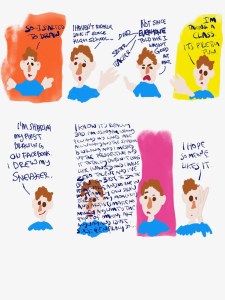
Under Brad’s influence, I decided to stop keeping a sketchbook journal and start making goofy cartoons instead. It was easy to simulate printing techniques like flat color panels and Ben-Day dot patterns so I plunged in and made a few comics:

I did not quit my day job.

Earlier in the Spring, I had grown quite obsessed with Felix Scheinberger’s book, Urban Watercolor Sketching. (I made this video about his work).

Felix’s drawings seems so simple and his watercolors so clean, and for months I had vowed that one day I’d sit down with the book and really work out how he does it. Then I realized that I could kill two birds with one auto-didactic stone if I tried to reproduce 1) his drawings using 2) the iPad.

I knew Felix uses soft, squishy pencils and procreate has a squishy 6B pencil that’s lovely to draw with. (If you hold the Pencil® at an angle, it gives you fash graphite smeary lines just like the real thing). He also uses a soft, pliable technical marker and, of course clean watercolors. I began by drawing the art on the cover.

Next, I just started working my way through the book, drawing by drawing.  I found I could copy his drawings pretty well and it definitely loosened up my drawing style as I’d hoped. But simulating watercolors on the iPad was a whole other deal.  There are tools that let you paint in the shape of watercolors and you can create layers of color that sort of simulate glazes but they are much harder to use than a brush and palette.

I drifted from Procreate to Adobe Sketch which at the time had a better way of blending wet on wet and even included a little fan that would dry the layers and stop them from bleeding. I ended up making watercolor layers and then exporting them to send back to Procreate. It was fiddly and inexact and the results lacked the luminosity and character of Felix’s analog paints. Nonetheless, the project kept me busy for much of the next month and my chops started developed further — thanks to two great teachers with Xs in their names: Felix and Experience.

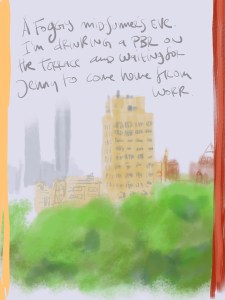
Here are some of the images I made:


Someone left a comment on the last post in this series, saying they assumed that in the next post I would reveal the a-ha moment that turned my iPad drawings from crap to genius. Alas, there was no such moment on the road to Damascus. Instead, a long slog through various small breakthroughs.  Stay tuned for the next ones.

(To be continued)

Pad and i: Part 2. the Month of Drawing Dreadfully

In the fall of 2015, Apple released the iPad Pro and the Pencil, a sort of bitten-off knitting needle. Despite being a fanboy for three decades, I’d been disenchanted by a lot of the recent releases and didn’t pay much attention. I already had two iPads kicking around the house and the addition of a drawing tool didn’t justify the near $1000 price tag.

Then I started to see Facebook posts that made me sit up and drool.

People seemed to actually be doing decent drawings with the thing. Drawings that didn’t look like they’d been made with a computer at all. Drawings that kept getting better and better as people got the hang of the thing.

The next time I was in an Apple store, I fooled around with the Pencil a bit. It was pretty damned responsive. But it wasn’t instant love. I didn’t like the idea of drawing on a cold sheet of glass. And what would I do with a bunch of digital drawings? Print them out? F’what? They weren’t going to replace my sketchbooks so how could I justify spending all that money? I imagined a giant iPad lying in a stack with expensive coffee table art books I’d never gotten around to reading. Nah, not for me.

Another year went by and this Spring, I found myself visiting Apple stores more and more, trying different apps, counting my pocket change, flirting. My heart was wandering because, frankly, my analog sketchbook practice was withering. After not travelling, not having a kid in the house, and spending all of my day in front of a computer at home surrounded by things I’d drawn a dozen times already, I just didn’t feel inspired to record my humdrum life in my book as I had for decades. Things got so dull, I’d spent a month just drawing my tea-cup over and over.

One fine June day, I crept out of the Apple store with a couple of slim boxes in an unmarked white bag, my heart pounding. I felt like I’d just bought a blow-up sex doll or something, a totally frivolous guilty pleasure I had no business owning. I slunk home, downloaded a few apps, and started to draw.

It was horrible.

Off the bat, I was overwhelmed by all the tools.  I had an infinite palette, hundred of pens and brushes that could each be tweaked and finessed. A simple drawing and some words — a thing I’d made a zillion times over two decades — looked murky and overworked as I worked through my gigantic toy chest.

On top of this ineptness was a deep sense of purposelessness. What was I trying to do here? Was this another form of illustrated journal, only more awful looking and frozen inside a tablet? Was it just an expensive toy? A doodle pad? Was I trying to make art? To be a digital illustrator? Was I wandering away from the whole reason I draw, entranced by a digital glow?

I had started drawing as a way to meditate, to engage with the moment, with what was happening right in front of me, the reality of my life. As the Master said:

 “The secret of health for both mind and body is not to mourn for the past, worry about the future, or anticipate troubles, but to live in the present moment wisely and earnestly.” ~ Buddha

Drawing had helped me do that and it had saved my life.

But this iPad distracted me in a thousand ways, placed barriers between me and the moment, between my observation and creation. This bewitching gizmo had me relying on cheap tricks like Technicolor backgrounds, gaudy palettes, airbrush sprays, and endless clicks on the undo arrow to mask my hopelessness. Instead of approaching Enlightenment, I was just scraping an overgrown swizzle stick across a sheet of glass, filling my screen with proof that I just could not draw at all any more, guilty at my frivolous extravagance, afraid to quit, but clueless as to how to proceed.

I was starting at Square One, or even worse. At least when I’d opened my very first sketchbook twenty years ago, I knew how to use a pen, how to turn a page, but now I was just blind, dumb, and wearing oven mitts. I am a published author, an art school founder, an “expert”, and yet I was drowning in a vortex of pixels with no shore in sight.

And so it went for a bleak month or so.

(To be continued)


Pad and i: Part 1. Passion and revulsion.

When I was nine, my first stepfather would let me tag along to the computer room in the basement of Australian National Uni. It was a big room with lino floors and rows of clacking mainframes. Bill would hand a big cardboard tray full of index cards over to a grad student with muttonchops who would feed his math program into the computer’s maw. Tape reels would whirr, lights would flash, printers would clatter, while we would sit and wait for the results.

On the wall over the computer bank, there was a gigantic picture of a naked lady printed out on green and white striped computer paper. Upon closer inspection (and I inspected it very closely, it being a naked lady and all), it turned out to be made entirely of numbers and letters, what was known as ASCII art. To nine-year-old me, this piece of early nerd porn was both fascinating and terrifying. And that sentiment has more or less characterized my feeling about computer art ever since. I want it — and I am repelled by it.

In 1984, I got my hands on my first 128 K Macintosh. It came with a super crude application called MacPaint (it cost $125!) that let you draw in black and white. No color, no grayscale, just a bunch of simple textures. It was like painting in tweed holding a cinderblock with a catcher’s mitt. I fiddled around with it for ten minutes, then went back to the miracle of wordprocessing.

Later that year, I came upon a ground-breaking book called Zen and the Art of the Macintosh: Discoveries on the path to computer enlightenment which introduced me to the idea that you could somehow get all kinds of photos and calligraphy and textures (Woodgrain! Thumbprints!) into your computer and add them to your desktop publishing. Seriously, ye people of the 21st century, this was a Gutenberg moment for me — it rocked my world.

Next revelations to come down from the mountain in the later ’80s: Quark Xpress and Illustrator 88. The first helped me churn out reams of books, posters, and fake magazine articles, on my purloined laser printer. The latter confused and frustrated me. I couldn’t figure out how to cut paths or turn lines into curves, there was no preview mode, and drawing with a mouse was still as alien and annoying as Jar Jar Binks. I could write and publish entire books but I couldn’t draw even a smiley face to serve as an author photo.

Through the 1990s, I admired and hired illustrators who worked in Photoshop and Illustrator, making gorgeous airbrushed looking paintings with style and character and I’d beg them for tutorials only to stop them midway and throw my mouse down in disgust. This wasn’t drawing. It was engineering.

Next potential breakthrough, the holy tablets of Wacom. Finally, I had a thing that was sort of like a pen (only super-stiff, unresponsive, and plasticy) but I’d have to draw down here on the tablet while looking up there at my screen. Then I’d have to constantly reposition my cursor, right click things, open windows, command- this or that, and it all felt unnatural and mawkish. Worst of all, I would draw like I was word processing, putting a line down, then immediately going back to erase and redo it, then make it bigger, then lasso it and nudge it over, then look through some filters, then reduce it, shift the colors, blah blah… It was nothing like the directness and simplicity of a pen in a sketchbook, my own true love. Again, I met loads of artists who strummed their tablets like Andrés Segovia but I just tied my fingers into knots.

Ten years ago or so, my boy David Hockney started sharing his first iPhone drawings. He drew them in bed with his index finger while still having his first cuppa. Then in 2009, Jorge Colombo, a guy I’d met around town and who seemed like a regular human being, published the very first New Yorker cover drawn with his index finger on the iPhone. Come on! A New Yorker cover?! With the finger?

Next up, the first iPad. I got one days after it was released in 2010. I immediately downloaded a drawing app called Brushes, cracked my knuckles, polished my fingertips — and made utter, breathtaking crap. I tried a couple more times but it was awful. I hated the lag, the feeling of the glass, the garish colors, the interface…. I went back to using my pen to draw with and my index finger to scratch my butt and pick my nose.

Ever so often I would see some insane masterpiece drawn on the iPad and I would whine, whimper, and order a new stylus. They all turned out to invariably to be metal sticks with felt balls at the end, like spindly QTips that balked and scraped, a long cry from my favorite drawing pens.  When France Belleville Van Stone showed me her digital sketchbooks done with the Paper app and a plastic thing that looked like a carpenter’s pencil, I broke down and spent too much money buying my own. It broke the first day I used it. Back to the sketchbook.

(To be continued…)


Author sits down to write blogpost — you won’t believe what happens next!

I’m not sure that I have anything to say today — but I do miss my blog. The poor thing has fallen victim to various impulses within me that claim to know best.

One said, “Hey, I read an article online that says that people don’t read any more, so you should just post videos. Oh, and another article said blogs are dead and people just look at Facebook posts, so stop bothering to write here.”

Another impulse is to focus my time and energy on my job, i.e. Sketchbook Skool. (Yes, I refer to it as a job. The world’s best job, but a job nonetheless.) That means I figure I should devote my creative energy to making kourses and telling people about them, rather than venting here.
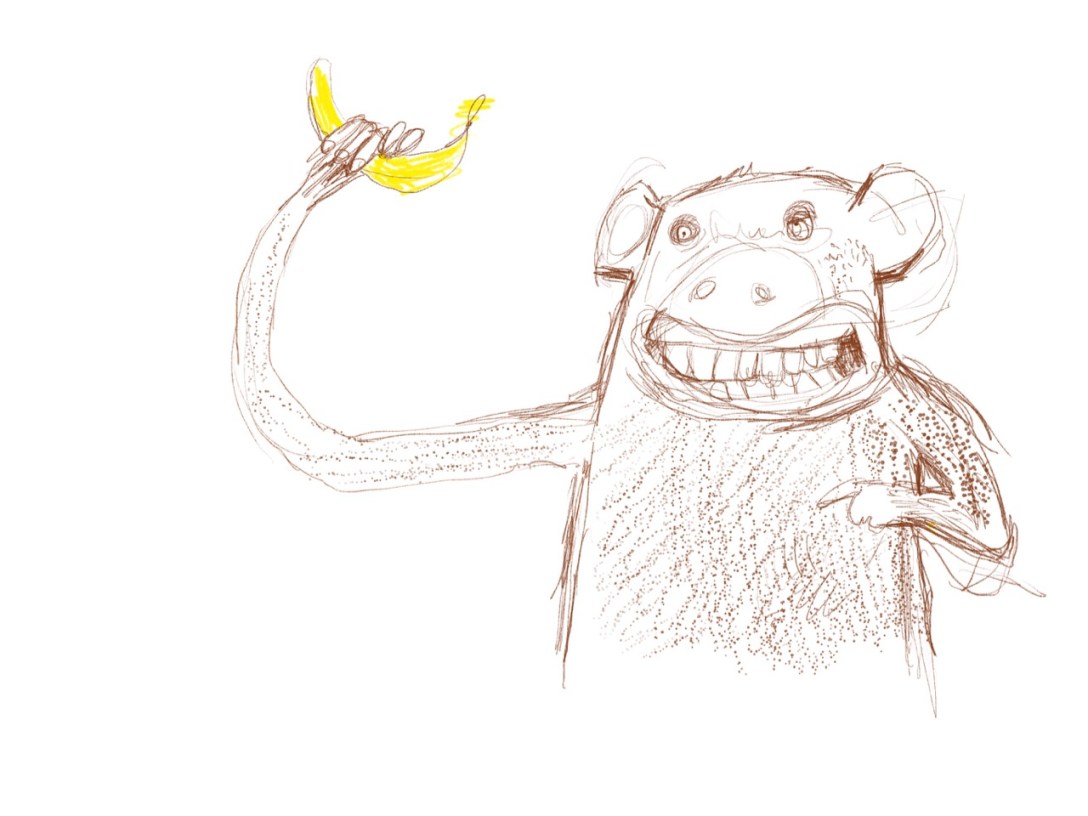
It’s a funny thing, being your own boss. There are definite perks, like taking off early to go to yoga or hiring a special effects team to make something you dreamed up, but there’s also the issue of having a boss who sits in a corner office in your skull and can call you into review your performance on a daily basis. My boss loves to tell me I could always be doing more. And this blog strikes him as a pointless cul-de-sac. (As you can tell, my week’s vacation helped revitalize my monkey. He’s tan, well-rested, and eager to get back to work.)

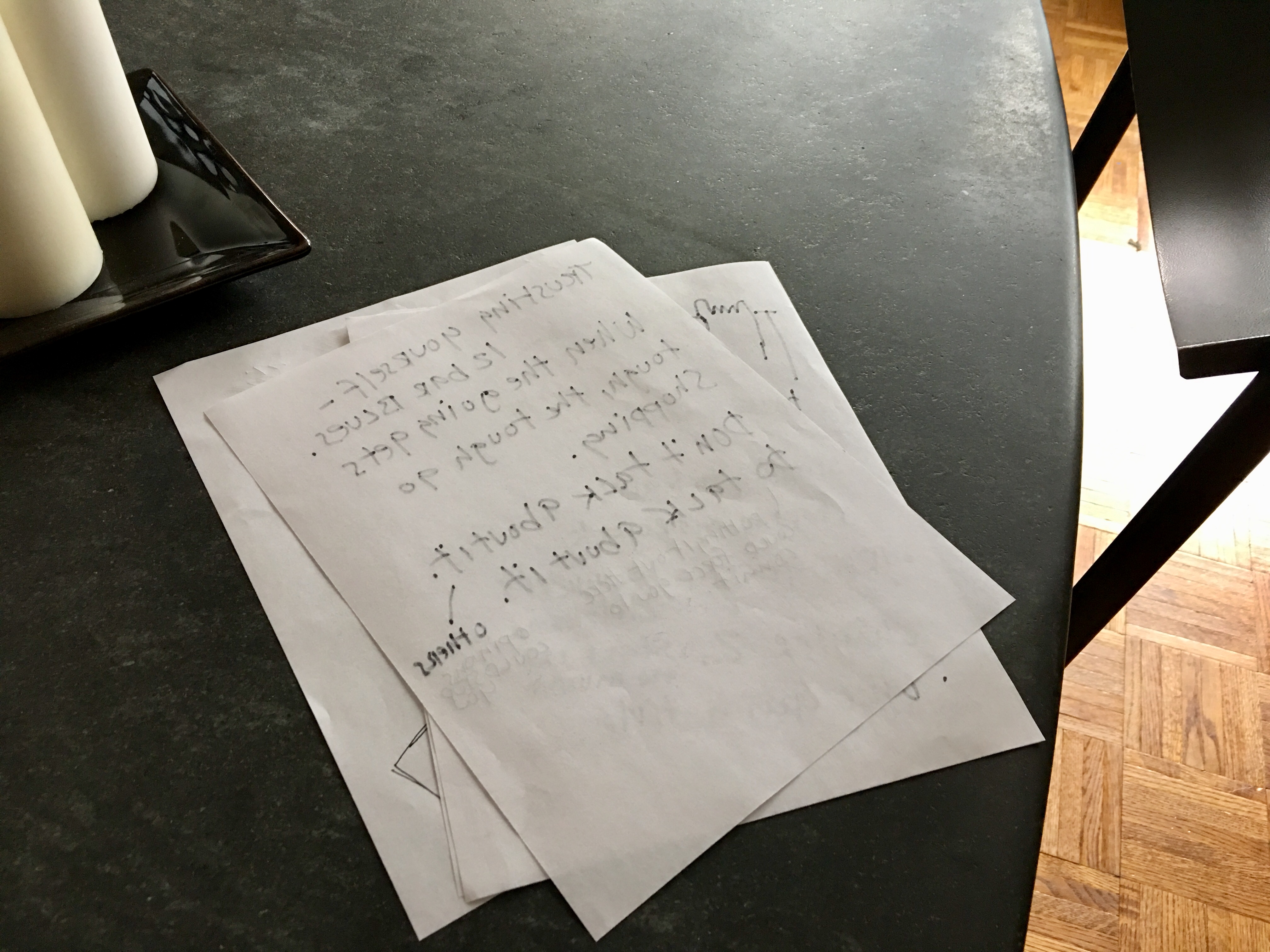
Despite all this wound licking, I have been thinking of a lot of ideas in the last few months, ideas that don’t necessarily have anything to do with teaching. A few weeks ago, I woke up in the middle of the night with a brilliant idea for a new book and wrote it down, in the dark, with a Sharpie, on a pile of paper on my dining room table. It’s sat in that pile ever since, unread.

I think it could be something interesting or utter crap, but I’m not ready to either take it on or be disappointed by it yet — so it just sits there, in a neat pile, waiting for me.

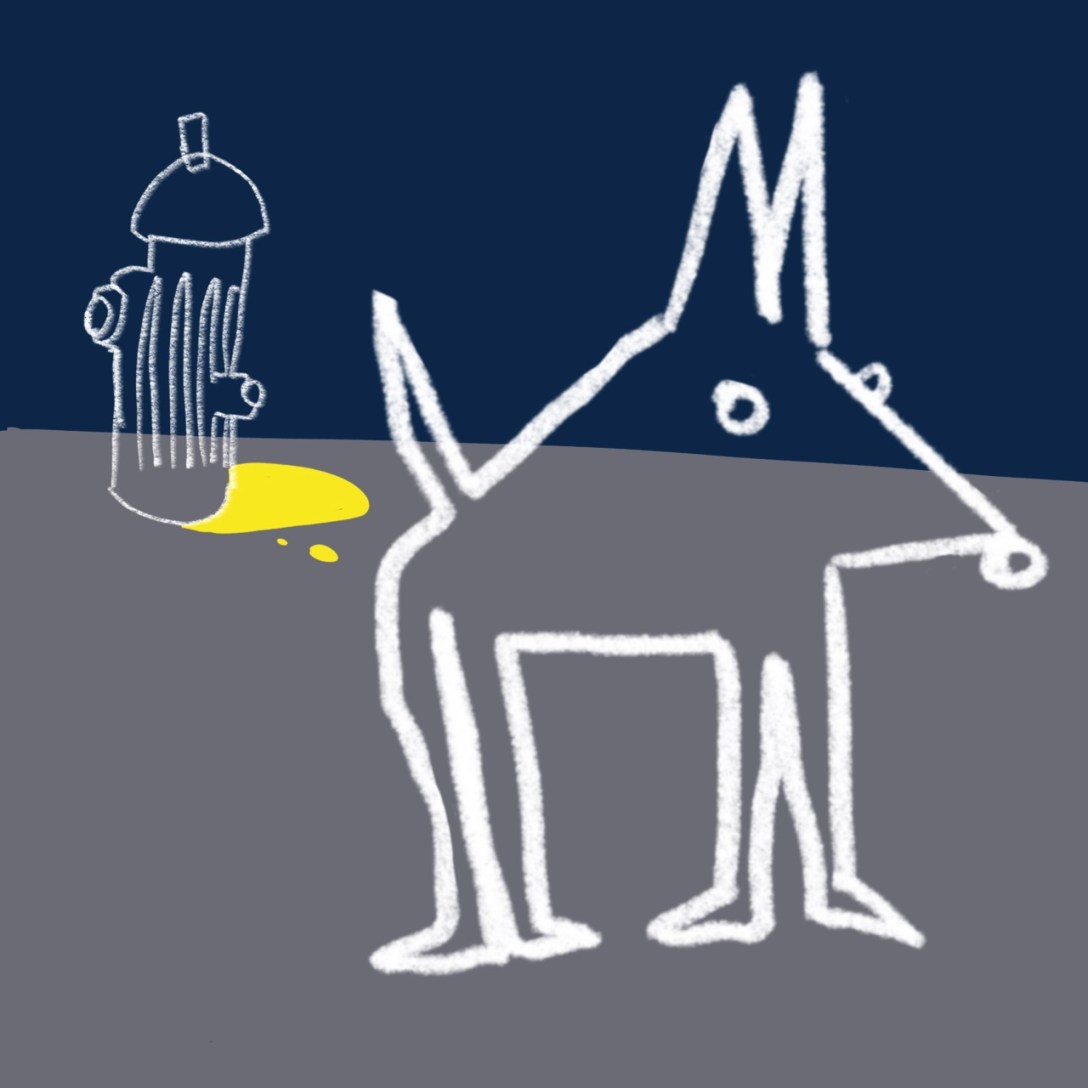
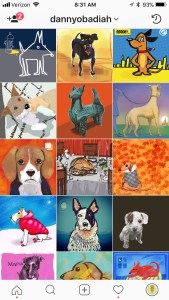
Another project: drawing dogs.  I started drawing on an iPad Pro this summer and flailed around for a while looking for a direction to my efforts. It was a pretty interesting exploration and I have been meaning to write a long post about it sometime (pending resolution of the issues in paragraphs 1, 2 and 3 above) but suffice it to say it kick started my drawing practice and toppled a number of hardened prejudices. The latest stage in this exploration has been to try to make a drawing of a dog every single day, always a different dog in  a different style.  Today I posted number 56.

This process has been energizing but has also resurfaced the usual issues.

One — monkey struggles. Three days ago I convinced myself I had milked the idea dry and could not make a drawing I could abide.   After giving up completely and bathing in failure, I drew three new dogs I really liked.

Two — the quest for approval, a monkey variation. Posting my dogs on social media has led inevitably to being overly aware of likes, comments, and all the attendant distractions. People like the ones that look like photos best and the monkey tells me these are the most pedestrian and not creative at all. Sigh.

I do apologize if this first post in ages feels a little lachrymose. I need to shake off the cobwebs and think of stuff I actually want to write about. But writing here this morning has scraped some of the rust off my hull and I look forward to setting forth on a new adventure.

Hopefully no one is reading this because you are all too busy watching baby hippo videos.

Sketchbook Club: Chris Ware

Chris Ware’s graphic novels are cerebral and meticulous. But his sketchbooks reveal the man behind the perfection: self-doubting, self-flagellating, and with a giant Monkey on his shoulder.

Books discussed include:

Sketchbook Club: Greeting Card memories

In this week’s club, I delve into my mailbox and my steamer-trunk archives to unearth the cards and letters that have meant the most to me. I ponder the power of  greeting cards to endure as slices of memory and why they are imperiled.

Sketchbook Club: Robert Crumb


Crumb has been an enormous influence on me over the years and today I discuss my huge collection of his amazing sketchbooks.  Including a never-before-seen personal letter from Crumb to me. Prepare to be inspired!

Including:

Sketchbook Club: Tommy Kane

I discuss Tommy’s work and go deep into his incrdible new book, All My Photographs Are Made With Pens. Get yours today!

Sketchbook Club: Felix Scheinberger

I took a short break from new episodes of the Sketchbook Club, but I was reinspired by this week’s author. I spent much of the summer forging Felix Scheinberger’s sketches on my iPad as I waited for the release of his newest book, Dare to Sketch, which finally(!) came out a few weeks ago.

(Warning: one of the book shown contains a bit of nudity and bondage)

In this episode, I consider the following books by Felix :