Top shelf.

My grandparents had a living room and a sitting room. We hardly ever used the former; it was a long, large cavernous place with my grandmother’s gramophone in one corner and a fireplace we never needed in Lahore’s equatorial heat. The living room was just for occasional cocktail and dinner parties but the sitting room was used every day.

At the end of the work day, my grandparents and their junior partner, Dr. Iqbal, would relax with a gin and tonic and some monkey nuts from the drinks cart and discuss the business of the day. I would have a bottle of 7Up, tall and green with white bubbles painted up its side, and look through the book shelves. They were recessed into an alcove on the right-hand side of the room, teak planks reaching to the ceiling.

When there were adults in the room, I would concentrate on the lower shelves, a row of coffee table books on art and Pakistani archeology, a set of Will and Ariel Durant’s encyclopedic Story of Civilization, various slip-cased editions of the Rubaiyat of Omar Khayyam, and a Punch annual from 1954.

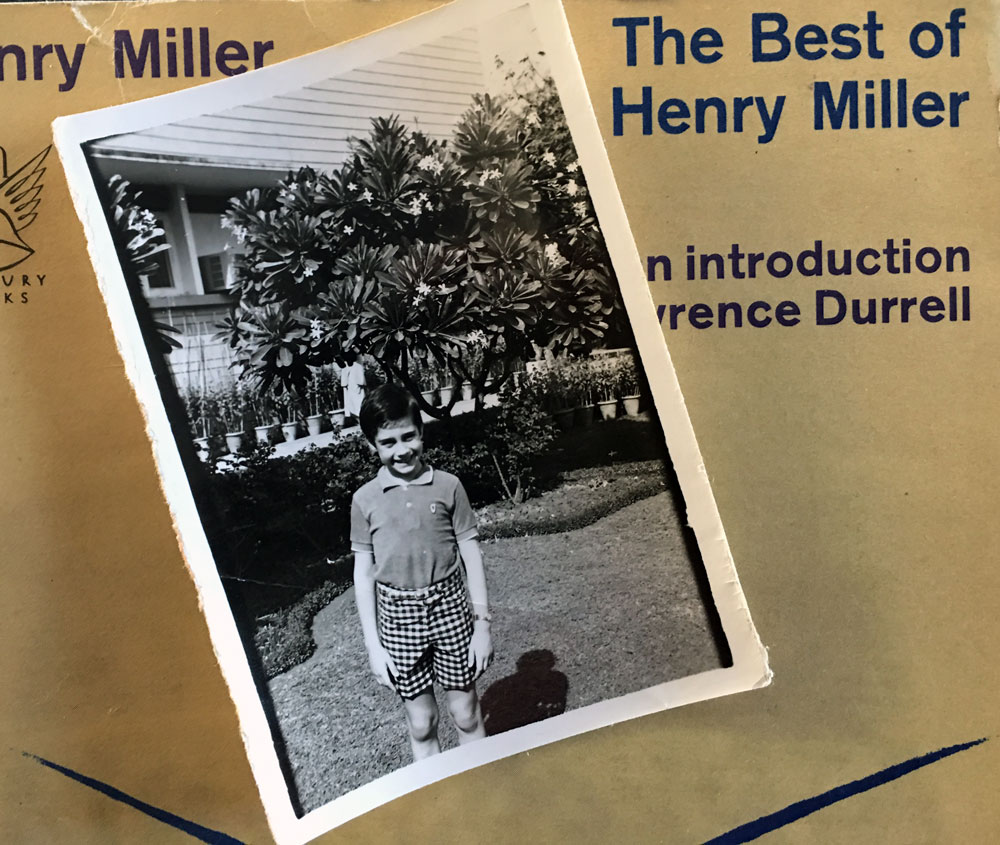
But when the adults were distracted or absent from the room, I would clamber onto the cabinets beneath the shelves so I could study the topmost shelves. There were the ‘grownup books’: fat, sexy novels by Harold Robbins and Henry Miller, chunky bestsellers by Robert Ruark,  William Golding, Nikos Kazantzakis, and James Jones. These top shelves were where I first discovered Gerald Durrell, Irving Stone, Richard Gordon, and Paul Gallico. I’d stand on the narrow ledge, my head grazing the ceiling, my eyes skimming back and forth across the spines.

yellow-books1More than forty years later, I still remember all the publisher imprints, ingrained in my skull from staring so hard at the jackets of all those illicit books. Penguins in orange, blue and green, Faber and Faber, yellow jacketed book from Gollancz, Corgi paperbacks, and the gorgeous bindings of the Folio Society.

My grandfather had a second library, in his brown office, so-called to distinguish it from the white consulting room where he examined patients and kept his gleaming steel tools behind the glass-doored of white enameled cabinets.

gran-mason
The Grandmaster
The brown office was a dark and cozy study that smelled of the tobacco he kept in a glass caddy and his row of burled oak pipes. It had two deep leather armchairs, heavily shaded lamps, wooden blinds and walls covered with framed photos from the Maharajahs and Maharanis that he’d treated, plaques and groups photos from his tenure as the Grandmaster of Pakistani Freemasons and the President of the Rotary.

These shelves were stocked with medical books in German, Italian and English, full of plates and diagrams of biopsied organs, tumors, amputations, and the unfortunates who presented with them. There was a series of books with acetate inserts that let me flip through slices of the human body, exposing the skin, the organs, the viscera, the skeleton, with each turn of the page. And there was Gran’s prized possession: a first edition of the collected works of Freud, in German, eleven volumes in stern blue.

As my grandfather worked at his desk, I’d sit cross-legged on the floor and slowly turn the pages of his medical school scrapbook, a heavy, black book with thick grey pages containing deckle-edged photos of his patients and their infirmities. An old woman with a goiter the size of a watermelon. A man with a moustache and no nose. Twins with matching tumors. A young girl with knocked-knees and no clothes. I still own that scrapbook and it still has the power to stir me with its voyeuristic perversity.

I haven’t been in my grandparents’ house since 1970. But I can still remember the sequence of the books, the smell of the bindings, the illicit thrill of reading books I was far too young to understand. The pages of books still provide most of the important experiences and enduring memories of my life.

Rage against the machine. Live!

After feeling a little vulnerable, I took to Facebook Live to express my anxieties. I’m not much of a Twitterer so I plied my steel nib and some India ink instead.

In case you had something better to do at the time, here’s a record of the event.


Library love fest

Jenny and I are spending the weekend in the country, enjoying the peace and quiet of a borrowed house surrounded by bare trees, piles of crunchy snow and the hoarse caws of ravens. We spend the evening listening to records on a turntable, playing casino, and reading books.

Jenny and I are both big readers; books are the shared love that first drew us together. I’m reading Michael Lewis’s new book on my Kindle, absorbed in a perspective on the birth of Israel that has overnight transformed my own (maybe I’ll write about that sometime). I have a half-finished paperback, A Short History of the United States in my backpack as well as a library book , Nutshell by Ian McEwan. I tend to travel with multiple books in multiple forms so I can shift gears with my moods. Even my favorite genre can become sticky and claustrophobic, like too many chocolates in a box.

Jenny’s reading several library books too and dipping into our absent host’s collection of cook books. She has always been a glutton for cookbooks. We have shelves of them at home and, on our weekly trip to the library, she inevitably hauls back more armfuls of heavily illustrated tomes from celebrity chefs. For me, cookbooks are a means to an end, cooking, but Jenny enjoys them for the vicarious pleasure, content to just rattle the pots in her mental kitchen.

We spent this Saturday morning on the Long Island Expressway instead of the library. That’s not the norm. Usually, we have a bagel from the baker on University Place, read the paper, then head to one of four public libraries in the ten-block radius of our house.

There’s the large Jefferson Market library with its stained glass windows and spiral staircase, a repurposed court-house with a red-brick tower. Or the compact Mulberry St. branch tucked into an alley by the Puck building. Chalky perfumes waft in from the Santa Maria Novella store next door, mingling with the excited murmurs of the kids from Chinatown playing computer games in the mezzanine and the exotic fragrances of the homeless men reading magazines. To the West, there’s the Hudson Park branch — we stop to read the chalkboard by the entrance. Some anonymous librarian always adds a witty welcome message: the first one we noticed was a celebration of grilled cheese and Lionel Richie, our favorites too. If we head East on our Saturday morning stroll, we end up at the Ottendorfer branch, formerly a 19th century clinic for German immigrants, its facade festooned with busts of Bavarian doctors. This branch is the smallest one, which shortens our visit but also produces the most book picks. I don’t know if it’s just especially well-curated, but we always come back with the biggest haul from the Ottendorfer.

We generally bring home 4-8 library books each week and stack them on a table at the end of the couch. Within a day or two, most of them have been thumbed and rejected. This culling is just the final pleasure of library gleaning, which begins with a visit to the new arrivals section of the library shelves. Jenny and I stand and browse side by side, reading spines, then examining covers and flyleaves, quietly passing good finds back and forth (“This looks like your sort of thing” “Read it last year”), amassing a stack on one of the library tables for further study. Then we read a page or two from each candidate, until we have separated the rejects from the chosen few. We check out the winners and stack them in our Trader Joe tote bags then head home to plunk down on the couch and further refine our search.

For the next few days, we dig deeper into each book, only occasionally making it to the very end. If dialogue sounds wooden, plotting forced, vocabulary opaque, then the book gets banished back to the TJ bag sitting beneath the end table. On rare occasion, one of us loves a book so much, we must go online to renew it so the other can get his/her fill of it too.

We can afford to be picky. New books are being published every day, the library shelves are groaning, and we have many pages to turn before we sleep.

Speaking of, I’m heading to the couch to read. And snooze.

How to make love.

Recently, I worked with Nelleke Verhoeff, a wonderful Dutch artist, on a little ebook of creative ways to express your love.  You can get a copy for free, just in time for Valentine’s Day.

Just click here 

Necktop.

I traveled back and forth across America in the last few days so I was pretty tired this weekend. Being tired tends to make me irritated, whiny and slow-witted. My superego has no problem needling me, my id just wants to eat ice cream and drink beer, and my hapless ego shuffles around with its hands in its pockets. But I don’t want to talk Freud right now (I bring him up because I spent a vegetative hour watching James Fox’s show on Vienna, 1908. You might like to, too. Brilliant Lights Brilliant Minds on Netflix). Instead let’s discuss two recent scientific projects on the physiology of the brain.

The Times reported on a couple of articles published last week in the journal Science about inquiries into the purpose of sleep. They focussed on a new explanation: that we sleep to forget.

Here’s how it works. Our brains are made up of 100 billion neurons and each one is networked into many others. We have some seven hundred trillion synaptic connections that allow signals to pass back and forth. Every day, we are bombarded with information and experiences, all of which rewire our brains. Literally. Every experience causes these synapses to grow like topsy and, this new synaptic homeostasis hypothesis says, when we sleep, our brains prune those connections to preserve important memories and lessons and ditch the rest. It’s vital — wIthout enough sleep, our memories get inundated and fuzzy.

This certainly makes sense to my bleary brain.

I have also been perusing a book by Sebastian Seung, a professor at MIT, who believes that this immense thicket of connections is the source of our identity, that we are who we are because of how we are wired. He’s part of a project to map these connections (sort of like the human genome project) to create a “connectome” and show that we are shaped by the brain structure we inherit and by the transformations the world make on it — nature plus nurture.

I’ve been looking at neural maps like the one above and I’m struck by how beautiful, delicate and deeply complex they are. We are each the sum of these deep networks and each one is unique. Sure, we come out of the box with certain structures set up, but every minute our brains are sprouting new filaments and plugs, then reorienting them, pruning and shaping ourselves. Every brain is constantly changing in special ways that make us each who we are.

It’s a powerful endorsement of the importance of authenticity, that we can’t and shouldn’t aspire to sameness. Mass culture and capitalism want to move us in that direction, to make us cogs in the machine, but our brains will never be happy trying to fit in. Instead, we need to understand, embrace and express our individuality.

That’s a key purpose of art, to show how we are similar and different, that we process the common experience through unique neural networks, that we are each the sum of inevitably different experiences. Sharing our perceptions allows us to be confident in the uniqueness of our selves and yet secure in our connections to all those other connectomes out there, all sharing our common experience of being different.

Chew on that. Meanwhile, I’ll be taking a nap.

Kick me. Harder.

Dianne wrote to me the other day. She’d never written to me before but I’d made her do it. She said:

Where Are YOU? I’m putting my foot down now. Summer break, ok. The end of the world as we know it, hey, please shine a light. just a wee one. A scribble in a pen that intimidated you, view out the window, your dog’s butt. No pressure, but moments of creativity just feel very important at the moment. My own, and those who are part of my psychic wellbeing. Sorry man, but you blog, you take on responsibility.

I stammered that I’d been really busy, that I was working on a bunch of new things, traveling to film stuff for Sketchbook Skool, and that I’d been doing Facebook live events every day, blah, blah. But I didn’t really tell her the truth.

And the truth is I’ve become hesitant.

This has been going on for a while with me, this impulse to pull back. Instead of sharing things, I amass them, filling up my hard drive with ideas, drafts, sketches, but not going the final step to finish and launch them.

I started this hesitancy last summer when I rented a studio, made a bunch of paintings and was then coy about it all, hesitating to write about what I was doing or share more than a glimpse of the work.

The monkey had a hand in this reticence. He said that none of the things I was doing was especially impressive and that maybe if I kept stockpiling them, their lack of quality could ultimately be masked by their quantity. Of course, that wasn’t true. I never made an especially significant number of bad paintings and ultimately had to just release the results candy coated in some baroque musings about the creative process, as if my handful of Sunday paintings was some earth-shattering exploration to deep wisdom.

Then I started working on a project that had pretenses to be a definitive exploration of the creative process. I did a fair amount of research and took a lot of notes which boiled down to a grubby handful of one-liner bon mots. Each was to be the basis of a short piece, maybe a chapter in a book, then more modestly an epic series of blog posts. then, after reading so much about the demise of blogs, I decided they should be little videos instead and I churned out a handful of scripts, shot them —and promptly sat on the bunch.

Then I decided that the quality of the ideas wasn’t so inadequately that I should make the videos less off the cuff to mask their inadequacy. So I tried making them more elaborate — but still they lurked in a folder. I almost shared them with my wife a few times, but then demurred again.

Then I started doing daily calligraphy videos on Facebook. These were initially fun to do, but then I worried they were no more than evanescent
trifles and stopped after a couple of weeks.

Meanwhile, my absence on the scene began to intensify my hesitation. I felt like I had to do something really cool or far-ranging, some awesomeness to make up for my indolence. That just made it heavier and heavier.

And, while I and my ego and character flaws bear the lion’s share of responsibility for all this balking, 2017 has not made it any easier. For the first time, I have really felt I had to watch what I say online. I have seen so much rage on the internet over the past few months, so much intolerance on all sides, so much fearful obstinacy, that my own tongue has been increasingly tied.

In the past, I’ve always liked to casually toss out the occasional extreme, not very well-thought-out idea, but the consequences for doing so have never felt higher. Sure, a reader or two has deleted me from their feed over the past decade and a half because I took a weird stance on something or other, but these days, it seems like whatever I do could end up on my permanent record. That’s not just self-aggrandizement; I think we are all a little paranoid right now. These are strange times indeed.

But the real fault lies with me. With my surrender to my inner critic and his incessant alarm ringing. With my harsh self judgement. With my short attention span.

So if you wished I’d write more, I think I shall. But I hesitate to promise anything. I’ve rarely live up to those pledges in the past.
I think I need to regain my confidence in what I am, what I have to offer, and in what is important to me and to you.

This post is the first step.

So thanks, Dianne, for the boot in the ass. I hope to pay you back in kind.

Being other.

When I was in college, I landed a summer internship at the White House. It was a weird time to be there; the Iranian hostage crisis was in full swing, the economy was dicey, there were gas lines and Carter was clearly going to lose the presidency. My bosses at the Old Executive Building were too busy typing their resumés to bother with me and, after a month or so, I quit to work in a sandwich shop in Georgetown.

I didn’t have much connection with Jimmy Carter as a man. He was from Georgia, a born-again Christian, and he tended to the preachy, telling people to save energy by wearing cardigans and the like. He was a decent guy but I couldn’t have told you a single thing he accomplished or wanted to accomplish in the White House. I didn’t feel him, as they say.

I didn’t feel Reagan much. Or Bush Sr. There were times Bill Clinton thrilled me but I doubt I could have just hung out with him. We were too different. George W. was also quite alien to me, born of privilege and Texas football, despite his aw, shucksness. (Ironically, his recent reincarnation as a painter has made me think again).

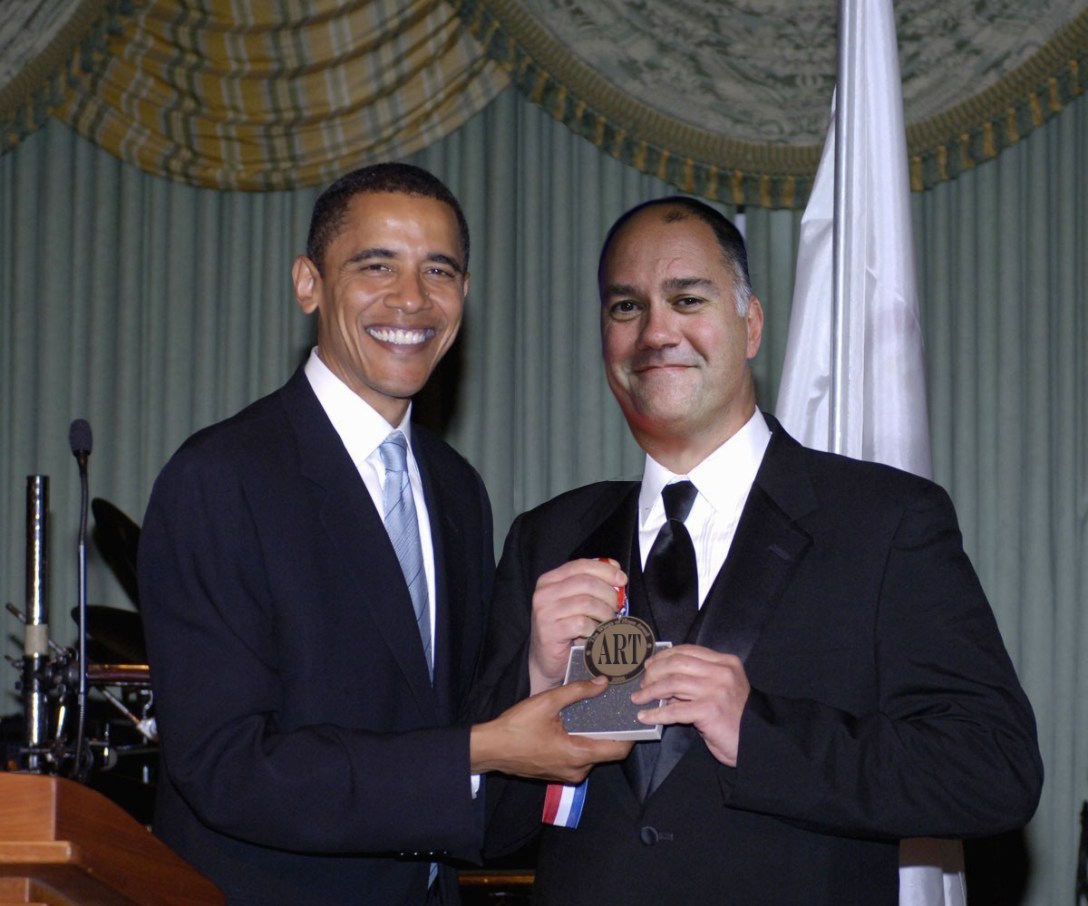
But Barack Obama was a man I know. Not in the way you might think, or even know him yourself. My connection with him is personal and deep.  It wasn’t just because he spoke so eloquently. Or that we are just about the same age. Or that I liked his policies (I actually didn’t like a lot of them and wish he’d been more effectual in so many ways).

It was because I saw many things in his biography that I see in my own, things I have rarely seen in anyone else, especially in American public life. And those things helped to make him who he is and make me who I am. A person who is outside of the norm but has always wanted to be in the middle of it, and who, in his outsiderness understood the idea of the center better than those who were born to it.

Let me explain.

Obama, like me, was born of two very different parents who, like mine, separated when he was a toddler. His father, like mine, was always an abstraction to him, a distant figure whom he only vaguely ever understood. A father who left to start another family in another country and to which Obama, like me, was only an occasional adjunct.

Obama, like me, was raised by his mother, a headstrong and free-spirited woman of the ’60’s, who took him to the other side of the world when he was young and dropped him into an alien culture. In Obama’s case, it was Indonesia.  In mine, it was Pakistan (and Australia and Israel).

Obama, like me, was half one race, half another. He is not entirely black, not entirely white. I am not entirely a Jew, nor entirely a Christian. My paternal grandfather was an anti-Semite. My maternal grandfather feared and suspected Christians.

Obama, like me, was raised by his grandparents. His were white midwesterners. Mine were German Jewish refugees living in Pakistan. Theirs’ was his true childhood home. Like mine was.

Obama, like me, grew up feeling like an outsider who wanted to be in. I was always the new kid, who didn’t know the language, the sports, the culture, but desperately wanted to be in the know. We were both ‘third culture kids’ growing up in cultures to which we weren’t born (I mean Indonesia, not the US. I’m no birther!), with mothers who were also alien. My mother was also a third-culture kid herself, so my feelings of dislocation were squared.

Obama, like me, retreated to books for perspective. When you spend your childhood reading to learn about the world, you are often wise beyond your years but also disconnected from the norms of childhood. You are more likely to relate to adults, making you even more alienated from other children. You also tend to think in abstractions, to loftier but more otherworldly thoughts. Books are great but they are not life or people. Books encourage you to dream, to relate to people far away, from distant times, better even than to those who surround you.

Obama, like me, always related to people who were pretty different from the norm. It’s easier to understand people who are also alien when you are raised as we were. When I was in college, my friends were Pakistani, Swiss, Greek, gay, Muslim.  In fact, one of my best friends, Binoo Mahmood, was also Obama’s roommate when they were at Columbia.  Small world.

When Obama was actually elected President, I was as delighted and surprised as many people. But not because he was black man. Because he was like me, an outsider who was now in the very center of it all.  It seemed unimaginable that one could go from pressing one’s nose against the window to being the leader of all these people who I (and I’m sure he) had envied for their normalcy.

When you are an outsider, yearning to get in, you spend a lot of time studying how normal people behave and seem to think and feel. And the more you observe, the better you get at seeing what makes them tick, and you can reflect that normalcy back at them, showing them what it is that makes them who they are. It is not second-nature, it is a studied effort. It’s also not acting or pretend. It is a genuine attempt to blend in, and to do so, you have to study every nuance of what means.

Obama, like me, did a good job of it. (He actually and obviously did a much better job than me. He made it to the White House, a place which has always been a shrine of normalcy even though inhabited by very unusual people. I made it to this blog. )

That’s not a given. Because one could take the opposite tack and embrace one’s otherness altogether, be obviously different, a freak, who’s differences encourage the unity of others, a jester, a scapegoat.  Neither of us could have borne that additional rejection.

Obama, like me, hasn’t convinced everyone. Sure, his approval ratings are in the mid 50s but 29% of Americans still strongly disapprove of the job he is doing. And who knows what percentage just disapprove of him, of the idea that an outsider got that far in. They do not accept his apparent normalcy. I know how that feels too. One misstep, one oddly pronounced word, and you can feel the mood shift, the air chill, hackles rise, low throaty growls reverberate.

Obama and I are not the only outsiders in this country or this world.  Billions of people feel some measure of this separation. And many of them are artists. Because being an artist always means being other, seeing  human experience from a slight remove, a distance that could have its origins in accidents of birth, gender, history, psychology or just chance. Artists see clearly because we have stepped back. And we have the need to express ourselves because our jigsaw piece doesn’t fit quite so neatly into the lovely picture arrayed before us. Our edges are rough or misshapen so we cannot take life quite so for granted. We balk at it, we question it, we make things in response.

Obama, like me, channels his creativity into words. His speeches are lofty but always with one foot in shared experience. He has always been able to take us from where we are to where we could be.  But in those words he has also betrayed his otherness and his tendency to abstract what people take for granted. Many are suspicious of this. They see his words as a coverup. They feel his difference in the way he speaks. He seems to think he is better. He may be but more importantly he is other. And in his otherness he has always showed me, at least, that one can strive to be better. One may not succeed but if we always just settle for what is, we will never achieve could be.

Our leaders are not us. They may not be better than us. And in many cases, they are nothing like us at all. But that doesn’t preclude them from knowing what want and need. Otherness makes the best of them see us more sharply and offer clearer direction.

Great leaders articulate the us that we could be. They may not complete the task of getting us there but they can shine a mighty light to guide our way. And it can take time for that articulation to sink in, to convince us that we can be better. One of the great outsiders once said, “I may not get there with you. But I want you to know tonight, that we, as a people, will get to the Promised Land.”

Obama, like me, has always hoped we will all still get there someday.

New me.

Ages ago, someone told me that we replace all of the cells in our bodies every seven years. Every single one.  That idea has haunted me since.  It seems to mean that I am literally no longer the same person I was seven years ago. Even though I have memories of things that go way further back, they are not the memories of the me of today.

That’s not a completely alien idea; it’s like copying files from an old computer to a new one or making a new printing of an old story. The information is the same but the vessel is new.  But somehow when it comes to the cells that make me up, this has always felt different. Because I think of me as this me, this couple of hundred pounds of meat and skin, these scars, this reflection in the mirror. I don’t usually think of myself as a concept, a construction, or as data that can be re-recorded on a new cassette.

I woke up with idea in my head again and as I write this, I’m starting to realize why. The first and most obvious reason is that I am in the middle of organizing all the data files for Sketchbook Skool, 16 terabytes of data stored on a big stack of hard drives. Part of my archiving process is to make clones of each drive so we have backups in case anything goes wrong with the originals. I put an empty drive into a slot in the dock, put the original in the other slot, push a button, lights flash, and soon every byte has been duplicated and I have two identical drives. All those hours of footage, all those conversations, and drawing demos are now in two places.

And somehow, as I do this, my  body is doing the same thing.  As I watch the blinking on the front of the dock, my old cells, the old me is slowly being copied and then deleted. Old cells are being cast off, exfoliated, dropping onto my pillow, blowing around my apartment with mites of dust, sluicing down the shower drain, peeing into the bowl, crapping out with my digested burrito.

Me shitting me out.

The other reason this popped into my conscious predawn today is that in less than two months, I will slough off the last cell that ever saw Patti first-hand. The last cells that ever talked to her, held her, kissed her goodbye.  Soon every part of me will be a fresh clone with no personal experience of her.

In December, Jack and I took Patti’s ashes out of the cookie jar that has contained them since March 18, 2010, and put them in their final resting place. We went to one of her favorite places, just after sunset, and we put her ashes in a place we can always come back to, a private place in a public spot, one she went to every day, where we know she would be happy to be, no matter where we are.

Her ashes are not Patti. They are just dead cells that were burned and preserved, not in amber but in a heavy-duty plastic bag, which we kept in that cookie jar, on a shelf where I could see it every day and gaze at when memories of her became intense. They stood for her but now they no longer need to do that. For she is in us.

new-cells-3

The process of burying Pattia was not sad.  It was actually slightly comic as Jack and I bumbled our way through it, making a couple of clumsy errors that were pure Patti, pure Hoofy. I don’t think either of us felt sad as we did it. Rather, we felt that she was with us still, that the pain of losing her was a faded memory, and that this was the final thing the three of  us would ever do together and that it should be light and silly just as our best times as a family always were.

Patti’s cells are now forever in that one place. Jack’s are now in Los Angeles, three thousand miles away. And mine are here, being replaced with new cells, new cells that look older, more wrinkled and grey.

Many of the hair cells were not replaced. Some of the brain cells did not replicate with all the memories in place. Other cells have less resiliency and vim than their predecessors. And  yet they are all still me, they all still bear the weathering of the years, the experiences, joys and traumas that made me and still do.new-cells-2

My memories of Patti have changed with these cells. Some are lost forever. And those that used to take precedence because they were at the front of the line, have stepped back into the mists. I am no longer haunted by thoughts of Patti at the window, of the policemen, of the visit to the coroner’s office. I no longer think of Patti as a woman of fifty, increasingly limited by her disabilities, who didn’t want to grow old in a wheelchair.

Now when I think of her, I rummage through my huge archive of snapshots. I see her in a Polaroid, pregnant with Jack. I see her in a soft focussed, black and white picture dressed up to go to a party, I see her laughing in a bar with friends I haven’t heard from in years, I see her smiling through her freshly cut bob, I see her holding our first dog Frank like a big baby, his long legs sticking up in the air, both of them grinning. I see her looking at me like she did on our first date, saying ‘Mommy’, the gap between her front teeth.

As I think of these memories, I feel old tears well up in my new eye cells. These new cells are never overwhelmed by the tsunami of grief that used to seize me but it’s good to know that those old memories can still effect them, even though I am happy, happy with my new cells, my new kitchen, my new job, my new love, my new wife, my new wife. My new cells make up a new me with all the best bits of the old.

On not drawing

It happens. You ought to write something, draw something, not eat something, but ya just aren’t feeling it. Your New Year resolutions have petered out — less than two weeks into January.  Are you a bad person? Worthless? Is the monkey 100% right?

‘Course not. Ronnie Lawlor (who is drawing monster, by the by) and I talk about why not.

(Happy Friday 13th! It’s your luck day.)

How to draw when it’s ccccold.

Cripes, but it was cold here this week.  To boot, we were all coming down with some sort of flu, but the cold even had our dogs snuggling into the same bed, deep under their blankets. Then there was snow and salt and muck and, ugh. It finally eased up today, bit still, what the hell, where’s global warming when you need it?

Anyway, I was fortunate to have chatted about how to cope with all this mess earlier with my Ronnie Lawlor.  Here ya go: