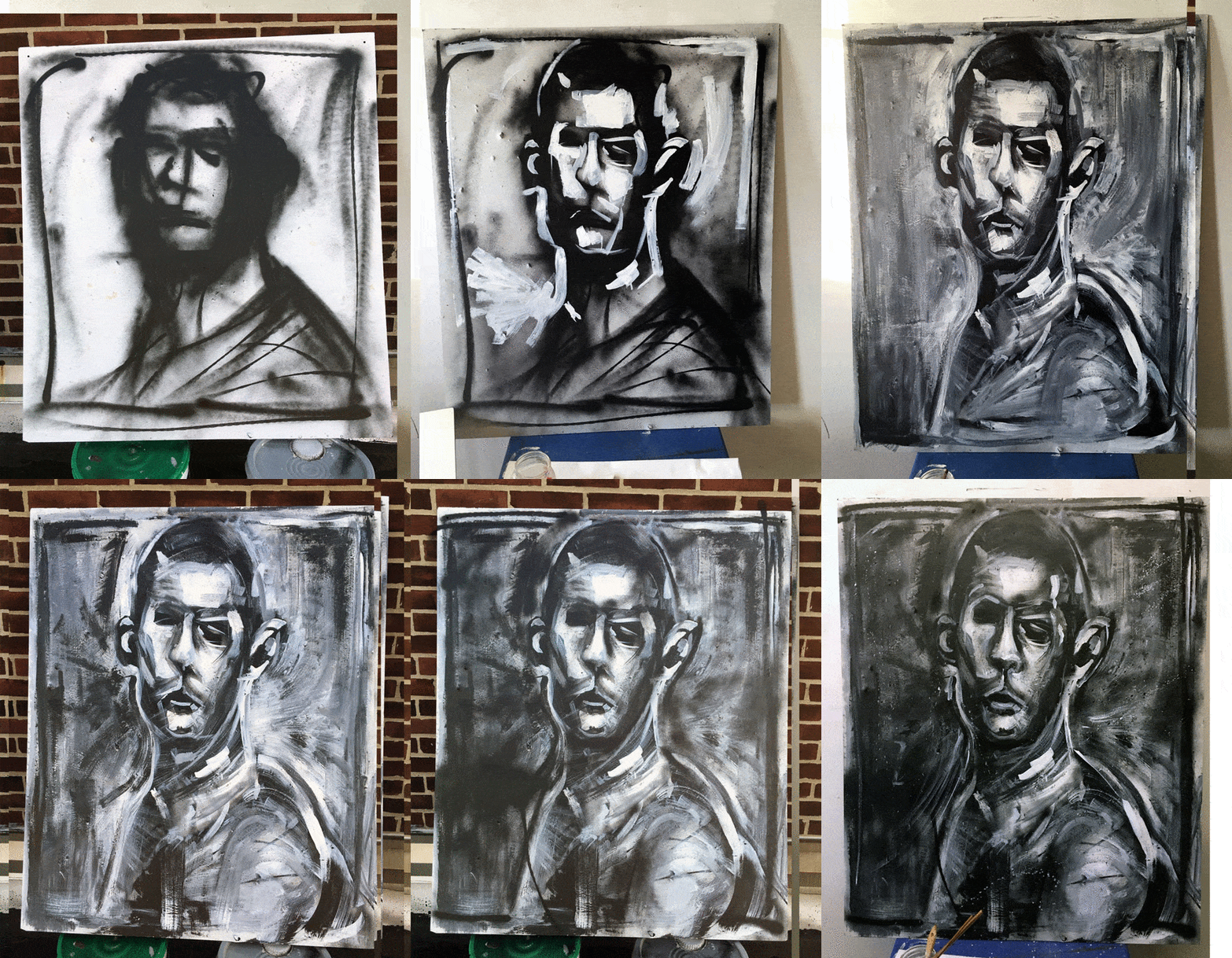
Painting No. 1


As I start writing this, I already feel ridiculous. Hypocritical. Spineless. Overprivileged. Maybe if I just write whatever’s on my mind, I’ll get some clarity and balls. Let’s see.
This afternoon, Jack and I are going to pick up the keys to our brand-new studio. It’s a big, lovely empty space made for doing nothing in but making art without interruption.Jack can’t wait. The weeks since he moved out of his studio in Providence have been torturous as his mind brims with unpainted paintings. He’s itching to get to work and put them all on canvas.
Jack has a clear sense of himself as a painter. He’s not thinking about the whys of making art, not concerned with who will see the work and what they’ll do in response. He knows that he’s meant to make art and so he’s been like a clamped firehose, thrashing around the pavement, struggling for release.
I am stomped down, bottled up, and tightly capped. I haven’t made anything larger than a sketchbook page since we left Los Angeles, almost two years ago. Even that period in the garage was an anomaly. The idea of making art that could hang on the wall is still scary and ‘wasteful’. I have used our lack of wall space as an excuse for decades. I have long-claimed that art with a small ‘a’ means focussing only on the process and filled books to gather dust on shelves. I tell people not to think about what they will have made but only on what they are making now. When you are done, store it, frame it, burn it, I don’t care.
This is not just a black and white matter. On the one hand, I believe that when I take the pressure off myself to produce something finished and public, I am freer and more likely to take risks and make progress. So working in obscurity has helped me develop. And on the other, I don’t liven a hermitage. I do share images of my images in books and on-line. You’ve seen ’em. So have thousands of others.
But there are shortcomings to this approach. For one, I am always off-hand about the images I make. They are mere illustrations for my blog posts or book pages. It’s a way of avoiding real responsibility, this business of making pictures that are just marginalia, just a record of a nice breakfast, a quick sketch here or there.
I know this is gift-horse dentistry, a problem we’d all like to have.
I could say the same about my writing. Even when published in a book, my words still lack a certain seriousness, a full embrace of their role. It’s as if I only write captions, quips, epigraphs, body copy to be tossed out with tomorrow’s trash. A brief amusement in a social media post here, an email there.
Am I writing or drawing for the ages? Can I? Do I dare?
Maybe my years in advertising convinced me that what I make is always subservient to someone else’s agenda, another’s strategies and goals. And making advertising is inherently impermanent. A commercial last for thirty seconds, a print ad runs for a couple of months. It’s a diversion, never the main event. I know that some of my books have been in print for years, and that they have had more than a passing effect. Nonetheless this, sense of triviality is deep-dyed in me. I’d like to make something that matters. But trying to also scares the shit out of me.
Jack is a wonder to watch because he doesn’t feel a burden to achieve greatness each time he picks up a brush. He throws things around, then paints over them. He doesn’t stop to explain or justify. He just does. He’s the same kid who made elaborate Lego towers, then knocked them down to build something new.
Before Jack was born, my mother and my sister chipped in to rent a painting studio for me for a moth. I entered it with a sketchbook, a marker, and a lump on my throat. I hadn’t really drawn for ages and this room seemed designed to strip me of excuses. The first week there I wrote a long polemic about art and posted it on the wall. The next week, I made a few half-hearted collages. I spent the final two weeks trying to make a painting from an old photo of my grandfather. When the month was up, I left behind the handful of things I’d made and ran like hell.
I know it won’t be like that when we start this new adventure. First off, Jack won’t let me get away with it. But also, I have the feeling I can get there, that there might actually be stuff in me that is worth saying, worth saying large, and worth saying well. On that last point, I know that I need to work harder on what I make. Instead of dashing off a sketch or a watercolor, I want to push myself deeper into a painting, to explore, to respond, to refine. To evolve from playing the field to deepening my relationship with a work of art.
I know this is gift-horse dentistry, a problem we’d all like to have. And I am ashamed to start a summer in a painting studio with a whining screed about my inadequacies and fear. But I hope this self-assessment helps me to move past the anxiety of starting something new.
Thanks for holding my hand while I steel myself for the first leap.
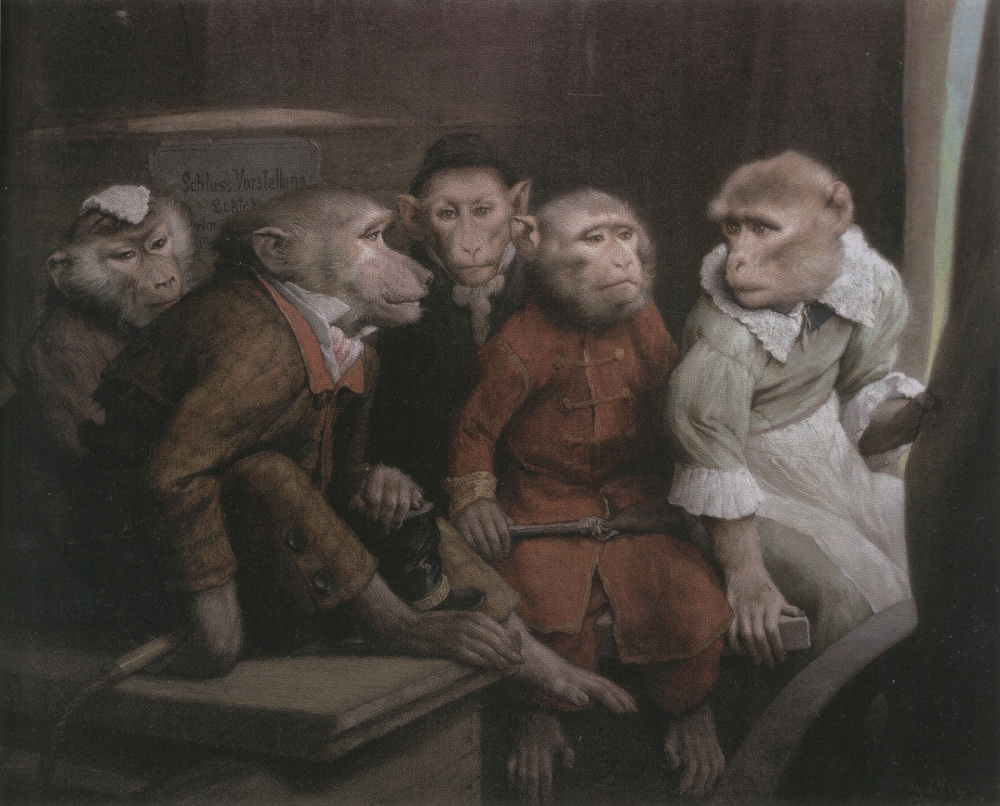
Here’s this week’s excuse. We’re in the middle of the biggest shoot we’ve done for Sketchbook Skool and I have been debating all week with the monkey on getting out this podcast. We’ve been at it from the crack o’ dawn till well into the dinner hour every single day this week and the Fuggedabout-It monkey has been gleefully urging me to skip posting a new episode for the first time.
I almost gave in a few times until the Perfectionist monkey chimed in to say, “What!? I thought you said this was gonna be a weekly podcast. You can’t miss an episode, you lazy buttwipe.”
I would nod earnestly until another voice piped up to tell me no one listens to or cares about the podcast, another would say I never follow through with anything, another said I was being a slave driver and it was time for a cold beer, and on and on till the break a dawn.
Which bring me to the podcast itself which you are about to listen to (I hope). It’s about how the monkey moves the goal posts, giving any sort of contradictory advice it wants, anything that fits its agenda and derails mine.
I had a nice chat about this topic and many others Ilise Benun. She is the founder of Marketing-Mentor.com where she dispenses sound, actionable advice for creative professionals. Ilise has been coaching freelancers and creative business owners for thirty years and has written more than a half dozen book essential books on how to build and manage your practice, connect with great clients, and be smarter and happier in what you do. She is intelligent and empathetic, and her counsel is practical and clear.
Here’s the episode:
Or better yet, subscribe to the whole series on iTunes (and leave a nice review).
Or you can visit monkeypodcast.com and listen to the episodes right in your browser.
What’s your experience with your monkey? How has it affected you, and how have you overcome it? Record your Monkey Tale at dannygregory.com/monkey.

Tim sent me the following email last week:
Hi Danny,
Thanks for Shut Your Monkey. I’ve been working on quieting my inner voice for 40 years mostly through meditation. I’ve added Shut Your Monkey to the list of books that have helped me over the years including Be Here Now, Ram Dass; The Power of Now, Eckhart Tolle; Experience of Insight, Joseph Goldstein; The Art of Living, William Hart; and Tibetan Book of Living and Dying, Sogyal Rinpoche.
Where your book has been extremely helpful is in discovering those nooks and crannies where my Monkey has been hiding and impersonating my voice with subtle little comments that I didn’t recognize as coming from him. So thank you.
I do have a question for you. I’ve been following you for a number of years and was especially touched by your willingness to be so open about your wife’s illness and death. I’m wondering how that inner voice was part of that experience?
Tim
Here’s what I wrote in response:
Tim:
I’m so glad my new book is helpful. Thanks for letting me know. I am flattered to be in such august company.
As to the inner voice and my wife….
When Patti was first injured, we spent a lot of time looking for information. We were in a fairly narrow niche among people dealing with spinal cord injuries: 1) my wife was a woman (obviously), 2) we had a 9 month-old-child and 3) we lived in a big city and 4) she was over 30. There just weren’t many people like her (one more way Patti was special). We were in a constant quest for information about our particular situation and it was hard to come by in those early days of the Internet. So I started a bulletin board called curbcut.com and it soon became a vibrant community for sharing information and support. You can see part of an archive of it here. The discussion we had there had to be frank to be useful and it became increasingly normal and comfortable for us to tell total strangers some pretty intimate stuff in order to get useful feedback.
Similarly, when I started drawing, there was very little information and inspiration about illustrated journaling. Hannah Hinchman had a book, d.price had a zine, but otherwise not much. So I formed a community on Yahoo! that quickly grew to 4,000 members.
In both cases, I found that sharing what I was going through with other people helped me and help them. That’s why I wrote Everyday Matters and eventually A Kiss Before You Go and Shut Your Monkey too. And that’s why I have been blogging for all the years: because turning the things of my life into words and pictures helps me understand them better and sharing them with people, even strangers, makes even the worst moments seems worthwhile.
The monkey doesn’t always agree. He told me many time that my sharing was actually exploitation, that I was turning my family into fodder for my bottomless need for attention. That may be true. But so is my other point: when I turn my experiences into some sort of art, it makes my life richer and clearer to me. And when I make art, it seems natural to share it. That’s what artists and writers do.
Sharing stuff publicly hasn’t had many negative consequences beyond the whining of the monkey in my head. And it seems to help other people too.They write to tell me that I am not alone in my feelings or that my description of an experience has helped clarify it for them too.
The monkey has a lot to say about every one of my projects. He has been particularly vocal about my book/podcast/newsletter. Nonetheless, creating them has been helpful to me and hopefully to others too so I persevere over the cries of outrage in my head.
I hope that’s helpful. Thanks for asking,
Danny

Pub date: Aug 30. Pre-order it here.
Self-help needs help. It can be tedious. It can be preachy. It can be dull and holier than thou. It’s an embarrassing part of the book store to be caught in.
Unless you’re with Karen Salmansohn.
She is a former copywriter (in fact, she named the Burger King Croissanwich®) and she has great knack for reducing wisdom to pithy memorable phrases. Her Facebook page is full of things like “You are a fine piece of china. Don’t let anyone treat you like a paper plate,” “If 2 people love each other, nothing is impossible (Except deciding where to eat)” and “If you are in a relationship and all you do is cry, you need to stop and ask yourself, are you dating a human being or an onion?” Her preoccupations may seem to be love and food but there’s a lot more to her too.
Karen has sold over a million copies of her wonderful and hilarious self-help books, gorgeously illustrated books like How to Be Happy Dammit, The Prince Harming Syndrome, and The Bounce Back Book. She’s a contributor to Oprah, Psychology Today, The Huffington Post, Lifetime TV, a relationship expert for match.com, and a radio host on Sirius. I am lucky to call her my friend and to have her share her wisdom with us on this week’s podcast.
We talked about Aristotle, optimism, perfectionism, masochistic equilibrium, breaking bad habits, changing your neural pathways, and the bucket list from Hell. Oh, and she defines “flawesome.” It’s a funny and fascinating conversation.
Monkey of the Week: The Fuggedabout-it. It’s that voice that says: Tomorrow’s another day. So’s the day after next Thursday. That tells me to quit doing anything that seems to be making a positive difference in my life. It’s an exhausting and boring beast.
Here’s the episode:
Or better yet, subscribe to the whole series on iTunes (and leave a nice review).
Or you can visit monkeypodcast.com and listen to the episodes right in your browser.
What’s your experience with your monkey? How has it affected you, and how have you overcome it? Record your Monkey Tale at dannygregory.com/monkey.

Today is the 30th anniversary of the day I met Patti Walahan at 18 West 18th Street.
It’s the 25th anniversary of the day she became Patti Gregory at 18 West 18th Street.
We should get some champagne.
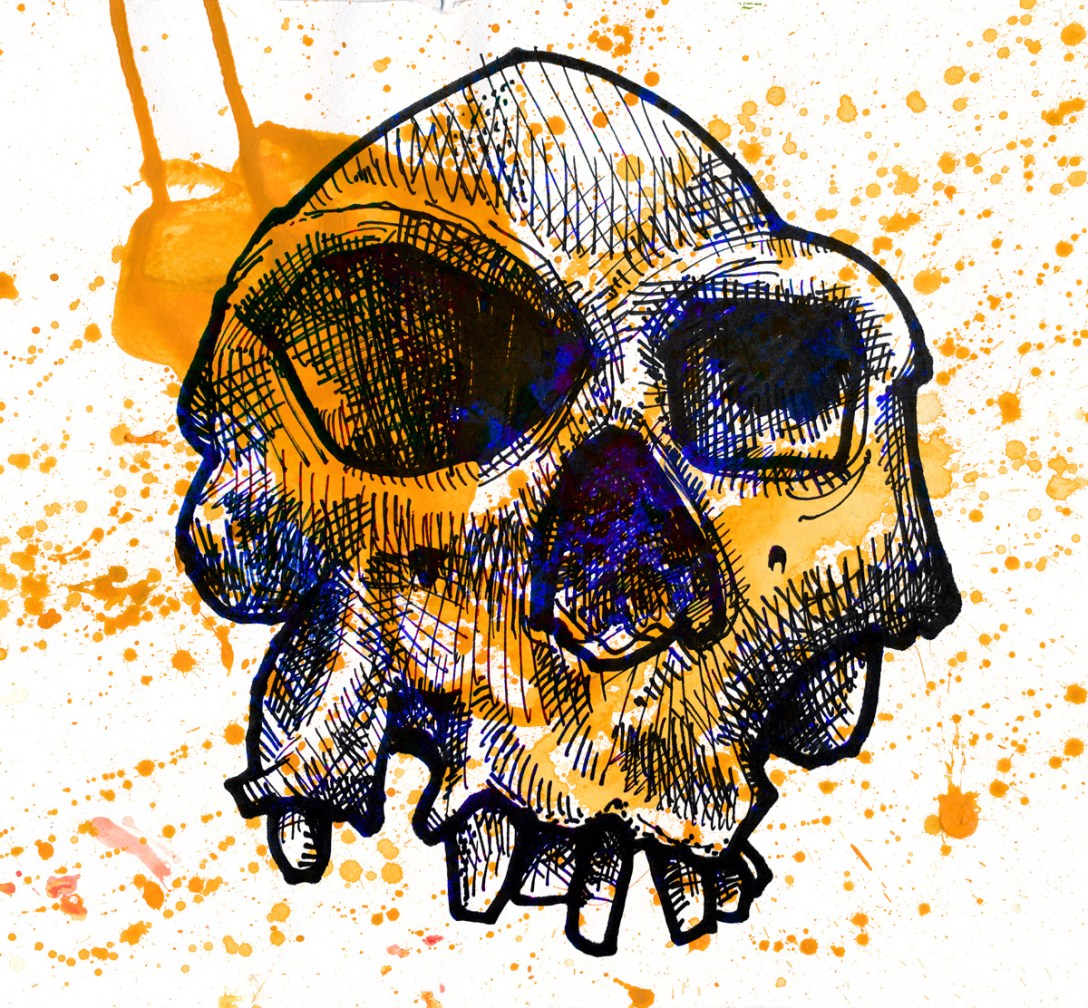
I learned recently (from an amazing, amazing must-read book called Sapiens) that human beings are born way too early.
While foals and calves are cantering around the paddock hours after birth, baby humans are toothless and hairless and defenseless when we slide out of the womb. We need protecting for years before we can be self-sufficient.
But that fact’s not the revelation, it’s the why: because our brains are too big. We have these disproportionately giant heads and if they were allowed to remain in the womb until our big old brains and skulls were properly developed, we and our moms (and our genes) would never survive delivery.
So we come out half-baked.
Now if, when we popped out and into our first prehistoric diapers, there were hordes of hungry monkeys skulking around the veld, we would have quickly become crunchy snacks. No matter how smart we were, no matter how much potential we had to grow big and strong, we would have been powerless before the monkey.
Fortunately, we had mothers to provide for us. And nursing mothers had families to provide for them. Without these layers of protection, we would never have lived long enough to hunt and gather and breed and check Facebook.
Can we say the same for the ideas we hatch in those giant skulls?
When we hatch a delicate new idea, do we shelter it from the monkey? Do we make sure it has time to dry off and catch its breath, to have a few meals, to interact with its brothers and sisters? Or do we grab it roughly, put it under a bright light and a magnifying klass, jab it and prod it and shake it hard?
If it has some flaws, do we toss the new idea aside? What if it has a few lumpy bits that could be massaged away, some unnecessary bits that just need pruning? What are we doing to secure the incubator and give our ideas time to grow?
To shift metaphors, our little idea is still a soufflé that needs time to rise. We can’t have hairy apes flinging open the oven door to look for perfection then jabbering loudly because it’s collapsed.
Don’t listen to the snide monkeys who hoot that your idea is weak and hairless. Keep working, shelter your babies, and let the poor things grow up.
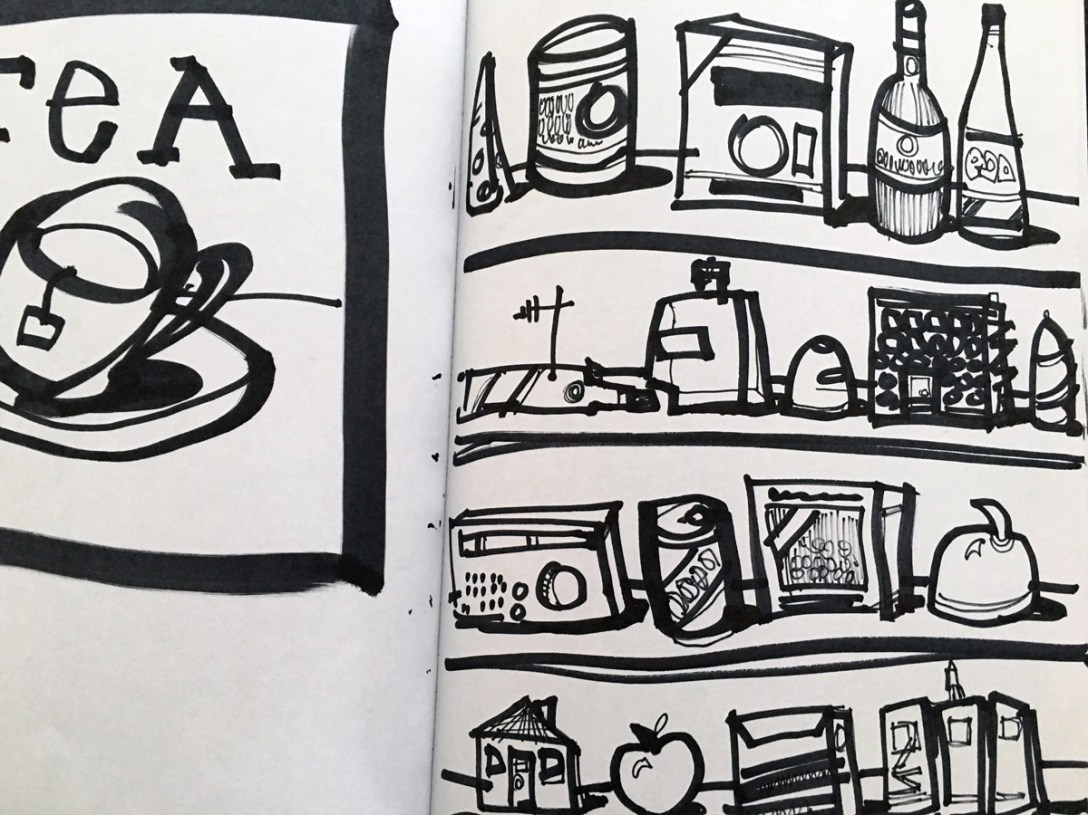
We think of genius as the ability to dream up something never seen before. But originality is overrated.
What matters more is reacting and responding and refining and adjusting and tweaking and struggling and sweating and polishing and finishing and delivering and making a difference.
AHA! is orgasmic, sure. But now the hard work begins.
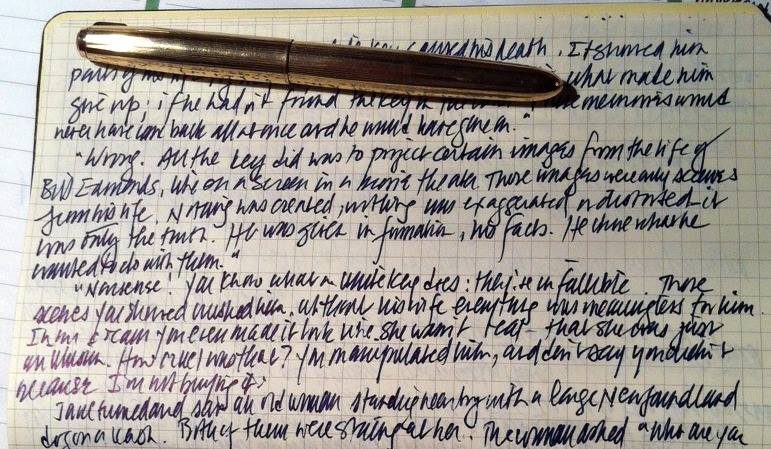
Every artist has their own way of working — tools and techniques they’ve honed over years of practice. We each figure out what works for us, what we need to do to pull an idea out of the recesses of our minds. Every artist faces obstacles and self-criticism along the way and being productive means figuring out ways to dodge the arrows the monkey fires at us as we settle down to work.
Some people start work at the crack of the dawn, while the monkey is still groggy and unable to put up a fight. Others work late at night when the monkey is exhausted. Some have stringent rules for how they work, what pens, what software, how cool the room, how hot the coffee. Some plunge into work like lemmings off a cliff; others fret and bustle about, sharpening pencils and brushing lint off their smoking jackets.
It’s fascinating to learn about the processes we each devise, but there’s no one correct way to proceed. Each person’s monkey erects a different set of road blocks and each of us has to figure out our own way to navigate around them.
One of the cool things I’m discovering about making this podcast is that it’s a great excuse for meeting people I admire and asking them all sorts of questions about their private doings. I happen to discover that one of my favorite novelists, Jonathan Carroll was following me on Twitter so I tripped all over myself to invite him to join me at the microphone.
What a treat! We talked about how he starts a novel, why writers need to read, how the wrong day job can leech your soul, what it was like to grow up in an intensely creative family (his dad was a screenwriter who wrote The Hustler (what a flick!), his mom was a star on Broadway, his half-brother is the genius composer Steven Reich), what it’s like to read your own books, how to judge an artist’s work, how to become friends with your inner creator, and the joys of writing books by hand.
Here’s the episode:
Or better yet, subscribe to the whole series on iTunes (and leave a nice review).
Or you can visit monkeypodcast.com and listen to the episodes right in your browser.
What’s your experience with your monkey? How has it affected you, and how have you overcome it? Record your Monkey Tale at dannygregory.com/monkey.
Jonathan also pointed me to this great video of Francis Ford Coppola showing the manuscript for The Godfather:
 Danny Gregory