The fears of a clown.

I am afraid. I am afraid of lots of things and always have been.
When I was little, I was afraid of getting lost, of monsters, of the dark.

Later I became afraid of girls.
Of exams.
Of plane crashes.
Of my stepfather.
Of fire engines pulling up outside my house.
For a while, I was afraid of going to the ATM, afraid I had no money
I have long been afraid of my body, of the hidden diseases and disasters it is concealing.
I have been afraid of strangers who write me mean emails telling me why they no longer like me or my blog.
I have been afraid of speaking to crowded rooms.
I have been afraid of death, especially the deaths of people I love.
I have been afraid to draw, afraid I can’t do it.

If we are willing to open ourselves up and be laid bare, to respond to the moment and without hesitation, to connect deeply with our audience’s eyeballs and the minds behind, we will be freed of the bullshit that holds us back.

I have come to believe that my life’s purpose, the key to my happiness, is to pare away the things I fear.

Some I have outgrown — I can now sleep with the door closed and the lights off.

Some I have had shaken out of me — I don’t fear death much anymore. Bring it on, bitch.

Some I have just faced — I have had a physical, so I know I am healthy, regardless of what the monkey voice tries to make of that twinge in my gut, the ache in my knee. I speak to groups of all sizes, no butterflies. I drive the freeways, radio blasting. I fly hundreds of thousands of miles, cool as a clam. I quit my fucking job. I fell in love again. I moved across the country. I roar, goddamn it, and I rock.

A few months ago, I overheard somebody at the gym talking about something called “Clown School”. I googled it. I found there’s one here in town. I signed up for the next intensive session. Why? Because I have no idea what it is but it sounds scary and important and utterly alien. Then I committed to not to think about it again until the day arrived. Why? So I wouldn’t chicken out.

I am now in my final day of Clown School. It was very scary — as clowns can be. Not because we wore makeup and big shoes, which we haven’t, but because we confronted many of the things that scare me the most. I stood in front of a room of strangers staring each one in the eye and telling embarrassing shameful things. I collaborated with strangers on humiliating choreography. I shrieked with fear, wailed with grief, howled with anger until I literally lost my voice. I sung a spontaneous song about what I loathe most. I danced across the stage, by myself, to demonstrate my self-confidence, and then had to do it again and again and again, until I was utterly without guile or reserve.

I have never before seen the people who saw me do this, and I sincerely hope that, though I loved them all, I never see them again. I couldn’t have done it otherwise.

Mostly, I revisited the most powerful emotions there are, familiar and often hateful emotions that I have worked so hard for so long to deny and avoid. And now, for day after day, I have sought them out and felt them surge through my body, grip my throat, shudder through my veins, cramp my stomach, churn my bowels. Terror. Loss. Humiliation. Sorrow. And joy, lots of joys — the longest lasting physical toll was the aches in my cheeks and neck and stomach: aches from too much laughter.

I am not a physical person, I spend all too much time living exclusively between my ears. But a few days of Clown School have helped me loosen my hips, have reminded me of what it is to really move with feeling, to express myself spontaneously from my gut, from my spine, from my balls, to be gripped by rhythm and to respond on a subconscious visceral level to another’s movement, to an impulse, to an emotion deep within.

Our teacher, a wise and hilarious clown, told us that clowning is about the importance of being ridiculous, because to be ridiculous is to fail, and failure is what we all have in common, the most basic and honest human experience, the one that helps us grow and change and improve and survive. If we are willing to open ourselves up and be laid bare, to respond to the moment and without hesitation, to connect deeply with our audience’s eyeballs and the minds behind, we will be freed of the bullshit that holds us back. We will tap into the deep wellsprings of creativity that lie beneath our artifice and style and self-conscious crap and hesitation and self-deception and excuses and fears. We will make art of truth.

Time and again, as I addressed old emotions in a new way, I thought about drawing.

About how the most important part of drawing is not what pen you use or the weight of your paper. At their core, drawing, painting, clowning, all art, are about letting go, of responding from your gut, of trusting, of working hard. Can you let go of all your preconceptions and finally, truly, truthfully see? Can you embrace and trust your audience rather than trying desperately to impress or con them? Can you put in the hours, the sweat, the pain of failure, so you can get deeper and deeper, looser and looser, sharper and sharper, digging down to essential truths?

Art is not entertainment. It is the way to what matters in our lives. To conquer our fears, we must face them, turn their ugly lies to beautiful truth, and share what we have made of them on the page or the stage.

I may just be a clown and a not very good one at that, but I ask you this: If you aren’t making art, what are you afraid of?
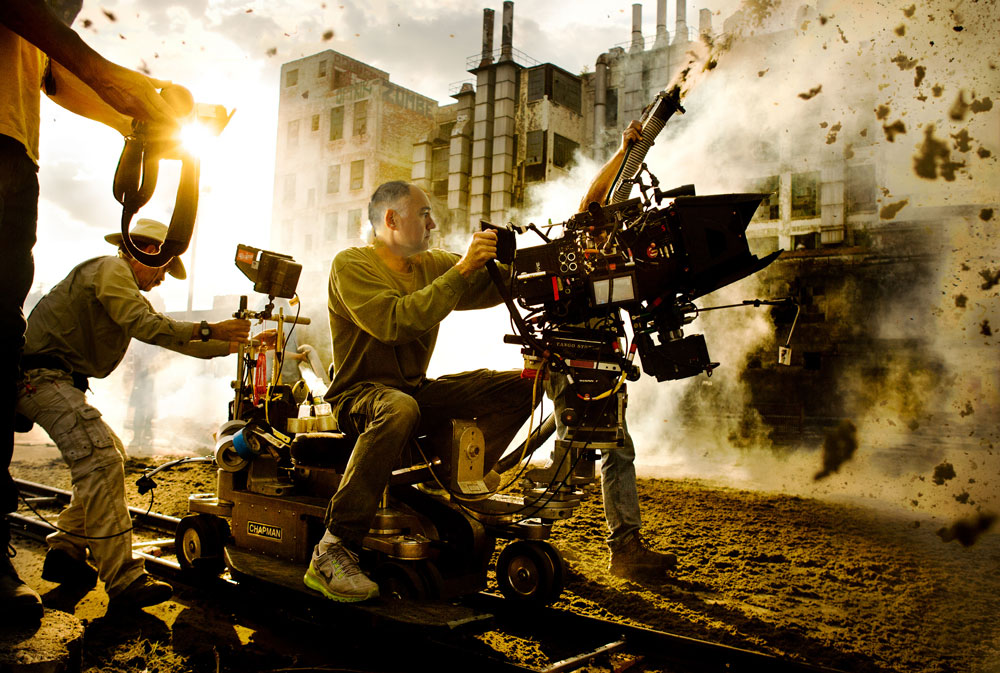
In production.

dog-on-transformers
FIlming an action sequence on ink spatter.

Teaching used to be a fairly simple business. You get some chalk, a dunce cap, a book with all the answers at the back and you’re in business. In 2014, it seems to be a little more complex.

tom-and-guests
Tommy Kane and special guests on the set.
lord-of-the-rings
In production with “Lord of the Pens”

When I first started thinking about doing online classes, I wanted to make sure they were as exciting and interesting as possible. So, being me and living a couple of miles from Hollywood, I immediately started to go overboard. I started to talk to my friends, many of whom you know and who are among the best sketchbook artists in the world. We decided that it wasn’t enough to just slap together some recycled lessons, a couple of PDFs and some poorly lit snapshots. We wanted to make sumptuous, hilarious, inspirational, instructional films that would get you so fired up you’d have to start drawing night and day. Our inspiration was first of all, Bob Ross, then the Cooking Channel, then National Geographic, and now we’re thinking Spielberg and Peter Jackson.

beam-me-up
Our mission: To boldly go where no man has drawn before.

So while everyone else was drinking eggnog, we have been deep into production.

DOG demo 2
Warming up some ink.

Tommy and I spent several days in the depths of Brooklyn in production on his klass. Then we turned around and finished up filming my workshop. Meanwhile, Prashant is heading to India to rendezvous with a production team that will capture his insights about watercolors. Koosje is setting up lights and camera in Amsterdam.

kane-on-set-1
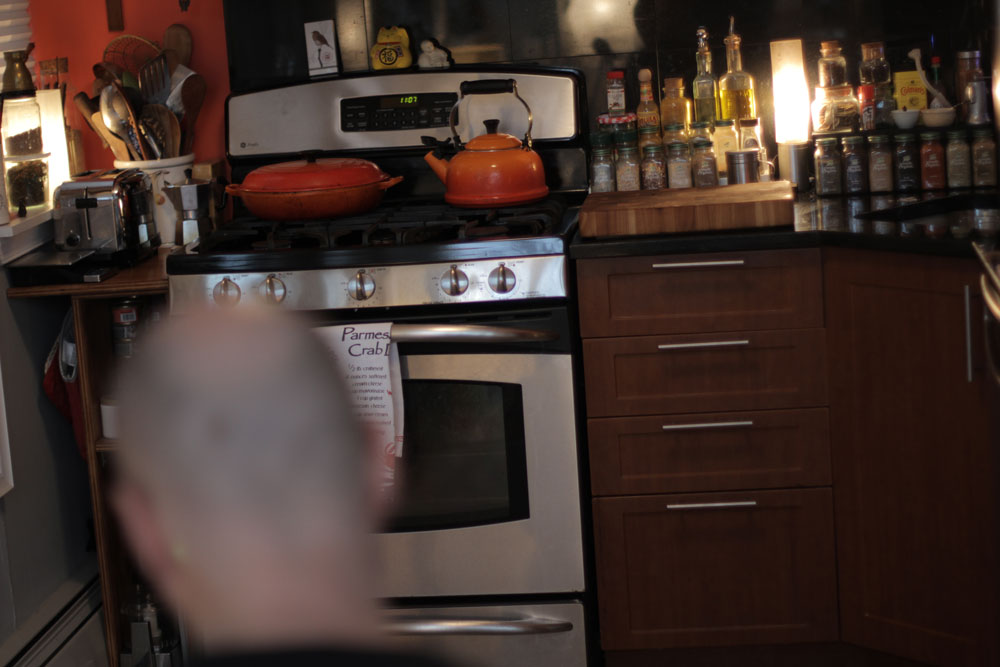
In the kitchen set, Tom gets his head into a drawing

Deep in a Minnesota snow bank, Roz is furiously pecking out epic scripts about paper and pens. And next week, I’ll be heading to San Diego to collaborate with Jane on her films.

Meanwhile, an elite team of even more amazing teachers are arrayed around the world, beavering away on the next wave of klasses. More on them soon.

If you want to know more about all of this flurry of activity when it is ready to launch, do sign up for our mailing list. Meanwhile, scrape together your pennies and polish your 3D glasses.

Happy New Year!

← Back

Thank you for your response. ✨

Warning
Warning

Warning.

.

Fallink in love again

fallinkWhile visiting Bergamot Station, a collection of art galleries in Santa Monica, I happened into Hiromi, a lovely store full of exotic paper from around the world. The store blind-sided me — Jack and I really just wanted to see some art — so I wasn’t prepared to start properly drooling over Korean mulberry Hanjo, Bhutani Dekar, or handmade tissue from Berlin.
Rooting around the shop’s counter for a business card as a reminder for a future more leisurely and acquisitive visit, I came upon a basket of what seemed to be regular old rollerballs pens. But on closer inspection, these unassuming bits of white plastic revealed themselves to be superfine Kuretake Fudegokochi brush pens. Their tips weren’t brush shaped, more like a plasticky fiber tip, so I tried one out on a scrap of paper.
As the first line serpentined out onto the page, clouds parted, birds tweeted, the world became ashimmer in a golden glow. This pen was amazing, as flexible and responsive as a steel nib, capable of super thin lines, then big fat wet ones, and all the gradations in between. The lines were jet black, crisp when I wanted, mushy when I didn’t.
I was in love. Again.
My name is Danny and I am a pen Lothario, a promiscuous and fickle romantic. It’s high time to sit down and discuss my oat-sowing ways before I commit blindly to yet another drawing playmate.
Flash back. My first pen was a roller ball, the Uniball, a friendly and welcoming old stand-by. It’s cheap, widely available, waterproof and a sensible choice, the pen next door. But after a while, its dependable lines began to bug me. They had so little character and variation. And the way the hard ball tracked a groove into soft paper began to grate, high heels tap-tap-tapping on parquet.
Another fling: a superfine needle-nosed technical pen with a pointy backside and a cap that always got lost. I drew microscopically with this pen, favoring smaller and smaller sketchbooks, until I was tempted to draw entire landscapes on the head of a pin while peering through a loupe. It was a super-anal relationship — clearly not healthy.
In a stationery store in the Esposizione Universale Roma, where Mussolini built a grand expo to celebrate the triumph of fascism, I came upon my first Faber-Castell PITT artist pen. Despite the unseemly way in which we met, these pens have been loyal friends to me ever since and I have PITTs stuffed in every drawer and pocket. They are the old standbys, the ones I come back to when the latest fling lets me down. I am never quite ready to settle down with any of the PITT family. Not even the soft, warm embrace of the Big Brush Pen. Always a bridesmaid, alas.
Speaking of big-boned pens, I spend a crazy month or so this fall scrawling on cardboard with increasingly huger Sharpies, working my way up to the King Size and finally the Magnum. Wow. I was a little wild and out of control for a few weeks, going on pure instinct and I loved the abandon of these fist-filling chunks of inky permanence. They can’t be let near my sketchbooks, however, drooling and seeping through the pages like Rottweiler puppies.
Another pal let me down this fall. My Lamy Safaris have fallen out of favor; well, to be fair, the blame falls on the ink that runs through their veins. For some time, I had been blaming my steel-nibbed calligraphy pens for the smears and speckles that kept appearing on my finished drawings but finally realized that the real culprit was the Noodler’s Bulletproof black ink in the Lamys I draw with. Now this ink is amazingly good stuff, black, waterproof, and super-permanent when it’s thoroughly dry. And there, quite literally, is the rub. I work fast, I work messy and if the page isn’t 100% dry before I turn it — catastrophe. Supposedly, it dries in under a minute; I have waited far longer still with disastrous results. And when I am in a period of wild abandon, cavorting with Sharpie Magnums, I have no time for noodling with Noodler’s plodding pace. So my Lamy’s are at the back of the desk until my pulse slows once more.
Back to my new Japanese amor. It didn’t take me long to discover her flaw — the ink is not waterproof. With a moist brush, her lines turn into a pool of ink. However, if decades of marriage taught me anything, it’s that one must compromise to be happy. And so for now, I am willing to draw and only draw. No slatherings of Dr. Ph Martin’s, no limpid pools of Winsor Newton. Simple line drawings are fine for now. Especially when those lines are springy, expressive and full of life. They suggest color, even in black and white. As we head into the grays of winter, I will work within Kurtake’s limitations. But Spring is not far off and my heart may soon wander again. Just saying.

Addendum.  This is the specific pen I just fell in love with. You can find it also on JetPen.

A quickening.

studio

We are being very productive in the studio these days. Jack (home for Xmas from RISD) and I have been painting together, and the air is redolent with the heady scent of Gamsol and the sounds of Biggie Smalls and NPR.  Our approaches are markedly different but our passion is similar.

GARDEN

Our lemon tree has put out  a fresh crop and the oranges and mandarins are ripe for picking. Each morning in my bare feet, I peel and eat a couple.

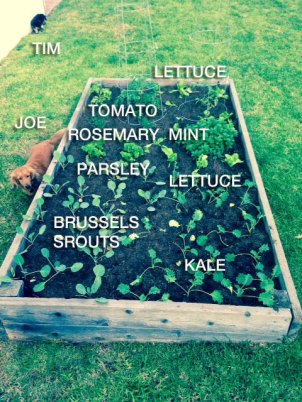
Our vegetable garden is fully stocked now and hurling up stalks and leaves (ah, the miracle of living in Cali in December!).  It adds to the fecund atmosphere with the perfume of chicken manure and the excited yaps of hovering crows. The hounds patrol but are more apt to roll in the soil than chase off varmints. Next project: build a dwarf scarecrow.

I love watering my patch and marveling at each’s days growth.  We will be eating well come the next solstice.

Another exciting development: I have finished the manuscript for my next book and it is safely in my editor’s grasp over at Chronicle Books. Now I have a manure-load of drawings and designing to do by my springtime deadline – a lovely chore. More on that as things develop.

And finally, the project I spoke about in my last post is growing by leaps and bounds.  We are working on what it will look like, where it will be housed, how big it will be, how tall, how loud, how fortified with vitamins.  It just keeps getting more and more amazing as more great talents join our team.

I do hope you have signed up to be alerted as soon as the blossoms appear on its branches. Oh, and perhaps put a way a penny or two in your Xmas fund for seed money.

I case you forgot to sign up, there’s still time:

← Back

Thank you for your response. ✨

Warning
Warning

Warning.

.

No title. Really, that’s the title.

ArtistI think my mother was the first one to tell me, “You can’t call yourself an ‘artist’.  Other people will decide that for you. It’s pretentious to assume the title for yourself. It’s like calling yourself a  genius. Maybe you can say you’re a ‘painter’. But not an artist.”

My mum is humbling like that.

“Teacher” is another title I am loathe to assume. I don’t have a degree in teaching, I don’t work at a school. And I think teaching is one of the most important and difficult and unrecognized jobs around. I really do think that’s a title you have to earn.

But I guess I do spend a fair amount of time telling people stuff, instructing them on how to live, to drawn, to think. So I’m either a bullying bore or I am maybe a teacher. Not that the two are the same thing, of course. It’s just that if you walked into a bank and started criticizing people’s penmanship or cracking knuckles in your local Starbucks because people have poor posture and are chewing gum, well, that wouldn’t fly. Teachers get to know better because they do.

I’ve had loads of corporate titles and they all seemed sort of ridiculous. Yesterday, a guy gave me his business card and said, “There’s no title there because I still haven’t quite figured out what it is I do.” He was being modest (he was actually the boss of a really big company) but I liked his attitude.

Let me get to the point.

One of the biggest irons I had in the fire when I left my last titled job was to put together an online class.  I’ve alluded to it here a bunch of times since — but it never seemed quite right to me.  Maybe it’s because of those two titles, ”artist” and “teacher” and the even more daunting combo: “art teacher.”

A couple of weeks ago, everything changed.

As result of number of amazing conversations I had in Amsterdam, most importantly with Koosje Koene, a clear, bright path has opened up. I now know what I will be doing next and I think it will be amazing.

It combines everything I have been working on for the last decade. Making art; sharing with other people; meeting so many amazing “artists” and “teachers”; thinking about creativity and all of its gifts and obstacles; the Internet and the global nature of everything; Everyday Matters and what it has come to mean on Yahoo! and Facebook; the thousands of emails I have received from great people everywhere; my decades in advertising helping big companies tell their stories —  all of this mass of rich stuff lumped together in one beautiful stew that finally is really bubbling.

A group of us are working on something that I really think is fresh and fantastic. It’s an answer to all those people who have asked me to do more workshops or to teach online or to give them advice or make more Sketchbook Films, all the people who are interested in art and want to make it more a part of their lives. And I think it’s a great answer, like nothing out there.

We still have a lot more work to do but we think we will be ready to roll it out in March. Gulp

It’s a lesson that settling for an existing title or solution or direction may not always be as good as making up something brand new.

Which is what we are doing.

If you find this, whatever it is that I’m going on about, interesting, stay tuned.

And if you’d like me to update and include you in our project, send me an email. Please do. Even if you are only intrigued. Or vaguely interested. Or utterly confused. It’s gonna be big. And probably won’t involve titles.

← Back

Thank you for your response. ✨

Warning
Warning

Warning.

.

On making shit.

turd
A recent turdlette.

It’s so easy to despair. You sit down, uncap your pen, start drawing and then realize you have drawn a large, stinking turd. It’s inescapable and it’s bad. So bad that the stench drives you from your sketchbook for days.

Congratulations, you are on your way. The fact is, crap is the inevitable byproduct of the creative process. It’s supposed to be. And it happens to us all.

(And now you know why the background of my blog is brown).

Let’s get some perspective. I recently took a huge book out of the library that contained all 2,137 known works by Vincent van Gogh. It almost broke the rear axle of my truck. Now, bear in mind that those are the 2,137 pieces that have actually survived for 125 years. You just know that there were several times as many that Vinnie or his brother or some skeptical landlord trashed, burnt or flushed long ago. So, maybe van Gogh made five or ten thousand drawings and paintings over his ten years of art making. Three a day. Sounds reasonable considering the tear he was on.

How many are great? Ten? Twenty? Let’s go crazy and say, a hundred — that still means his hit rate was, generously, 1%.

I love the movie Amadeus. But let’s face it, it’s fiction. The idea that Mozart just sharpened a fresh quill and wrote down the Requiem or the Jupiter or Don Giovanni or any of his other 623 works of varying quality as fast as he could take dictation from God is just nonsense. He  squeezed out turds every day, just like the rest of us.

Picasso left behind 50,000 works. On some days, he made five paintings. The Cahiers d’Art, the complete catalog of his works, takes up 33 volumes and costs $20,000! Did Pablo think all 50,00 were genius? Did his gallery owner? I doubt it. So, these are some of the greatest geniuses of all time and even they didn’t hit home runs every time at bat. That’s why they worked on paper — because it can be crumpled up and hurled against the wall in frustration.

We have good reason to be afraid of failure.  Even if we actually are great.

In our commercially rapacious world, we don’t allow for crap (although there’s certainly plenty of it). The minute we set someone up on a pedestal, we start working to pull them down. If you write a great book, have a great show, make a great record, expectations will be immediately ratcheted up. But your initial success will probably be followed by something that isn’t quite as good. Overnight, you’re the Knack or the Stone Roses or Terence Trent D’arby. Or Skeet Ulrich. Or Lindsay Lohan. And once you stumble, you’re dead Meatloaf. There is little tolerance for failure.

Better to just be Harper Lee and quit while you’re ahead.

You are different. Because you are learning (hopefully for the rest of your life).To succeed in the creative process, you need a long-term view. Thick hide. And you need to keep working. You can’t get hung up with self-doubt and give up at the gate. You can’t mistake a failed drawing for a failed you. You aren’t your turds. You just aren’t.

And stop insisting on perfection as the price of moving on. Even Tiger Woods isn’t Tiger Woods. You have to swing at lots of balls, before you slowly inch your way from van Gogh’s brown potato paintings to Sunflowers and Irises. It’s a battle of inches. Slowly but surely, your turds will smell sweeter.

Learn from your mistakes. Otherwise all the pain you endured from making that bad art was just a pricey ticket you never got punched.

Bottom line: If you’re going through a period of making bad art, you must go on. You can take a break, but eventually, soon, you must go on. Because otherwise what you’re running away from isn’t the way you put pen on paper. It’s fear of who you are. And you’ll never escape who you are. Instead learn to accept and to love it. Flaws and all. And then to go on. Trust me, you are more together and less smelly than Vincent van Gogh.

Don’t be tripped up by a few bad drawings.  Keep them and learn from them and let them improve your future art and your future self.

People who never produce turds die of constipation.

Koosje!

IMG_0849

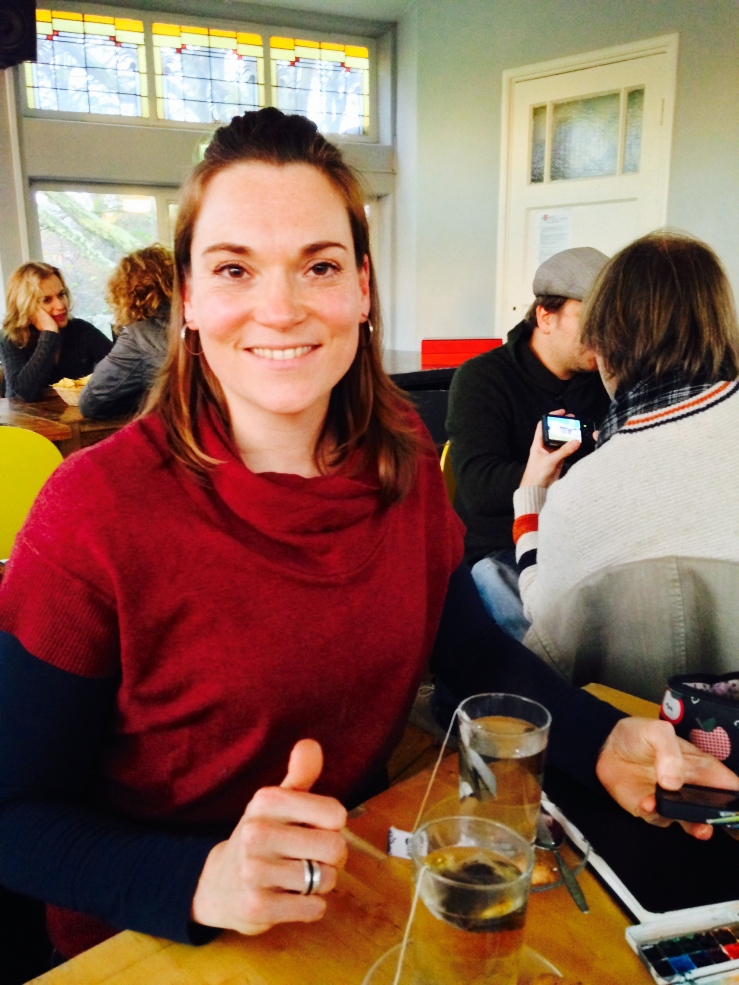
Vincent van Gogh was not the only Dutch artist I met in Amsterdam. I also had a lovely time with Koosje Koene, a wonderfully talented illustrator who has been my online pal.  Koosje draws amazingly well — I am especially amazed by her work with color pencil — but also has a lovely sense of wit and wisdom. She creates cartoon characters, illustrates food, tell visual stories, and has become the mentor for lots of people in the EDM community.

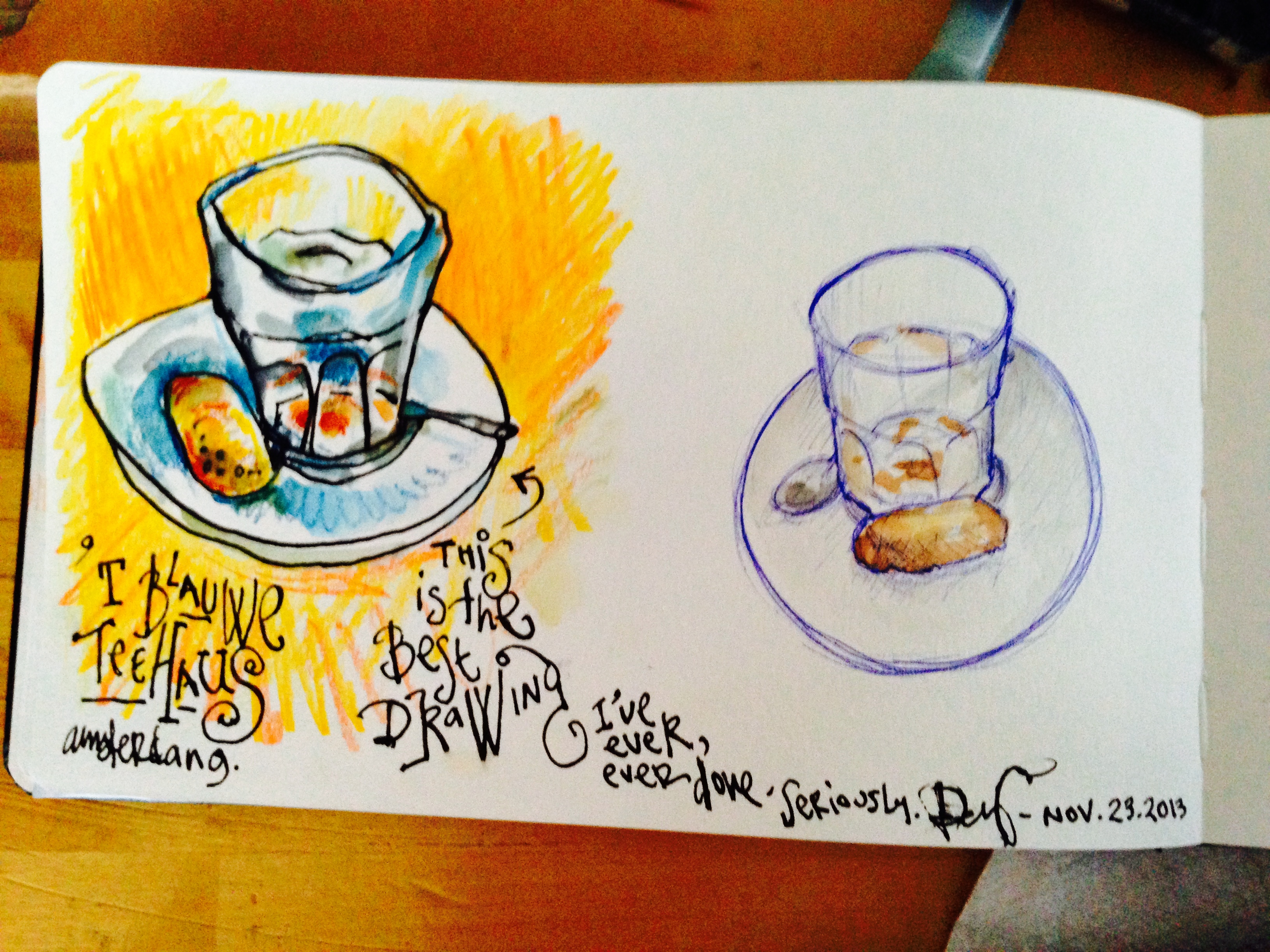
We met at a teahouse in the Vondelpark, shared stories, tea, and a stack of journals, then drew together.  Our styles are different but complementary, doncha think? Then we met up with Pascal, Koosje’s musician husband, and had a sumptuous Indonesian feast.IMG_0844Koosje is also one of the first people to offer really great online classes in drawing and she has been really helpful with advice on my budding efforts. I urge you to check out her work, watch her free weekly drawing tip videos,  and sign up for her next class. She’s awesome!

Vinnie’s balls.

IMG_0718
A mural in my ‘hood foreshadows my trip to Amsterdam.

The conference and Amsterdam’s cold, damp (I miss LA!) didn’t leave me a lot of opportunity to roam around the city but I did get to the Rijksmuseum and the Van Gogh Museum.

Vincent van Gogh has alway been a huge inspiration to me. I love his colors, his ferocity, but most of all, the whole journey of discovery he took trying to beat and bend himself into being an artist. In just ten years, he went from painting awful brown crap into changing art for all time. I’ve always even a kindred spirit because of the way he went about teaching himself, how he absorbed so many influences, how he went down one path after another to get clearer and more direct in his work.  He spent a few months in art school, studied under a couple of professionals, read loads of instructional books, but most of all he just painted and painted, often filling a canvas a day, day after day.

As you can imagine, I was really excited by the enormous show called “Van Gogh at Work”. It focusses entirely on this process, showing how Vincent learned and evolved through more than 200 drawings, paintings, and sketchbooks. There are exhibits of his easels, his paints, palettes, preparatory drawings, and loads of completed masterpieces, in a sweeping chronological exhibit covering four entire floors.

I learned a huge amount in the hours I spent there.

First, there was the shock of seeing all these amazing paintings as working examples, rather than “Priceless Masterpieces,” giving them an immediacy that made me understand how Van Gogh himself must have seen them.

Have you ever had the experience of seeing an artist with his own work, how he might rub the paint with his thumb, or want to repaint a corner, or throws them onto a stack in the corner?  Artists  have such a different relationship with their pieces than curators or gallerists who tiptoe around with white gloves and X-ray machines, because artists value the process of their art as much, if not more, than the actual products of that process. Van Gogh would paint on the back of old paintings, or just scrape them down so he could make something new. He would knock out stacks of paintings of the exact same subject, trying new and different things. When you see, for example, both paintings of his room at Arles, two version of an iconic image hanging next to each other, similar but different in a hundred ways, you feel the living artist behind them, how he thought and developed, what he was considering, where he saw mistakes that became lessons. How often he would make copies of his paintings so he could give them to other people or just to brighten up his room. All those priceless sunflowers — he made them just so Gauguin would be happy in a cheerfully decorated room when he came to Arles.

And he was such a thirsty sponge. He was always studying others, absorbing, mimicking, incorporating, and then surpassing a long list of painters who seem at first to be him betters but ultimately look regressive, formulaic, and only of their moment, now past.

You get the sense that people are always telling him, “No, this is how you must make Art,” from the one professional teacher in his hometown who briefly mentored him, to the teachers at the Académie who gave him the worst marks, to the Impressionists who opened his eyes in Paris to Gauguin and on and on. Everyone knows better and he seems to listen, guilelessly. But, unlike them, he is never satisfied, never thinks he has the final answer, and keep pushing on.

vvg quote

You could sense how hard he was working and how he kept pushing himself onward. Even if he liked a painting he’d done, he would try something new. A new approach, a new subject, new materials, different canvas sizes… new, new, new. He never felt like the journey was over, that he had arrived; there was so much more to discover. I love that hunger and enthusiasm.

And, as the chronology of the show takes him (and you) from milestone to milestone, you can see his work progress and yet retain certain things that make them all Van Gogh. He copies and copies and copies — Impressionists, Dutch masters, Japanese Woodcuts, all of his friends from Lautrec to Seurat, absorbing each influence, going down by ways and dead ends, accumulating new ideas and ways of seeing, and yet each brush stroke can’t help but look like his. He couldn’t help being Van Gogh.

If you hear a voice within you say ‘you cannot paint,’ then by all means paint, and that voice will be silenced. — Vinny vG.

His passion and his passion never abate and the miracle of what he is making himself into through sheer force of will is exciting and inspiring. No matter how familiar the images look, seeing them in the flesh makes them new and exciting.

IMG_0786

Oh, and he is always drawing. 

There are lines over and under the paint, that give everything definition and clarity.  That’s been my desire with my paintings too but it didn’t seem “painterly” and he shows how it can be.  His influences in this are those Japanese woodcuts, Lautrec, and Gauguin — lines that are sometimes black or in contrasting colors or just darker shades or hues of the blocked-in shapes. Or lines that graduate in color and tone along their length. Sometimes the lines are picture elements: a branch, a window frame, a doorway, the edge of a petal, but often they are just there to separate planes and outline color fields.

Also: I was surprised to learn that he used store-bought, pre-stretched canvases. And that for a long period, he relied on a wire perspective frame to help him draw more accurately. And that he would used lengths of colored wool to plan out the color compositions of his paintings. They displayed the actual box full of balls of yarn that corresponded to many of his most famous works.

Vinnie's balls

And finally, I saw that his work is a record of his life. He painted the people he knew: lovers, friends, neighbors, postmen, landlords. The places he lived. The cafés he ate in. The landscape all around him.  His subjects had meaning to him and it shows in his best work.

When he does academic work, painting from professional models or plaster casts, it feels dull and lifeless. But when he paints sunflowers he picked, irises he wants to decorate a room he will live in, the difference is palpable. I have always loved his painting of almond blossoms against a teal background, a background that he painted last, carefully outlining every branch. Now I know that he painted it so carefully for his newly born nephew, blossoms for a fresh life, and there is love and care in every stroke.

Great art isn’t scary and imposing and “Important”. It’s personal and full of feeling. At some point, van Gogh gave up making paintings to be sold — that seemed like it would never happen. Instead he made so many paintings because he had to, he wanted to, he had problems to unravel and the world around him was beautiful and cried out to him to be embraced.

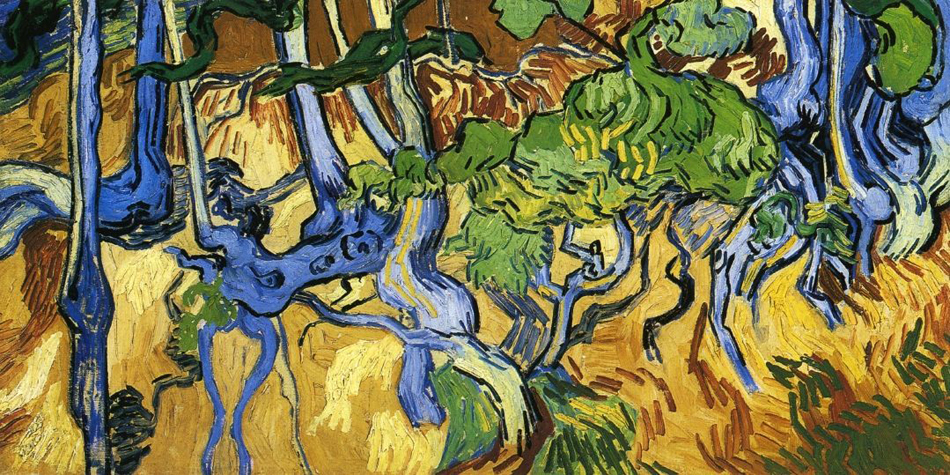
The last two paintings in the show left me with a lump in my throat, like the ending of a great 1940s movie. The wheat field aswirl with crows, big wet-on-wet strokes that he slapped down in the baking sun, is well-known as a symbol of his tortured state. But the very last painting was one I had never seen before.  It’s of the roots of trees, tangled like snakes, and it’s unfinished. It was his last lesson and he never completed it.

roots

What must that last day have been like, him stopping in the middle of a painting and deciding that he’d had enough, that it was hopeless, and putting a revolver to his chest? One can never know. But as I walked down from the fourth floor of the museum, after seeing all of his hard work over the years, all of his experiments and discoveries, his catching up to and then surpassing so many other great artists, it was so sad to think that, in the end, van Gogh felt he had failed.

The monkey got him.

Skateboards and mousepads in the gift shop.

Imagine if Vincent had known how loved he would soon be. How we would all learn from his lessons and discoveries. How his works would become icons and decorate tea towels and boxershorts. And that the voice in his head was utterly wrong, despite how it seemed that one lousy day.

The monkey is almost always wrong. And the only answer is to keep trying and pushing and learning and discovering. The road has no end, just lots of twists and turns, and it keeps moving upwards even if we can’t feel it all the time.

Dutch doors

car-and-bike

Since I first started drawing again, more than fifteen years ago, I’ve discovered that drawing in a book is a lot more than making nice pictures. 

Observing one’s life, recording one’s days, contemplating the details of the everyday, being more present, finding the beauty all around me, these are powerful experiences that have been transformative for me, particularly in difficult times — and I have always hoped that I could discover how to share this discovery to help others. I’ve long wanted to go beyond the world of Art and illustration and talk to people in schools, hospitals, and prisons about how drawing can help them discover the world as it truly is: beautiful and full of meaning.

IMG_0818

Since leaving my job in advertising, I have been thinking about and working on how to do this. I’m not there yet, but this week I took another step forward.

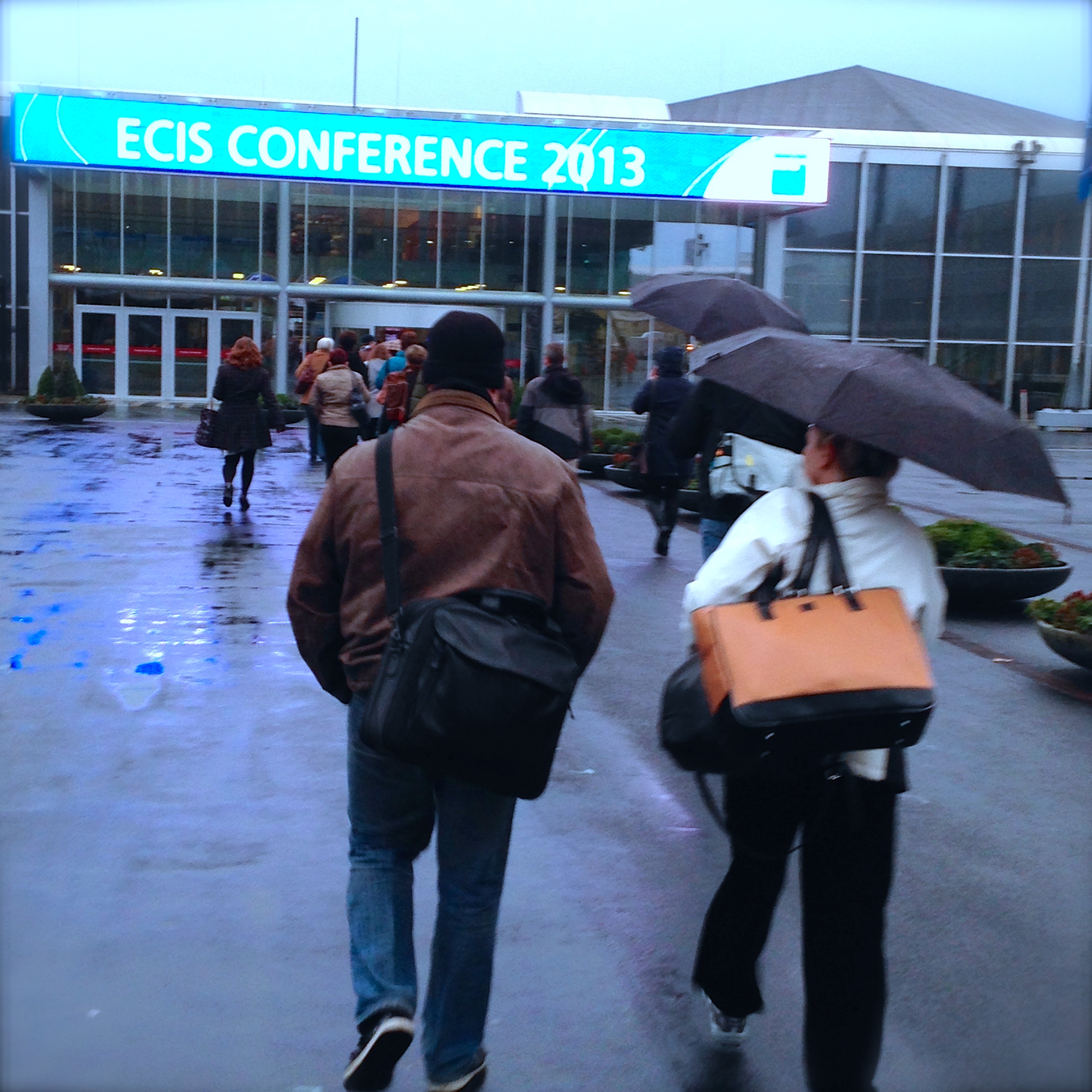
IMG_0798I’ve just come back from five days in Amsterdam, where I gave the keynote address at an educational conference, addressing 1800 teachers from 213 schools in 37 countries.

IMG_0767 After my presentation and workshops, I had loads of interesting conversations — about the true meaning of drawing, how to encourage teens to reignite their childhood creativity, how to get children to express their inner lives in their own journals, how drawing can go beyond the art classroom to be a part of all subjects, and much more.

IMG_0815

These conversations opened new doors. I got invitations to come  talk with students, teachers and parents in Germany, Czech Republic, England, Tanzania, Malaysia, Switzerland and the Netherlands. I don’t know what will come of all this but it’s very exciting.

Those who educate children well are more to be honored than they who produce them; for these only gave them life, those the art of living well.  — Aristotle 

Many of you were enormously helpful over the past few months as I prepared for the conference. Dozens of teachers generously shared their experiences with illustrated journaling in the classroom and sent me the wonderful work their students had created.
Their stories and images helped build a bridge between the work I have done and the needs of the teachers at the conference.  It was invaluable and I want to thank you again for collaborating with me. 

Teachers rock.

An earie sign.


monopiniotomySince the early 1995, Frank has cut what I laughingly call my hair. Every 18 days or so, once over with a 1.5 clipper.  It takes fifteen minutes tops, we chat about the weather, listen to Italian radio. He applies warm shaving cream to my neck and sideburns, wields the straight razor, slaps on some stingy stuff. No muss, no fuss. He was trained in Sicily, authentically, pre-hipster, old school.

Now Frank is three thousand miles away. I have scoured West L.A. looking for his distant cousin and have had three haircuts from three different “barbers”. The ambience, the chit-chat, the music, the results, have all been very disappointing.

On Friday, in preparation for my trip to New York (sadly, Frank is closed the days I’ll be there) and then Amsterdam, I tried yet another place. A very nice lady tried a) to talk me out of my usual haircut, b) put a paper rather than cloth towel around my neck, and c) badly sliced the edge of my ear with the clippers. She tried to blame the shape (somewhat pointy) of my ear, then handed me a series of towels to absorb the geysering blood.  I held a towel to the side of my head while she cut around it.

By the time I woke up in the morning, with bloodstains on my pillow (isn’t that the name of a song?), the wound seems to have closed. I grumbled a bit more about it and then suddenly had an epiphany. Of course! I am headed to the Netherlands, home of Vincent V. Clearly, this is a great omen that the trip will be a wonderful artistic experience.

Or that I should let my hair grow long.