Dancing with myself

I have become utterly bored by my breakfast (in dismay at my shortening belt, I’ve taken to eating celery and radishes and the like while staring out the kitchen window dreaming of waffles) so I have embarked on a new subject – my reflection. I don’t think it’s pure vanity but rather the easy availability of the subject and his increasing lumpy wrinkledness which makes for more interesting lines and shadows than the usual bagel.

I have also been considering the several international trips I have scheduled for the rest of the year and wondering if there’s an easy way to make Sketchbook Films on my own while I am abroad. I plan to draw, obviously, while I’m there and it would be interesting to share the process with you. Unfortunately I won’t be able to sneak my crew into my bag, so I may have to make do with ingenuity and a jury-rigged camera setup.

To that end, I knocked out a quick test at home which was fairly educational. I didn’t plan it properly so I ended up drawing myself with a couple of Sharpies on an old shopping list and the light was quickly fading. The old Flip camera I was testing likes a lot of sunlight so I’ll probably get better image quality in Shanghai, Rio, Capetown and Perth. The resulting film is a bit ugly and fairly interesting, like the drawing itself, and if you have any creative suggestions about how to improve future versions (that don’t require helicopters, Teamsters, or an army of makeup artists), please leave a comment. I have been collecting some small tripods and a wide-angle lens so testing will continue.

If you think the idea of me doing a drawing and stopping to readjust a barrage of cameras around me like some schizophrenic paparazzo, you are quite right. These are the sacrifices I willingly make for art.

The Artist’s Pulse – now on video

At the end of March, I was part of a panel of artists (including Karen Cole, Jill Zaheer, Roxanne Evans Stout, Julie Prichard, and Michelle Ward) gathered to discuss our work and Seth Apter‘s new book, The Pulse of Mixed Media.

It was an interesting morning and for those who were not able to attend, Seth has posted a rather abbreviated video of the discussion.

If this doesn’t satisfy you, there is more on Seth’s blog. More importantly, there’s Seth’s book, brimming with many more inspiring thoughts and art thingees.

The Daily Grind

A short film about my everyday.

For the last few years, I have walked to work every day. It’s about two miles and the trip takes about 35 minutes. I only made an exception if it’s raining hard.  Recently I got a new bicycle, a Bobbin from England, and I now make the trip in about twelve minutes, most of it along the Hudson RIver. My bike is new but old-fashioned. It has five gears but they are all fairly slow. Men in Lycra crouched over titanium frames from Italy streak past me as I toodle along. I am like an old man with a baguette in his basket, whistling under my beret, enjoying the birds and the sunshine and the breezes off the river.

Spring: a new Sketchbook film about, well, me

I really enjoy making our little series of Sketchbook Films. With each one we become more ambitious and discover new techniques and gear to use. Last weekend, we decided to make a fairly simple one — no dollies, Winnebagos or helicopters.  I got in front of the camera again and left Jack to man the lens for the action sequences then Jenny covered off my drawing process (the fourth Beetle, Tommy Kane, was off doing something productive and couldn’t join us on this one though he approved the final cut as being Sketchbook Films worthy).

I wanted to show a simple pen and ink drawing, done outside on a gorgeous day. The weather didn’t cooperate and instead of gorgeous we got clouds and rain which meant things got more complicated and technical and we actually had to shoot bits and pieces over the course of four days and in three different parks.

It was still fun to make though horrifying as always to see myself on screen. It may surprise you to know that no aging makeup was used on this production — that’s actually how decrepit I now look.

A new Sketchbook film: Hayley Morris in “Under the Sea”

Hayley Morris is a whimsical, sometimes dark stop-motion animator whose sketchbooks are filled with creative musings and pencil sketches. My girlfriend Jenny met her recently and immediately called me to say she thought she’d be willing to be in a Sketchbook film. I love Hayley’s films and videos and was super-excited to visit her Brooklyn studio and once again collaborate with Tommy Kane on shooting her creative process.

Despite her scratchy line, Hayley puts down each stroke with confidence and vigor. Her drawing seems to pulse and vibrate. She layers her watercolor quickly, wet-on-wet, creating more vibration and vitality. I like the ease and spontaneity of the way she makes art — you’d think a stop-motion animator would be enormously controlled in her work but Hayley leaves room for reaction and response as she makes her art. In an era of CGI and digital processes, her work harkens back to stop-motion puppeteers like the Jan Švankmajer and the Brothers Quay. It’s beautiful and emotional.

Hayley uses her sketchbook to incubate ideas, jotting down notes in the margin to remind her of how she will execute the thoughts in film. We watched her develop creature designs for a new video, animating to the strains of a new collaboration by Hilary Hahn and Hauschka. It’s a dark and powerful piece for violin and piano and Hayley turns it into an undulating underwater dance in a densely populated tidal pool.

——

We shot this film more quickly than our last one (we didnt need to stop to replenish huge amounts of alcohol or to wipe up blood) and even we managed to fit in a few crude little  stop-motion animations of our own. I filmed Hayley with a Canon 7D and four lenses (a 15/2.8 Fisheye, a 50/1.4, a16-35/2.8 L II, and a100/2.8 L IS MACRO) and Tommy used his own video camera for the aerial shots.

The music is the classic chanson “La Mer” by Charles Trenet.

PS The film was just mentioned on motionographer:

How to Be Evil.

I love to write; I have since I was wee. Every so often, an idea will just appear in my skull, asking to be born, to occupy some part of my mind for a while so it can curl up nice and toastily and slowly germinate into bookhood. It’s very pleasant and slightly itchy.

The first time I can remember it happening, I was eight and was visited by a pea-sized idea about a knight who traveled the countryside accompanied by a dachshund. I spend a fair amount of time filling a spiral bound book with that tale, each page taken up with a little text and a lot of drawings of the knight and the dog and some dragon or damsel or crumbling castle.

I loved making the book but I also loved having made it.

There was always something so appealing to me about the idea of having a shelf of books each with my name on their spines, books that were oh so familiar and yet complete and independent and living lives of their own. That book about Sir Roger Watford and Nicky the Long gave me just such a thrill for the first time.

Now I’m a grown up writer and I do have a shelf of books with my name tattooed on their vertebra. It’s as nice as I imagined it would be.

Anyway, a couple of summers ago, I was visited by an idea on Fifth Avenue, near Madison Square, and by the time I reached my house, I was excitedly unwrapping it. It was a novel, it seemed, a novel for young adolescents, and frankly nothing to do with anything I had ever published. At that point, neither the idea nor I cared much about the fact that it was a red-headed stepchild — we loved each other and hung out every morning for months. The story unfurled like a bolt of silk. I just had to provide two fingers to do the typing and chapter after chapter rolled onto my screen. It inspired drawings too, just like the ones that opened each chapter f my favorite boyhood books. Then Patti read it and Jack read it and we all thought it time well spent.

My (then-) agent loved the writing too. She just didn’t think anyone in their right mind would buy it.

First of all, she said, it is clearly not about drawing or creativity or any of the subjects I have built my so-called career upon. And secondly, it’s a children’s novel about evil — exaggerated, funny, hard to put down— but still evil.

I disagreed with my agent. The novel is not especially grisly or likely to inspire nightmares but it certainly is casual about things like murder for hire and con games and the best way to debone a corpse. I mean, it’s about evil. But in the nicest possible way.

I wrote it after spending a number of years living with a child who seemed quite interested in evil things, in bad guys, monsters, killers, etc. And I, as a former child, remember being equally intrigued by sick and disturbing things. In fact, both Jack and I found that most children’s literature was just too moralizing and coddling about such matters, while there seemed to be no end to mayhem in the adult world that was easy for a child of any age to slip under the velvet rope and wade their way into — so what harm could there be in one more slab of unrepentant horrorshow that at least like, totally, used tween vocabulary?

Despite my defense of the book, my agent has the Rolodex and wouldn’t show it to any publishers. Nope, no way.

So the book went into a virtual drawer on my laptop until last year when I decided I really wanted to see that book’s spine on my shelf, by hook or crook. So, poor judgment notwithstanding, I had it printed and bound up and got the first glossy paperbacks into my collection at last. It looks awesome and is hi-larious and I just didn’t care what the stupid ladies in the publishing world said. It’s evil, it’s twisted, and it’s mine. Mwaaaahhhhhaha.

Which brings me to to today.
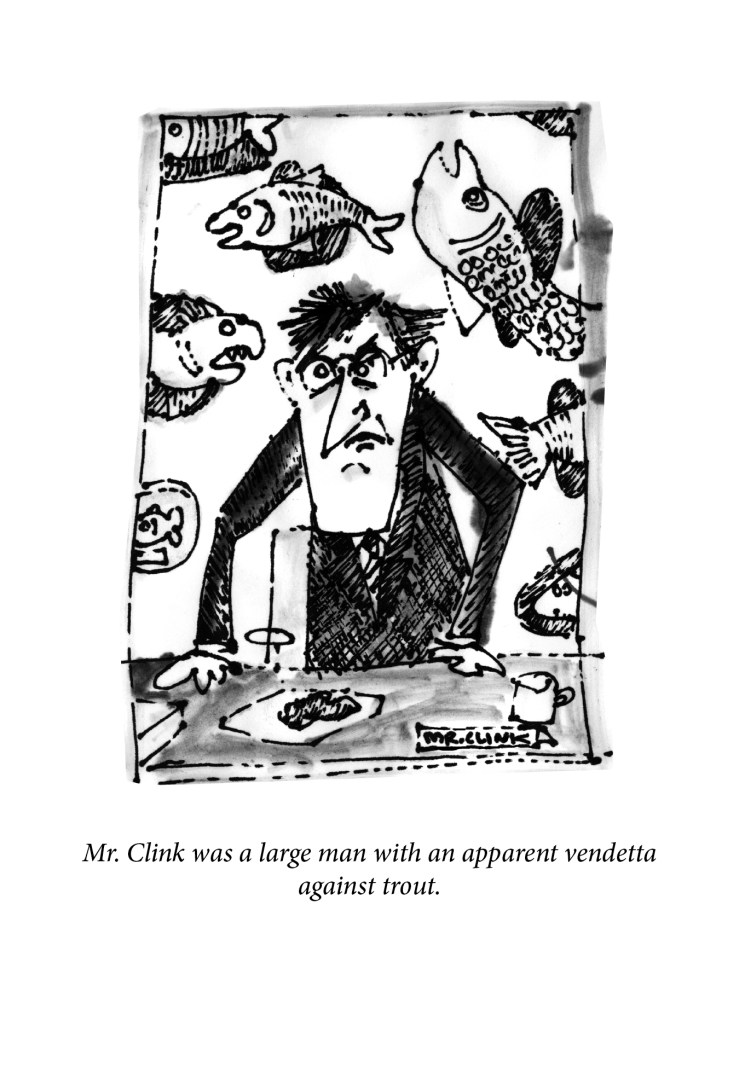
In 2012, I have become more and more devoted to my Kindle, packing huge stacks of books into its tiny frame and devouring them wherever I go.  I love paper and ink and the feel of a real book in my hands but let’s be real — ebooks are clealry the way things are going. I know many of you may not yet have converted and that assumption has been holding me back a bit, frankly. I have so many little book ideas in my head that I’d love to write and illustrate and share with you right from my website, books that interest me and probably you, but don’t fit into the big publishing machine’s view of marketing. Unless we agree to go virtual, they will just remain ideas.

So I have decided, as a sort of initial salvo, to turn School for Evil into an ebook (e for evil) version on Amazon. And here’s the amazing bit: While my paperback is lovely and pocket-sized and as cheap as I can make it (I make, literally, one penny in profit — I think I have earned that), you will still have to spend a couple of bucks having it shipped.
But the ebook version is as dirt cheap as I could make it. Just 99 paltry cents. That’s £0.75. A measly €0.86. What a steal! 

If you would like to see what all the fuss isn’t about, you can buy yourself (and any children you don’t care about) a few copies of “School for Evil” for an unlimited time only in either form. Both are ludicrously priced for an illustrated masterpiece and all proceeds will go to supporting my special brand of evil. Check it out and, please, read it with at least one light on.

Buy “School for Evil” in paperback here. Criminally affordable. Do it now!

Or buy it the ebook version for your Kindle. Equally evil, less attractive on the bookshelf. So cheap it’s just wrong.

Oh, and if you buy it and love it and want to help propel it to to the top of the Amazon charts (even though it’s not erotica or written by a drug-addled radio host or a pregnant celebrity who lost huge amounts of weight overnight while being attacked by zombies), tell your friends (particularly those in publishing)  and me how much you loved it.
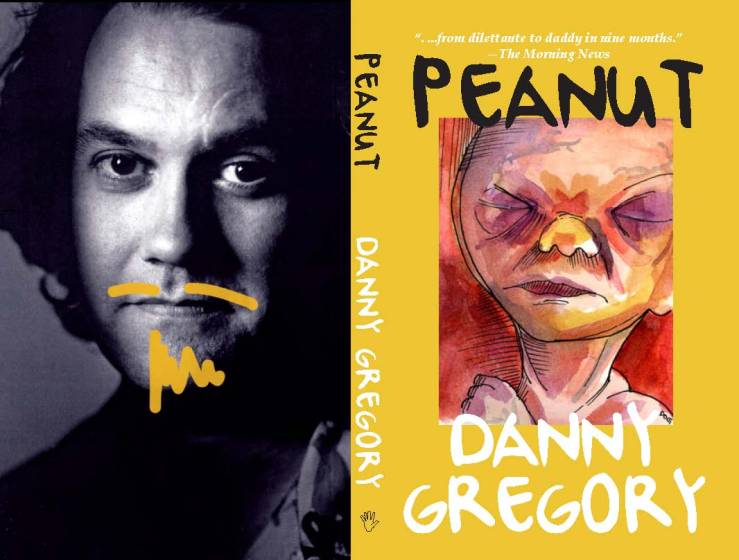
—- But, wait, there’s more:  Now my memoir of becoming a dad is also an ebook on Amazon for the same dangerously low price. Put “Peanut” on your kindle right now.

Further Providence

Jack and I are just back from our first post-acceptance trip to the Rhode Island School of Design (RISD) where Jack will be spending the next four years. We ate in the dining hall, prowled the dorms and had in-depth tours of the department Jack and another prospective freshman are considering.

First of all, I am consumed with jealousy. I want to spend ten hours a day in drawing class, I want to build furniture prototypes, I want to work in the lithography studio, I want to learn to set type and study art history and read novels. I want to be eighteen again!

Instead, I’ll have to be happy with the fact that my boy will get to do all those things and more.

I was impressed by the dynamic between teachers and students. We sat in on several classes and they weren’t big droning lectures or didactic prescriptions. The teachers seemed genuinely interested in working with each creative person, discussing their work one-on-one, giving specific pointers and encouragement, bringing in other opinions from the class, cajoling, inspiring, illuminating.

One of the teachers in the furniture design department took us on a tour of the work that the graduate students are doing — so imaginative and gorgeously crafted. Then we talked about the overall perspective of the school and what it hopes to accomplish for the people who graduate from RISD. Of course, the type of focus of the students and the school on professionalism and post-graduate career opportunities varies with the economic cycle, but he said that the goal is not on getting graduates a job but making sure that they can earn a living doing the things they love. That takes many forms, many directions. Sure, some may end up as baristas but most have creatively constructed creative careers, solving problems, making things.

Our day at RISD opened my eyes to the  real purpose of a great art school and of pursuing life as an artist. I guess I hadn’t thought about it enough or in my most cynical moments had settled on a vague and not very convinced view of the purpose of art school: a sort of self-indulgent playground, filing students with jargon, pomposity, and convoluted rationales for abstract art forms, a mill for perpetuating the institution of the gallery establishment and validating the views of artists who couldn’t make it as such and so had become art teachers.*

Here’s the revelation I had: RISD’s purpose is to give students the skills to discover and distill their creative viewpoint, to give them the confidence and ability to communicate it clearly to others, to develop their creative problem-solving skills, to find where they fit in the world and how to apply their skills to be useful.

That’s true whether you are a painting major or a printmaker, photographer or industrial designer. In fact, by declaring a major you are not just embarking on the road to developing the skills that will make you a better designer or sculptor. No, you are picking a passion. When you are passionate about drawing or painting or carving, you will hang in there to develop the commitment, focus, and perseverance  to learn the larger life lessons about how to be a fully-formed creative person. They take lots of time and hard work and tough setbacks to acquire and you will only stick to it through this discomfort if you are in love with what you are doing. You will learn how to take criticism and use it to make your art better, or stay up all night to polish your idea, or scrape your canvas after weeks of work and start again, because you passionately want to make great furniture or fashion or photography. Passion +  perseverance = greatness. As Milton Glaser says, “Art is Work”.

All RISD freshmen spend their first year doing the same thing: Foundation studies. Each week they spend a full day each (from 8 a.m. till 6 p.m. plus a night’s worth of homework) on drawing, 2D design and 3D design. They also get a taste of all the other disciplines so by sophomore year they are ready to choose a direction to specialize built on this solid layer of disciplined hard work.

Our visit confirmed what I have learned over the past decade and a half of illustrated journaling.  From the get-go, I chose to draw things that interested me, not just bowls of fruit and naked strangers. This subject kept me engaged so I could develop the skills of drawing. I didn’t get bored before I established the habit because I wanted to record the things of my life and everydays. Nothing is more interesting to me than me and so I could carry on past all the lousy drawings and ink blots until I achieved facility. This is the principle behind a great art education; I’m fortunate to have stumbled upon it on my own.

Jack already knows it — witness the dozens and dozens of sketchbooks he’s already filled. But now he will learn to make art as if it mattered, to fall in love with it on a professional level, and  to reach amazing new heights. I’m so proud of him and lucky I get  a front row seat to what he does next.


Cover story

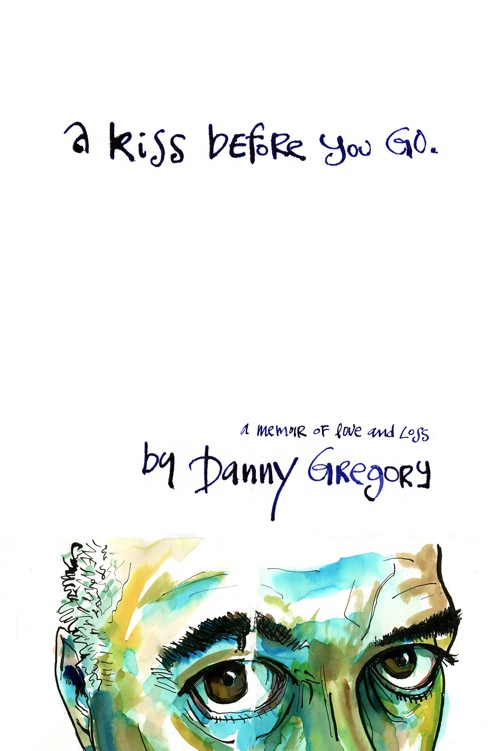
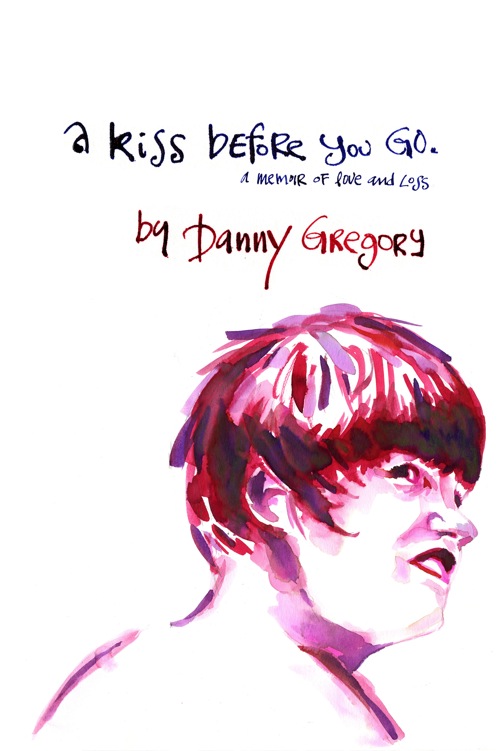
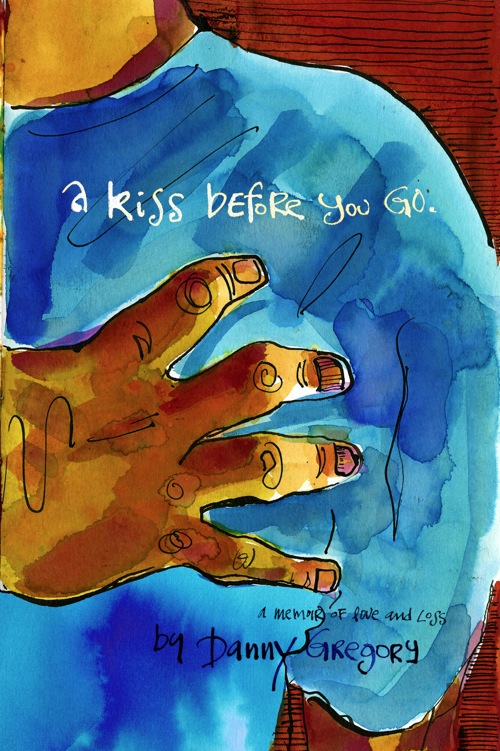
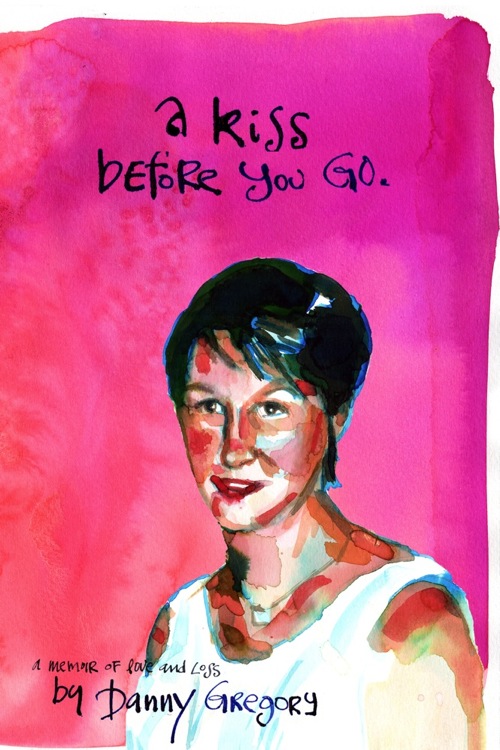
While I try to do my best making every book I’ve published, my next book, A Kiss Before You Go, is the most important one I’ve written — to me. It’s a recollection of the lovely years I spent with Patti and a journal of the months after she died, how Jack and I coped, how it changed and sharpened my view of the world. Because the subject is so dear to my heart, I have worked very hard to make every inch of it as perfect as I can, to fill it with the bright colors Patti loved, to be as scrupulously honest as I can be, to craft it to the highest standards I can muster and to drive my editor a little nuts by insisting on all sorts of things to make it perfect, from the exact dimensions of the book to the bleed trim on the inside of the cover.

The book itself has been in production for months and I am so happy with it; I have okayed the proofs of the pages and have now only to be patient until the first bound copy arrives in my hands. The part that is always the toughest on every book I’ve done — the cover – took months of experimentation and discussion. How to encapsulate this book in a single visual statement that would attract a casual browser and still evoke all of the richness within? And how to make the most of the fact that this is my first book with a dust jacket, making it feel even more real and special.  I made almost thirty different designs; I even dragged in Patti’s old friend Mick Haggerty, one of the great album cover designers of all times, to lob in his ideas.

Simultaneously, I worried over who would be the best person to write the cover blurb, the first review. I finally decided to ask our old pal Moby who loved Patti and who is the sort of sensitive artist whose endorsement would mean so much. He got the book and wrote, “I loved Danny’s wife Patti. And I love this honest, beautiful book.” That’s so simple and nice.

Last weekend, after I dismounted from my horse, I opened a FedEx package and out fell the first proof of the dust jacket. I wrapped it around a book and, for a minute, pretended I had just come across it in my local independent bookstore. One of my favorite features works perfectly —the dustjacket contains a lovely surprise that will only be experienced by people who buy the book. I do hope you like it.

The book will be out this winter — I’ll be talking about it a lot more in the interim. Meanwhile, here is a peek at some of the designs I considered for the cover.

Yipee-ki-yay

I‘ve just returned from a ranch in Patagonia, a few miles from the Mexican border. While I was there, I didn’t do any drawing. But I did some things that reminded me of drawing and how it makes me feel.

I haven’t ridden on a horse since I was three and the ghora-wallah brought a pony to our house in Lahore and led me around the garden on its back. Last week, I clambered onto the back of Joe, a huge chestnut quarter horse with enormous patience for novice riders. The experience was so new, so strange, that I couldn’t stifle girlish giggles. The strangeness increased when a half-dozen of us, most outfitted in boot, ten gallon hats, gingham shirts and jeans, galumphed out of the corral and rode off in a cloud of dust like every posse I’ve ever seen in a John Ford movie. Only this time, rather than watching from the couch, I was in the middle of the herd. This thing that I have always seen and wanted and now here I was doing it. It was new and a little tricky but nothing like as scary as I’d imagined. My fears of immediately being unseated by a balky stallion and dumped unceremoniously on my head or in the Christopher Reeves Memorial Quadriplegic Ward, were replaced by exhilaration and power. One is never too old to learn something new and to marvel at how much more one’s body can do than one gives it credit for being capable of.

By Day Two, I graduated to loping which is sort of like galloping. Att first I couldn’t get the hang of it for the simple reason that I couldn’t see it in my mind’s eye. Then it came to me: that ‘hee-yah’ moment when a cowboy puts his spurs to his steed and gallops off after the injuns or the stage-coach or the escaping dogie. And now, I, bouncing up and down like a lunatic yoyo, was doing the same. Granted I was snickering like a jackass and clutching my saddle horn but I was doing it nonetheless and remained astride my mount.

Each day, we spend four or five hours thundering around the 6,000 acres of the ranch, up mountains, through ravines, and across gulches. My wrangler counseled me in horse psychology, warning me to never let my horse get the upper hoof, that I had to always remind Joe, with a kick to the ribs and a tug on the reins, that I was the one on top. Joe had spent his whole life running around these peaks and valleys and obviously knew what he was doing, but I tried valiantly to steer him and appear in control. I’d urged him up each hillside, and he’d scramble across loose chunks of rock, harumphing and snorting out great lungfuls of dust.

While Joe was doing most of the work, I’d try to do my share. I’d keep my eyes peeled wide as we slowly inched our way down really steep inclines, pulling on the reins and muttering ‘whoa’. Rock would crumble and shift, Joe’s hooves would clatter and I would hang on for dear life.

As the hours elapsed, my brain began to shift into a new state, one that felt really familiar. I was in charge — but also letting go, alive and awake — but also zenned and blissed out. I felt on edge and alert — yet safe and calm. New York and my office and all my cares felt thousands of miles away (2,454.7 miles, to be precise). The rocking motion, the spectacular countryside, the newness of it all, combined to wring out my head like an old washcloth. When I finally staggered out of the saddle, bowlegged with locked hips and dry as a saltine, I felt empty and peaceful — much like I always have after an hour with my pen in my hand and my sketchbook on my lap.

Patagonia is one of the world’s best bird-watching spots. I haven’t really paid that much attention to my fine feathered friends until this winter when I participated in the annual Central park bird count. I was amazed to discover so many species I’d never noticed, to be heeding bird calls and then tracing them to their sources, lurking in a bush or on a windowsill. Now we sat having breakfast in the garden and saw cardinals, woodpeckers, and five different species of hummingbirds. I felt my predator instincts emerging, noticing each little change in the landscape, the slightest shift in the leaves, a shadow in the grass. It was wild to feel so a part of nature rather than just tramping through it with my iPod on. And again, this started to feel like drawing to me, like the sharpened awareness that comes when you really see something clearly, studying every detail, overcoming preconceptions to be in the moment, fully present.

Drawing is a state of mind more than a way of putting ink on paper or filling a picture frame. My days in Arizona brought that home in a whole new way.

Event this weekend

This Saturday at 10 a.m., I will be participating in a panel assembled by Seth Apter and sponsored by The Ink Pad. It features some of the many artists who are featured in Seth’s new Book, The Pulse of Mixed Media.

If you’d like to come, please call the Ink Pad by tomorrow, March 29th to reserve a spot: 212.463.9876.

The event takes place at Westbeth at 55 Bethune Street, corner of Washington Street, in Greenwich Village, New York.  Here is the link to Westbeth where you will find directions.

I hope to see you there.