Book learning

Yesterday, I ducked out of my office for a couple of hours to visit the midtown Sheraton, site of the National Art Education Association (NAEA) conference. I was the guest of Bob Fisher, a contributor to my upcoming book, An Illustrated Journey. Bob was participating in a seminar with his former teacher, Greg Stanforth, who has taught art at Cincinnati’s Archbishop Moeller High School for thirty years. Their topic, “Creating a Culture of Sketchbooks in a High School Art Program,” was close to my heart.

Greg’s school has about 1,000 students and they have three 90-minute art classes each week. He requires them to fill a page in their sketchbooks seven days  a week, and to cover it completely with color, collage and line. The boys fill at least one complete mid-sized Moleskine every semester and by the time they graduate have a tall stack of a dozen or so volumes. Greg brought a lot of these books with him and passed them around the room and then discussed how he gets these teenagers to produce so much beautiful and personal work.

FIrst of all, he insists that they consistently make pages: they work on them at home and in school and their grades are based on their consistent commitment not on any evaluation of the work itself. Nonetheless, the quality was really high and it was clear that they had spent a lot of time and thought day after day.

He also has them share their work with each other, something the students actually insisted upon. They pass their work around and boys pick out pages they like from others’ sketchbooks and discuss what they like about them. Many of the pages were surprisingly personal, discussing their reactions to parental divorce and other major issues in their lives. Greg reported that one boy even came out to his classmates, (and this is a Catholic school!)

He also brings them all sorts of inspiration, showing them established artists’ work and bringing in guests like Bob, an alumnus who went on to be a succesful illustrator and designer. But he also insists that the boys don’t copy from others but rather channel that influence through their own work, drawing always from observation, using each others as models and sketching and painting the scenes and objects around them.

Apparently Bob’s students have earned over $1 million in art scholarships, a fact that helps the program vital and cherished among the school’s administration.

Greg runs an amazing program and I’m glad to say that the room was packed with teachers sitting on the ground and eagerly asking questions after the talk. It certainly suggest that there may be many new converts to the world of sketchbooking and illustrated journaling.

At the end of the presentation, Bob distributed a list of sketchbooking resources which you can access here.
The Times they Are a Changin’

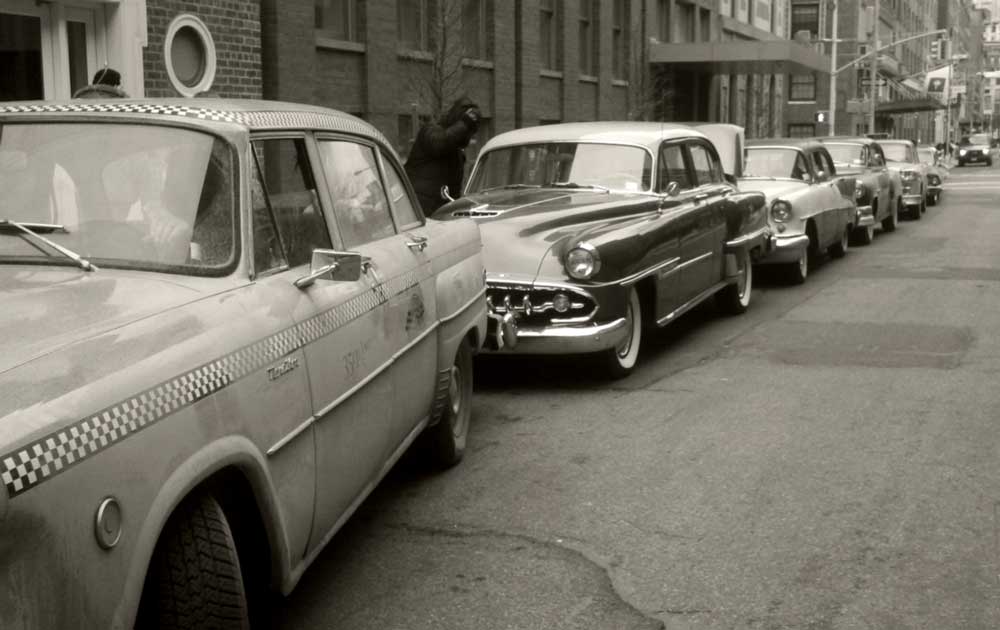
A propos of nothing, the Coen Brothers are shooting their new movie in my neighborhood, turning the clock back to 1962, one of the heydays of Greenwich Village

I’m in a new book: The Pulse of Mixed Media

Some three years ago, I taught the one and only class of my career, a 12 week program at the Open Center. I learned a lot and met a number of interesting artists over the weeks. Seth Apter was in my class and I began to visit his sumptuous website, The Altered Page , and to talk with him about drawing and art and the creative process. He interviewed me for his blog and again, the conversation broke new ground for me/
Last year, Seth began work on a book, The Pulse of Mixed Media: Secrets and Passions of 100 Artists Revealed, and invited me to participate.
Now, I have been a part of a number of books that collected the work of many artists, and generally it’s a simple and painless affair. In fact, while putting together An Illustrated Life and its upcoming sequel, An Illustrated Journey, I found myself in the reverse position of having to badger other artists to join up and then send me pages from their journals and answer my questions. It’s a fair amount of work but one learns so much by shepherding this sort of book.
Anyway, being a part of Seth’s book was more than I initially thought when I signed up. That’s because Seth really demanded that I think a lot about myself and my process in answering his questions, think in ways I’d not been asked to do before, not even by myself. He’s a psychologist and he challenged me to really explain the many things I take for granted in my work, the media I use and the ways I use them, what defines my work and what does not, He asked me questions like “What three words do not describe your artistic style?” and “If you could sell one piece of art to anyone in the world, whom would you want to buy it and why?”
Seth asked these sorts of questions of me and many, many other artists. From what I’ve seen of it, the resulting book is a rich and beautiful tapestry that explores the deepest aspects of the creative process, and provokes and inspires over and again.
The Pulse of Mixed Media will be officially published at the end of this month but apparently it’s in some stores already. You can also get it direct from the publisher.  Meanwhile, Seth is doing all sorts of things on his site to dimensionalize the content, with samples and peeks inside. Seth has promised me that the actual book will be in my hands any day now but my trips to the mailbox have been for naught so far. I hope to share a deeper dive between its covers in the near future.
Meanwhile, if you get a copy, do let me know what you think.

A new Sketchbook Film: Pencil & Ink


(Sorry for the delayed launch of this post; had some last minute tweaks to do)

Tommy Kane, Jack, and I have just completed production on another in our series of drawing films — this one about NY artist, Justin Klein. It was a long and grueling shoot day, a good 14 hours, and by the end of the shoot, our set was full of bloodied paper, broken furniture, and empty beer cans and whiskey bottles. We all left the set changed for ever.

As I say to myself with each subsequent film, this is the best one yet. It is a bit of a departure from what we have done in the past but I think you’ll agree that it is an interesting extension of our core idea.
I’ll try to post again with some behind-the-scenes details about the production and answer any questions you post here.

Happy New Year!

—-

Filmed with a Canon 7D, edited in Final Cut Pro X.
Music: “Lux Aeterna – Cum Sanctis Tuis” from the Requiem by Wolfgang Amadeus Mozart
Color Correction by Lenny Mastrandrea at Nice Shoes.

Legacy

My friend Michael loves jazz. He infected his son with the same passion for music. By the time Nick enrolled in Jack’s school, he was already an accomplished guitarist and now in his junior year, he regularly plays with several jazz bands and combos. Our friend Jeff, also a jazz lover, recently said to Michael, “Congratulations. You’ve created a jazz musician.… Now what?

When Jack was little, Patti and I, like most parents, collected and saved his artwork. We continue to encourage his creativity over the hump of the tween years, up to the present day. Along the way there were times I shared Jeff’s ambivalence, thinking to myself, “Are you just preparing him for life in a garret or working at a Starbucks full-time?”  I would hear the voice in my head chastising me for not preparing him for law school or medical school or Wall Street: “He’s a smart kid, he could be making a lot of money”. So when Jack decided that he wanted to focus on going to art college, I could feel the conflict rumbling in my tummy. I mean, there’s no question that I’ve always regretted the 10 or 15 years in which I didn’t create art. I wonder what my life would’ve been like had I gone to art school rather than studying political science.

But I knew deep in my heart that I could give Jack no better preparation in life than to let them know how important it is to follow your passion. I told him “most people are not passionate or talented in any particular way. You are a gifted artist and you love to make art. You are doubly lucky. It would be criminal to ignore those things to lead a life of mediocrity.” So I helped him to put his portfolio together and think about his application essays. We went to visit various art schools in the spring and I shared his anxiety over the weeks in which we were waiting for a decision.

He decided that RISD was his first choice. It was mine too, had been since I was 16 and I had attended the RISD summer program where I had the most extraordinary time of my young life, making art all day, living hundreds of miles away from my family, being surrounded by talented and creative friends, smelling of turpentine, and loving life.

I guess it’s a cliché: the father, frustrated in his youth, sending his son along the same path, like a mediocre football former high school player goading his son until he becomes a star quarterback. My own father was frustrated in the fact that he didn’t become a full-time artist, and, when I was in my 20s, he sort of encouraged me to take a different path, to study bookbinding or some such. Like most things my father said to me, I didn’t take it very seriously and so continued to go to the office every day.

I have learned so many things from art over the years, and I’ve learned it does not derail your destiny or condemn you to penury. Art is a constant in my life, even if I haven’t drawn a sausage for a month, informing how I see the world, how I think, how I feel. I can think of no greater legacy to leave my own son than to share in that wisdom and experience.

So I had no ambivalence last week, when Jack texted me excitedly at school to say that he’d been accepted into the class of 2016 at the Rhode Island School of Design. Instead, I felt enormously proud. And I felt, from some other plane, that Patti was sharing in my pride, because she too wanted Jack to follow his muse, to lead a creative life, but most of all to be happy. I think that in Providence he’ll be able to do all those things.

If a half-century of living on this sphere has taught me anything, it’s that regret is a waste of time, that one should seize every opportunity that comes one’s way, and that the fear of the unknown is just a one-way ticket into darkness. Fortunately, my son is braver than I am, less damaged, brighter, more confident in his abilities to change the world. He is my greatest work of art (though, of course I can’t claim all the credit).

Applying myself

For the last year or so, Jack has been applying to college. And so have I. Not literally (I wish) but I have agonized vicariously through every step of the way with him. I am proud of my boy and confident in his abilities but it is nerve-wracking nonetheless.

I described it to a friend recently: “It’s like hailing a cab to the airport for an important flight. As I settle into the back seat, I quickly realize that the driver is a recent immigrant who doesn’t know New York, has limited driving skills and not only doesn’t really know where the airport is but refuses to ask for directions. I can’t make him pull over and let me get in the driver’s seat and so can only sit on the edge of the back seat, hurling suggestions through the little window in the divider. Hopefully we’ll arrive before I miss my flight.”

Anyway, the basement of my building got mildly flooded a few months ago and my super has been urging me to go to the storage room and check on my stuff which may have gotten wet. As we were getting ready to set up our first Christmas tree since Patti left us, Jack and I finally went down there yesterday to look for all the decorations she’d stored and to pull all the rest of our stuff out. One box was a bit moldy but most of them were fine but, as the thought of all those things down in the basement has haunted my sleep for a while, we hauled them all up to our apartment. For a day or two, our Christmas tree is surrounded by cardboard boxes and plastic storage bins.

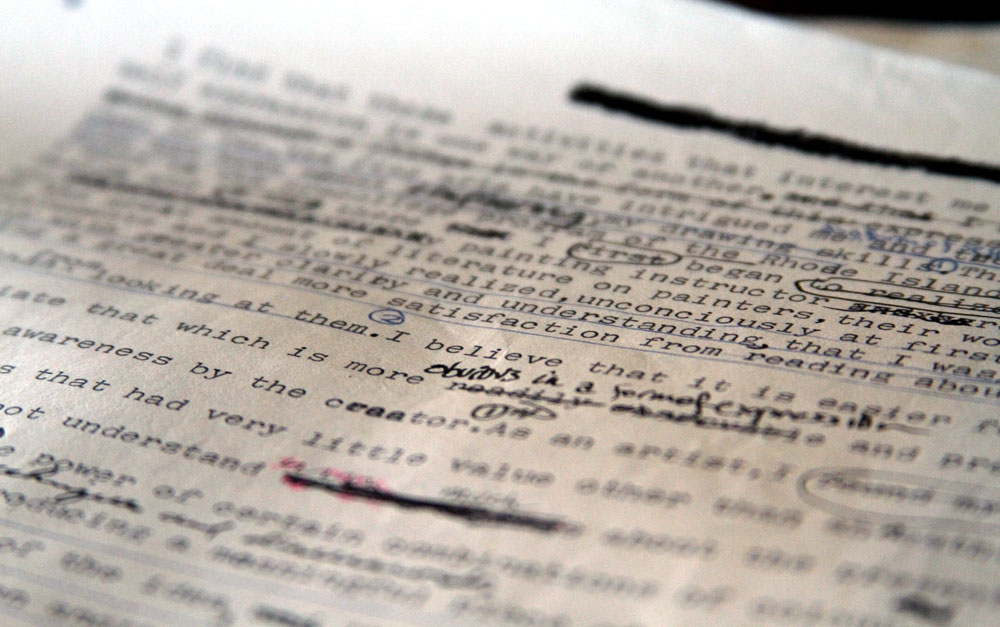
Rooting through the boxes, I came upon a folder containing the essays I’d written for my own college essays a million years ago, including my various letters of acceptance and rejection.   One essay seems apropos to share with you, so I reproduce it here, without all the XXXed out sections and marginalia (how the hell did we write on typewriters back in the day?). Bear in mind, this was written by a 17 year-old me, and yet it seems to foreshadow where I am today, 34 years later.

I find those activities that interest me the most deal with self-expression in one way or another.  In the past year or two, the fine arts have intrigued me as a form of self-expression and the bulk of my time is spent improving my drawing skills.

This summer I went to the pre-college program of the Rhode Island School of Design and there began a transition. My painting instructor revealed to me the great amount of literature on painters, their works and their environments, and I slowly realized, unconsciously at first, but eventually with greater clarity and understanding, that I was, in fact, getting a great deal more satisfaction from reading about the paintings than from looking at them. I believe it is easier for me to appreciate that which is more obvious in a form of expression and presented with the full awareness by the creator.

As an artist, I created things that had very little value other than an aesthetic one, for I did not understand much about the presentation of ideas in painting and the power of certain combinations of color, form, shapes, texture, and other techniques and dimensions. I found that in producing a meaningful piece of art, one had first to feel the force of the idea, then transcribe that force into another form, even another language, that of the colors and shapes that appear on the canvas.


On the other hand, the writer, I thought, does not go through that step, but simply records his ideas on paper in a one-to-one reproduction. He must be more specific than the painter, and his ideas more clear, so the writer appears to blatantly present the same message to every reader. The painter leaves his work to individual interpretation. This became a stumbling block. But as I began to read more, I realized that the written word too, has many levels of understanding, and a good writer must be able to be clear and unclear the same time, so his words evoke images which are purely personal for the reader.

The idea of being able to work on these many levels, to create work that makes the reader stop and wonder, outweighed the satisfaction of creating a painting that people could simply pass by. For when one reads, one ignores one’s immediate surroundings and enters a world of the author’s creation. It takes a certain commitment to read a book, a commitment to give that author a chance to persuade or entertain you. A painting, on the other hand, is hung among hundreds of others and does not have the same chance to grab the viewer and whisk them off into the creator’s world. One may go to a museum and look at all the paintings in one day, as so many people do, but who would consider reading all the books in a library one Sunday afternoon?

Thus I have begun to devote myself more to the creation of colorful words than of colorful colors, although I still return occasionally to my paints. I look forward to the day when I shall be able to find a proper balance to allow equal expression in words and paint.

Interesting that I have continued to slide back and forth across from expressing myself in words and pictures through all these subsequent years, finding as I have at last a happy meeting point in the art of the illustrated journal.

RISD will announce its decision on Jack’s application on the 15th of December. Till then, we wait with bated breath.


Update on our film

Just got this mail from the Red Hook Film Festival:

Hi Danny – Just a quick update – we are planning to open the Red Hook Film Festival with your film! (Red Hook-A portrait of Tommy Kane). It will screen on Saturday October 15th at 1pm in our opening block.

The schedule is up at our myspace page right now, and will be on the website tomorrow.

Our MySpace page:

This year’s festival will take place on October 15th and 16th, 2011 at the Brooklyn Waterfront Artist Coalition (BWAC) screening room, which is located at 499 Van Brunt Street, Red Hook, Brooklyn, 11231. That’s at the very end of Van Brunt Street, across from the Fairway Supermarket.

Jack and I invite everyone who can make it to Brooklyn to the Festival. It should be a blast!

Red Hook in the Red Hook Film Festival

We were just invited to submit our last film tor the Red Hook Film festival. Next stop … Cannes!

Our next sketchbook film, “To El and Back” should be debuting here and on Vimeo in the next few days. It’s the best one yet. Stay tuned!

A new drawing film: Red Hook

(This film was shot, and is best viewed, in full-screen HD. If there’s  a problem, you can go to it directly on Vimeo here.)

A few months ago I decided I wanted to make a series of films about illustrated journaling. Not a how-to, step-by-step sort of thing but films that capture the adventure of drawing, the discovery, the spirit, the fun. I hope they will inspire you to make drawings (and films, if you want) and to keep an illustrated journal as a regular part of your everyday lives.

My son, Jack Tea, has joined me in this project and together we have worked through lots of technical obstacles to make films that look as good as we can make them on no budget. Our inspiration comes from the Cooking Channel, from Etsy’s vlog, and from too many decades of loving movies.

We shoot on our Canon 7D, rent different lenses each weekend (in this case we relied heavily on the 100/2.8 L IS Macro), use Jack’s skateboard as a dolly, and rope our friends in for help and opinions.

Here’s the newest film in the series, a portrait of my great friend, Tommy Kane, as he rides around his neighborhood in search of something new to draw. Tom is a great traveller — he regularly posts sumptuous journal pages made on his vacations and business trips. His favorite home-away-from-home is Korea and he has made many amazing drawings on its streets and in its markets.

This time, we decided he should travel through his own neck of the woods, see it anew like a visiting stranger and capture a mundane little corner and fill it with his particular brand of magic. Normally Tom works mainly on site, dragging out all of his materials onto the pavement around his little folding stool but instead we decided to expand the scene and show you some of Tom’s home and studio and incidentally some of the wonderful big paintings he’s done on canvas. (He took the unusual step of using a reference photo he shot of the scene to jog his memory once back at his studio).

When journaling, he works in Uniball, watercolor and pencil, sometime in books, sometimes on loose sheets of bond or watercolor paper. He is a meticulous crosshatcher and spend hours on some of his drawings.  When we draw together, I invariably start to chafe at the bit and beg him to finish at home as I am tired of sitting in his shadow, my own drawing long finished and yellowing on the page, glazing over as he crosshatches more and more details.

We shot the film in two days — on the streets of Brooklyn and in Tom’s home where his lovely wife, Yun, made us lunch and watched our obsessiveness with a bemused smile.  It was the height of a baking summer and storm crowds rolled in and out, marring our continuity.

We shot an extravagant amount and it took a month to wade through it all and pare it down. The first cut was twice as long as what you’ll see today, but we resharpened our blades and ruthlessly trimmed back to the bare essentials. We tried to retain the essence of how Tom works, the way he layers media and adds detail. It’s fascinating to see how his drawing builds and builds — when you see the final result, it’s often hard to figure out how he got there. With this film, please share in how the journey unfolds.

Jack Tea in Europe

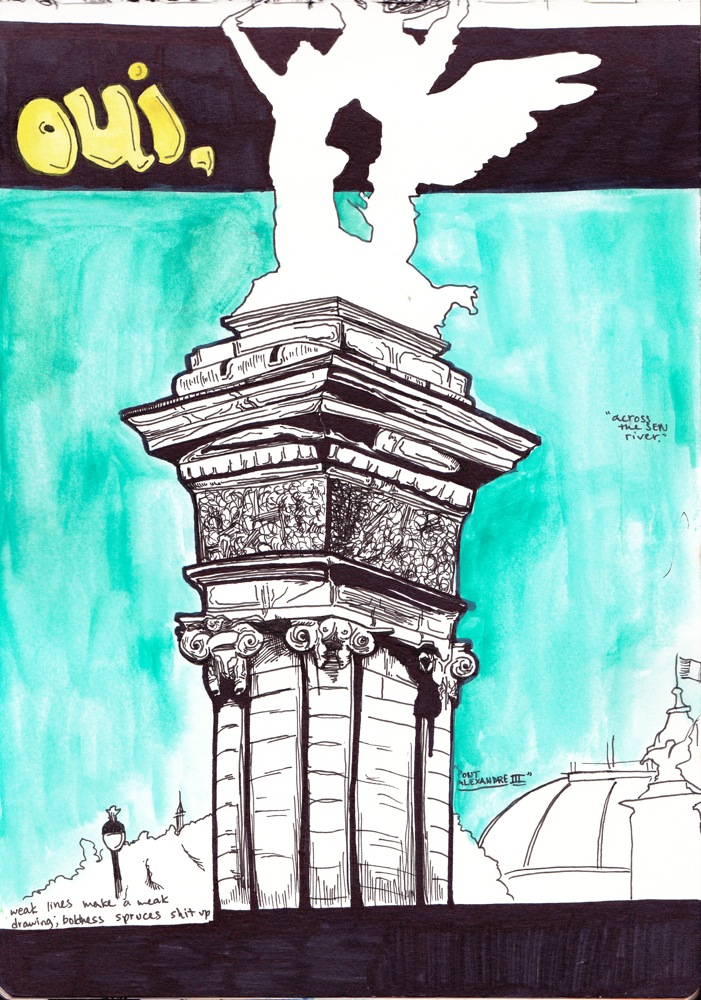
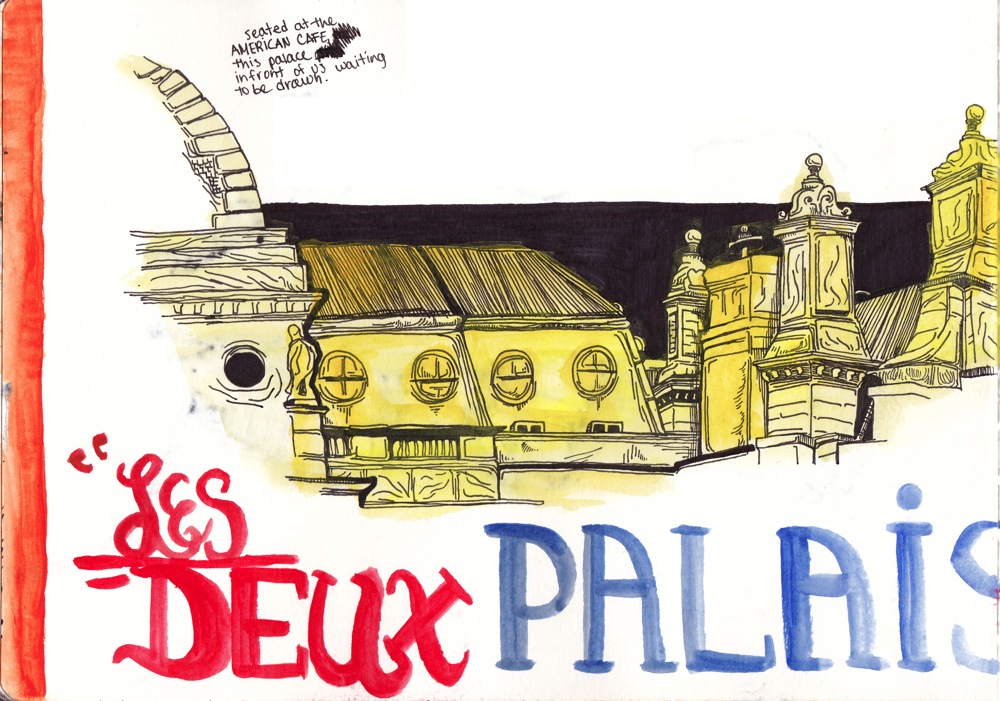
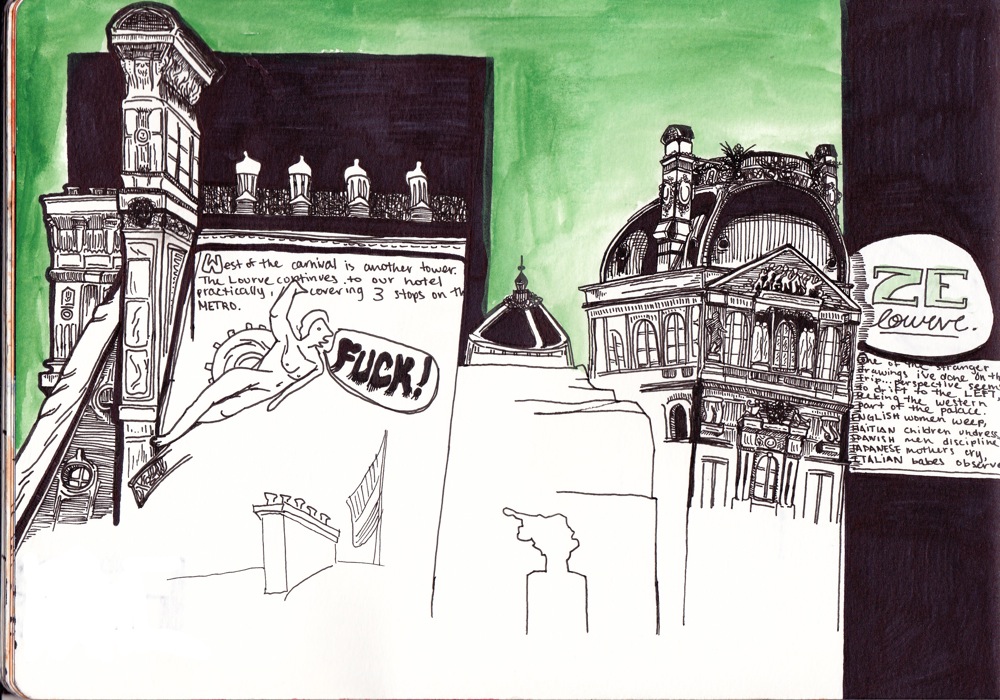
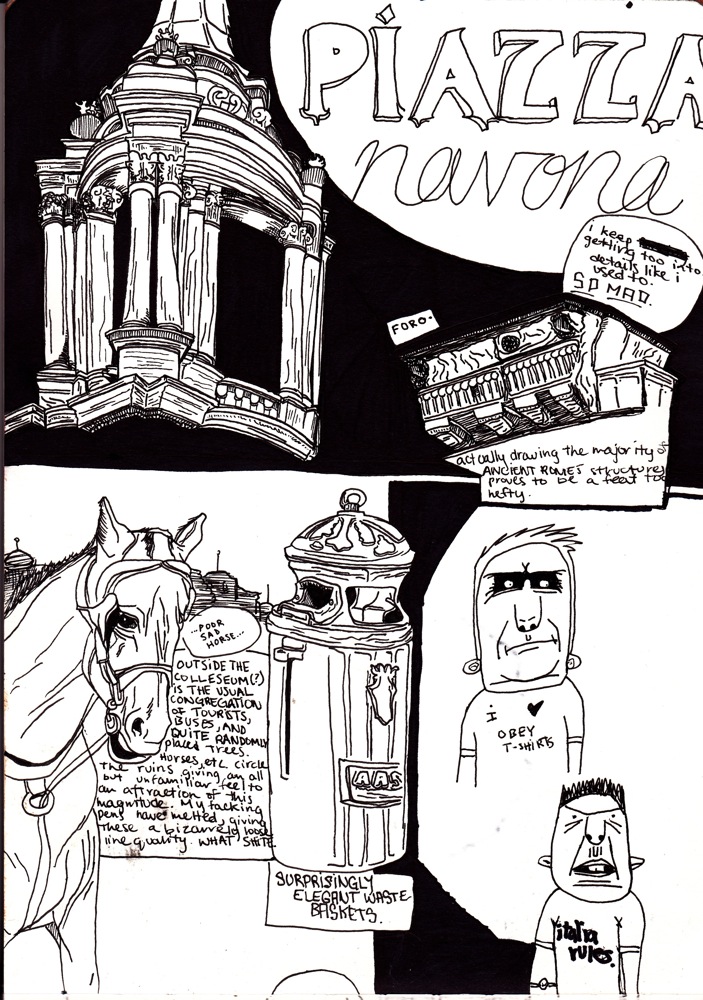
Here are some pages from Jack’s recent travel sketchbook. He drew them with  Uniball and Sharpie with occasional hits of watercolor in a big Moleskine. He also enjoys the use of salty language and occasional nudity. Oh, and he had a broken arm.