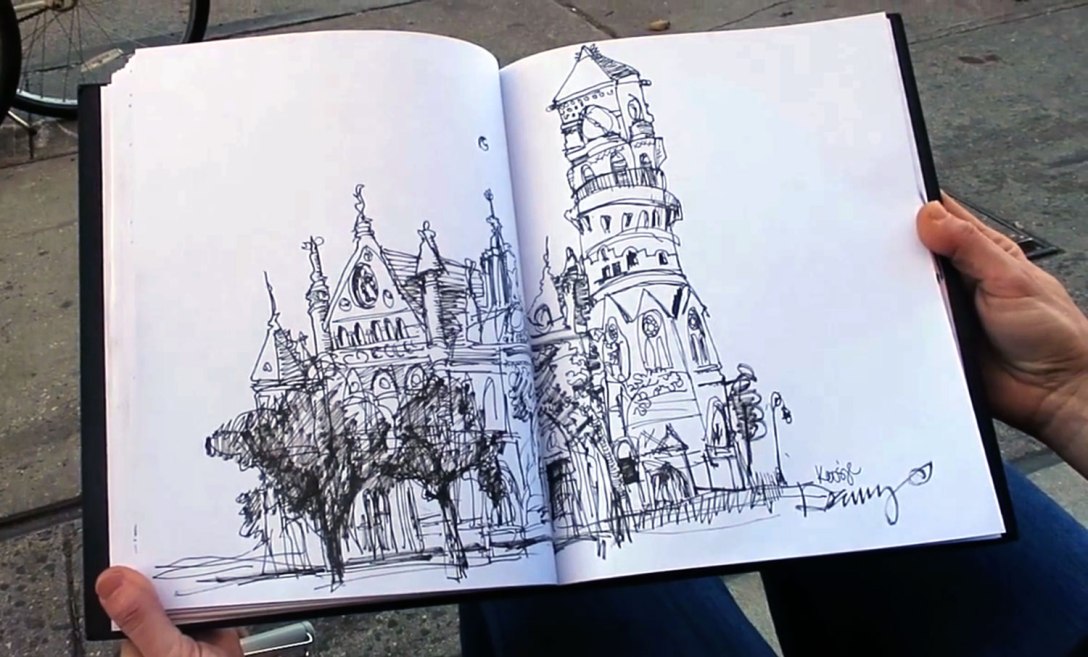
My friend Koosje Koene has been staying with us this week. Koosje is a wonderful artist and teacher so we spent a lot of time talking about drawing and sharing our sketchbooks. The weather was great so I showed her around the Village and then we sat down to draw the Jefferson Market Library.
We decided to do a fun exercise— working on a single drawing together. We sat side by side with a sketchbook on our laps and worked back and forth across the spread. As you’ll hear in the video, we strategized a bit before we began, discussing how to lay out the building across both pages. Then we put our pens together and worked out from the center. Throughout, we jumped back and forth across the drawing, adding to each other’s lines, and discussing the drawing as we went.
It was a blast and the whole exercise took us less than twenty minutes. Get a friend and give it a try this weekend!
Every Friday I work through an idea from my latest book, Art Before Breakfast. It would be lovely if I could imagine you out there drawing along with me. This particular exercise comes from the Art Before Breakfast Workbook, to be published by Chronicle Books early next year. If you decide to do it too, please share with me how how it turned out! (Share the results on your own blog or on Facebook and post a link in my comments section. Use #artb4bkfst on Twitter or FB).
PS Sorry if the video is a little noisy — we shot it on a busy morning in New York City!
I woke up at 4 am and this was in my inbox. I watched it in the dark and it filled my heart.
When I decided to share it with you, I thought I’d make a joke of it. Call it, “Cure for Insomnia” or some such.
But every time I watch it, it fills my heart again. Fills it with peace, with sweetness, with raw simplicity. I think of my boy, standing on a hillside in Sicily, filming this on his phone, hanging on till the end of an extraordinary moment.
I love the beauty he sees. I hope you like it too.
Suggestion: watch the whole thing. Give yourself a two-minute experience before clicking away.
Several experiences topped up my well of inspiration. Maybe they’ll feed you too.
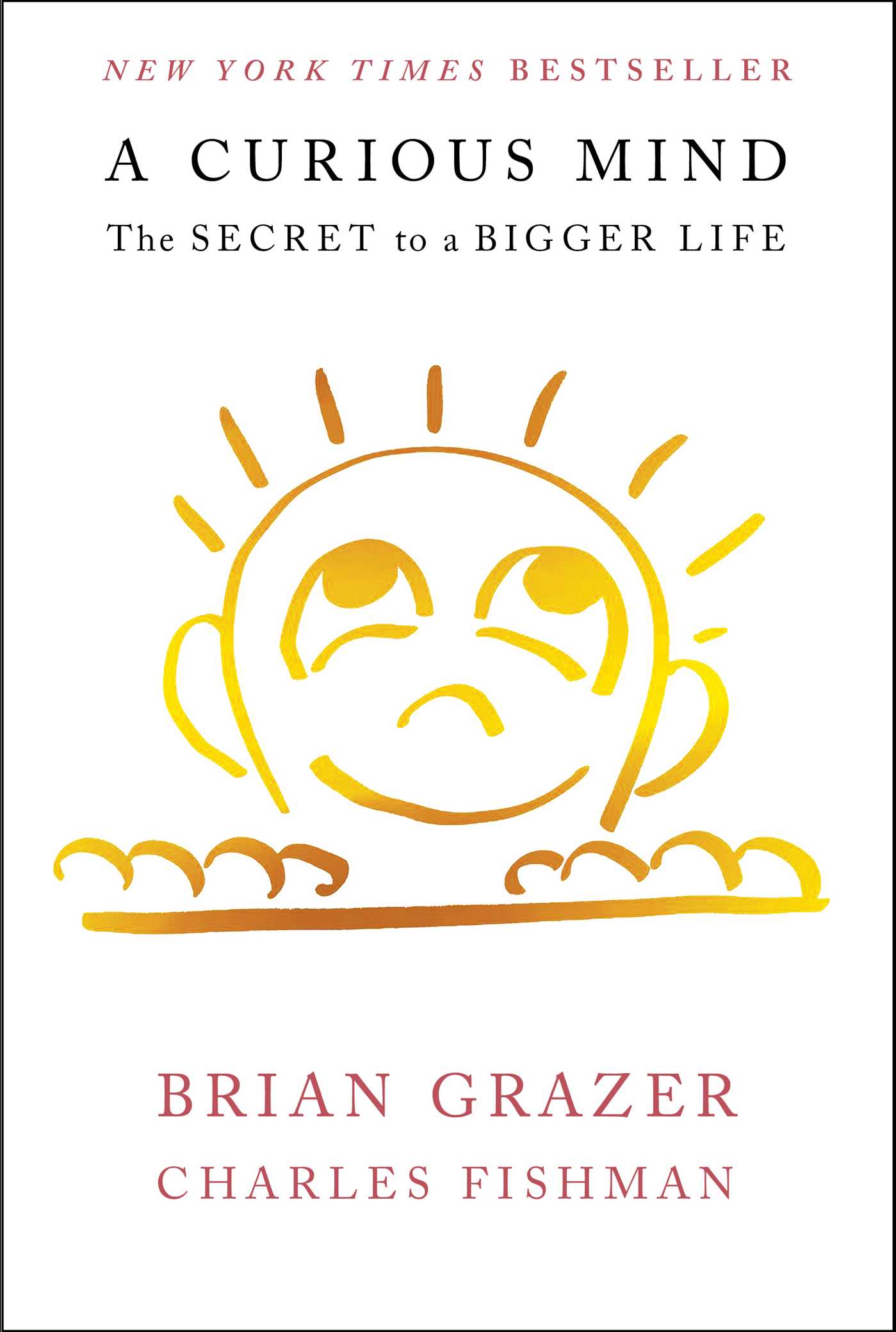
I’ve been reading Brian Grazer’s book, A Curious Mind. Grazer is a mega-successful movie producer (Splash, Apollo 13, A Beautiful Mind, etc) and he identifies curiosity as the key to his success, his creativity and a happy and engaged life. By having an open and enquiring mind, he has been comfortable with risk taking and exploration. Curiosity is the spark that kindles new creative explorations.
If you can look at learning a new skill, like, say, drawing, as a thing to learn about and explore, rather than an grim evaluation of yourself and your skills, you will make eager progress. If you are genuinely curious to learn about people, you will search out new connections and ask questions without preconceptions. If you are curious, you will not let the past hold you back. If you live a curious life, you will fill your head with a rich soup of influences, ideas and inspiration. You will make new connections which will lead to new ideas and creations.
As Glazer puts it, “Life isn’t about finding the answers. It’s about asking the questions.”
Last week, Jenny and I went to the Brooklyn Academy of Music to see Refuse the Hour, William Kentridge’s multimedia chamber opera. We went with zero knowledge about what the piece was about (Jenny impulsively bought the tickets on craigslist at the last minute). I vaguely knew of Kentridge as an artist but was surprised to think he had made a stage work. Turns out he has a rich resumé in many forms and has even staged operas at La Scala, the mecca of grand opera.
Refuse the Hour is about his lifelong fascination with time, its plasticity and relativity, and the piece brimmed with fresh insights. It combines a poetic script, incredible vocal performances enhanced with audio processing, mechanical musical sculptures, dance, an orchestra playing modified instruments and film projections that layer drawings over performances
What I took away from the evening was the incredible act of creative collaboration between a score of enormously talented people. The program fairly bulged with accomplishment. Each person — the dramaturg, the choreographer, each musician, the singers — had paragraph after paragraph of accomplishments. Honestly, any one of them could have been the headliner, but they all worked together in a joyous harmony. There were so many unusual intersections between the forms, it couldn’t possibly have come from a single creative mind.
One singer took a refrain from the script Kentridge read, and turned it into a aria running up and down the scales. Another singer then sang the same aria backwards into a megaphone, perfectly mimicking all of the reversed breaths and shifts. Then an artist played an array of airpumps venting through brass horns. Next a tuba and a modified trombone took over. Meanwhile, a flickering projection of Kentridge’s hand turning the pages of a sketchbook was layered on top of a couple fighting in a stark painted kitchen set in gorgeously coordinated graphic costumes. I could go on and I would never approximate the tapestry of ideas and skills on display.
Above all, the experience urged me to think of new ways I can collaborate with others in such an open and generous way. The power of Ours over Mine is immense and exciting.
I am also reading Elizabeth Gilberts’ latest book: Big Magic. The author of Eat Pray Love has become somewhat of a self-help guru and is now focussed on thinking about the creative process and how to overcome fear.
I really like the book. Liz has a wonderful, chatty writing style, confessional and inspiring. I was particularly caught up with one notion: that ideas are a life form that inhabit the world just like dogs and walruses and have a single purpose — to be made manifest. They appear to us creators and it is up to us to shun them or to adopt them.
If we do take them on, we now have a responsibility to show up and do the work to make them come to life. If we fail in holding up our end, the ideas will wither and then slip away. Ultimately it will then appear to someone else. Drag your feet if you must, but don’t be surprised if ‘your’ idea eventually blossoms attached to another artist’s name.
I love this idea. It takes away the pressure of judgment, of self-evaluation, and replaces it with a spark which it is up to us to kindle. We don’t own the idea. We are simply its collaborator. Liz’s perspective turns the wasteful drama of self flagellation into a joyous, if sweaty, dance.
What have you read, seen, experienced, or thought of recently that could inspire me and others? Please share your discoveries and help fill my well with inspiration.
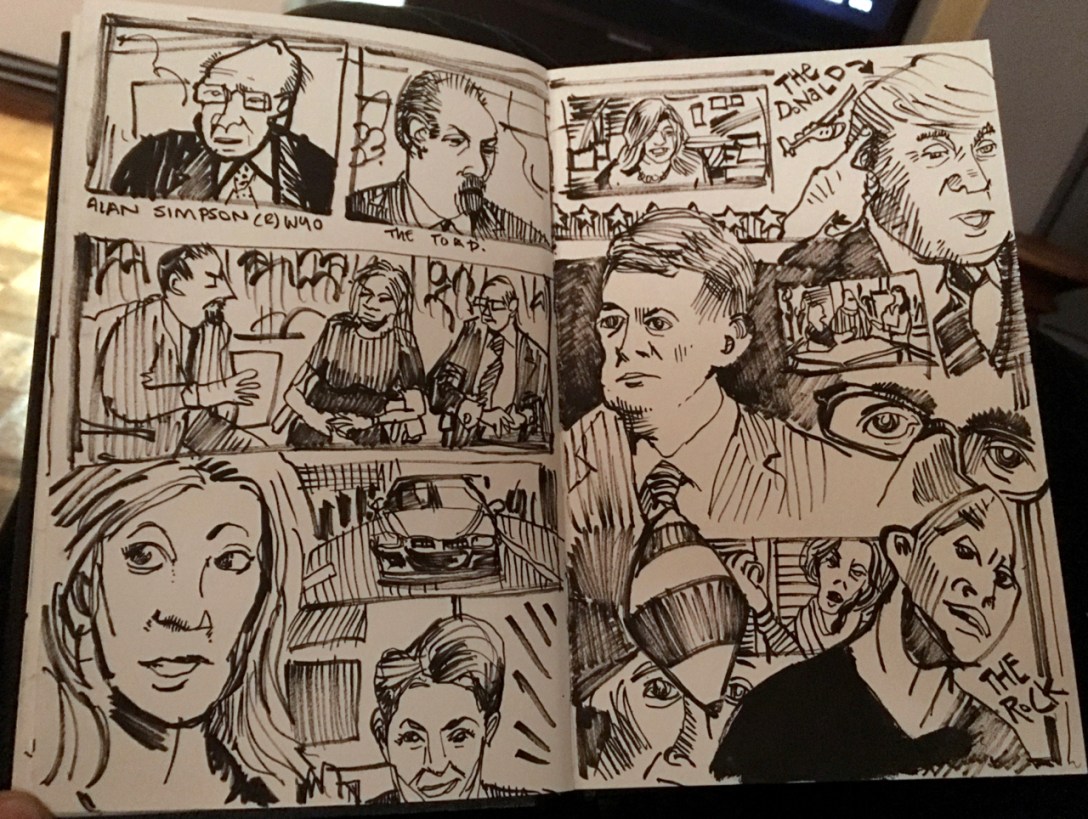
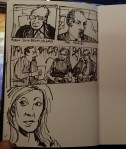
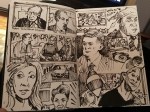
I usually listen to the radio while I potter around in the kitchen of a morning. Today I put on the TV instead and watched talkingheads discuss the last Republican debate. While they kvetched, I sketched.
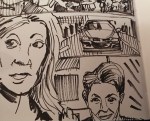
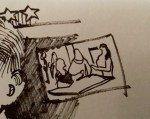
I approached it like a doodly collage, capturing moments in boxes that approximate the shape of the screen without being too slavish to reality, and augmenting them with decorative bits. I kept moving around the page, adding bits to earlier parts, making the whole thing denser and more detailed. It’s a fairly mindless way of drawing, half paying attention to the screen, half to the page.
I started working in a linear way. Then I got outta the box with a blonde.
This woman had fantastic hair.
Part of a BMW commercial and Rachel Maddow’s hairdo.
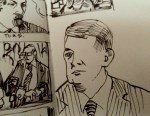
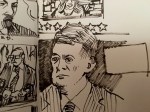
A politico with a cowlick.
The obligatory suit and tie,
And some patriotic embellishments.
An AT&T commercial
The Rock! For Ford trucks.
A lady with diabetes.
The Donald.
Great glasses!
Done! Time to eat some toast.
One trade secret: the pause button on my remote control. I can freeze the action for a couple of minutes and catch a gesture. Other bits I just drew while they were happening or from memory. Or from my imagination.
Every Friday I work through an idea from my latest book, Art Before Breakfast. It would be lovely if I could imagine you out there drawing along with me. This particular exercise comes from p.51. If you decide to do it too, please share how it turned out! (Share the results on your own blog or on Facebook and post a link in my comments section. Use #artb4bkfst on Twitter or FB).
Recently Tommy Kane showed me this incredible video of a flip-through tour through James Jean‘s latest sketchbook.
It’s awesome but what it inspired Tommy to do is greater still: a tour of his sketchbook from this past summer. I have seen this book and I have watched him draw several of these drawings and it is amazing. Obsessive, imaginative, hilarious and moving. Just like my old pal, Tommy Kane.
I hope it sets your week off in the right direction.
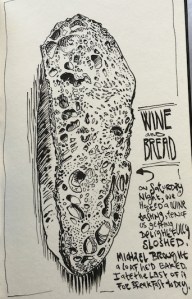
Instead of hitting the POST button at 7 am as per usual, I sat down to draw my breakfast.
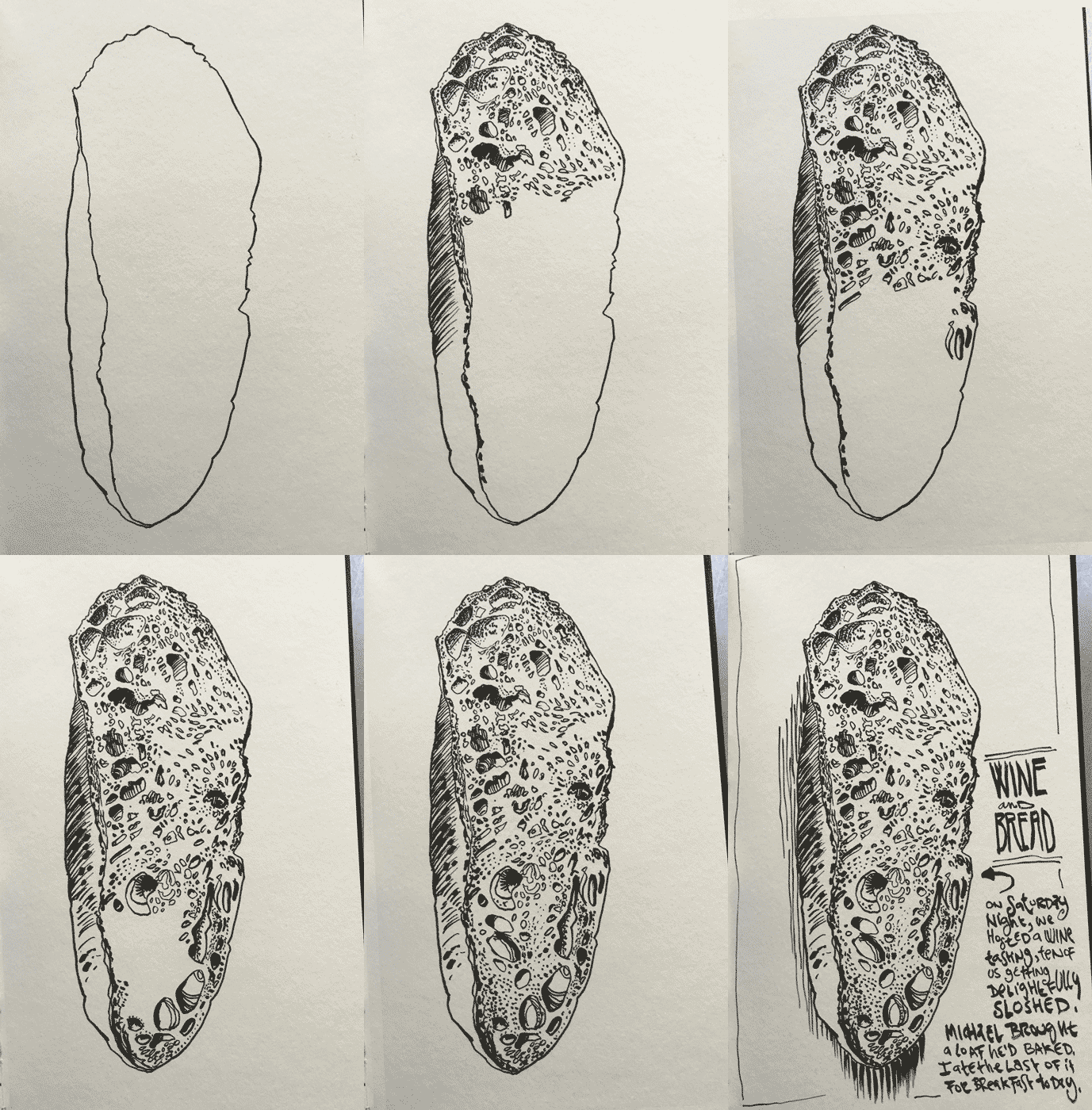
This particular slice comes from a loaf baked by our pal, Michael. He brought it to a wine tasting we hosted last weekend and it was so delicious I managed to stretch the loaf out all week. Today I hit the heel.
Drawing toast is an adventure. It’s an opportunity to slow way down and delve deep. I begin by slowly driving my pen around the perimeter and then, quadrant by quadrant, I work my way through every nook, crumb, divot, pit and hole. It’s not difficult work but it’s absorbing and clears the mind.
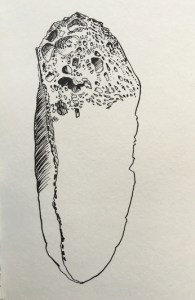
I draw the contour of the whole slice.
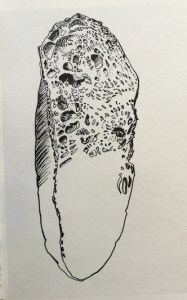
I begin at the top.
I add more details and some shading to the crust.
Working further down the slice.
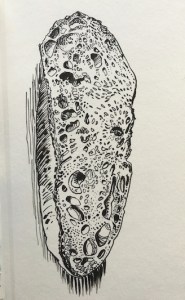
More details, finish the crust.
Experimenting with different line qualities
Finished the inner details.
Add some thrown shadow.
A title and a little note. Done!
I have gone into this in more depth here on the blog, in Art Before Breakfast and in Seeing at SBS but all you really need is a pen, a piece of paper, some toast, and about 10 spare minutes.
Every Friday I work through an idea from my latest book, Art Before Breakfast. It would be lovely if I could imagine you out there drawing along with me. This particular exercise comes from p.38. If you decide to do it too, please share how it turned out! (Share the results on your own blog or on Facebook and post a link in my comments section. Use #artb4bkfst on Twitter or FB).
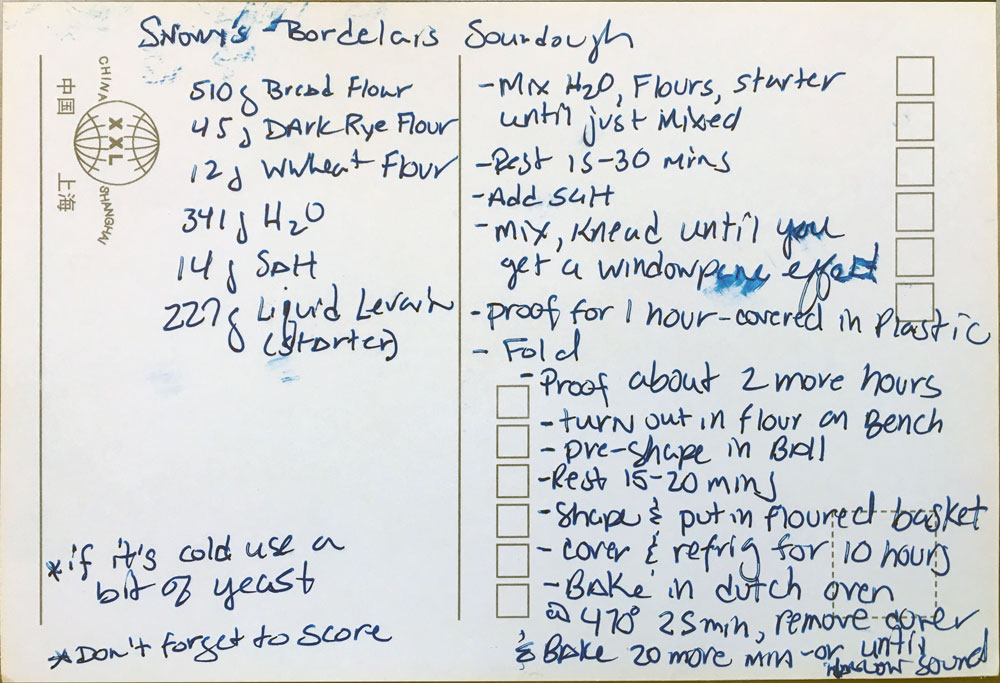
And if you’d like to draw the same bread I did, here’s Michael’s recipe:
Ten years ago, I illustrated a book called A Writer’s Paris by Eric Maisel. It’s about why/how you could/should move to Paris, at least temporarily, to fuel your artistic impulses. It worked on mine — Eric’s publisher paid for Patti and me to spend a long weekend wandering around Paris and making many of the drawings that would fill the book. What a time!
I’ll be honest, I don’t remember the book’s argument in detail. I was irritated that the publisher thought to combine my drawings with some collage artist’s work and so I couldn’t read the final version of the book with an open mind. That peevishness notwithstanding, the basic premise of Eric’s book came back to me as I sat here in the Piazza Benedetto Cairoli with my Macbook on my lap. I’ve been in Rome for less than forty eight hours, but the magic of a different continent, city, culture, place and pace is already working on me.
At Jack’s suggestion, I didn’t book a hotel room but found an AirBnB just a few meters from the door of his school. It’s a fourth floor walkup in a 15th century building with a giant front door key and iron shutters I swing open each morning to flood my room with sunshine. As I sit here in the Piazza across the road, I hear the tram rattle by, the chuckle of an accelerating Vespa, the doo-da, doo-da of the carabinieri, and snatches of Italian wafting over from the men on the next bench, smoking and joking. I’m not in Kansas anymore.
Being in a new place always open my eyes and ears. Everything is unfamiliar to some degree, a degree that inspires my record in ink to be deeper and fresher. My travel journals contain the richest pages on my shelves, the most experimental, the most free. Each day in a new city is both energizing and depleting. I strain every hole in my skull to suck in more and more information and end the day wrung out and deep in sleep.
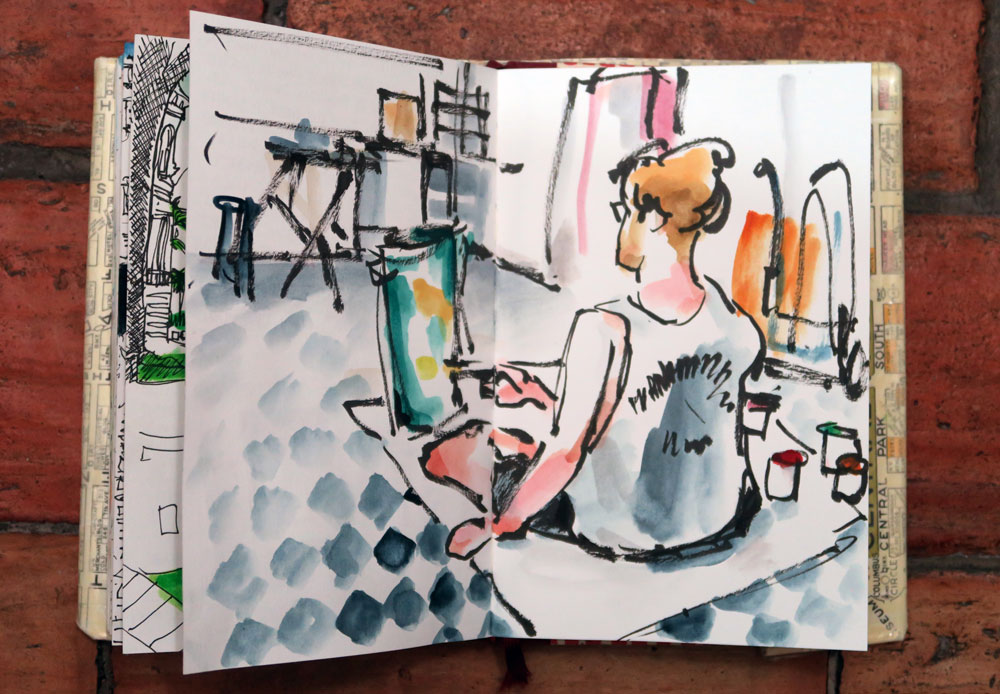
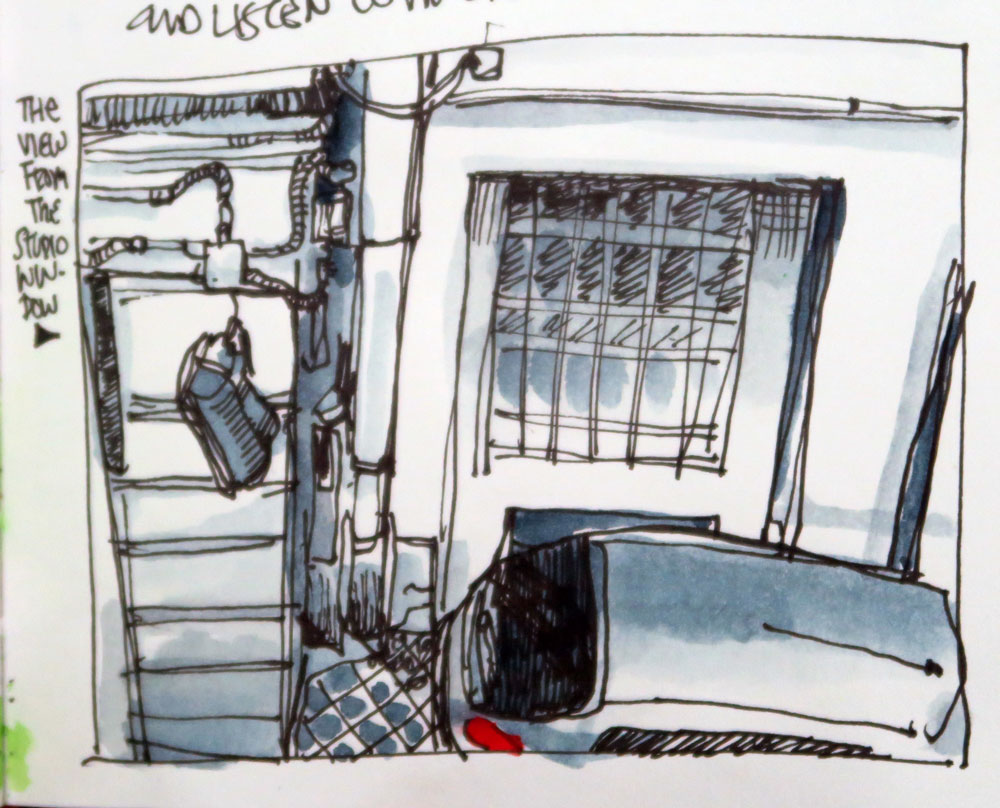
Hanging out with my boy in his new city makes my imagination run wild. He lives and works in a gorgeous old building, a 15th century villa with frescos on the 16 foot ceilings and huge windows flung open upon mouldering terra cotta walls and stone alleyways strung with phone wires. His bed is narrow and hard but he has his own studio, bigger than our living room, with a checkerboard marble floor and walls filled with sketches and pages pulled from the old Italian magazines he buys at the flea market. A few blocks away is a park full of Roman ruins, fenced and gated to protect the hundreds of ferrel cats who’ve made it home. The Jewish Quarter is full of street markets selling big blocks of mozzarella and cadres of prosciuttos in chrome slings waiting to be shaven. Jack has learned to make pasta from scratch and to order a cornetto and a cappuccino with confidence.
He has less than a year till he graduates. But something in me tells him not to worry, to take it slow, to revel in this season in Italy, that it will be something he never forgets. Last week, he and his classmates traveled to Abruzzo and put on a performance in the earthquake ruins of a tiny village. Next week, he heads to Venice to sleep on a boat. I tell him that for the first year or two, he can keep his needs modest, can earn money here and there, can work on being a man of the world rather than a slave of the wage.
I spent a year in a garage in LA. And then I came back to the Manhattan haunts I had commuted through for decades, a new perspective on the same streets. It would be nice to have a garret here in Rome. Or to couch surf across India like Prashant. Or to get a cabin in the woods or a minihouse I could pull behind my car. It’s hard to eat leftovers with the same relish, but certainly New York is the kind of place I can have creative reawakenings, just like Eric’s Paris or Jack’s Rome.
Going somewhere fresh and rich and living just for one’s art for a period, that’s something every creative person should try, methinks. Forget the pressures of income of language and culture and history, just for a month or two, long enough to rearrange the pieces and shake the monkey back into his hole.
I don’t know that I need an adventure so complete, to completely pull up roots and repot on foreign soil. More likely, the many trips I have planned over the next few months will suffice. Next weekend, I’ll be in Austin. Then to Prague, Doha, Reykjavik, maybe Hanoi too. Shifting perspectives, fresh pages in my travel journal, the search for adventure, new faces, new menus, new conversations, all adding up to a big thick deck to shuffle and deal myself out another winning hand.
I’ve just completed the first leg of my European crusade: a week in Switzerland. Basel is a lovely medieval city along the Rhine right on the edge of Germany and France. It’s home to loads of banks and pharmaceutical corporations and two dozen museums — some with extremely contemporary contemporary art, one which is the size of a doorway.
I’ll tell you more about my visit to the city in another post. Today I’ll just try to summarize why I was there.
Important skills: focus and self-starting.
Last winter, I was invited to be an artist-in-residency at the International School of Basel this September. Perhaps you remember that a year ago, I was in residency at another ISB (the International School of Beijing) and had a lovely and illuminating time, so this invitation was very welcome. I was pumped to spend more time with kids, making art, and wallowing in their creative energy. Additional pluses: I’ve never been to Switzerland and, of course, Basel is a mecca for art.
My week began with a school assembly. Six hundred children under the age of 11 sat on the ground while I introduced myself and talked about all we would do in the week ahead.
The future.
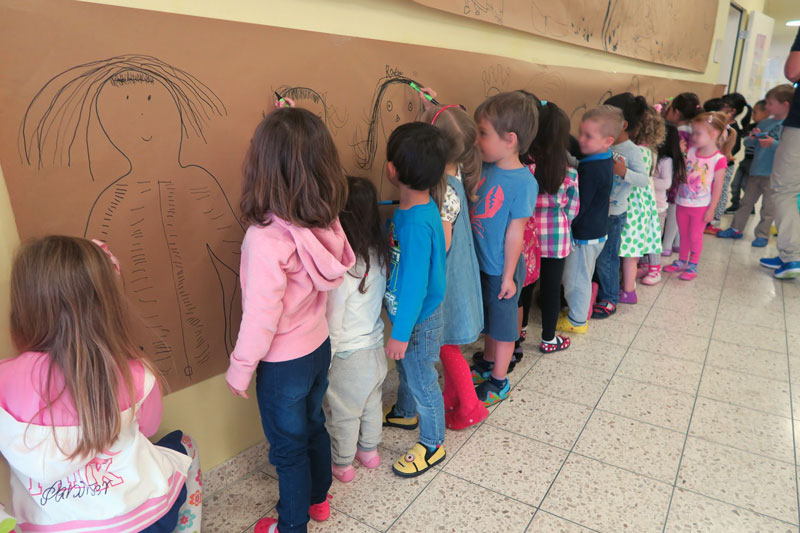
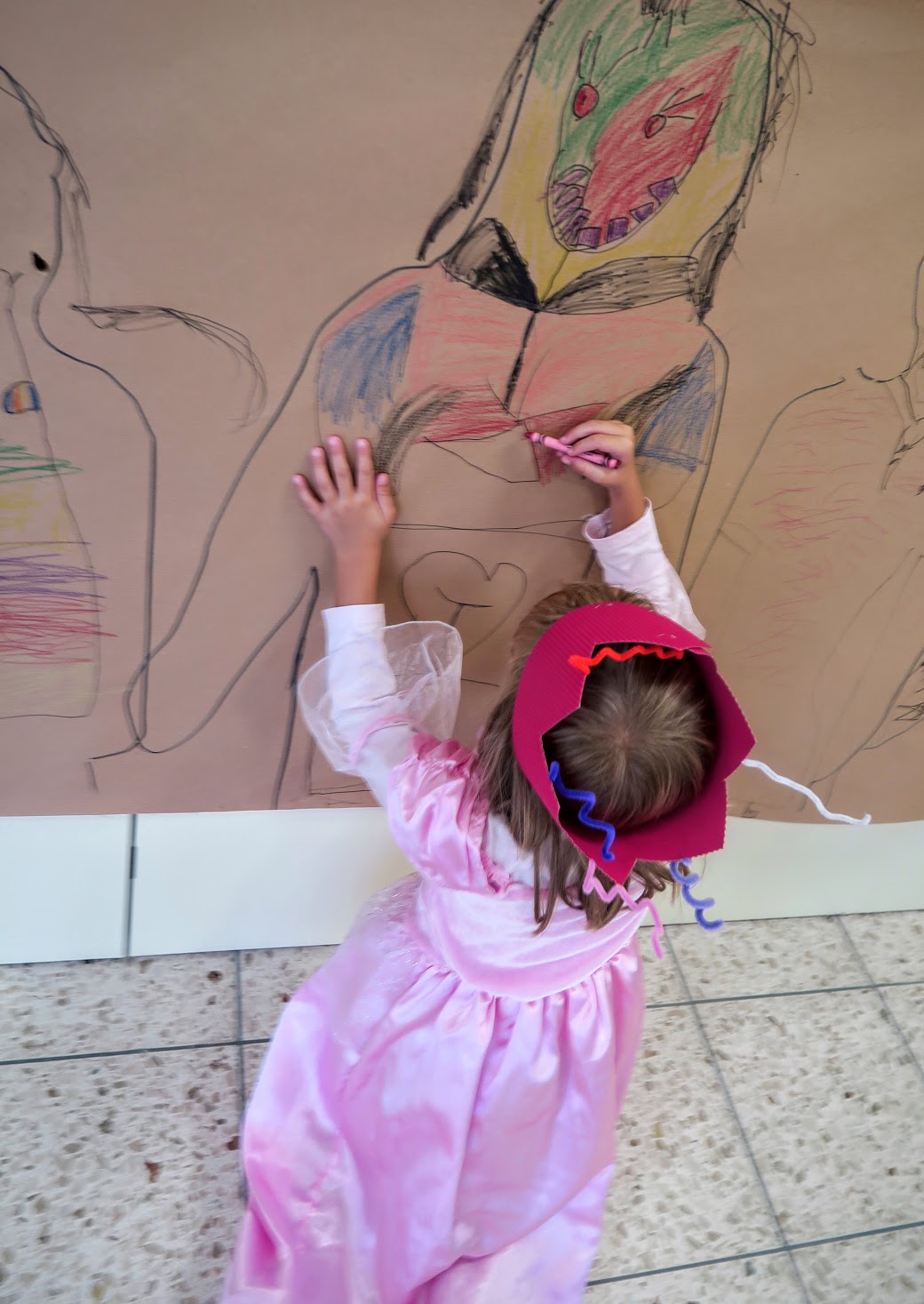
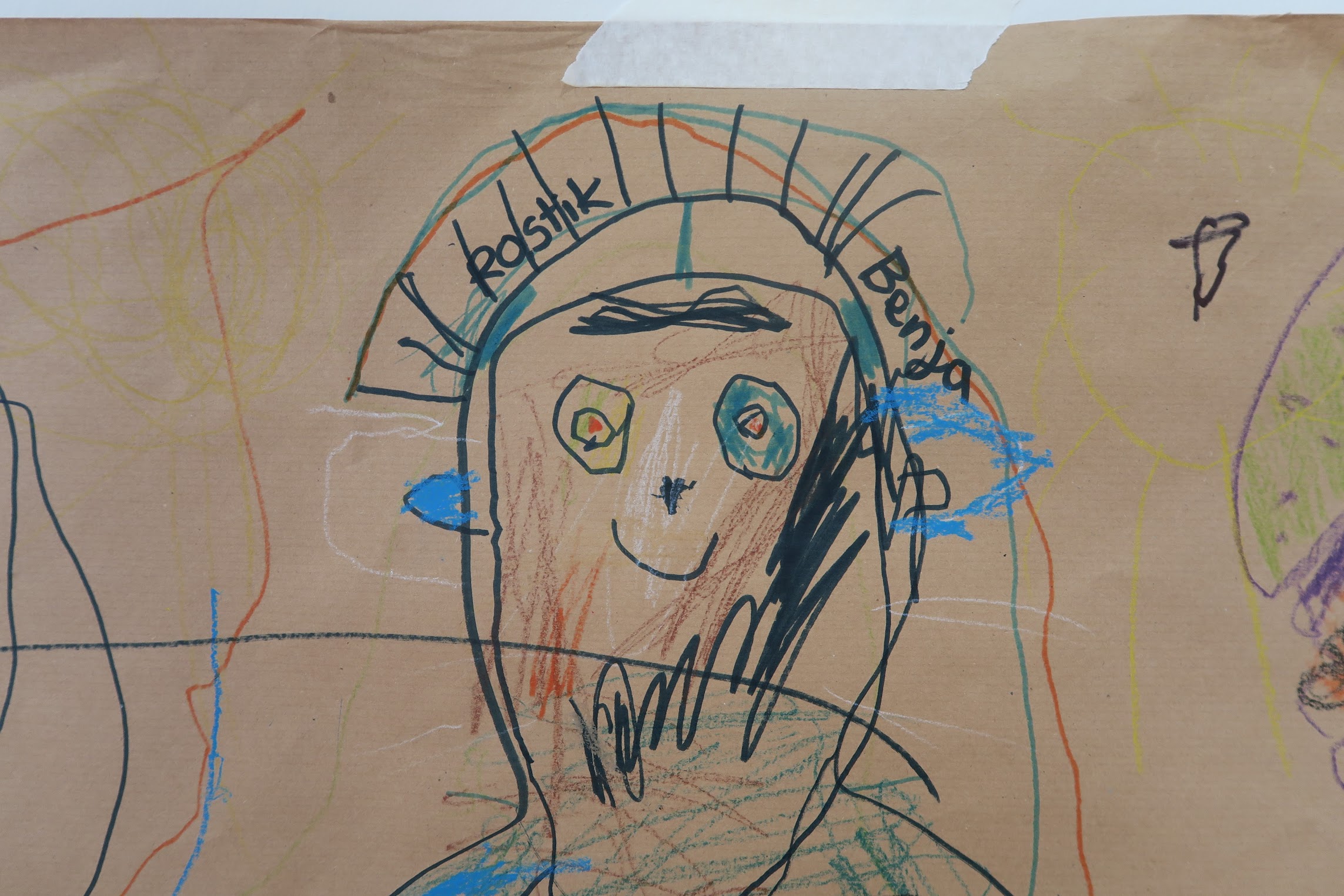
Then each morning at 8:15, I’d let a couple hundred kids and their teachers into my gigantic office/studio/lecture hall and showed them films and gave them creative assignments. We drew breakfast and lunch and shoes and upside-down bicycles and portraits and more. We made enormous murals that covered all the halls and stair wells. We ended the week with a sprawling field trip to the natural history museum to draw dinosaurs and endangered animals and then drew the cathedral and the twisting medieval streets.
It didn’t stop in my classroom. The kids went home at night mad for drawing. Each morning, moms and dads came into the school with stories of kids transformed. They filled up sketchbooks at home, drew with their parents and teachers, insisted that nobody eat their dinners until they had been drawn.
Important skill: observation
After school on Tuesday, I met with all the teachers and showed them how art had opened my eyes. I told them that art is not just for art class — it’s for learning about the world and can be applied to any discipline, from literature to social studies to science to music to gym. I pulled out examples of my travel journals, of my investigations into homelessness, fishing in Manhattan, and dogs in coats. I showed them my maps and Koosje’s recipes and the SBS students’ instruction manuals.
Important skill: problem solving
The next day, an inspired math teacher asked her 4th graders to make drawings that explain the concept of ’rounding up’ numbers. She showed me dozens of stories and watercolors the kids made in response to her assignment. They were all different, all clear, all beautiful. She was able to see how well they understood the concept and they could use their pieces to teach the 3rd graders this concept.
On Thursday evening, I met with the parents and told them why I had come to Basel and why I thought it mattered that their kids had started keeping illustrated journals.
Important skills: collaboration and communication
It was to prepare them for the future — not a future as professional artists necessarily, but as successful people in an ever-changing world. The days of being able to assume that a well-educated person could finish school, get a corporate job, and rise up the ladder till retirement, are over. Instead, kids need to be prepared for the unforeseeable. Technology is upending every industry, traditional jobs are withering while new opportunities are springing up in surprising places. Change is the constant. Kids need to learn to swim in it.
Important skill: Innovation and problem solving
Parents can no longer assume that a traditional education in math, science, literature, language and history will be enough prepare a child for the future. A crucial new skill will be the ability to think creatively. That doesn’t mean dabbling in fingerpaints, but knowing how to spark innovations, to develop ideas, to present them clearly and persuasively, to find resources and collaborators to bring them to fruition, to build networks, to be entrepreneurial. I told them that’s why I supported my own son’s plan to go to art school, so he could learn skills I think will be essential to his future. If he had majored in English or pre-med, I wouldn’t have the same sense of confidence that I had given him the necessary tools.
I told them that they should look at art not just as a sign of being cultured, a middle-class luxury, but as a key component of their children’s total education. I suggested they insist the school’s administration support and look for ways to incorporate art and creativity into all aspects of the curriculum.
Important skill: optimism
If a student is encouraged to look everywhere for inspiration, to combine ideas into new ones, to replace competition with collaboration, to accept mistakes and ambiguity and learn from them, to have faith in the creative process, to know how to overcome its pitfalls, only then will he or she be prepared for a world full of self-driving cars, delivery drones, mobile apps, and Donald Trump.
Knowledge alone is no longer power — it’s something that pops up in your browser. Knowing how to use that knowledge to create new ideas and solve new problems, that will be the source of true power, a power that will serve all mankind.
Look, I’m going to tell you some thing pretty embarrassing. I need to get it off my chest so I’m just telling you, but please don’t let it get around.
A couple of weeks ago, I realized I was horribly, horribly out of shape. I’ve been pretty busy this summer and haven’t had a lot of time for much, but this is no excuse. I know better but frankly, I had just plain let myself go.
One afternoon, I sat down, brushed the dust off my sketchbook, uncapped my pen and began to draw Jenny’s shoes.
I couldn’t believe what came out. It was awful. And even worse, the act of drawing was awkward and crabbed, like I had three left hands and they each had sprained wrists and five thumbs. I tried slathering on some gouache to cover my mistake but that just made matters worse. The prognosis was clear and so was the cause.
I had forgotten how to draw.
I felt humiliated. I mean, I have been so busy all summer writing books, giving talks, blogging, making stuff for Sketchbook Skool that I had become that archetype: he who can’t, teaches. I felt really awful. And I wasn’t sure how to fix it. Well, I sort of was but I wasn’t sure it would work.
I had three left hands and they each had sprained wrists and five thumbs.
My first impulse was to get down all my old favorite, sure-fire drawing instruction books. Sketchbook for the Artist. Work small, Learn big! Creative Ink Drawing. then all the artists who’s inspired me. Crumb. Searle. Gentleman. Hogarth. Kane. Ware. Jean. They remind me how to do it. But my mentors just made me feel more inept and hopeless and lost.
Next, I decided I’d better go to the art supply store. Maybe, I just need some thicker pens. And a new type of sketchbook. I bought a painfully expensive one that claims that ink never bleed through its page. Cool, I could finally draw with Sharpies. I’d seen Jonny Twingley doing that to great effect. And the Basquiat notebook show at the Brooklyn Museum was full of big bold lines and flat colors that seemed just the ticket. I came home with an armful.
That was another mistake. Thinking that switching everything up would provide instantly good results. Not only had I forgotten to draw, I was now setting out to learn how to use a bunch of new materials and simultaneously ape someone else’s style and POV to boot.
The first few pages in the book continued down the disastrous path. I kept thinking and thinking about how to reduce things into shapes, struggled with how to add tone, drew far too fast, and then, to cap things off, the cap came off one of my fat new pens while it was in my pocket, scrawling a tattoo of india ink down my leg, my pants and even my good salmon Lacoste shirt.
Early one sweltering morning, I sat in my boxer shorts and made a self-diagnostic comic. Time to get to work.
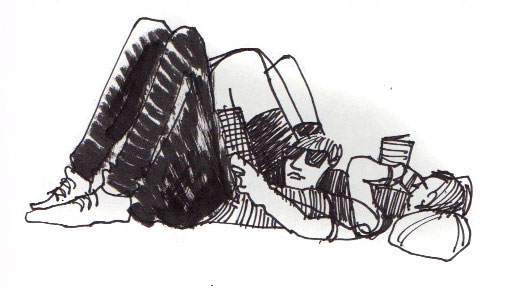
The weekend arrived and Jenny and the dogs and I went to the park. While my family dozed on a picnic blanket, I drew people. Fat, tall, crazy, slow-moving, sleeping, texting, skateboarding people filled my pages. Even the slowest were too unpredictable for me to do a lot of strategizing. I just drew and, if they got up off the bench, I started drawing the next person who sat down. The shadows grew longer, people got sweatier, Jenny and the dogs when back to the air-conditioning, while I kept going.
The next day, I started my morning in the window of the Lafayette bakery, drawing a couple seated at a sidewalk table and having a long argument. Over and over I drew them both, as they gesticulated, accused, sobbed, then paused to shovel down almond croissants. Then I went to church and drew the choir and the congregants, page after page of earnest reverent faces.
I spent the rest of the day watching the U.S. Open on TV. I drew the players, the commentators, the actors in the commercials. Occasionally, I would hit the pause button and to freeze and study a gesture.
As Federer rejected half the balls the linesmen lobbed him, squeezing, bouncing, assessing, until he found the right one to serve, I grabbed new pens from the pile, testing out different weights until I found my way back to an old favorite, a Stabilo pigment liner, but a fatter one than I’d ever used before, a 0.7. I was feeling my old line start to flow again and it had picked up a bit of weight from the influence of Jonny and Jean-Michel.
“I am the one who knocks!”
Monday, Jenny went to work and I began to binge. Summer rains had rolled in, and I started to rewatch Breaking Bad on Netflix. Episode after episode, season after season, I drew bald heads and grimaces and dramatic lighting.
I didn’t try to draw accurate portraits, I just let my pen slide over their heads to take me to new inventions. I didn’t write clever quips, didn’t compose my page, didn’t add color, didn’t judge. I didn’t think. Just drew the scene, turned the page, and moved on.
Fortunately there are five seasons of Breaking Bad and there are still some empty pages left in my expensive sketchbook. After a week of intensive workout, drawing has started to become second nature again. The lines flow. I’m still not thinking but I can just plunk down the pen on the page and it starts to move. And generally in the right direction. For better or worse, the drawings look like mine. And best of all, I love it again. I can’t wait to keep going.


















 Danny Gregory