A Zillion Sketchbook Tours

I just uploaded a zillion sketchbook tours from various random points in my library. They’re all on my YouTube channel now and now magically embedded here too.

It’s to celebrate the launch of our new kourse, A Zillion Ways To Fill Your Sketchbook. This kourse is pretty amazing, if I do say so myself.  It’s basically an encyclopedic review of what is so freaking amazing about sketchbook art. Trust me, my feeble tours are a mere blip in the firmament of this vast masterwork.  Hope you’ll join us.

Meanwhile, here’re the trailer and a dozen tours.

You’re welcome!

My Life in Pens: Pt. 4 Bic Banana

When I first landed in America, everything was overwhelming and new and deluxe.  Even a 29¢ pen had the power to impress me mightily.

My Life in Pens- Pt. 3 Cross

A sacred memory from the Holy Land. Another heart-wrenching chapter in my endless journey towards manhood.

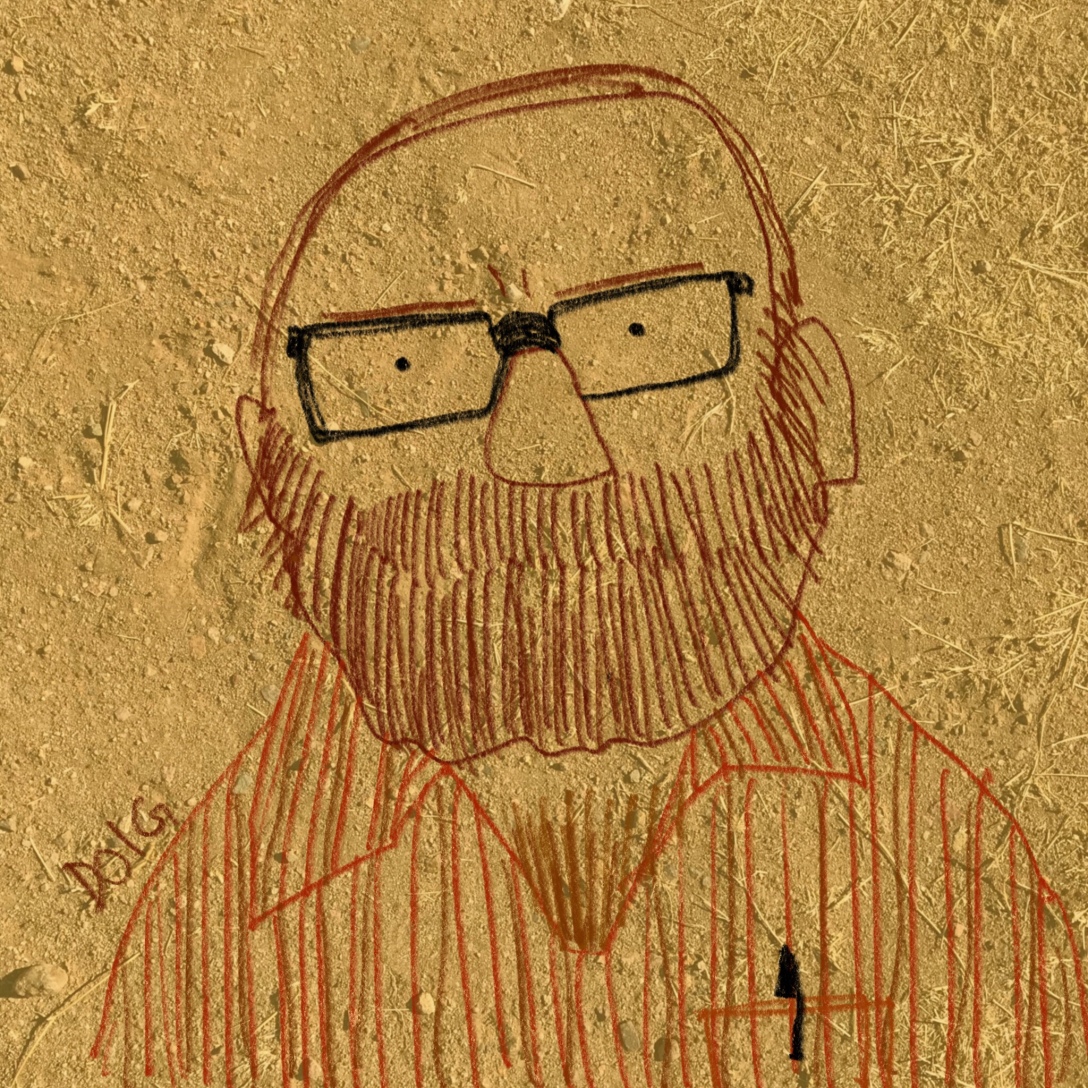
Authors: Ivan Doig

In December, after months in my desk chair, I reseated myself in a saddle on a brown quarter horse. Jenny and I went back to a guest ranch in Southern Arizona and rode horses twice every day for a week. My phone didn’t work. My laptop was 2500 miles away. For hours on end, I looked at cacti, rocks, birds, clouds and horses’ tails. And my brain uncramped and stretched out to the horizons, not thinking about anything particular, unfettered by time and space.

When I wasn’t riding or eating or playing cards, I was reading. I’d packed my Kindle with ranch appropriate materials; two disappointing Elmore Leonard Westerns, the Assassination of Jesse James By Ron Hansen and English Creek by Ivan Doig.

I’d never read Doig before. I’d noticed his name on the shelves of Three Lives in the West Village but always dismissed him, thinking he was Russian (I think I confused him with Gogol or Gorky or some such). Amazon insisted that I might like English Creek. And, boy, did I.

English Creek is not about an English creek. Or a Russian one either. It takes place in the 1930s in a small town in Montana, the story of one summer in the life of a 14-year-old boy whose dad is in the forestry service and whose brother has just fallen in love with the wrong girl and left home to work on a big ranch. But this description, like the fly leaf blurb, does it scant justice.

The books is really about the fleeting nature of time, how a single summer can reshuffle the deck of one’s life, how people a century ago lived the same dramas we do, how a single mistake can rewrite the future. Sure, it’s also about the grueling work of a rancher, about the scary loneliness of sheep farmers high in the mountains, about the brutal indifference of nature, about rodeos, piles of sheep corpses, and forest fires. So, on one hand, it’s about a world and people that are living lives so unfamiliar, and on the other, like all great literature, it’s about the essential dramas all humans live through, regardless of time and place.

After English Creek, I read Dancing at the Rascal Fair, the next volume in a trilogy but which actually takes place two generations earlier, when the first settlers came from Scotland. It’s an even more grueling story of making something from nothing, a seemingly impossible task that the characters manage to muddle through, and features another central character distracted by an ill-advised romance. Covering decades, it’s much more epic than Creek but ultimately less satisfying.

It’s the language of English Creek that enticed me most. It’s not stylized to fit the time or genre like Leonard and it’s not baroque in describing the terrible beauty of nature. It’s human, timeless, and true. Doig isn’t perverse like say, Cormac McCarthy, but he’s not afraid to describe terrible things when they are a part of a raw and essential life. His people speak and behave like real people, individual, relatable. I had the deep sense of being in their lives, of being transported. As I sat astride my own steed, I’d mentally page back through what I’d read the night before, feeling rooted to the earth, to my horse, to the past, to America, to a wonderful author who, fortunately, left behind many more books for me to read.

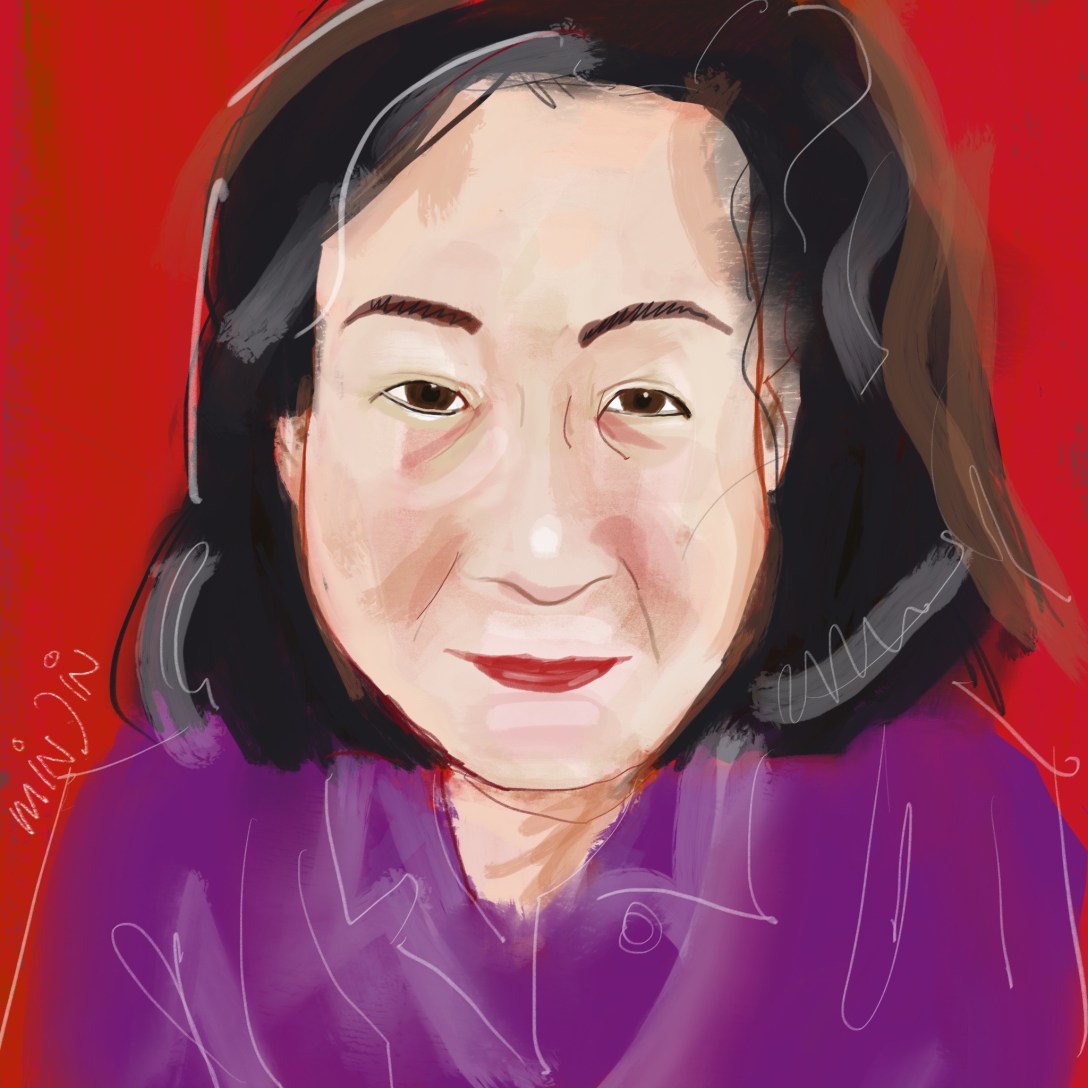
Authors: Min Jin Lee

For most of my reading life, I loved to slowly graze through bookshelves. At least once a week, I’d spend a good couple of hours just browsing, usually in a used bookstore, not discriminating between genres, prices, pub. dates, or authors’ backlists. I would stand and stare at spines, then hinge out one book after another, reading jacket copy, flyleaves and a paragraph or two plucked at random. Sometimes I’d emerge with an armful, sometimes empty-handed. The hunt was the fun.

Things have changed a lot as bookstores have been increasingly usurped by websites. Now I am forced to hopscotch on a course based on others’ opinions and algorithmic recommendations. I am a difficult read, I imagine. — I consume history, pulp fiction, thrillers, classics, science, nature guides, how-to, how-not-to. Genre is an unreliable guide of what will strike my fancy. But Amazon thinks it knows me and serves up minor variations on the themes and authors I’ve already exhausted.

I used to judge a book by its cover. But now books appear on my Kindle as tiny greyscale icons. I can barely read their titles. Looking for any sort of guidance, I read a lot more newly published books and best sellers than I ever have. And I find I abandon many books mid-course, a practice I would never have permitted when I was younger and much more loyal or maybe just forgiving.  Now I know time is growing shorter and the options seemingly infinite. Lose me in the first hundred pages and I’ll find another book on the fishes in the sea.

Certain books keep appearing in my recommendation list. Years ago, I read Free Food for Millionaires.  I barely remember much more about it than I liked it.  But Amazon wants me to read Pachinko, also by Min Jin Lee. It’s a National Book Award finalist. I tend to be attracted to award nominees, just because they blink brighter in the endless sea of books, appearing to ensure quality in the bottomless fathoms of self-published crap and mystery novels with “Girl” in the title.

Finally, I give in and click over to read the description. A book about Christian Koreans in Japan in the 1930s? Uh, no. None of that is interesting. But Amazon insists and Pachinko shows up again and again, “Inspired by your purchases”. Inspired!

I give in again and download the sample. It begins in a boarding house for Impoverished fisherman. Again, not something I care about. But slowly I do start to care. The sample hooks me and begins to reel in. I start to care about these people. Their fastidiousness.  Their morality. The strangeness of the situation. The unfamiliarity contains the familiar.  The language is as crisp and clean as sun-dried bed sheets.

And even though it’s foreign and historical, it’s honest. Discussion of bodily functions, of sexuality, of wavering morals are all modern and not wrapped in pious bullshit. People speak and act like people. They are very different from me and yet the same.

The book is longish, something I tend to forget on my Kindle which holds so many books of so many lengths. But it contains so much. It follows one generation then another, interweaving stories, throwing characters into impossible situations and then fishing them out, dripping with regret or discovery, forgiveness or shame, setting them back on their pins to struggle forward. It’s epic and yet so personal.

The whole mystery of Korea, of what it is, where it comes for, how it has been shaped by history, where it fits into my world, all become clearer with each page. Not in a didactic way but through story, through the way global conflict inflicts itself on little lives, how they groan under its weight, how they struggle on.  I learn but also feel how poverty inevitably creates criminality, how religion provides succor and delusion, how nuanced and brutal racism is in every society.

One of the characters in the book manipulates the pins in his Pachinko machines so customers’ balls are guided to certain outcomes.  That’s how I felt reading the book, pinging between events and people, bouncing across the story, on a long and surprising journey crafted by a master of physics, story, and the human mind. I don’t mean Amazon (though that too) but Min Jin Lee, whose next books I will immediately download when it appears on my recommendation list.

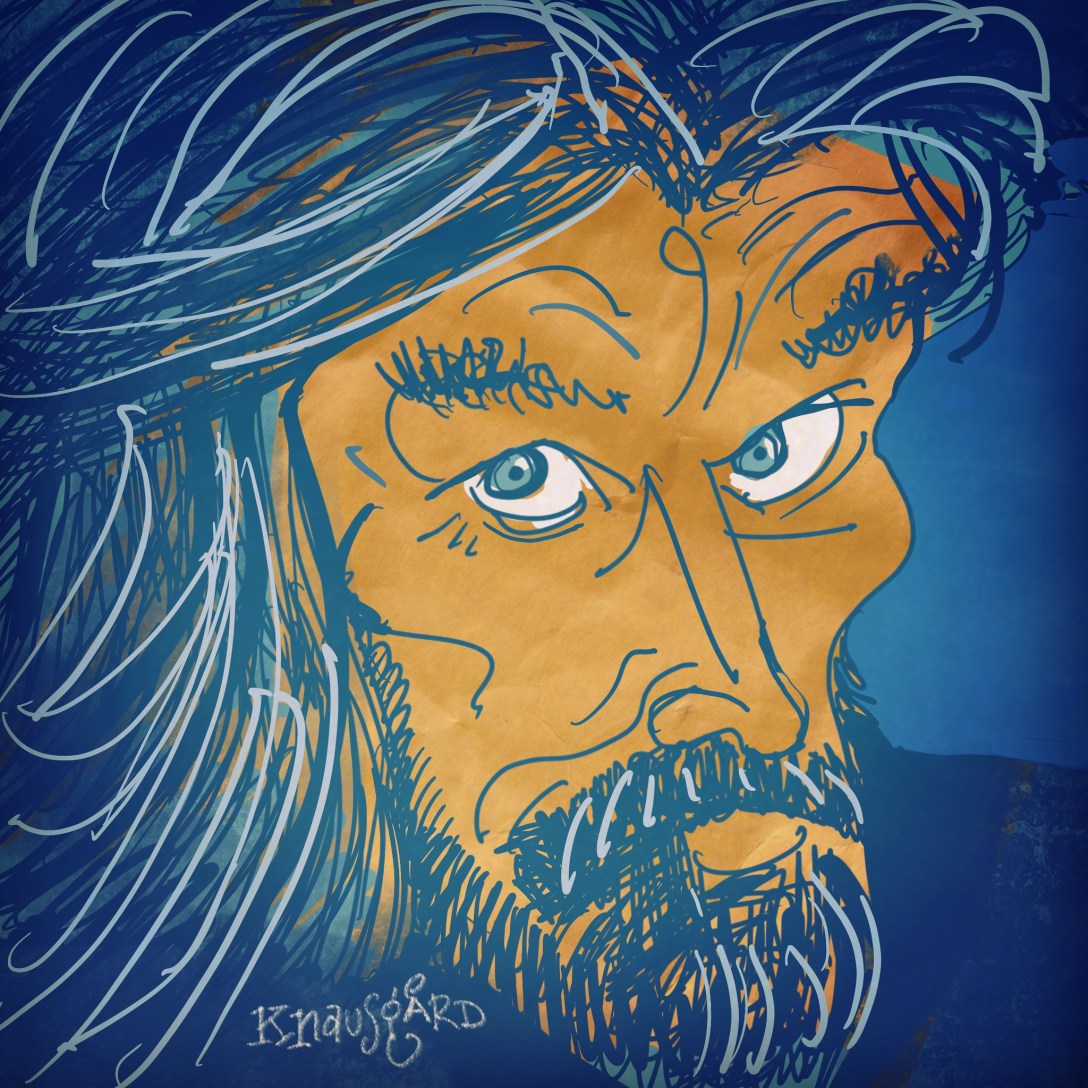
Authors: Karl Ove Knaussgaard

Life is a relentless bombardment of experiences. Each day is the same yet different. I am writing this on an airport terminal, one like so many I’ve sat in before, but just now a sparrow flew past and landed on the luggage scanner, a reminder that the humdrum of modern flight is still a miracle. Life is amazing but you need to pay attention.

Karl Ove Knaussgaard takes the minutia of his life and zooms in more and more to reveal the miracles that lie within all those gray moments we all take for granted. He recalls the ambitions and delusions of adolescence so sharply that they force me to dust off my own memories, to look beyond the familiar packaging and remember how it really felt to be fifteen, horny, dreamy, arrogant, and afraid, vivid reminders that force me to also shake off my torpor of this moment and come a little more awake. He recreates the anxieties and chaos of parenting small children and the lurking fear of mortality our parents come to embody as we age.

Knaussgaard, whether filling pages with the experience of eating an apple, cramming on a rubber boot, changing a diaper, or losing a parent, delivers such particularity that it becomes universal. Last weekend, his NY Times Magazine cover story revealed simple truths about how Russians view themselves that demystified and humanized them in a way I’ve never experienced before.

The candor, intensity, banality, and epic scale of his books can be an ordeal and no one has ever taken me up on my Knaussgaard recommendations. But I love sharing space in my brain with his, seeing through his eyes, inhaling his second-hand smoke and familiar human fragility.

My Life in Pens: Pt. 2 — Ballograf

Another gripping episode about my early years. Abused, ignored, mistreated. Me. And my writing tools.

Sketchbook Club: Eric Sloane

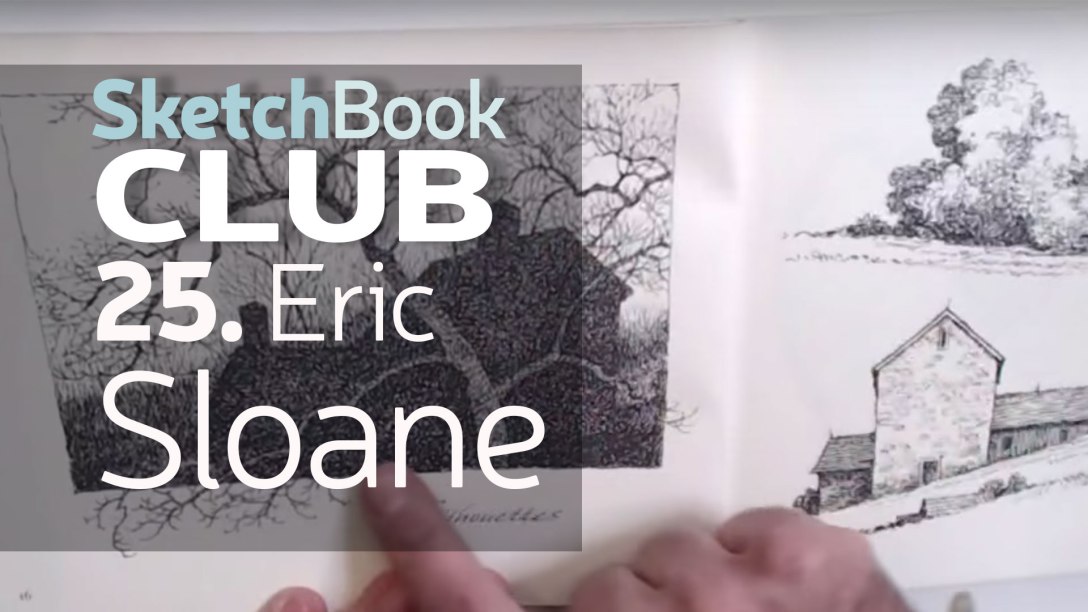
In this week’s episode, I explore the work of American illustrator Eric Sloane.  And by American, I mean AMERICAN!

In his many books, he explores Americana in lots of forms — from the tools early farmers used to the huge skies of the plains to the old barns of Pennsylvania to American wood to early cross-country car trips and much more. His ink drawings have a classic, bygone feel, and he is a master of the dip pen. ANd he makes some dandy url paintings too.

I made the mistake of doing this presentation live on Facebook rather than using my better cameras and mics in the more controlled way I usually have been doing. I tried it in the interest of capturing live conversation with viewers but I don’t think it’s worth the loss in quality.

Anyway, no slight to Mr. Sloane, who I think was a brilliant artist who has long inspired my own.

My Life in Pens: Pt. 1 – Parker

There’s a line running through my life — a line drawn by a handful of different pens. I will trace that line in a series of short films to be released episodically, starting today. I hope you enjoy “My Life in Pens”.

Sketchbook Club: Self-published

Today I shared a bunch of my favorite self published books. I hope they inspire you to make something awesome!  Here are the book I discussed and how to get ’em, for your own library.

And here’s some more info on Illustration Nation, our brand new kourse: