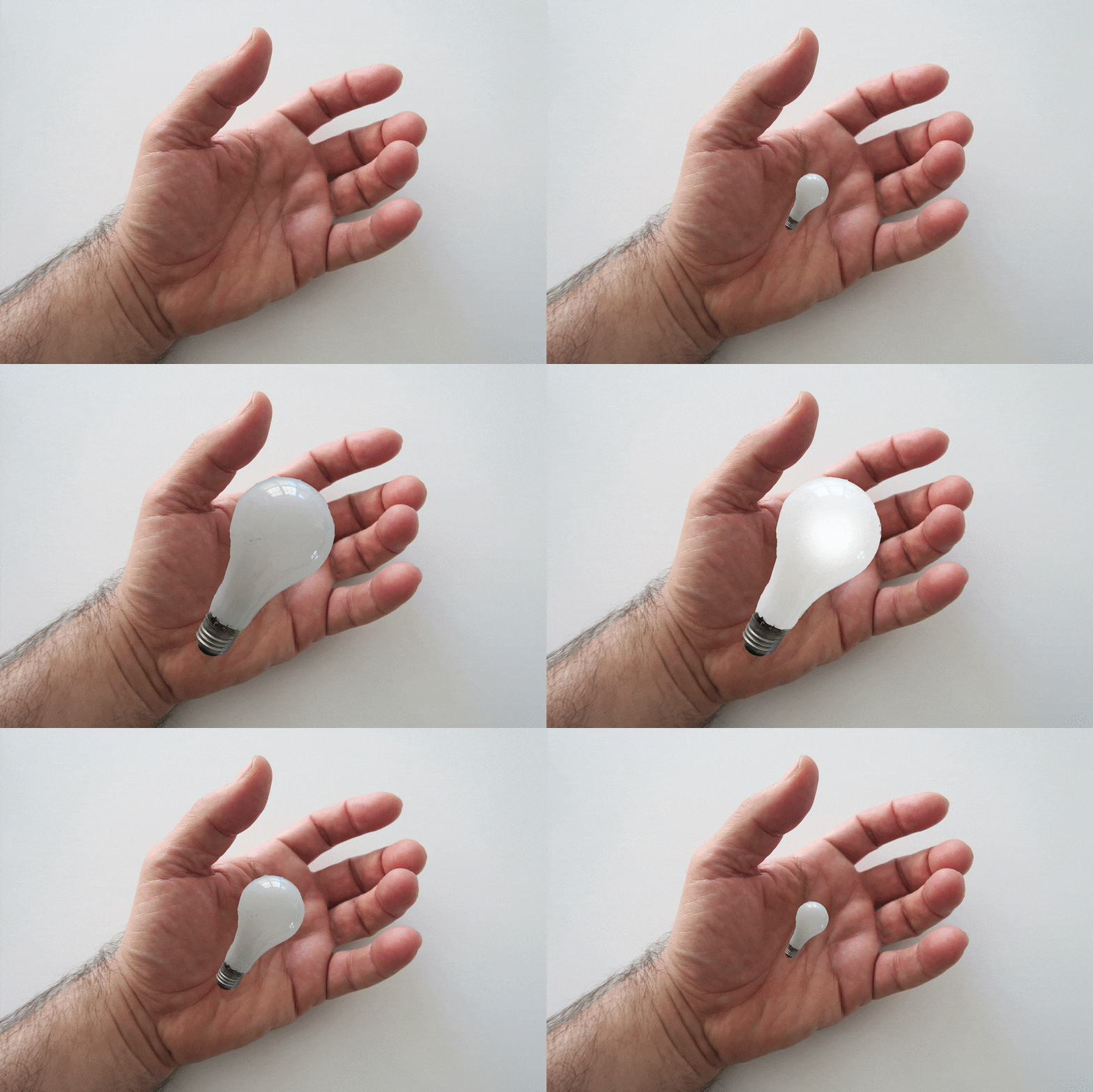
I have the foggiest idea.

I’m at the very early stages of starting to think about a new idea. It’s more of an inkling at this point that I hope to develop into a notion, then maybe let it simmer in the skullpot till it becomes a concept.

Not sure where it’s gonna take me, but I’m excited to feel myself off on a new adventure. I don’t know how far I’ll go, what heights I might scale, what dead ends I might meet, wbut I’m ready to begin.

It doesn’t matter where I start this journey of discovery. Turn left at the doorstep or right. Go two blocks then turn right or continue straight.
What’s important is that I am moving, that my mind, eyes, and heart are open, that I am having new experiences and that they are connecting and sparking with other experiences to create something fresh and alive. That I am striding confidently and laying tracks.

An idea lurks around every corner. It doesn’t matter where I bump into it. But it won’t show up until I make the first move.

The man.

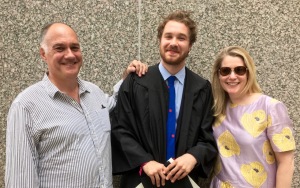
My boy is now a man. He’s 6’3, 190 lbs. He has a beard and looks good in a suit. As of Saturday, he has a degree too, a BFA from the finest art school in the world. When the graduation ceremony was over, my sister texted me: Now what?

For some of Jack’s friends, the answer to that question is clear. They are the newest employees of some big corporation or another, a freshly printed job offer in their paws. Others are off on a grandparent-sponsored summer in Europe. And some are on to graduate school and a future of student loans.  But Jack and most of his friends from RISD are getting ready for journey full of twists and turns. Being a creative person means living life creatively, with no clearly charted course, a brave foray into the uncharted. They are at their own helm as they sail into the foggy future, guided only by their sense of themselves as artists.

IMG_7565I think long and hard before I give Jack advice. I begin my dusting off my own post-graduate memories. I left school with only one plan, to avoid academia, politics or journalism, the three areas my degree in political science had prepared me for. The flame under my butt: my mother’s warning that I had to be out of the house by the end of the summer. I flailed in the job waters for a bit, then grasped at the first outstretched hand and ended up working in advertising for thirty years. It was a career, it provided security, I was good at it — but I always felt a tinge of regret that I hadn’t held out for something that more closely fit my values and dreams. No matter what I achieved, people would always ask me when I was going to quit and do what I was really meant to do. I don’t wish that for Jack.

I also graduated into very different world. It was the middle of a terrible recession. No sane person thought of starting their own business out of college. The goal was to work for a big, safe company with plush benefits and stay there for life. Advertising was a flourishing and respectable business. And the internet didn’t exist.

I also want Jack (and my) investment in his creativity to have a chance to pay off. That takes time, work and opportunity. If we give in to the desire for a swift and permanent solution to his security, he could end up in an ad agency too. Or worse. So I tell him he has time and freedom. He is responsible to nobody but himself right now, so he needn’t feel like he needs to embark on a career as yet,

101_0184But he does need a job. He needs to make money so he has options. And for a tall, smart, handsome guy, there are always ways to make money. So I tell him to start by focussing on that.

He is pretty smart about working. First, he decides doesn’t want a job that is too creative. Last summer he was a landscape gardener. He believes that if he avoids channeling all his creative energies into a job, he will still be able to paint. So he has some things lined up that will add to his coffers until he has a nest egg that will let him move out of our home and into his own. In the meantime, we’ll be sharing a studio where he can continue following his passion and I can get back to the kind of creativity I enjoyed when I lived in LA.

I tell him, try things. Be open, make connections. Soon you will find a way to make money that feels right. That feels in harmony with your creative self. It’s impossible to say what that will be. It could be some job we have never even heard of before, working with people we don’t know.

When he was first thinking about going to art school, I said, “Jack, most people don’t have a passion for anything. And most people don’t have something they excel at. You have both. Don’t walk away from it. If you love art and you are good at it, stick with it. That can’t be the wrong decision.” I still believe that. Neither of us think it will be easy in the short run, certainly not as easy as it might seem to be for those of his friends with corporate job offers in hand.  But it will be easier in the long run, because being untrue to yourself is very hard indeed. Living a half-life, even with a full bank account, will leave you feeling hollow.

Being a parent isn’t easy. I am always balancing on the accelerator and then the brake, pushing him forward but not wanting to push him away. I am keenly always aware of the preciousness of our time together.

Last week I was watching some ancient videos I found on a hard drive, Jack at ten, shuffling a deck of cards for the first time, Jack on an early podcast of mine, reciting an African folktale he had made up.

gregory8376-1a-wa800In the old pictures of the two of us, he is still fresh and new with gleaming eyes, and I look essentially like I do now, a little less grey but the same. But of course I wasn’t. Patti was behind the camera, I was still a creative director, Bush was in the White House, Sketchbook Skool hadn’t been born. But Jack was another person, an energetic shrimp, his voice still high and clear, full of confidence and energy.

I want to shelter and harbor that optimism and ocean of possibilities, to protect him from the buffeting winds of reality, but I also know I can’t, he has to sail forth, he has to test himself against what the world throws at him.

I have faith in all that Patti and Jenny and I have done to make him, the opportunities and lessons we have provided. I have confidence in his intelligence, his values, his energy, his talent. But still I rewatch those old videos. Jack giving a speech about Patti’s disability, Jack marooned on a desert island, Jack playing the drums in his band, Jack parodying a kung-fu film.

A decade has passed in a heartbeat, the world has been shuffled, and Jack is a man.

I’m pretty proud of this.

My friend Michael Saia, one of the top film editors in New York spend a couple of weeks taking all of the hundreds of little documentaries we’ve made and turned it into one short film that tells the story of Sketchbook Skool.

It’s been two and a half years in the making and stars tens of thousands of people. It’s emotional, it’s funny, it’s exciting and it’s real.  Dozens of students made videos telling their feelings about the Skool and I am so moved by their passion for what we have done. I never imagined that this project would grow so big or touch so many lives but it’s wonderful to see how it has.

If you like this film, please consider joining us for the next term at sketchbookskool.com. It starts on June 10. And if you are already enrolled, please share this film on social media and with your friends. I really appreciate your support.

New Podcast: My monkey made me write this.

I had big plans for this week, clearing the decks so I could focus on doing some writing and drawing. Instead the monkey managed to help me find a million distractions.

He and I have been having a lot of discussion about why I need to force myself each week to A) make a podcast, B) make a newsletter and C) write a blog post about it as well. He insists that I need to be consistent about it or else I will disappoint my dozens of fans. I would rather be a bit flexible and play it as it comes but, as you can see (because you are reading this), he won.

To be honest, we could totally switch places. I could say it’s important to commit to this and see where it leads me and he would say, take it easy, it’s 80 degrees out, let’s go eat a Good Humor bar in the park. He loves moving the

I think he’s worried that with a fat block of free time, I might come up with something really nuts to do next.

In this week’s podcast, I talk with Todd Colby, the poet, artist, and former member of Drunken Boat. We’ll discuss the creative process and the role of discipline and preparation in keeping the monkey at bay. Todd is awesome, so’s his poetry and his art and his band rocked savagely hard.

Monkey of the Week: the Paranoid. It’s that voice that says: “They’re laughing and sneering, because no one likes you. Or trusts you. Or admires you. And they can’t wait to see you screw up.” What can we say in response?

Monkey Tale: Lenore has a revelation in the shower about who her monkey really is.

All the episodes of the Shut Your Monkey Podcast are on iTunes.
To hear them, you can can either:

  • Subscribe directly from your podcast app by searching for ‘Shut Your Monkey’.
  • Or you can click this link and it will take you to the iTunes page.
  • Or you can visit monkeypodcast.com and listen to the episodes right in your browser.
  • Do you have a meddling monkey?

    Tell me about it. I am collecting Monkey Tales, stories from all sorts of people about about the challenges the monkey brought them and how they dealt with them. Real stories, real moving. If you have a monkey tale you’d like to share, just visit my website and click the red tab on the right to record it. That would be great.

Drawing without drawing.

A couple of days ago, I had a mindful moment in an unlikely place. I had to go to a government office to renew a document. It was a large room filled with rows of chairs facing a series of steel desks with computers and clerks. Not Kafkaesque, just dead boring. I wasn’t perfectly prepared for this chore — it was one of a series of appointments I had that day and I had rushed there from a completely unrelated matter.

As a result, all I had with me was a sheaf of important documents. In my hurry, I hadn’t brought anything to while away the time, no book, no sketchbook. But the Kindle app on my phone was stocked with several books if need be. I figured I’d be fine.

After much paper shuffling and stapling, the desk clerk handed me a number and pointed at the sign on the wall: “No phones, cameras or recording devices.” If I took out my phone, she said, I’d be booted and have to make a new appointment for another time.

I shuffled over to an empty seat and slumped down, feeling like a snot-nosed, scuffed-kneed nine-year-old waiting to see the principal. Rows of people surrounded me, their faces blank, their eyes glazed. On the wall, a counter displayed a four-digit number in red letters. A number significantly lower than the one on the chit in my hand. I’d be there for a while.

I spent a few minutes grumbling to myself about the archaic ban on mobile devices. What could be the stupid reason? I’d already had to empty my pockets and pass through a metal detector to get into the room. What did they think I’d do with a phone? Snap pictures of my co-victims? Of the lovely clerks? Of the tottering piles of yellowing papers? Of the warning signs, the 20th century computers, the flickering fluorescents? Grumble, groan.

I fidgeted a bit in my uncomfortable chair, then I squirmed, then I examined at the boil on the neck of the man in the seat ahead of me, then tried to calculate if the glowing number on the counter was prime. I hadn’t had lunch yet so I spent a while listening to my stomach too.

Then I noticed a spray bottle of glass cleaner on one of the metal tables. I thought, that’d actually be interesting to draw. I had a pen in my pocket to fill out forms but no sketchbook. Then I remembered the neatly paper-clipped stack of papers in my lap. I flashed forward to handing over these documents to an official, papers now covered with drawings of Windex bottles and neck boils. No, I wants things to go smoothly and handing in my VIPapers festooned with junior high marginalia wouldn’t cut it.

I went back to looking at the bottle. I liked the way the neck curved into the body, the six concentric rings that were debossed into the plastic, the soft highlight in the middle, the way one square side of the nozzle was a slightly darker red that the next.

I decided to draw the bottle with my eyes. I coursed slowly along the edge, looking deeply just as I would if I were drawing. I made a run around the edge of the label, a contoured path with one continuous line. Then I jumped to the edge of the blue trigger, cruising into the hollows that fell into shadow, peering in to see every detail I could pull out. I trekked up the side, then slowed myself, not wanting to hurry too fast even though it was an unpunctuated stretch. Move too quickly, I told myself, and you miss something. I down shifted, making myself maintain the same pace no matter how dull the landscape.
A chair squeaked. I looked up, ten numbers had flipped on the counter. Still a way to go.

I moved to the boilscape on the pale neck in front of me. I uncapped my mental pen again and started to draw each hair surrounding it, the rivulets of sweat, the fold of flesh, the soft ridge of fat. I worked my way down to the yellowing neck of the t-shirt, then across to the right shoulder, then down to the sleeve, the arm, the top of the next chair, up the leather jacket of the man in the next chair, documenting each fold in the leather, then up the neck tattoo, across the lightly freckled shaven head, then up a column, over each poster, on the bulletin board, down the clerk’s handbag, over her bottle of Jergens, around the stapler and then a loud cough brought me back. My number was up. Forty-five minutes of my life had been compressed. I gathered my papers and approached the clerk on a cloud.

This morning, I sat in my kitchen. It was six thirty and the sun washed the room. I had been asleep five minutes before but I decided not to start this day by reading the paper and scanning my email.

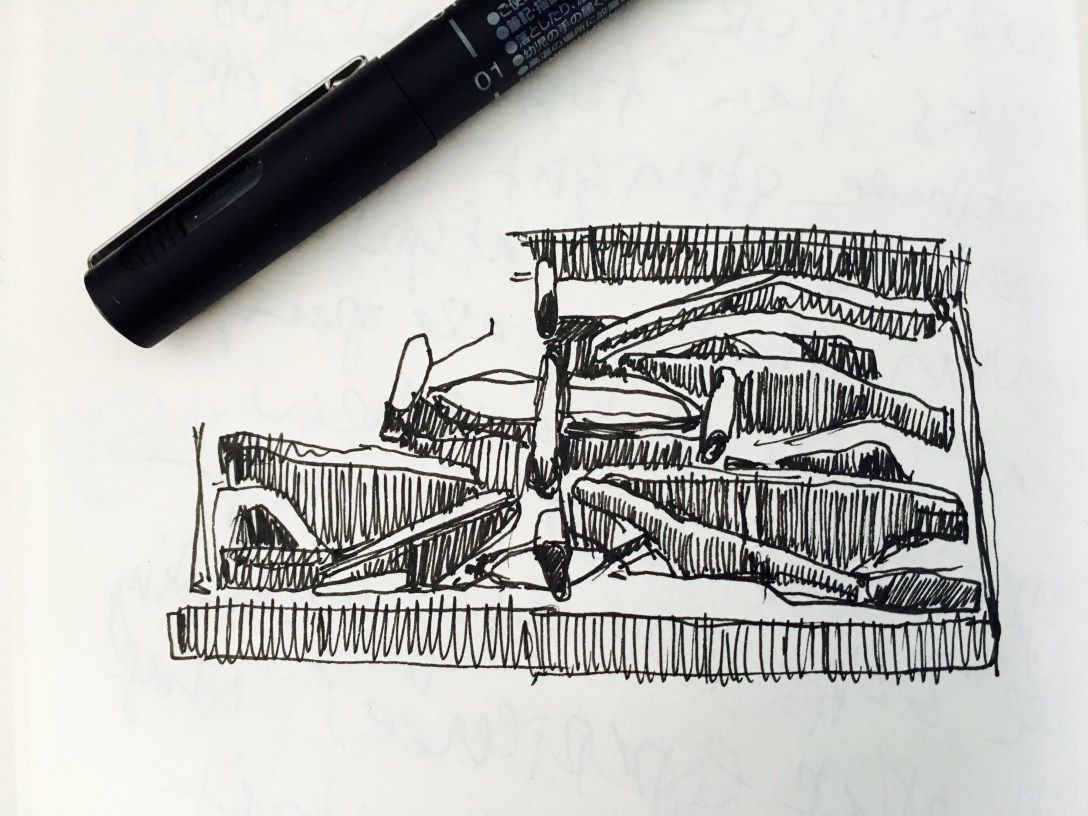
Instead, I went back to my moment in the temple of bureaucracy. I’d felt surprising peace there on my stiff-backed chair and it seemed it be a nice way to start my day, a little contemplation of nothing. I fixed my gaze on the top of my range, the burners and the bars that criss-cross the top, and started to trace the edges of the first one with my mind. The bars are black, so are the burner and the steel pan underneath, but the morning light made a hundred gradations of the curves and angles. The vertical bars stretch away from me, perspective forcing them into lozenge shapes The angled bars were cut by the bars in front of them so they formed jig saw shapes. I looked at each one in succession, working my way towards the back, increment by increment. The kitchen clock ticked away.

After twenty minutes, I had traversed the whole left side of the stove top. I slid my sketchbook over, uncapped my pen and spent the next twenty minutes taking the same trip, only this time I recorded the observations I made. At 7:20, Jenny came in to make coffee and the spell was broken.

I’ve never thought of myself as capable of mediation, but I think this exercise has a similar effect, slowing down and clearing my mind before the day begins and giving me a boost of creative energy that had me writing this blog post and sipping my morning tea.

I liked it. I think I’ll call it Omm-bama care.

New podcast: Ghosts.

After months of preparation, I gave my first post-publication presentation about Shut Your Monkey: How to Control Your Inner Critic and Get More Done. I spoke to a packed hall in Atlanta, GA at the HOW Design Live conference.

I was joined on the podium by my old pal, the Monkey.

DOG-@-HOW-2016-3He told me that people were bored, that my fly was open, that they saw through my fake expert pose, that this was surely the end of the road for me. Despite all that, the talk went very well and afterwards, I received lots of positive response —of course, the monkey told me that the applause just came from toadies and second-raters with nothing better to do.
Sigh.

This week’s podcast is all about the tapes that play in our heads that were recorded in a by-gone era. 78s that became LPs that became cassettes, CDs, MP3s, and now stream live from Spotify, but always the same old song: “You suck, you are in danger, you better watch out lalala!”

Sometimes that song was recorded before we were born, the trauma that molded a great-grand parent or an even more distant ancestor. A war, an economic crisis, a death, can mold a world-view that gets passed on through a family. We end up hearing those distant echoes long past their sell-by date and are screwed up by their reverberations.

Joining me on this podcast is Patti Digh. She’s a wonderful and wise woman,  a best-selling author who has recently been studying post-traumatic stress. We talked all about our ghosts and how to exorcise them. It’s a really useful discussion.

Do you have a ghost story? Share it with me. I am collecting Monkey Tales, stories from all sorts of people about the challenges the monkey brought them and how they dealt with them. Real stories, real moving. If you have a monkey tale you’d like to share, just go here and click the red tab on the right to record it. That would be great.

All the episodes of the Shut Your Monkey Podcast are on iTunes and will soon be on all the other places you subscribe to podcasts (as I figure out what they all are).

To hear them, you can can either:

I hope you like this episode. I hope your monkey and his/her grandparents do not.

New podcast: why the monkey messes with creatives.

There’s a terrific new episode (#4) of the Shut Your Monkey podcast going up today and I hope you’ll give it a listen. First, I talk about creativity and how the monkey loves to hate it, meddling with your creative process and throwing up blocks. Then I am joined by this week’s guest, the rock-star of graphic design, Stefan Sagmeister.

I’ve known Stefan for about fifteen years and every time we chat, I come away excited, impressed, and inspired.  He first became famous for a poster for which he carved all the type into his chest with a razor blade. That shocking experiment was typical of an artist who breaks boundaries left and right. His work for clients like Levis, the Guggenheim, Red Bull, Jay Z, the Olympics, the Rolling Stones, have won every design award and  two Grammies. He has published several gorgeous and mind-bending books (and his sketchbooks are included in my book, An Illustrated Life), and he is a legend to designers everywhere.

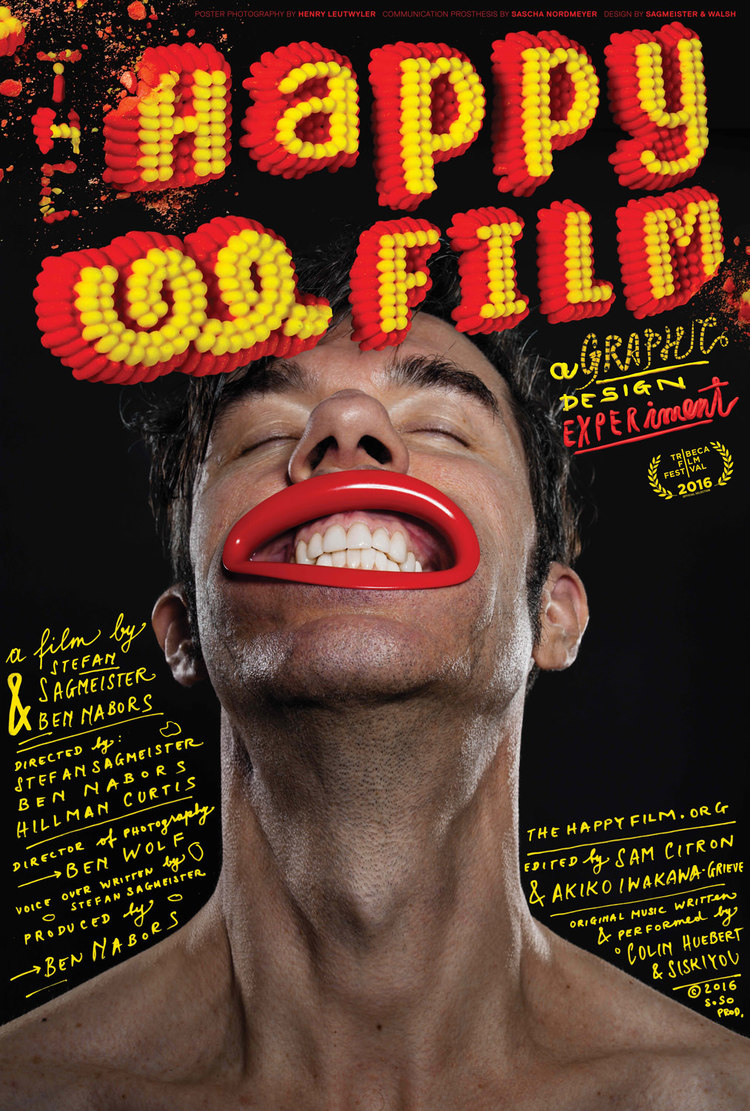
Every seven years, Stefan closes his studio for a year to recharge his batteries. Most recently, he used his sabbatical to explore the science of happiness which led to the most visited design exhibit ever. He has also just finished directing his first motion picture, The Happy Film.

On the podcast, we talk about the process of making it, the obstacles inherent in trying something so brand new, the important of honesty and self-exploration in making good work, the power of communication to improve lives, and so many topics that matter to us both. The conversation was quite a long one but I have decided to share it all in one episode because I think Stefan is one of the most important creative minds of our time and every minute spent with him is never wasted.

You can listen to the whole episode right here.

Better yet, subscribe on iTunes so all the future monkey-shutting-goodness goes right to your device as soon as it’s outta the oven.

As always, I am interested to know what you think of the show. Please leave me a comment below if you are so inclined.

The artist I love most.

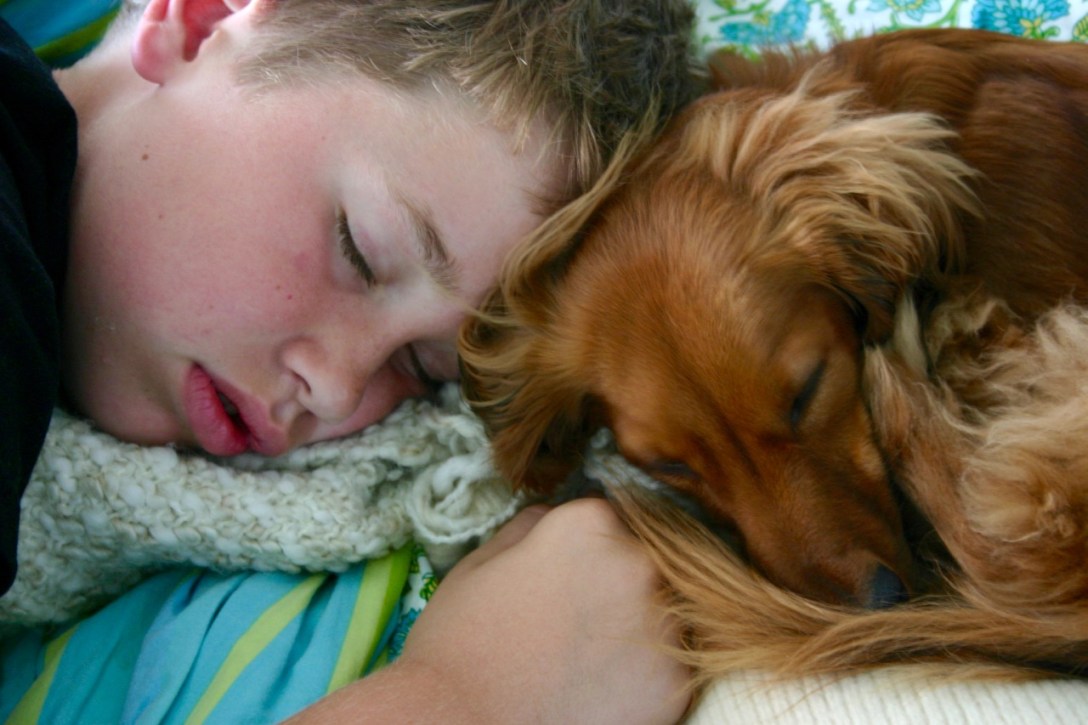
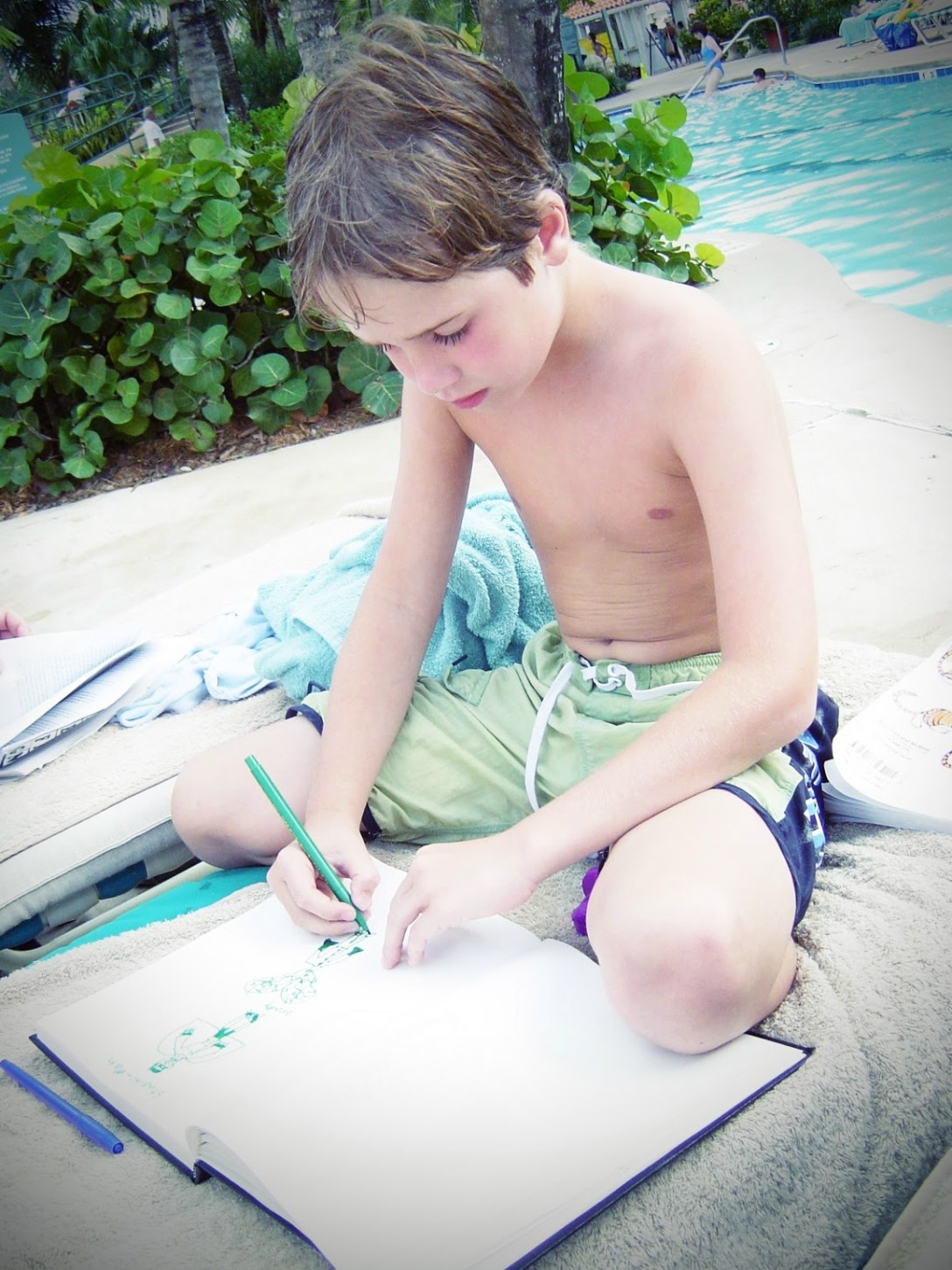
When Jack was little, we started collecting his drawings in books labelled the Collected Works of Jack Tea Gregory. Before he was in middle school, we’d filled a shelf with big fat volumes. I don’t know that we always thought he’d be an artist— we didn’t give much thought to what he’d be like as a grownup. But he liked to draw and he had a great imagination and he made a lot of stuff all the time and that was just the way Jack was.

Untitled-5
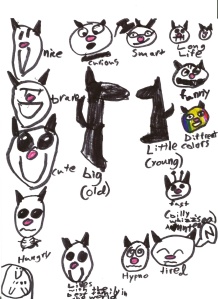
“Dog expressions.” From the Collected Works of Jack Tea Gregory, Vol. 3. 2002

After four years at the Rhode Island School of Design, Jack and five other painters had their final Senior show last night. People held glasses of ginger ale and milled around walls covered with paintings and videos and projections. Jack had three pieces in the show, a sculpture, a painting and teeny, tiny drawing and layer he lead us up to his studio to see the rest of the work he’s been doing since he came from Rome last Christmas. It was voluminous.

Jack has been working on a series of related works for the last few months, all inspired by an encyclopedia of dogs he had as a kid. There’re a half dozen large, monochromatic and semi-abstract paintings based loosely on dog photos. There is a series of drawings and sculptures about Pluto and Goofy. A fabric sculpture of Pluto wearing dog mask that was embroidered with images of Goofy. A paper sculpture of an articulated dog that ran when you turn a crank. There was a huge painting of an attacking German shepherd. An abstracted figure with a speech balloon and a blurred action stroke. A book with a soft embroidered fabric cover that was filled with stretched digital abstraction and debossed imprints of dogs.

DSC00902
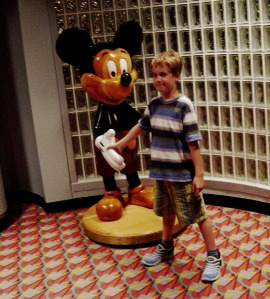
Jack and Mickey, 2002

He has been working on a long series on Instagram. Each day he’d make a crude, bulbous, clay sculpture of Mickey Mouse. The next day he’d destroy the sculpture and reform it into another Mickey and upload a new picture. It went on for months.

Jack’s work never offers easy answers. It’s not ironic even when it’s using pop iconography. It’s always filled with emotion and a certain lack of control. It evokes loss and a commemoration of the underdog. His subjects always feel abandoned and overlooked.

When he was 19, he made a series of little sculptures he set up in the lost corners of alleyways around town. They were made by a fictional homeless artist who worked with found materials and then abandoned the sculptures to be ignored by passers by. The final pieces themselves were photos of the sculptures and their environs. One was in the ATM vestibule of a bank, photographed by a surveillance camera. In Rome, he made an installation of grubby, scratched and bent photos in glass frames. One had fallen to the ground and lay smashed underfoot.

Jack is an upbeat, funny guy. He has lots of friends, is warm and open. But his work reveals a dark part inside of him, forged perhaps by Patti’s disability and death, by his concern for the underprivileged and exploited.

Jack has always been a defender of the downtrodden. In middle school he was preoccupied with slavery and wrote plays and made drawings about old slaves who had lost their power to work. He has always worried about racism and sexism and how animals are treated.

I am so proud of him.

His willingness to reveal his feelings in his art, to have such high and selfless values, to be committed to his own creativity — they all make me bewildered at my part in making him who he is.

I don’t know where his art is going. Or where his life is going. It is beyond my control, even my influence. I think it will be challenging at times, the life of an artist always is. But I know it will be rich with experience, discovery, emotion, beauty and truth.

It’s hard for a parent to let go. To admit that your child is doing things you can’t do, sometimes can’t understand. But I have enormous faith in Jack and his abilities and talent and mind. I can’t wait to see what happens next.

Jack Ruby’s Second Life.

Last night, JJ and I went to see a friend of hers have a dream come impossibly true. When Robin was in his late teens, he and some friends formed a band which they named Jack Ruby. They made music that was loud, distorted, punk. It was the early 1970s and that sort of things was very new, even in New York City. They played in their loft, and occasionally for other people.

After a few years of dicking around, Jack Ruby disbanded. The members got jobs, families, mortgages. Randy became the Ethics columnist for the New York Times. Robin became an advertising TV producer. Their Jack Ruby memories faded and dimmed.

One day a couple of years ago, Martin Scorsese hired Don Fleming and Lee Ranaldo (who used to be in a different band, a successful one called Sonic Youth). He asked them to help him make an HBO show about the music scene of the 1970s. At the core of the show is a punk band — the lead singer is played by Mick Jagger’s son.

In their research, the guys happened upon a bootleg tape of Jack Ruby’s songs and it blew them away. They decided that this music would be what the band in the TV show would play. They rerecorded the songs using authentic period instruments, the fake band lip-synched along, and Marty shot his show around them. Suddenly, finally, and out of the blue, Jack Ruby’s music is being heard by millions of people. It had taken forty years but the members of Jack Ruby had never intended it to happen.

Robin called up JJ one day and told her this story. He invited us to the recording of a radio show in which the guys from HBO would be interviewed about the show. At the end of it, the musicians would be performing the Jack Ruby songs. And Robin would be singing. He hadn’t been on stage since Jerry Ford was in the White House and his voice was shaking on the phone. Small wonder.

So yesterday, we went to see the show. The recording was in front of a live audience on lower Broadway, just a few blocks from Wall Street. We took an ear-poppingly fast elevator to the 20th floor and go out on what turned out to be one one of those collaborative working spaces where startups rent desks by the month and share wifi and espresso machines. About a hundred people were there to watch the interview and afterwards the band played. They were so loud we could barely hear anything Robin bellowed into the mic. It sounded awful and just like every show I ever saw at CBGBs. It was awesome and odd.

During the interview, the musicians had talked about coming to New York in the 1970s, about how exciting it was, about how there were all these overlapping cultures converging and sparking. American culture was transforming.

Three forces that would soon define today’s popular culture were emerging and NYC was Ground Zero. Downtown, CBGB was giving a stage for music that came to be labeled New Wave and Punk. In the Bronx, people were laying refrigerator boxes on the pavement to break dance and free-form poetry over spinning records, sowing the seeds of the rap and hop-hop that is today’s status quo. And in Bay Ridge, in gay clubs and eventually in Studio 54, disco music was upending Rock’n’Roll’s throne.

Because the tectonic plates were shifting, a few guys in a loft in SoHo could make noise that would make a difference. Despite never having a Soundcloud page or posting on Facebook or even releasing a record, Jack Ruby could still make a ripple. A ripple that still mattered when their hair was grey and their shades were trifocal.

While the band played, I kept thinking about where we were and how the world has changed. Here I was on a conference room chair in a co-working space. Every so often, a dude with a sleeve of tats and a man bun would emerge from his glass cube to make a macchiato, only casually interested in the piece of history being honored in his lobby.

He didn’t know it but this dude is the heir of the Jack Ruby guys. He’d come to New York to be a part of the scene too. He was one of hundreds of thousands just like him, dudes who packed up their fixies and plaid shirts and business plans and come to the Big Apple.

He’s a part of a creative revolution but one with extraordinarily different goals. These new dudes are not interested in the long dead music scene. No one makes a dime making records. Instead of smashing guitars or thundering baselines, the dude and his bros are coding VR headsets and delivery drones. Unlike Randy and Robin, the dude came to New York to get funded, IPOed, to be a billionaire by thirty.

As Jack Ruby’s last chords died out, I wondered, “Will anyone celebrate this dude’s accomplishments — in 2056?”