
The Sin of PRIDE
In the 21st century, it’s more difficult to see “pride” as a sin. We think of LGBT pride, Black pride, national pride, Bono singing “In the Name of Love.” Isn’t that song about Martin Luther King — surely he wasn’t a sinner?
Here’s a different take on pride. Actually let’s call it ‘hubris’ so no one gets confused.
Hubris is about insisting on your own greatness. In fact, that’s why Lucifer fell from heaven and ended up on the dark side. He insisted that he was greater than the rest of the crew. But, Kanye not withstanding, most creative people seem to have a problem with low self-esteem, not grandiosity.
But whereas they would never say that they are better than others, they insist that their work be. They judge their art too harshly, dismissing what they produce with contempt.They demand a higher standard than is reasonable, possible, necessary. They are absolutely intolerant of anything but perfection. It’s hero or zero. Whatever misses the mark gets binned.
If you can’t accept your own normal human weakness, isn’t that hubris? If you are completely intolerant of your own mistakes, isn’t that vanity? Aren’t you saying you can and should be perfect? If it’s a sin to judge others that way, why doesn’t the same apply to how you look at yourself?
If you are unwilling to be vulnerable, you are limited by fear. Overwhelming fear of any form of weakness, of being irrelevant, of being rebuked by others, of falling even slightly below the mark, can prevent you from taking chances. If you are so wary of falling on your face that you won’t take risks, you will never achieve anything great, no matter how high your standards.
Do great work, please, and be proud of it. But don’t let perfectionist, monkey pride stop you from expressing your real, human self.
Third in a series on seven deadly creative sins. Incidentally, and I say this with all due humility, the original list of seven deadly sins was written by Pope Gregory I. Probably no relation.
The Sin of GLUTTONY

Gluttony means consuming way more than you need. And it’s a great way for the monkey to distract you from your creative path.
Walking through a museum and snapping a picture of each painting you pass, then hurrying on to the next. Signing up for classes, then never bothering to show up and do the work. Why start that painting when you and your credit card could while away the afternoon at the art supply store? Easier to amass more drying tubes of paint, teetering piles of empty sketchbooks, basket-loads of supplies for crafts you doesn’t have the time to master — than bypass the monkey and get to work.
Gluttony means valuing quantity over quality. And we live in times of more, more, more, where there’s always a new distraction, a new treat popping upon our phones. Why do they call it a Facebook feed, d’ya think? Because it stuffs our troughs with trivia, 24/7. We consume bytes instead of being in the moment and appreciating the wonder and beauty around us already. We are gluttonous with our time and yet stingy with it too, wasting it rather than investing it in the self-improvement and habits that can bring us the things that will truly satisfy our hungers.
Gluttony is a sin of lost control. Like Lust, it drives out of our minds, to places we don’t recognize in the mirror. We automatically grab for more entertainment, more stimulation, more consumption, faster, longer, all of which distract us from our purpose, our skills, our deepening experience as human beings. We are unable to ignore the buzz in our pockets, the dings on our night stands, we drool and reach and feast.
Creativity is about creating something new, adding to the world of beauty, not just taking and acquiring.
Gluttony stems from fear. We are afraid of exposing ourselves, standing naked as we are. Afraid of being vulnerable. We cloak ourselves in a thick protective layer of shopping bags from Abercrombie & Fitch, Dean & DeLuca or Windsor & Newton. We need distraction from our true selves, from loneliness, from inadequacy, from being who we are.
The solution is to make more, rather than take more. Pull your excess art supplies off the shelf and give them to your local public school. Turn off all electronics a day a week and fill your time with songbirds and wind. Unsubscribe from distraction and sign up for a healthy diet of starving artistry. It won’t kill you, it’ll fill your soul.
Second in a series on seven deadly creative sins.
The Sin of GREED

Creativity, like songbirds, can be bought and sold. But songs sound differently from behind the bars of a gilded cage, when sung for a supper.
Greed makes artists compromise. They follow trends rather than their hearts. They measure success in sales rather than in the call of their souls. They agree to distort their work to fit corporate agendas and market demands. Greed turns originality into predictability into a worthless tin horn.
Ironically, greed rusts the very things that made an artist’s work valuable in the first place. Greed transforms artists into celebrities, hogging the limelight, addicted to fame, prisoners of their egos, and detached from the pure, original source of their creativity.
Greed distorts and cripples the true purpose of art, turning the fruits of personal expression into a mere commodity. An artist’s heart-felt response to the world shrivels into a rich man’s prized asset, garnering millions at auction, then hidden away, another coveted diamond on a dragon’s hoard.
The opposite of greed is generosity.
Greed prevents artists from sharing their work with the world, afraid it will be poached. Rather than joining a creative community, inspiring others, collaborating, teaching, sharing their insights and lessons, greedy artists hide in their studios, squirreling away their work, waiting for the best offer. They refuse to support causes, to contribute their creativity, to reap the benefits of selflessness.
Greed clouds perspective, skews values, saps generosity.
Greed is a symptom of fear.
When you are afraid of being deprived, you hoard possessions against any possible future famine, no matter how remote. When you are afraid of being passed over and neglected, left to shrivel and die, you hoard attention. Afraid of competition, you crouch on your mountain of toys so no one else and play with them. Afraid of being taken advantage of, you refuse to open the door to others. Afraid of being vulnerable, you amass a pile of any stuff than could be a bulwark or a weapon. You bank your work rather than letting it see the light of day and of possible critique.
Greed blocks your way. Generosity and creativity clear it.
First in a series on seven deadly creative sins.
The Month of Sleeping Dangerously

A month ago, I stayed up several hours past my normal bedtime then went to Queens to board a plane. After midnight, we took off and I stayed more or less upright in a middle seat surrounded by several people with sketchy notions about personal hygiene for a bunch of hours until we landed in Paris. It was noonish in France but about 6 a.m in my head.
I had a cafe au lait from a vending machine, then three hours later flew to Basel, Switzerland. Some lovely people met me at the airport, drove me to my hotel, then took me for a long walk and some snacks by the Rhine. They explained the general concept behind the mass transit system, pointed at the tram stop and walked me back up to my hotel. It was 9 PM in Basel. It was somewhere between 3 PM and 3 AM in my head.
The next morning, my phone, my ipad and my laptop all sounded their alarms. Apparently, it was 6:30 am in Basel. In my head, it was coffee time. At 7 AM, I was on what I really, really hoped was the tram to the International School of Basel. I spent 45 minutes staring at the tram map, crossing all appendages, and praying in German, Italian and French. At 7:40, I detrammed and walked into what I hoped was the school I’d be visiting for the next week. A few minutes later, the teacher who was my host gave me more coffee and led me into the school auditorium where I would address 600 students and their teachers. I did a good job, I think. They applauded raucously while I stifled a yawn and calculated that it was about 2 am in New York.
For each of the next five days, I worked with several hundred children from the ages of 3 to 11. They had loads of energy. I absorbed much of it and increased my caffeine consumption quite alarmingly. On a couple of nights, I took a half of one of the old Valiums I’d found under the sink in our bathroom. When I did, I slept till it was time for the breakfast buffet. When I didn’t, I read books and watched Swiss late night TV.
After the school day ended, I gave talks to staff or parents or visited an art museum. I had a magical experience on an ancient ferry boat. One night, I ate Wiener Schnitzel. Another night, I got a sausage roll at the supermarket. I avoided fondue, imagining it coming back to haunt me at 4 AM Basel time, 10 PM in New York. On my last night, I went with some friends to eat dinner in Alsace Loraine. That’s in France. In the restaurant, some children came up to our table. They had been in my drawing classes at the school. I pretended that I remembered them well and told them to make sure to visit me in New York.
The next afternoon, I flew to Rome. I spent four days with Jack, eating pasta, drinking beer, drawing domes and walking everywhere. I stayed in an airbnb in a 15th century Palazzo. The day I arrived, they decided to renovate the hallways. Each morning at 7 AM, Italian men would make sure I was awake and pound away the five hundred year-old plaster with hammers and chisels.
I dream about being late for buses, trains, planes, ocean liners, dentist appointments and giving speeches before the UN in the nude.
On my last night, before I was to leave for a 7 AM. flight, the neighbors had a five hour coop board meeting on the landing outside my door. At 10:30, I stood in the doorway in my underwear and made every pleading gesture I could think of to communicate my wit’s end. Italians understand gestures and despair and, by 11PM, they had packed up their ashtrays, card tables, and folding chairs. I considered taking the last half Valium but then imagined sleeping through the alarm and decided to tough it out.
I rarely set an alarm because I often wake up before it rings, sometimes a minute before hand. At other times, I wake up every hour wondering if it had gone off. I dream about being late for buses, trains, planes, ocean liners, dentist appointments and giving speeches before the UN in the nude.
One middle seat later, I arrived at JFK. As per my new self-employed habit, I took the subway home from Queens. My dogs were glad to see me, Jenny was at work. It was 2:30 PM in New York. It was 8:30 PM in Rome. I stayed up till Jenny came home, had dinner, and pushed it till 10 PM EST. Then I slept, sort of, till morning.
Two days later, we took a plane to Austin, Texas. the plane was slightly delayed and we took off at one in the morning EST. That’s 7:30 AM in Rome and midnight in Texas. I don’t remember when we got to our hotel or where we got up in the morning but we started our drinking early and then got on a bus to our friends’ wedding at about 5 PM, Texas time. The bride was from Dallas, the groom from New Zealand, so there were pyramids of beers and wines and shots and we danced until the wee hours We couldn’t get a flight out on Sunday so we decided to stay at the hotel at the airport to get an early start. The car picked us up before 5 am and we caught B6794, leaving Austin at 6:20AM.
My plan for the next weekend was to drive five hours, alone to New Hampshire to shoot a new set of videos for Sketchbook Skool. Then the media started predicting the first massive hurricane in two years heading our ways. Reviving fears of Hurricane Sandy, (we and much of NY were without electricity for ten days and my sister’s house was trashed), I decided to cancel the shoot. The hurricane never materialized so we spent the weekend hanging out and drinking too much on Saturday afternoon with a friend visiting from Virginia.
I spent thirty minutes trying to remember Christian Bale’s last name. Blaze? Blade? Bartofski?
Each night I would wake up at 8 AM. … in Rome. Only problem, I was in New York and it was 2 AM. But I am used to getting by on the occasional rough night of sleep. I come from a long line of bad sleepers. My mother generally rises and walks around like making tea each 4 AM. My grandfather took a schlurp of brandy and a Lunesta every night and he lived to be 98. It can get a little crunchy at 3 PM but, by 4 PM, I am usually filled with vim again and motor on till bedtime.
Not this time. The effects of my peripatetic ways finally caught up with me. I wasn’t sleepy. I’d just lost my mind.
One night, I woke up so I could spend thirty minutes trying to remember Christian Bale’s last name. Blaze? Blade? Bartofski? Then I tried to remember all the people who had worked for me at my last job. I spend all day, every day with them till just two years ago but I couldn’t remember who any of them were. Slowly, I worked my way cubicle by cubicle, remembering first names, then finally, surnames. That took me till dawn illuminated the NYU library across the street.
When I fell back asleep, I dreamt wildly — about apocalypses, unscheduled presentations, oncology visits, police investigations.
I didn’t have Alzheimer’s. Or lupus.
When I was fully awake, my memory returned intact. But my mood grew worse and worse. I became blue, then deeply sorry for myself, then downright bleak. I couldn’t write a blog post, couldn’t do a drawing, couldn’t think of an idea. I guess I looked sort of okay, but inside I was a basket case. (Way more than usual.) Not me.
I had weird aches and pains. I felt like I’d sprained my ankle. My stomach was constantly rumbling and sour. My teeth didn’t feel like they fit properly in my jaws.
Finally at the end of the week, I slept. Deeply, dreamlessly, untwitching for nine hours. Straight. Unmedicated. Flat out.
And then, only then, did I realize what had happened.
I didn’t have Alzheimer’s. Or lupus. I wasn’t going insane. I was just sleep deprived and a wreck after a rough month. I had to recharge.
What stuck me most was that it didn’t feel like normal tiredness. I wasn’t yawning and dragging around. I went to the gym. I went to bed at 10. I avoided coffee. I seemed normal and functional. But I was losing me. It was like half of my brain, my imagination. my judgement, were carved away. I was functional, mobile, but a zombie.
Sleep is crucial. Sleep is lovely. And I am making it a priority. I’ll be traveling quite a bit over the next few months but I’ll be a lot smarter about it.
ZZZ.
This post was just a way of blowing out the cobwebs, stretching the old grey matter and warming up the carpal tunnels.
Okay, that’s all for now. Hope I didn’t put you to sleep.
From to-do to Done Deal.

I frequently risk being the prisoner of my ambition. I dream big and often, then wake up exhausted with a long to-do list and a sense of dread. How will I get it all done? How will I climb this mountain I have built?
I sit at its base, exhausted by the possibilities, wrapped in a sense of failure before I begin. That sense threatens to keep me from the first step. And the longer I wait to begin, the further away the summit will stretch.
Not doing can easily become a reflex. Like a hoarder with newspapers to the rafters, like a 700 lb. man trapped in bed, like a refugee clutching a trash bag of possessions and a child’s hand, it can all seem too big to tackle. Submission to failure and the monkey can seem the only possible recourse.
But doing, like failure, can be incendiary. I start by taking on one challenge, maybe the easiest, teeniest one on the pile. When I have surmounted it, one checkmark on the epic list, I feel a flicker of hope. I pull the next task toward me and the flicker starts to smolder.
I make the bed, I got to the gym, I do a drawing, I write a blog post, I arrange a lunch meeting, I write a chapter, and soon the flames are roaring, wheels are turning, we are half-way up the peak.
Not doing can easily become a reflex.
Then, I sift through the list. I discard the pointless, the distracting, the indulgent. I break the most overwhelming obstacles into a small series of do-able tasks. I beaver on. Soon the list is a scaffolding, a set of pitons leading me hand-over-hand to the top.
Last night we watched The Martian. It’s a great move based on an even greater book. It deals with an impossible challenge: surviving on Mars, with rescue years away. The solution is increments — tackling one small problem, then the next, and so on. The more bite-sized the problems, the easier the whale is to digest.
Dream big. Start small.
Write on! A podcast interview

I was recently (9/24/2015) interviewed for a writers’ podcast called WriterAccess. Some interesting questions about the creative process, about how I write, about advertising, and more. Oh, and you can hear what my voice sounds like.
Check it out here.
La vita bohemien!
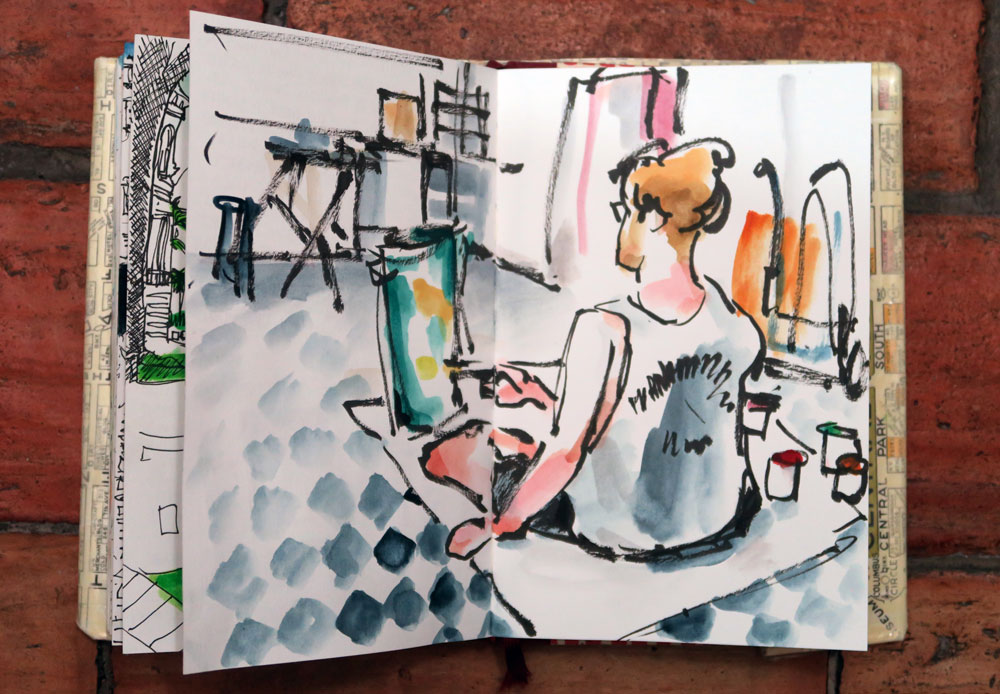
Ten years ago, I illustrated a book called A Writer’s Paris by Eric Maisel. It’s about why/how you could/should move to Paris, at least temporarily, to fuel your artistic impulses. It worked on mine — Eric’s publisher paid for Patti and me to spend a long weekend wandering around Paris and making many of the drawings that would fill the book. What a time!
I’ll be honest, I don’t remember the book’s argument in detail. I was irritated that the publisher thought to combine my drawings with some collage artist’s work and so I couldn’t read the final version of the book with an open mind. That peevishness notwithstanding, the basic premise of Eric’s book came back to me as I sat here in the Piazza Benedetto Cairoli with my Macbook on my lap. I’ve been in Rome for less than forty eight hours, but the magic of a different continent, city, culture, place and pace is already working on me.
 At Jack’s suggestion, I didn’t book a hotel room but found an AirBnB just a few meters from the door of his school. It’s a fourth floor walkup in a 15th century building with a giant front door key and iron shutters I swing open each morning to flood my room with sunshine. As I sit here in the Piazza across the road, I hear the tram rattle by, the chuckle of an accelerating Vespa, the doo-da, doo-da of the carabinieri, and snatches of Italian wafting over from the men on the next bench, smoking and joking. I’m not in Kansas anymore.
Being in a new place always open my eyes and ears. Everything is unfamiliar to some degree, a degree that inspires my record in ink to be deeper and fresher. My travel journals contain the richest pages on my shelves, the most experimental, the most free. Each day in a new city is both energizing and depleting. I strain every hole in my skull to suck in more and more information and end the day wrung out and deep in sleep.
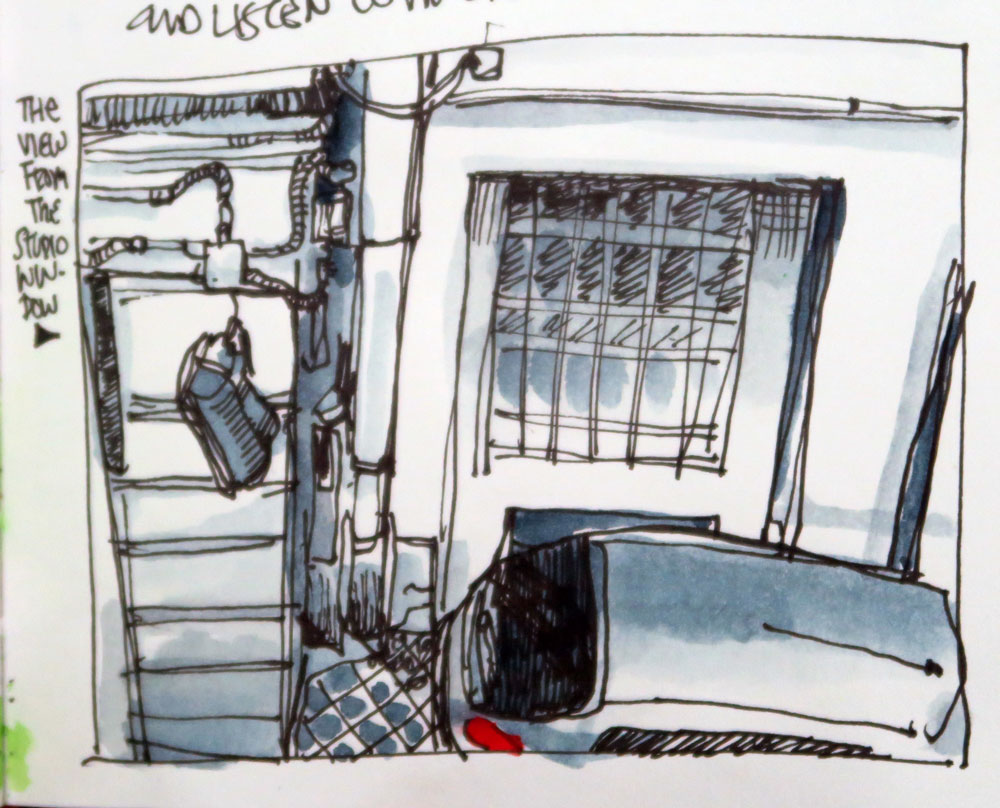
Hanging out with my boy in his new city makes my imagination run wild. He lives and works in a gorgeous old building, a 15th century villa with frescos on the 16 foot ceilings and huge windows flung open upon mouldering terra cotta walls and stone alleyways strung with phone wires. His bed is narrow and hard but he has his own studio, bigger than our living room, with a checkerboard marble floor and walls filled with sketches and pages pulled from the old Italian magazines he buys at the flea market. A few blocks away is a park full of Roman ruins, fenced and gated to protect the hundreds of ferrel cats who’ve made it home. The Jewish Quarter is full of street markets selling big blocks of mozzarella and cadres of prosciuttos in chrome slings waiting to be shaven. Jack has learned to make pasta from scratch and to order a cornetto and a cappuccino with confidence.
He has less than a year till he graduates. But something in me tells him not to worry, to take it slow, to revel in this season in Italy, that it will be something he never forgets. Last week, he and his classmates traveled to Abruzzo and put on a performance in the earthquake ruins of a tiny village. Next week, he heads to Venice to sleep on a boat. I tell him that for the first year or two, he can keep his needs modest, can earn money here and there, can work on being a man of the world rather than a slave of the wage.
 I spent a year in a garage in LA. And then I came back to the Manhattan haunts I had commuted through for decades, a new perspective on the same streets. It would be nice to have a garret here in Rome. Or to couch surf across India like Prashant. Or to get a cabin in the woods or a minihouse I could pull behind my car. It’s hard to eat leftovers with the same relish, but certainly New York is the kind of place I can have creative reawakenings, just like Eric’s Paris or Jack’s Rome.
Going somewhere fresh and rich and living just for one’s art for a period, that’s something every creative person should try, methinks. Forget the pressures of income of language and culture and history, just for a month or two, long enough to rearrange the pieces and shake the monkey back into his hole.
I don’t know that I need an adventure so complete, to completely pull up roots and repot on foreign soil. More likely, the many trips I have planned over the next few months will suffice. Next weekend, I’ll be in Austin. Then to Prague, Doha, Reykjavik, maybe Hanoi too. Shifting perspectives, fresh pages in my travel journal, the search for adventure, new faces, new menus, new conversations, all adding up to a big thick deck to shuffle and deal myself out another winning hand.
A new interview
I was just interviewed in a special magazine for teachers. But you might like it too!
Check it out here.
Corrupting the youth of Switzerland.

I’ve just completed the first leg of my European crusade: a week in Switzerland. Basel is a lovely medieval city along the Rhine right on the edge of Germany and France. It’s home to loads of banks and pharmaceutical corporations and two dozen museums — some with extremely contemporary contemporary art, one which is the size of a doorway.
I’ll tell you more about my visit to the city in another post. Today I’ll just try to summarize why I was there.

Last winter, I was invited to be an artist-in-residency at the International School of Basel this September. Perhaps you remember that a year ago, I was in residency at another ISB (the International School of Beijing) and had a lovely and illuminating time, so this invitation was very welcome. I was pumped to spend more time with kids, making art, and wallowing in their creative energy. Additional pluses: I’ve never been to Switzerland and, of course, Basel is a mecca for art.
My week began with a school assembly. Six hundred children under the age of 11 sat on the ground while I introduced myself and talked about all we would do in the week ahead.

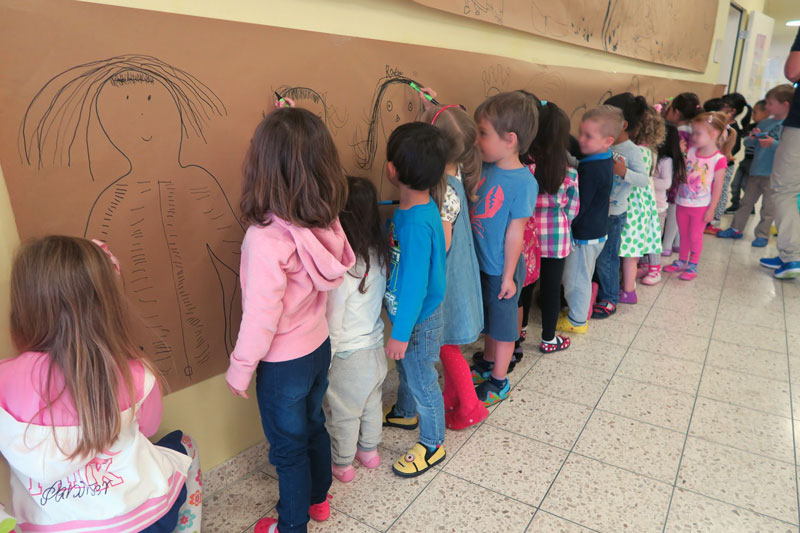
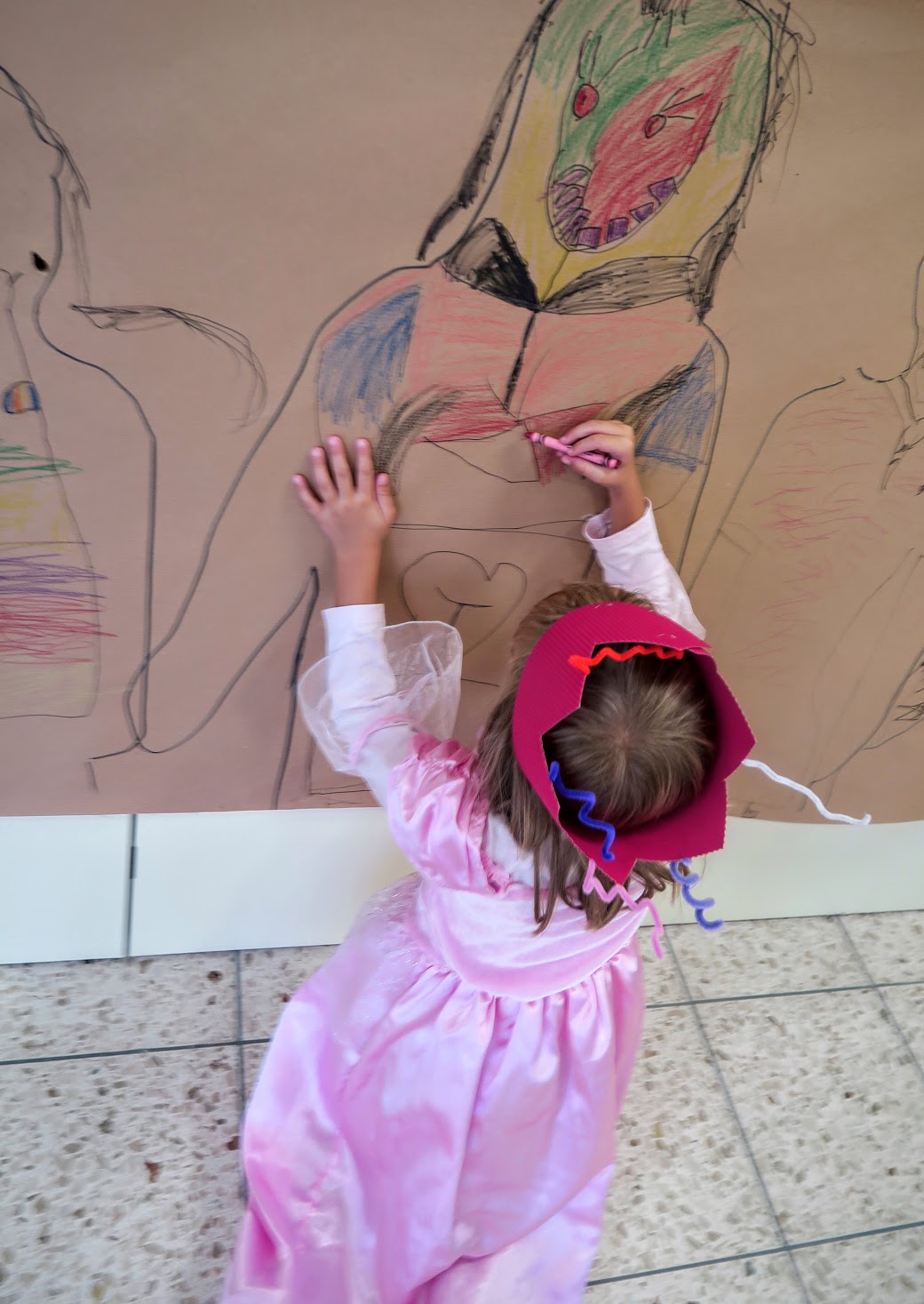
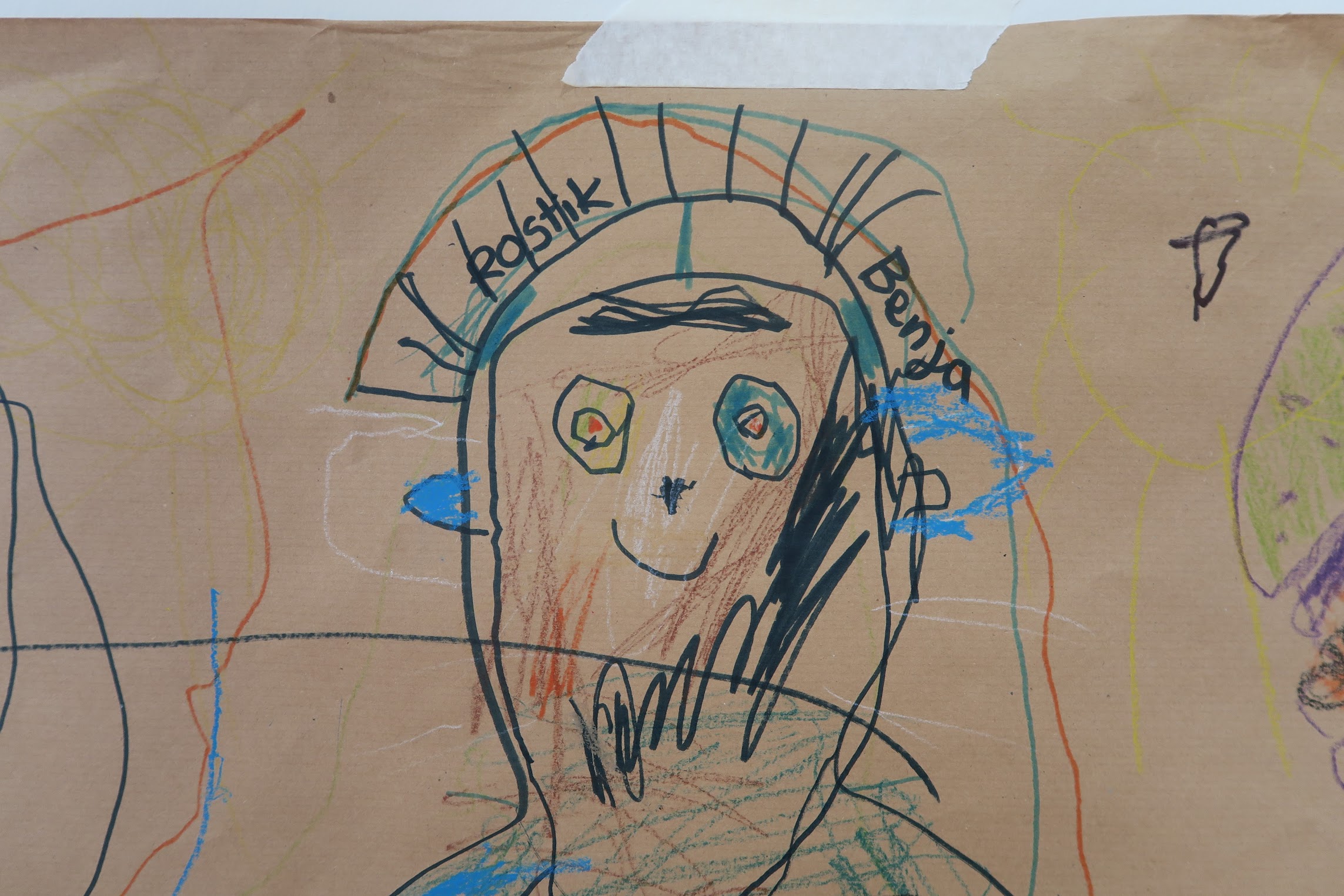
Then each morning at 8:15, I’d let a couple hundred kids and their teachers into my gigantic office/studio/lecture hall and showed them films and gave them creative assignments. We drew breakfast and lunch and shoes and upside-down bicycles and portraits and more. We made enormous murals that covered all the halls and stair wells. We ended the week with a sprawling field trip to the natural history museum to draw dinosaurs and endangered animals and then drew the cathedral and the twisting medieval streets.
It didn’t stop in my classroom. The kids went home at night mad for drawing. Each morning, moms and dads came into the school with stories of kids transformed. They filled up sketchbooks at home, drew with their parents and teachers, insisted that nobody eat their dinners until they had been drawn.

After school on Tuesday, I met with all the teachers and showed them how art had opened my eyes. I told them that art is not just for art class — it’s for learning about the world and can be applied to any discipline, from literature to social studies to science to music to gym. I pulled out examples of my travel journals, of my investigations into homelessness, fishing in Manhattan, and dogs in coats. I showed them my maps and Koosje’s recipes and the SBS students’ instruction manuals.

The next day, an inspired math teacher asked her 4th graders to make drawings that explain the concept of ’rounding up’ numbers. She showed me dozens of stories and watercolors the kids made in response to her assignment. They were all different, all clear, all beautiful. She was able to see how well they understood the concept and they could use their pieces to teach the 3rd graders this concept.
On Thursday evening, I met with the parents and told them why I had come to Basel and why I thought it mattered that their kids had started keeping illustrated journals.
It was to prepare them for the future — not a future as professional artists necessarily, but as successful people in an ever-changing world. The days of being able to assume that a well-educated person could finish school, get a corporate job, and rise up the ladder till retirement, are over. Instead, kids need to be prepared for the unforeseeable. Technology is upending every industry, traditional jobs are withering while new opportunities are springing up in surprising places. Change is the constant. Kids need to learn to swim in it.
Parents can no longer assume that a traditional education in math, science, literature, language and history will be enough prepare a child for the future. A crucial new skill will be the ability to think creatively. That doesn’t mean dabbling in fingerpaints, but knowing how to spark innovations, to develop ideas, to present them clearly and persuasively, to find resources and collaborators to bring them to fruition, to build networks, to be entrepreneurial. I told them that’s why I supported my own son’s plan to go to art school, so he could learn skills I think will be essential to his future. If he had majored in English or pre-med, I wouldn’t have the same sense of confidence that I had given him the necessary tools.
I told them that they should look at art not just as a sign of being cultured, a middle-class luxury, but as a key component of their children’s total education. I suggested they insist the school’s administration support and look for ways to incorporate art and creativity into all aspects of the curriculum.
If a student is encouraged to look everywhere for inspiration, to combine ideas into new ones, to replace competition with collaboration, to accept mistakes and ambiguity and learn from them, to have faith in the creative process, to know how to overcome its pitfalls, only then will he or she be prepared for a world full of self-driving cars, delivery drones, mobile apps, and Donald Trump.
Knowledge alone is no longer power — it’s something that pops up in your browser. Knowing how to use that knowledge to create new ideas and solve new problems, that will be the source of true power, a power that will serve all mankind.
 Danny Gregory