Reading me.

I don’t usually read my books for a long time after I write them. I’ll have some occasion to look back and read what I wrote and the experience will be quite odd. Sometimes it will seem familiar, and very much me. At other times, I’ll think, “Did I really say that?”, sometimes with pleasure, sometimes with dismay.

Often I am possessed by some other version of me when I write, a version that is a co-creation of the book itself, the inexorable march of ideas and words that surge forward as I write at length, ideas taking on their own voice, connections stopping out of the shadows. That’s one of the prime pleasure of writing, how the process takes over. When I wrote a novel a few years ago, I was constantly surprised at things the characters said, at the way bits of plot came full circle to tie up ends, at the life the story had quite beyond me. I sometimes think back on the characters, wondering how they are now, as if they lived on even though I stepped away from the keyboard.

I can have the same feelings when I draw. I begin with an impulse of what sort of drawing I want to make but invariably where I end up is pretty different. Making a drawing, like writing, is an exploration, an adventure. The destination is subject to change. My mission is to discover myself. And sometimes what I find may be pretty unfamiliar and surprising.

I write my books. But I read them too. And I hope I’ll always get lost in their pages, lost so I can find something surprising and new.
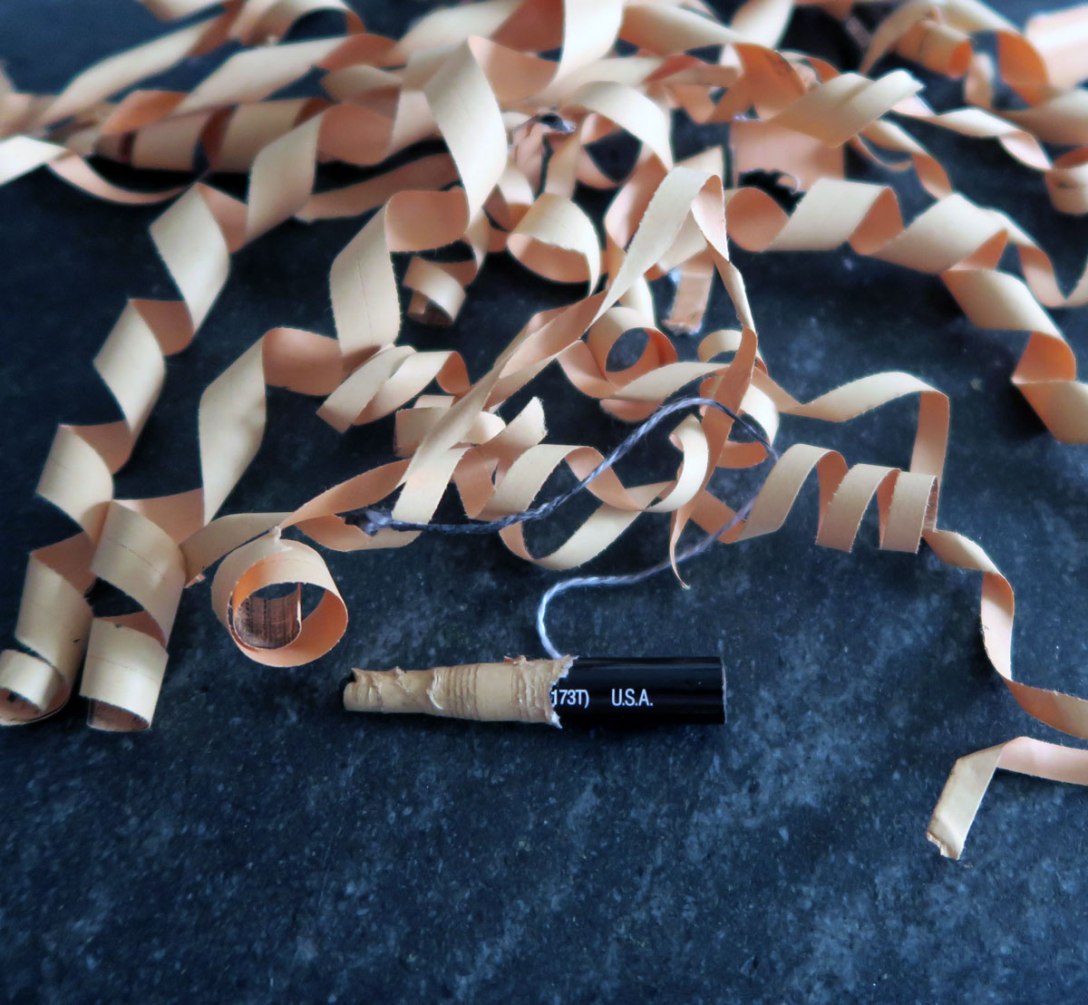
Keeping the fun in fundamentals.

Teaching yourself to make art is a lifelong endeavor. Books and courses will help but it’s up to you to keep the work interesting and relevant.

Look for creative ways to keep practicing the basics, like contour drawing, proportions, foreshortening, tone, shading, volume, etc.

Don’t make drills dull. Find ways to mix things up. Draw things that mean something to you.

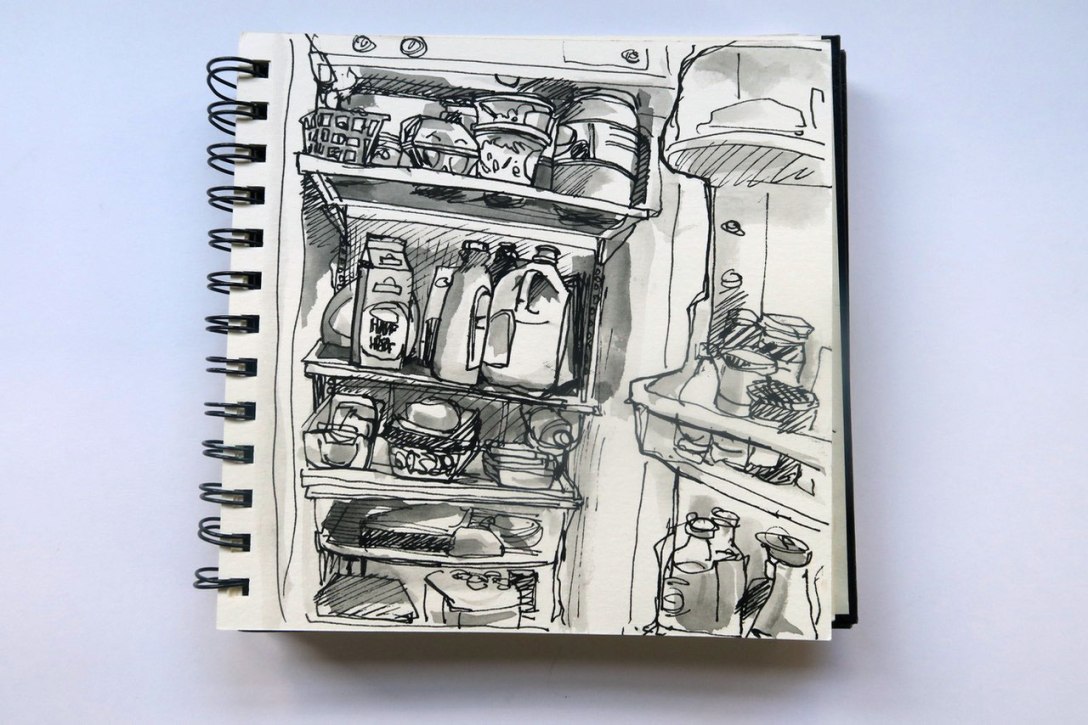
Instead of setting up artificial subjects like bowls of fruit or vases of flowers, draw the contents of your fridge. Draw the roses you got for your birthday and write about how you feel getting a year older. Instead of drawing naked strangers in a life drawing class, draw your naked spouse, your cat, your boss. Rather than doing “Drapery studies,” draw the shapes your feet make under the covers on a Sunday morning.

Be inventive. Be fresh. Be personal. It’s an adventure, not a chore.

Monkey break

I am taking off from my blog today — to work on illustrations for “Shut Your Monkey.”

See you on Saturday.

Working out the bad

Recently I have been doing a lot of drawings that emerge for the womb of my mind with dents and lumps and stork bites all over. They look just ugly to me, five minutes in. I know this is a function of my being out of shape — I need to keep limbering up my powers of observation and forcing myself to slow down.

To deal with these lifeless pups, I turn to advice for my old pal, Tommy Kane. If you took “Beginning” at Sketchbook Skool you will remember his lecture exhorting us to keep working on bad drawings, massaging them until they cough, splutter and start to breathe.

I have been wondering why this works.

Is it like taking a wrong turn early in the journey and then continuing to drive, circling, perambulating until eventually you get back on track, slowing down, recalculating, finally getting oriented, our earlier mistakes now buried in many miles of tire tracks?

Or maybe you keep making mistakes, more and more inaccurate observations, until they all even out, balancing too long with too short, too left with too right. The mean is accurate.

Or does all the effort show, the layers, the thousands of strokes, the many decisions all evident on the page so they coalesce to exude an air of confidence that make the early mistakes seem intentional, now polished and upholstered in finger sweat?

Regardless, the act of concentration and dogged perseverance clear my mind, assuage the pain of earlier blunders to bring me a doodly peace.

Once again, drawing is like living. Perseverance will out.

My ever changing moods

How do I explain who I am and what I do? Some people know me as a blogger, some as an author, others as an Olympic gold-medalling shot putter. To bring all my myriad facets into one place, I have just created a bulging new website, located appropriately enough at dannygregory.com.

If you are curious, satiate yourself here.

If you share my passion for Paul Weller, then your time will be better spent here instead.

I’m the best!

Maybe I’m not the best writer.

Maybe I’m not the best artist.

Maybe I’m not the best thinker.

But I am supremely qualified to do at least one thing. Here’s my superpower:

I’m the best person to write what I think.

I’m the best person to draw the world through my eyes.

I’m the best person to express my point of view, my experiences, my mistakes, my shortcomings, my strengths.

When I compare myself with others and what they make, when I think, ‘Oh, I could never do that!’, it’s easy to forget my superpower.

And if I do, I won’t express myself — and no one else will.

And even if they were to try, they couldn’t to do it as well as I could. So, it’s up to me.

Learn from others, but don’t wish to be them. We all have unique ways of seeing the world. And we all have our own, priceless way to express what we are.

Have you used your superpower yet?

Five beautiful things I saw today.

I looked up from my book and glimpsed the setting sun reflected in a window across West 3rd Street. It was enormous, an incredible, unnatural, cherry red. I rushed to the corner of the terrace to look at the actual sun but it was hidden behind a tangle of water towers and satellite dishes. I watched the last slivers disappear in the mirrors of my neighbors’ picture windows.

In the park, a woman in a black pinafore spun lime green hula hoops ’round her hips, her waist, and knees, and then suddenly convulsed and folded them all into a single shape, a globe with all its meridians demarcated by the buzzing hoops.

The fur on Tim’s back is curly as Persian lamb today. The air is still but he is knotted and wavy. His fur is a dusky rainbow: eggplant, auburn, battleship grey, matte black, all threaded with silver highlights.

I went to Jack’s room to put away some towels. On his top bookshelf, the albums of his drawings that we collected when he was just starting to draw, aged 2 to 4. On their spines, they’re labeled “The Art of Jack Tea Gregory, Vols 1-4.”  On the shelf below them, arranged, apparently in the last few weeks, a row of books of art notes Jack’s been making this year.  Each is labeled with a Brother P-Touch that I didn’t even know he had.  Those two rows of books encompass the last twenty years of his life. And of mine.

At least seven blocks away, there’s a railroad apartment. It has windows at the west end near me and at the far eastern side. A slice of sky is visible through that far window and, across that bright patch, the silhouette of a person passes back and forth. A single leaf on the crabapple tree across the street appears larger than that tiny silhouette yet somehow, I am connected, and know something about how that miniature person feels, pacing so many blocks away.

Bulletproof

I saw some cops having lunch at the diner the other day. There were three of them, big guys crammed into a booth, working through sandwiches and fries.  They each wore a heavy leather utility belt with a flashlight, handcuffs, mace, a Taser, a notebook, a radio, a nightstick, a big handgun and God knows what else.  These cops sat very erect — under their uniforms, their torsos were girded in a thick bulletproof vest.

When their meal was done, one officer reached for the bill — but it slipped out of his grip and fluttered to the floor. He leaned over, grunting, to pick it up. Straining and cursing, he couldn’t bend in the middle to reach it. The gun, the vest, all the clobber had him strapped down and inflexible. Eventually, the waitress saw his predicament and darted down to lightly pick up the bill and replace it in front of him.

Life can force us to armor up. As we endure traumas, abuse, poor judgment, we layer on defenses to protect us from what has happened. As they say in the Pentagon, we are always preparing to fight the last war. But many of our shields are redundant, obsolete, and confining. As we bolster ourselves against more and more possible eventualities, we become like medieval knights struggling to get back on the horse under a load of steel plate.

Do you need it all? Look at your ramparts. Monitor your reactions. Check your gear and see if, maybe, you can lighten your load.

Spine-tingling

My uncle Michael published half a dozen books. Everyone in our family prominently displayed their set. A foot-long row of familiar spines standing proudly together — his books, his name repeated across them. I envied the pleasure I imagined that gave him, that cube of honored real estate.

I made my first book when I was six. A stack of deliciously thick paper. The smell of library paste, a smell I can taste (probably because I did). A clear plastic sleeve filled with a rainbow of markers. Brass paper fasteners.

I treasured the pleasures of bookmaking. Carefully lettering my name on the title page. Alternating pages of drawings with pages filled with large, neatly penciled letters. Numbering all the pages. Making up the front matter: the publisher, the copyright, the dedication. Conjuring up blurbs from my favorite authors to put on the back.

My biggest regret: my books never had a proper spine. I couldn’t run my name and title and the Dewy Decimal number down the edge. It didn’t look right on the shelf.
But that was a minor blunt to my pleasure. I was still “an author”.

A half century later, whenever I visit a book store or a library, I always, eventually, wind up looking for my books on the shelf. I can spot them from across the room, familiar faces in a sea of stripes, like spotting my son on a crowded playground.

No matter how many books I publish or sketchbooks I fill, that boyhood thrill is still there. I love the shelves of books I’ve made, all together, spines aligned like little soldiers.

Oh, BTW, I am soon gonna add a new spine to my collection. Shut Your Monkey: How  to control your inner critic and get more done is in the design/illustration phase and will soon head to the printer.  It’ll be on the shelves of your local bookstore this fall.