Soup.

I’m a big, fat vat of soup.  Deep below my surface, I am roiling, ingredients churning, interacting, breaking down to add flavor and texture.  Sometimes I’m hot and bubbling, giving off a delicious aroma. At other times, I’m tepid and lifeless, the gas off, a greasy film forming, unappetizing, dull.

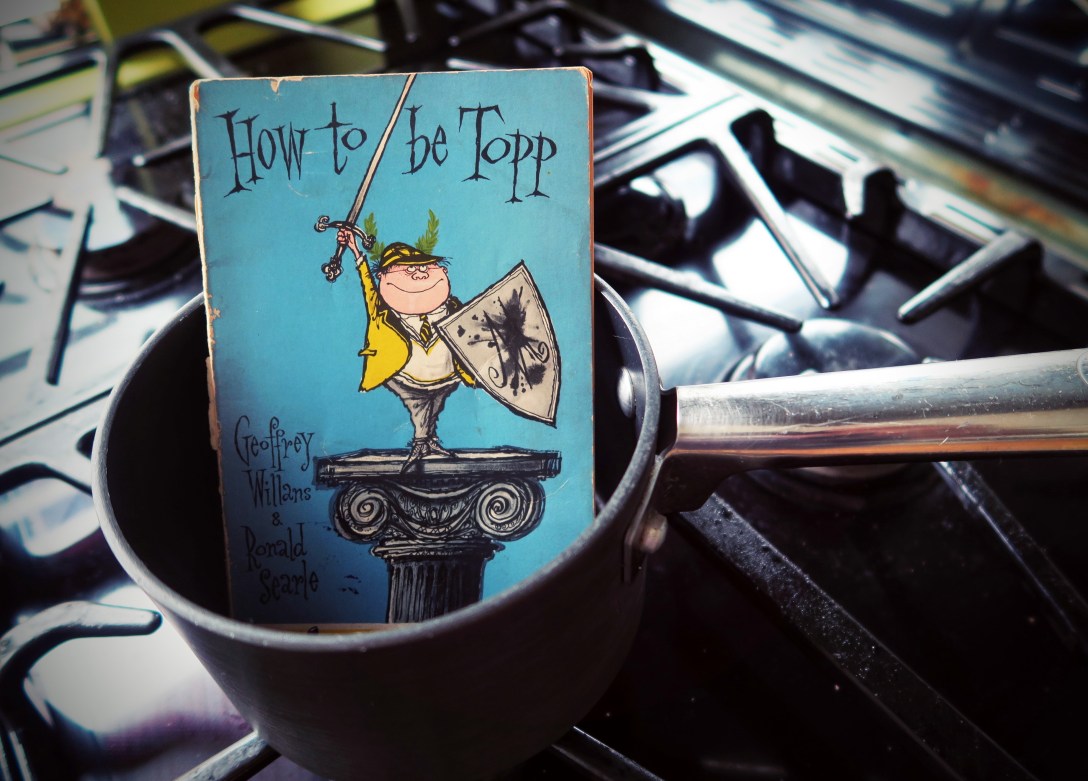
What’s in the soup? Well, let’s dip in the ladle and fish out an ingredient. Ooh, it’s a book I’ve owned since I was eight, dog-eared and well-thumbed, its browning pages loose in the binding. How to be Topp is a satire about success written by a fictional school boy. It’s a fairly silly book and I don’t think I’ve ever read it all the way through. But it was illustrated by Ronald Searle and its pages are full of splatters, spidery calligraphy and loose, scratchy drawings. I may not look at this book for years but it’s in the soup, adding its flavor.

When I was eight I read a lot, several books a week. It’s a pattern I have kept up ever since. Each of the many books stacked on many bedside, in my Kindle, on my phone, and my desk, all end up sliced, diced and scraped into the soup. Many of them break down completely, their pages diluted, vanishing from memory. But each sentence, like a single granule of salt or a delicate frond of dill, though disintegrated, has added  a few more molecules to the flavor and body of the soup that is me.

There are the Grove Press books on the top shelf of my grandfather’s study, “grownup up” books I climbed up to purloin and read in private. There are all the Gerald Durrell books that fed my fantasies about raking through the jungles of Borneo and Brazil for aardvarks and toucans, kitted out with a solar topi and a butterfly net.  There are 92 volumes of PG Wodehouse, Professor Branestawm, Raymond Chandler, Geoffrey Chaucer, Spiderman.

There’s the girl I kissed in David Heller’s basement in 1975, the bucket of coffee cooked over a campfire on a patch of Israeli wasteland one dawn, the snow boots my mother made me wear that were too big and made me trip over every hummock of snow in downtown Brooklyn. There’s my dog Pogo’s third litter of puppies, two stillborn. The boss who yelled at me while eating an egg salad sandwich. My first Rapid-o-liner. My second stepfather’s broken toe when he kicked in the door of my mum’s MGB. All are bobbing in the drink, coming up to the surface, then subsiding like Moby Dick into the darkness below. There’s Moby Dick, Holden Caulfield, JJ ‘Dynomite’ Walker, the English Beat, my Latin teacher, Jenny’s stuffed hippos, Jack’s soccer cleats, my Pakistani orthodontist.

My soup is rich and complex and like none other, a unique combination of stuff that has been cooking for decades. It contains some ingredients found in your soup, maybe lots of them, but the way they interact with the rest of the bits and bobs bobbing around is all mine, all me.

This cauldron of soup is the source of all I create. If I write a story, make a drawing, come up with an idea, it’s all because of this big bubbling vat of experiences and influences. If I neglect the soup, forget to add new spices, fail to stir it up and fill some new bowls, let the pilot light go out and the temperature cool, the soup becomes anemic and tasteless, a bland consommé that’s forgettable and without value.  But if I work the soup, it fills me up.

Being an artist or a writer means reading, looking, listening, cribbing, copying, from a zillion sources. That’s much of our job. These slices of inspiration may have disproportionate effect when they first enter the soup, big undigested chunks that are too obvious when they show up in the work. But over time they break down and dissolve, leaving only ripples that intertwine with others to form a new flavor note, subtle and unique.

We are all vats of soup. Make sure you tend yours, stirring and adding new ingredients every day. Keep the hot on medium-high and take the lid off now and then. And don’t be afraid to dish it up to share with others, to pour a few tablespoons into their tureens. I want to taste your soup. Here’s a spoonful of mine.

Pep talk.

Having trouble starting your creative habit?
Wrestling with the Monkey in your head?
Here’s a helpful little video I made for you — with some assistance from Shia.

Caution: Contains a little, well, yelling — which may offend those with delicate sensibilities and fragile eardrums.

The Dangers of Dabbling

You may be good at several things.  You may be one of those “creative types” who cooks and weaves and writes poetry and plays the ukulele. I’m there. I am a dabbler in all sorts of things. I love plunging into new skills, learning the basics of HTML5, then editing film, then painting with gouache, then roasting a chicken.

But I know, not even that deep down, that I am not getting all I can out of any of these skills. That I am still envious when I see someone doing something truly great at which I am only marginal. I know they are getting far more out of this art than I am.

Being great at something takes work.

Doesn’t matter how talented, how smart, how connected you are, you have to focus and work to refine you skills and your vision. That can be painful at times; how much easier to find another meadow to graze in.

Here’s an interesting phenomenon: the famous, would-be poly-tasker. Michael Jordan leaving the NBA to play baseball for one dismal season. Eddie Murphy recording a disco album. Fame brings opportunity: who was gonna tell Allan Iverson not to record a gangsta rap album? When Picasso read his poetry at Gertrude Stein’s salon, she said “Pablo, stick to painting.” And then there’s James Franco. But being a genius in one field doesn’t effortlessly make you Leonardo.

I wonder how many people get sidetracked from their true calling by the fact that they have talent to excel at more than one artistic medium. This is a curse rather than a blessing. If you have only one option, you can’t make a wrong choice. If you have two options, you have a fifty percent chance of being wrong.
— Twyla Tharp

I’m not saying, “Stick to your knitting.” It’s quite possible you don’t need to excel at at one thing, that you are content playing the field. For you, creativity is just a hobby, and you don’t want to invest in any particular medium or metier. If so, good on ya — but know what you are giving up. When you focus on the thing that you were born to do, work hard and really push yourself, you will find new pleasures, deeper, richer, more fulfilling experiences that dabbling will never provide.

Do some self-examination and listen for your true calling. What do you feel in your marrow? And are you investing all you need to to achieve your own personal form of Greatness® there?

Enter your email address to subscribe to this blog and receive notifications of new posts by email.

Finding fulfillment

Recently, I have been reading the amazing biography of van Gogh by Steven Naifeh and Gregory White Smith. What a story! Vincent tried so many things before turning to art. He was desperate to find a vocation and devote his life to something that his family would think was worthy. But nothing stuck. He tried being a print dealer, a clerk, a schoolteacher, a minister, a missionary, and each time, despite starting with intense enthusiasm, he gave up and wandered away.

Getting good at something involves two, related factors.

One — you have to work at your skills. Practice, experiment, research, study, and come back to work, regularly, for an extended period of time. I don’t care who you are or what talents you think you have, working at your craft is crucial to greatness. Experience makes you better, more facile, more intuitive, more apt to come up to some new and great. There may seem to be shortcuts. They are illusions. Even one-hit wonders work their butts off for years. Vincent was certainly willing to put in the work — but he couldn’t stick with anything. Why?

The second factor is purpose. This is more complicated than just wanting to be great at something. It’s about your calling. What must you do even if no one ever saw you doing it or paid you to do it? What will you stay up late to do? Skip meals to do? Do until your shoulders cramp and your hands fall asleep? What completes you?

We all have something we can excel at. It might be throwing a football, making a sauce, curing disease, building a house or running a country. If you can’t think of what that is, you just haven’t found it yet.

When you discover this purpose, it will fuel you while you do all the work required to be good at it. Without it, you won’t get far. But to find your true purpose, you must be brutally honest with yourself.

I took a creative writing class in college. When the professor told us we needed to submit a story each week, one of my classmates groaned, “A story every week? That’s required?” The teacher paused then said, “Why are you here?” and we each looked into our souls.

You can’t pick a purpose because it’s fashionable or lucrative. Don’t take up acting just to become a celebrity. Don’t go to graduate school just because no one will hire you. Don’t become a missionary just to please your dad. Write because you have to, not because you want to be “a writer”.

Finding your purpose can take work too. It means exposing yourself to lots of different experiences until something clicks. Watch YouTube videos, observe people running different kinds of businesses, wander through museums or hardware stores, ask strangers what they do and why. What draws you in?

Look into yourself and your past. What were the moments that brought you the greatest happiness? When did you truly feel you were you? Where were you? What were you doing? What was the essence of that moment? Was it about helping others? Making something with your hands? Solving a complex problem? Organizing chaos?

You can discover your purpose at any age. You might be young and starting your career. You might have spent thirty years doing something indifferently because you had to bring home the bacon. It’s not too late. Vincent discovered his purpose just ten years before he died. But it gave his whole life meaning.

Can you live yours without it? Should you?


{Thanks to everyone who commented and emailed after my mea culpa post yesterday.  Your understanding and encouragement mean the world to me.}

Why I started to suck & how I plan to stop.

Let me be honest. Over the past few months, I’ve abandoned this blog — a vital part of my creative life for the last dozen years. I have been just using it as a soapbox for hawking books, talks, interviews and klasses. I’ve ignored why I’ve kept it for so many years: to explore my ideas about creativity and my experiences as an artist and a human being.

Where did I go wrong?

To find the answer, I’ve been doing a lot of self-analysis and reflection. And I’ve realized that I started to lose my perspective last September, around the time that Jenny and I drove across country, leaving sunny Cali behind for the familiar grey canyons of a New York winter.

This wasn’t how it was meant to be. When I left my advertising job almost two years ago, it was to set myself free. I wanted to slow down, to paint, to draw, to write, to ruminate, and to see if the path I had been following since college was in fact the best one for me.

Moving to LA with Jenny scared me at first but I understood myself well enough to know that, if we stayed in New York, walking the same streets I have for decades, my resolve to leave advertising and pursue my own path would be sorely tested. Before long, someone would tempt me into putting on a jacket and tie and sitting in a conference room once again. I had to get outta town.

Before long, someone would tempt me into putting on a jacket and tie and sitting in a conference room once again.

Going West transformed me. I fed hummingbirds, bought a truck, grew kale in the backyard, built a studio in my garage, made Art Before Breakfast, met Koosje on my travels and we launched Sketchbook Skool.

The first six months of SBS were amazing. It was mind-blowing that so many people signed up straight out of the gates and we were having an absolute blast working with talented friends and seeing our dream come to life.

Our ambition was grand: ‘art for all’ was our mantra from the get-go. We wanted to inspire people everywhere to start making stuff. We wanted to capture the sketchbooks and processes and ideas and experience of brilliant artists and share them with anyone looking for a fresh start.

At first, we thought, let’s just make it free — but we discovered that would mean a severely compromised version of our vision. So we settled on charging the minimum that we could to still deliver on our promise to pack each klass with quality. But charging tuition led us into a whole new world.

Welcome to Capitalism®. If you take money, you must have a bank account. To open a business bank account, you need to be a corporation. To be a corporation, you need a lawyer and accountants. To operate globally in a non-traditional business, you need more lawyers and accountants. Soon, instead of spending all our time making videos with our friends, we were doing a lot of administrative work that was not in our DNA.

We live in a time that celebrates entrepreneurialism, where twenty-year-olds assume they’ll be billionaires, where people make a living selling artisanal okra instead of taking corporate jobs. There are endless online tools and services that entice anyone anywhere to start a corporation, set up a website, and be a star.

We live in a time that celebrates entrepreneurialism, where twenty-year-olds assume they’ll be billionaires, where people make a living selling artisanal okra instead of taking corporate jobs.

I knew the appeal. Although I started a Marx-Engels study circle in high school, I spent much of my career writing poetry about business, corporate manifestos, sixty-second Super Bowl commercials about ideals and values and romantic visions for the future of mankind for my clients.

Inevitably, Sketchbook Skool was morphing from a pure passion project into a demanding business. We had to bring on a raft of advisors to cope with the ever-shifting matrix of requirements for operating a global online business. It became clear that if we didn’t want to raise prices, we had to increase sales — so we added a bunch of marketing consultants. In order to grow, we had to address the emerging limitations of our existing platform which just couldn’t handle so many students so next we brought in a team of developers.   I was working for a company again. How the hell did that happen?

I was working for a company again.

How the hell did that happen?

After much development and expense, we launched our new platform. It caused a lot of confusion among our students. Thousands of people with different computers, browsers, operating systems and varying bandwidth speeds mean that, despite all our Beta testing, we had to deal with a steady stream of concerns. Anyone who understood what we were doing told us that this was totally normal, that every new platform or system has bugs that take time to work out but it was still painful. One by one, we knocked them each down and the platform works reliably now, in a way that our old one never could. But people were unhappy and that was awful.

Meanwhile, Art Before Breakfast, came out to stellar reviews and my publisher and I were ecstatic. Only problem: there was a strike at the docks and new copies of the book were stuck in the harbor on container ships coming in from our printers in China. Despite all the NPR interviews whipping up enthusiasm for the book, no one had copies for a month or more. More people were unhappy.

Ironically (and this strikes me as the dictionary definition of irony), I was also in the middle of writing a book called Shut Your Monkey: How to control your inner critic and get more done. It was the hardest book I’ve ever written because the subject of the book, my own inner critic, was having a field day with all of the stresses I’d taken on, delighting in telling me I was the cause of them all.

Now, I don’t think I was wrong to have so many balls in the air. My error was in losing sight of what I wanted. I was defaulting to a lot of ancient habits, using a few overdeveloped muscles instead of developing the ones I really cared about. It was easy to default to having wall-to-wall logistical meetings and never saying no.

Soon, I got to the point that I just didn’t want to do anything. It was really scary to think that I had no one to blame but myself but here I was, in a rut, not having fun, feeling beleaguered. I barely had the energy to do any drawing of my own, let alone write my blog or teach. I’d been in this corner before but I could always blame my job, my boss, the Man. Now I was the Man.

… I could always blame my job, my boss, the Man. Now I was the Man.

At first, I didn’t know what to do. I was apprehensive about telling anyone how I felt because there had been so much hoopla around the success of Sketchbook Skool and Art Before Breakfast. Who would understand if I wasn’t happy about it? I felt like an ungrateful ass.

Eventually I discussed it with Jenny. We decided that something had to change. Should I just quit? Should we fold the Skool? It meant so much to so many people, especially me, but there had to be a better way.

Next, with a lump in my throat, I called Koosje. It turned out she was feeling much the same way. We talked about how we had lost our original reason for creating the Skool and we needed to have more creative fun, to reset expectations, and dial back the scope of our plans for the Skool.

First up, in the next kourse, we would be the teachers. That would give us a chance to make stuff again, to express ourselves, to get out from the back office. It would be a total departure from anything we’d done before —  playful, light, experimental and fresh. Our inspiration comes from when we most loved to draw and explore as kids, full of animation and crayons and fart sounds. It’ll take work but it’s the sort of work that creates energy rather than depletes it. Maybe some people won’t like it. Oh well, Koosje and I do. We’ll see what folks think when it starts in about a month.

I also decided that I would have to deeply examine and reconsider everything else I had on my plate. Blogging helps me further that goal. It is the seed-bed out of which grow all my ideas, projects and connections. I pledged to get back to writing new (non-self-promoting essays) several times a week, starting today.

Next, Shut Your Monkey is an important book to me and it needs to be treated with care. I am working with an incredibly talented book designer to make it look beautiful and wild and new. I think it has the potential to help a lot of people and I really want it to be great.

I also need to fill my well. That means more time reading, drawing, visiting museums and galleries, hanging out with artists and traveling. I have been invited to be an artist in residency in several international schools this fall and I can’t wait. Working with kids is the greatest inspiration for me and I crave being immersed in their creative energy. Plus, I will get to visit some amazing new places on this beautiful world we live in.

I’ve also been thinking about why I stopped blogging. Busyness isn’t the whole reason. I have written even at the busiest times over the years. I think the issue has been honesty, honestly.

I’ve always tried to be painfully straightforward when I write here. Similarly in my books and when I teach classes. I try to be myself, warts, carbuncles and all. As a writer, an artist and person, I can be flawed and vulnerable. This works less well as an entrepreneur. As person taking credit card payments, I need to project an unimpeachable face.

I try to be myself, warts, carbuncles and all.

It’s not a face I’m unfamiliar with. I wore it for years, in board meetings, client presentations, job interviews and staff briefings. The authority. The decider. 100% sure. But it’s just not me. And it’s just not my voice, especially not the one I use here, among friends. But increasingly, as the face of Sketchbook Skool, when I came to write here on my blog, I felt I had to be the shill, the Mad Man of Mad Ave, always upbeat, bringing the most awesome! things.

And that’s probably not why you read this blog. I know it’s not why I wrote it all these years. That Slick Willy facade (a close pal of the Monkey’s) is strongly advising me not to post this little diatribe on my blog today, that it’s Too Much Information, that it’s whiney. But I owe it to you and to me to explain what has been going on and why I think it has to change.

Thanks for hanging in here with me, despite my ups and downs. I appreciate it.

Honestly, I do.

heART

I am late to share this interview I did last month with Heart Your Art. I reveal a lot in this short interview, including why I prefer cities over deserts and how I sum myself up in a word.
Read it and you could win a free kourse at Sketchbook Skool.

A lovely interview with Lisa Congdon

I was just interviewed by the amazing Lisa Congdon​. What an honor and what a fun conversation.
Check it out!

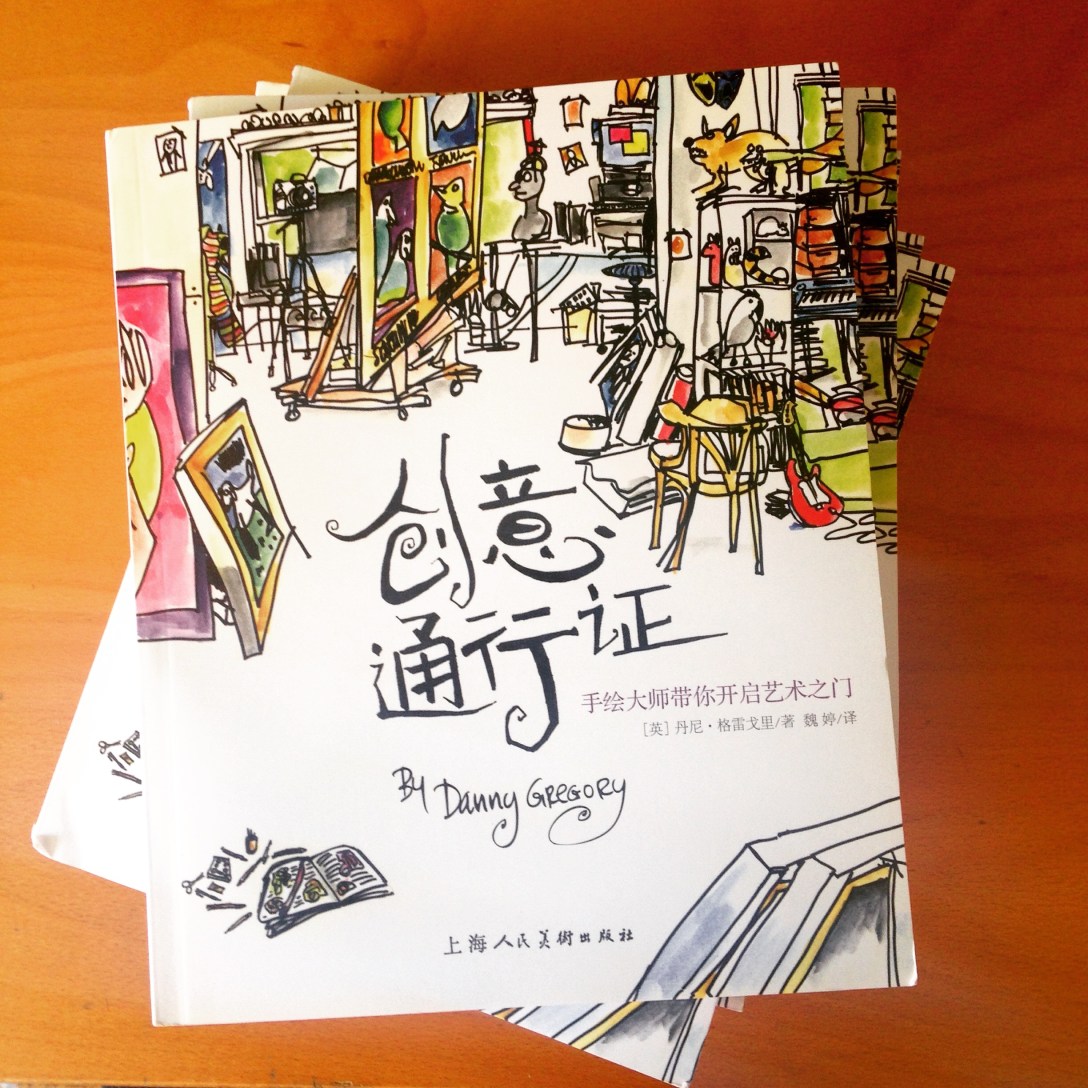
在创牌

My book, The Creative License: Giving Yourself Permission to Be the Artist You Truly Are  just showed up in Simplified Chinese!

искусство перед завтраком

I just learned that there is to be a Russian edition of Art Before Breakfast.  I hope it will get many people drawing their samovars.

A Kimchi Before You Go

i just received the exquisite Korean edition of my book, A Kiss Before You Go. The same publisher who created the K version of Everyday Matters did another amazing job, hand lettering all the type in crayon, pen and brush.  What an honor.  And how strange to see my private journals in a language I don’t understand!