Mad Old Men unearthed

So many people seemed interested in my recollections about old typewriters that I thought I’d share this dusty relic, a three-part conversation between Tommy Kane and me in which we discuss all the old technologies that used to be part of our work in advertising. If you’ve had a long career in design or what you used to be called ‘Madison Avenue,’ it’ll ring some ancient bells.

We recorded it about four years ago. It’s sort of pathetic how unreliable our memories were already.

QWERTY and all that.

Hankz

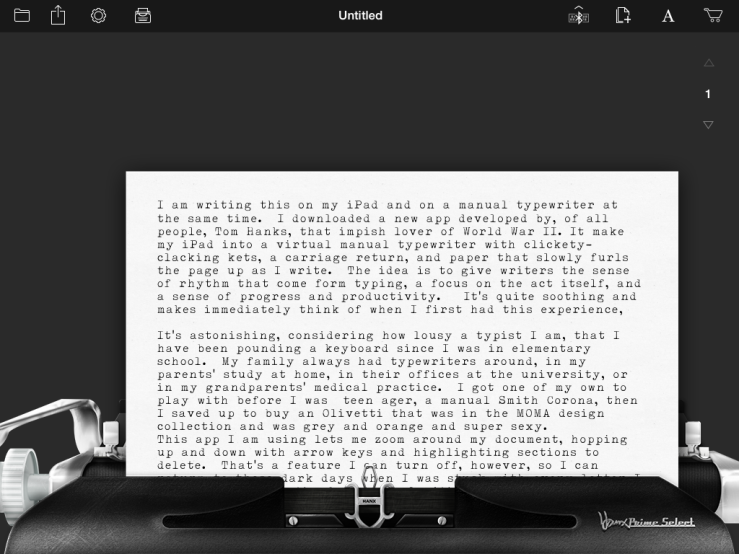
I am writing this on my iPad and on a manual typewriter — at the same time.  I downloaded a new app developed by, of all people, Tom Hanks, that impish lover of World War II. It make my iPad into a virtual manual typewriter with clickety-clacking keys, a carriage return, and paper that slowly furls the page up as I write.  The idea is to give writers the sense of rhythm that come form typing, a focus on the act itself, and  a sense of progress and productivity.   It’s quite soothing and makes immediately think of when I first had this experience,

It’s astonishing, considering how lousy a typist I am, that I have been pounding a keyboard since I was in elementary school.  My family always had typewriters around, in my parents’ study at home, in their offices at the university, or in my grandparents’ medical practice.  I got one of my own to play with before I was  teen ager, a manual Smith Corona, then  I saved up to buy an Olivetti Lexikon 83DL that was in the MOMA design collection and was grey and orange and super sexy.

This app I am using lets me zoom around my document, hopping up and down with arrow keys and highlighting sections to delete.  That’s a feature I can turn off, however, so I can return to those dark days when I was stuck with every letter I mistyped. Back in the day, to deal with my inevitable plague of typos, I used a typewriter eraser, a round thing with a plastic brush for wiping away the crumbs.  And Liquid Paper which I consumed by the gallon. It also came with little plastic brush to apply the opaque paint in little dabs.

This app lacks a few other features I remember. Like the way the keys would tangle together if I hit several at the same time in my zeal to get the words down. I used carbon paper if I thought there was any reason to have more than one copy of what I wrote.  When I worked for my local paper I would write on rough yellow paper and type —30— at the end of each article.

But I always hankered for an IBM Selectric, which had the backspacing correction function and used a little golf ball with different exchangeable typefaces, like “Orator”.

Then, when I got my first job as a writer, there was an actual  Selectric at my desk.  I felt I had arrived. But within a year or two, I had my first word processor, a TRS-80, and I could save my articles onto cassette tapes, reformat them, backspace away typos virtually, and write wand write without ever having to roll in  another sheet of onionskin paper.

I have written on so many things in my life — notebooks, legal pads, index cards, pages torn from the ends of paperbacks and the corners of newspapers, on laptops, desktops, phones, tablets…  Each new tool arrives with a fanfare, but they were all peripheral to the real tool, the one resting between my ears that has not yet been replaced.  I work everyday to upgrade it — with reading, living, thinking, and pounding on whatever keys are at hand.

Art before publication

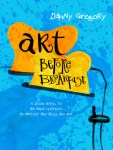
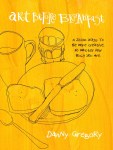
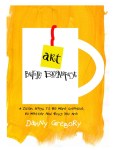
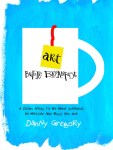
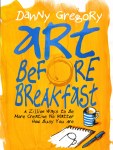
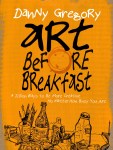
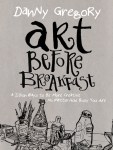
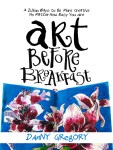
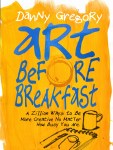
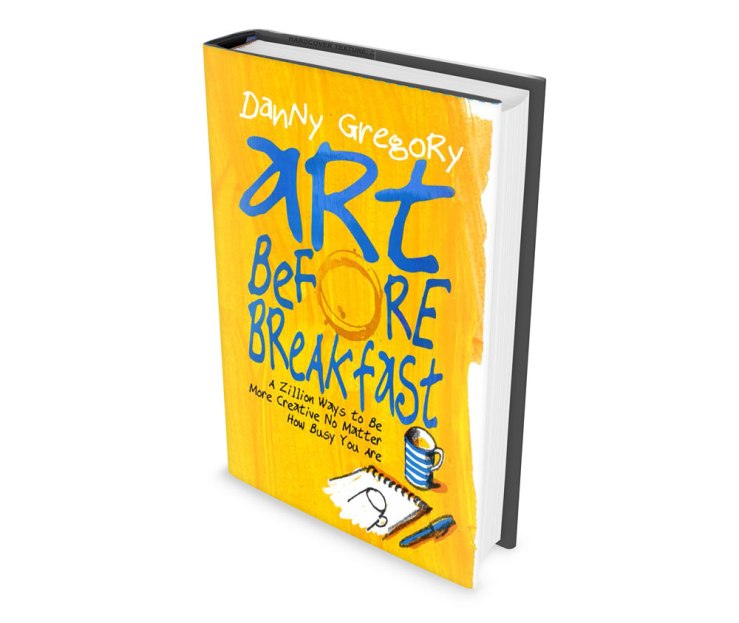
My editor, my design director and I have been working on covers for the new book all summer.  We all love the final design but I thought you might look a peek at the top 25 contenders (trust me, there were many, many others!)

(CLICK ON ANY IMAGE TO OPEN THE GALLERY)

And here’s the winner:

abb-final-cover-3D

The shortest distance between two coasts is a wonky line.

sights-1

Playwrights say that if a gun appears on stage, somebody will use it before the curtain falls. Photographers say that the best camera is the one you have with you. The New York Lottery says “You gotta be in it to win it.”

I just spent ten days in a car with a journal on my lap.  As  result, I did a lot of drawing. Not that drawing in a car is ideal. I am prey to carsickness so jolting highways and juddering views are usually not the ideal environment for the delicate stomach of my muse. Nonetheless, as I looked out the windshield four thousand miles, I was constantly drawn to draw.

Aphorists say when you have a hammer, everything looks like a nail. And as I spent my whole day with a pen lightly gripped in my hand, everything looked like a drawing. The only effort required to start a drawing was to shrug off the cap and, whenever I wasn’t at the helm, I seized every excuse to draw (thank you, Tommy Kane).

sights-2

The unfolding miles inspired me to use the pen which in turn defined the journey we were on. I saw connections between things, I saw unusual shapes, I saw common things suddenly looking very uncommon. I was hyperaware of the light, of the weather, of the ravages of time. Holding a pen can be like donning polarizing sunglasses, sharpening everything in your field of vision.

Now I am back on terra firma, I want to hold on to that urge and habit. To keep recording all the days that pass under my feet, to keep seeing even the most familiar landscape with the fresh eyes and open mind of a traveler.

Lost in the giftshop

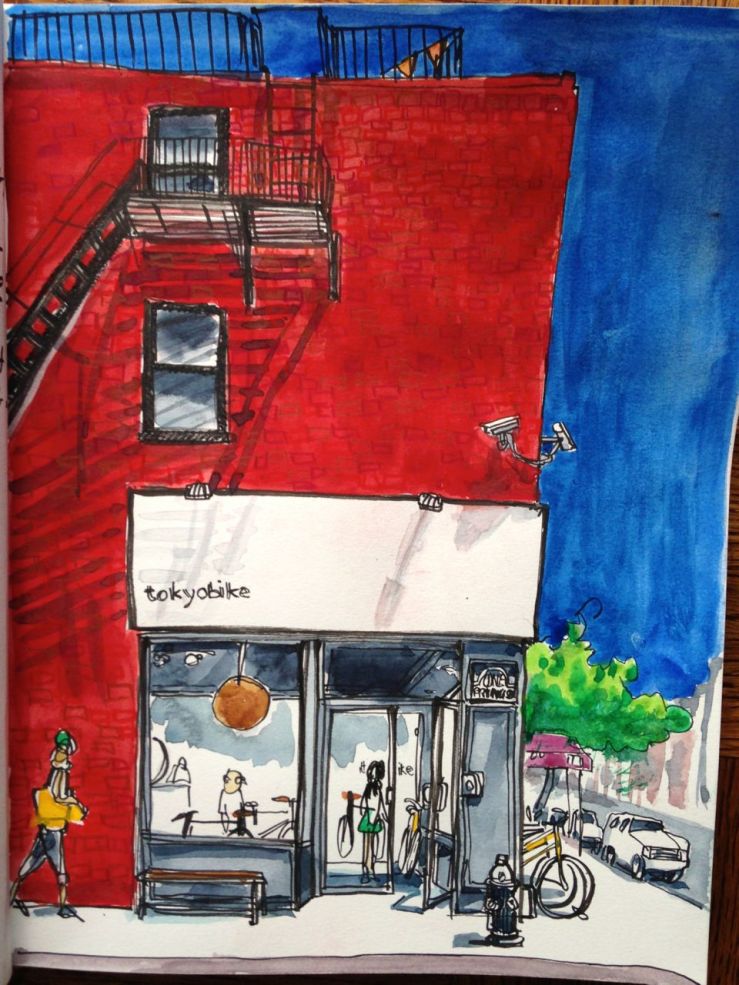
tokyo bikes
Tokyobike store, right off the Bowery, NYC.

Is art about owning?

Is the mere act of looking somehow acquisitive? As predators, when we look at something, we are tracking it, stalking it. “Just looking” can actually be an act of aggression. Is drawing even more invasive? Why do we worry that people will resent us for drawing them on the subway? We all know the cliché of the primitive societies that feared that cameras would steal their souls. When we do a good drawing, why do people say “you’ve really captured it”?

Is drawing also stealing?

Why does every single museum have a gift shop? Why do we feel drawn to shop in them?

When we have just seen the originals, why do we want postcards, tea mugs, coffee table books of the same images?

Why do people walk through museums snapping photos of every piece on the wall? Are they just adding them to their own collections?

Are museums themselves just giant closets full of acquisitions on display?

Much of the history of art has dictated by those who would own the art, the clients, the patrons.  They set the theme, dictated many of the choices for the artist.

Museums are filled with portraits of the rich and powerful. The artists didn’t choose these subjects by chance, the market dictated them. And they have survived because their various owners preserved them. The pieces that were most valuable have become what we call ‘art history’. So buying and selling and choices about importance are all bound up together.

Can art be valuable — if it’s never bought or sold?

Further on down the road

The final leg of our cross-country drive.  4,000 miles, 10 days, loads of eating, driving, drawing, and fun. Click on any picture to see the gallery. Or you can follow me on instagram: dannyobadiah.

Images from the road.

We are driving from LA to NYC.  I’ll post pictures from the trip here. Click on any picture to see the gallery.

Or you can follow me on instagram: dannyobadiah.

Farewell.

photo 2 copyI finished cleaning out my studio today, this old garage in which I’ve I spent much of the last eleven months. I felt a bit melancholy as I swept it out and locked the door for good.

I came here last autumn not knowing what I was doing or what might become of me, but I felt I needed a place to do it in. And I’ve done quite a bit between these three walls. I picked up a brush again and made forty feet of paintings. I wrote and illustrated a book. And started another. I wrote, shot, and edited films in here. I read books. I thought. I napped. photo 1 copy

And we started Sketchbook Skool out of this garage, like real West Coast entrepreneurs. Maybe they’ll put up a plaque.

And now, concrete and wood, it’s going back to being a garage again. But me, I’m not going back to what I was. IMG_7924

Jenny and I are hitting the road today. We’re heading eastward on what was Route 66. Don’t know how long we’ll take to get back to New York. A week, two, whatevs. I’ll try to keep you reasonably updated.  Follow us on  Instagram: dannnyobadiah

Life story.

corners n curves

Tonight I was thinking about the story of my life. The story that began when I was born and then certain things happened. My parents did certain things, my family was a certain way, we lived in a certain place, I went to certain schools. That was my childhood. In some ways, it was like other people’s childhoods but in other ways it wasn’t. But it was the only childhood that I had.

And then I had my teen years. My adolescence was, what five or six years of my life. They were pretty important years, even though I don’t actually remember that much about them. I remember the first time I kissed a girl, the first time I drank so much I threw up on the subway, the first time I was in a play.

These were all important events in my life. But they were one-time events and I will never have them again. All these events were difficult to judge and put into context at the time. Things happened that seemed incredibly important at the time but now I don’t remember them at all. Whereas other things that seemed trivial have remained with me for decades since.

What I was thinking about tonight was, I guess, this finite quality of my life. Not death, the end, but just the whole arc of my life. Right now I am at a certain point in my life. It feels like it’s probably the middle of my life but I don’t know that for sure — I could be a day away from the end. But assuming it is the middle of my life, I can’t necessarily look at it and see how everything that has preceded it has led to this point. It feels sort of like progress but also somewhat random.

Looking back at those events in the past that had either a significant impact on me or were completely forgettable, I’m struck by the fact that they are so difficult to assess. I look at things that were clearly watersheds, like getting married, having a kid, losing a loved one, but all those events turned out to have a different meaning than I thought they would have the time. It’s just proved impossible to chart the course of my life or even understand it as it unfolds.

So I could look at this very moment, sitting here, a certain point in the summer, when certain events have happened or changes took place, and I can imagine that I could look back on this time and see it for something or other, but right now I have no idea what that is.

The only meaningful way to look at your life is twofold. On one hand, this big sweeping story: I was born, I lived my life, and then it ended. Or the minuscule: one day at a time, one hour at a time, putting down the events of each day in my journal, I ate this for lunch, I talked about that with my friend, I bought new tires, I discovered a lump, I found five dollars on the street. I can’t tell whether it matters, or why, or how much, I can only live through it. And thinking about the big picture reminds me that this is the only time that I will have today, and because I don’t know what role or purpose today will hand I should try to live it fully.

Perhaps this is all just a trite observation. But tonight it struck me that my life is like a TV show and I can pause it and see how much time has passed in the episode so far, but I can’t tell how much time is left. I can look back on what has happened in the episode so far but I can’t change any of it. And what is to come may or may not have as much excitement or laughs as what has transpired so far but I plan to watch the rest of it regardless.

When I look back at what has happened so far, it’s again that feeling that that was my one childhood, that was my one adolescence, that was my one first job, and that’s it. It can make life seem fleeting but it can also show the importance of each one of these sections, including the section I’m in now. And when I think about the uniqueness of this period I’m going through, it makes me want to get the most out of it, to not take it for granted but to live it deeply, richly, cause this is the one I have. ‘One Life to live’, so I guess in the end, yes, the conclusion is trite. But somehow, tonight, that didn’t make It any less true or less important to think about.

Oh, and I know my blog looks different, You’ll get used to it. So will I.

Why it doesn’t look just like the picture.

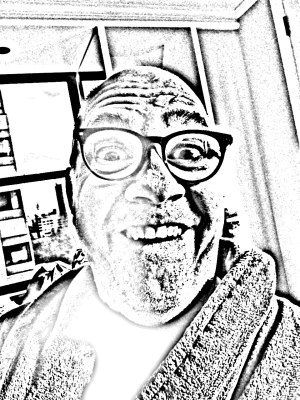
fax-faceIn the 1980s when photocopying technology became increasingly available, David Hockney made a series of prints using a Xerox machine.  I was looking at some of these prints recently and trying to overcome my initial dismissive reaction: these aren’t ‘prints’. But of course, they are. They were state-of-the art prints in their day.

Printing is and has always been a mechanical method of making multiple reproductions of an image. In the past artists used woodblocks, etchings, engravings, then lithography, screen printing and so on. Today, many artists sell giclée prints of their work, prints that are digital scans of their drawings which are then processed and printed on inkjet printers. And what if we skip the paper part of it all together and use an iPhone and a distant computer server. Isn’t that basically the same idea?

Our instincts say no. It’s somehow not hard or special enough. Where’s the craft? But of course a good digital scan take experience and tools and work. So that’s not it. Or maybe it’s posterity, the sense that an old Xerox or a computer print out surely won’t survive for hundred of years like a Dürer woodcut. But with archival papers and inks and proper handling, that’s probably not the case either.

No, I think the real issue is scarcity. If you can just push a button and bang out an infinite number of reproductions, it is no longer precious, a limited edition, valuable. If someone can make an infinite number of copies, then there’s no value to any particular one. A Work of Art is reduced to the same status as a call report or a lost pet flyer. So the Art Market has trained us to dismiss this way of looking at it. If it can’t be bought or sold for increasing amounts, don’t bother making it.

Now, if inventive, creative, curious people like Dürer or Rembrandt had been able to make thousands and thousands of copies of their images with just the push of a button, believe me, they would not have been sweating over blocks of wood. They weren’t burdened with the same market concerns that weigh down our view of art. They made limited editions mainly because it took a helluva lot of work to get even a dozen proper prints from a copper plate.

But that’s not what I want to talk about.

Thinking about Hockney’s Xeroxes made me think about how technology is constantly improving the ways it solves basic human problems. Not just labor saving devices, but things that make our lives better and richer. Examples abound.

But what about image making? There was a point when people drew on cave walls with blood and mud, to make some point lost to the sands of time but they were using the best image-making technology they had. Eventually we figured out how to carve stone statues, to make fresco, to stretch canvas, and so on.

This image-making and image-sharing had a purpose. Usually it was to tell a story or pass on some vital information: this is what the Gods did, this is how we won this war, This is how handsome and powerful the King is, this is how Jesus came back, and so on. Nowadays, if Jesus came back again, we would probably use Vine or a Facebook post to share the news, not a fresco or calligraphy on a goatskin.

So if, in one split second and with no real experience or skill, you can use the phone in your pocket to make an image that is technically superior and precise to anything you can make with pencil, why make art at all anymore?

That’s a question people have been asking themselves for almost two centuries. And the answer that Manet and Monet and Seurat and Cezanne and Van Gogh and the rest of the gang came up with over a hundred years ago is that the purpose of art is no longer to reproduce physical reality, it’s to convey how we feel about it. To capture the human condition, the way we see the world through the veils of subjectivity, experience, emotion, history and all the rest of the stuff that make us who we are.

This is something we have to think about when we draw.  Stop assessing your work based on how close it is to “reality”. Don’t bother posting a snapshot of your dog next to the drawing you did of it. Who cares if you are almost as good as that camera in your pocket. ‘Cause in fact, you’re not even close. That photo is a far better way to make that image. More efficient, more accurate.

But that image isn’t really what you want, is it? What you want is to capture your soul, your inner state, the love you feel for that dog. You want to make a picture of the inside of your mind.

Don’t worry about Xerox®ing reality with your sketchbook. Focus on capturing You instead.

So far nobody, in Silicon Valley or elsewhere, has come up with an app for that.