Five beautiful things I saw today.

I looked up from my book and glimpsed the setting sun reflected in a window across West 3rd Street. It was enormous, an incredible, unnatural, cherry red. I rushed to the corner of the terrace to look at the actual sun but it was hidden behind a tangle of water towers and satellite dishes. I watched the last slivers disappear in the mirrors of my neighbors’ picture windows.

In the park, a woman in a black pinafore spun lime green hula hoops ’round her hips, her waist, and knees, and then suddenly convulsed and folded them all into a single shape, a globe with all its meridians demarcated by the buzzing hoops.

The fur on Tim’s back is curly as Persian lamb today. The air is still but he is knotted and wavy. His fur is a dusky rainbow: eggplant, auburn, battleship grey, matte black, all threaded with silver highlights.

I went to Jack’s room to put away some towels. On his top bookshelf, the albums of his drawings that we collected when he was just starting to draw, aged 2 to 4. On their spines, they’re labeled “The Art of Jack Tea Gregory, Vols 1-4.”  On the shelf below them, arranged, apparently in the last few weeks, a row of books of art notes Jack’s been making this year.  Each is labeled with a Brother P-Touch that I didn’t even know he had.  Those two rows of books encompass the last twenty years of his life. And of mine.

At least seven blocks away, there’s a railroad apartment. It has windows at the west end near me and at the far eastern side. A slice of sky is visible through that far window and, across that bright patch, the silhouette of a person passes back and forth. A single leaf on the crabapple tree across the street appears larger than that tiny silhouette yet somehow, I am connected, and know something about how that miniature person feels, pacing so many blocks away.

All I wanna do…

all-i-wanna-do

Freaky Friday

A few days ago, I woke up in a parallel universe. It took a while to realize that I was in a new dimension because my bedroom, my bathroom, my dachshunds, all looked pretty much the same. But the back page of my neighbor’s New York Post, lying face down on the elevator floor, clued me in.

The headline screamed, “Yee Dominates Open” over a picture of some ceramic sculptures. The caption went on to explain that artist Lulu Yee’s work was all the rage at the Bushwick Open Studios.

I nudged through the rest of the paper with my toe. Where I expected to see hockey scores and an update on the Yankee’s quest for a shortstop, I found reviews of two shows at the new Whitney, a long essay on Robert Motherwell’s legacy, and a table charting the top twenty seniors at RISD and their expected prospects at Art Basel in Miami.

I walked back into my apartment and hit the remote. A flashy logo for ESPN (the Exhibition, Sculpture & Painting Network), swept across the screen. Two talking heads were discussing Gerhard Richter’s decision to switch to a new brand of paint thinner, then rumors about Damien Hirst’s wrist injury, the economics of a trade of three Rachel Whiteread sculptures between the Guggenheim and a huge new museum in Dallas, and Matthew Barney’s newly trimmed beard.

In this alternate world, art schools recruited talented third graders, galleries poached art school freshmen, and major corporations viciously competed to sponsor retrospectives at the Guggenheim. There were hundreds of extraordinary new artists I had never heard of before: they now had the chance to show their work, were supported and encouraged to push boundaries and create new dimensions in art.  School art programs were lavishly supported and even the most provincial colleges had big, sun-swept studios, subsidized art supply stores and  deep pockets. Most athletic programs, alas, had meager support and sparse attendance.

Every city built stadiums to present Pussy Riot performance pieces and screen Tom McCarthy videos. Teenaged girls mooned over half-naked pinups of Richard Prince. Marina Abramovic had her own cable network. Every street tough wore Basquiat dreadlocks and paint spattered shoes. Kids coveted jackets festooned with Liquitex and Grumbacher logos. Parents named their babies “Winsor” and “Newton”. Art students lived in mini-mansions and drove Escalades to Starbucks where star quarterbacks made them pumpkin lattes.

Exhilarated and exhausted by my first day in this wonderland, I drank too much absinthe and passed out. When I woke up the next morning, it was to the sound of reality, two cab drivers across the street arguing over how the Yankee’s star pitcher’s strained forearm would effect their season. Art funding was still in crisis, parents still worry about their creative kids’ prospects, museums catered to the lowest common denominator, and our education system and our culture were still ruled by sports and money.

Oh, well.

If I figure out how to get back to the other side,would you want to come with me?

Child’s Play

Sometimes I want a spoonful or two of sugar in my tea. I want to reread The Wind in the Willows. I want to watch Tom & Jerry. I want to eat Lucky Charms, or a meat pie with ketchup, peanut butter and jelly on white bread. I want to listen to Danny Kaye singing Hans Christian Andersen.

I want to spoil the kid in me.

My childhood was far from idyllic but things from my childhood can make me feel comfortable and free. And that freedom makes me feel creative in a visceral, fundamental way. The smell of paste, the feeling of scribbling with crayons, splattering poster paint with a big mushy brush, they loosen something in my head, the something that binds me to judgment and fear. School art supplies release me from rules and expectations and let me free to play.

I’ve been using materials like these more and more, since I started to explore in my California garage and then spent time with schoolkids in Beijing. I bought tempera and huge rolls of brown paper and Play-Do and sheets of cardboard and started to let loose.

It took work to let go, to undo the handcuffs and shake off the rust, but poster paints and fat cheap brushes helped a lot. There was nothing at stake. I could chuck paint around then toss the results in the trash. I didn’t care. And the kids in China didn’t either. We were just playing.

A couple of months ago, I started working on some projects using these childhood materials I’d rediscovered. I made some videos for an imaginary kid, someone six or eight or ten, to show him or her some cool things we could make together. I turned my thumbs into rubber-stamps, I melted crayons, I made masks out of grocery bags, I made stop-motion animations — and I had a lot of fun.

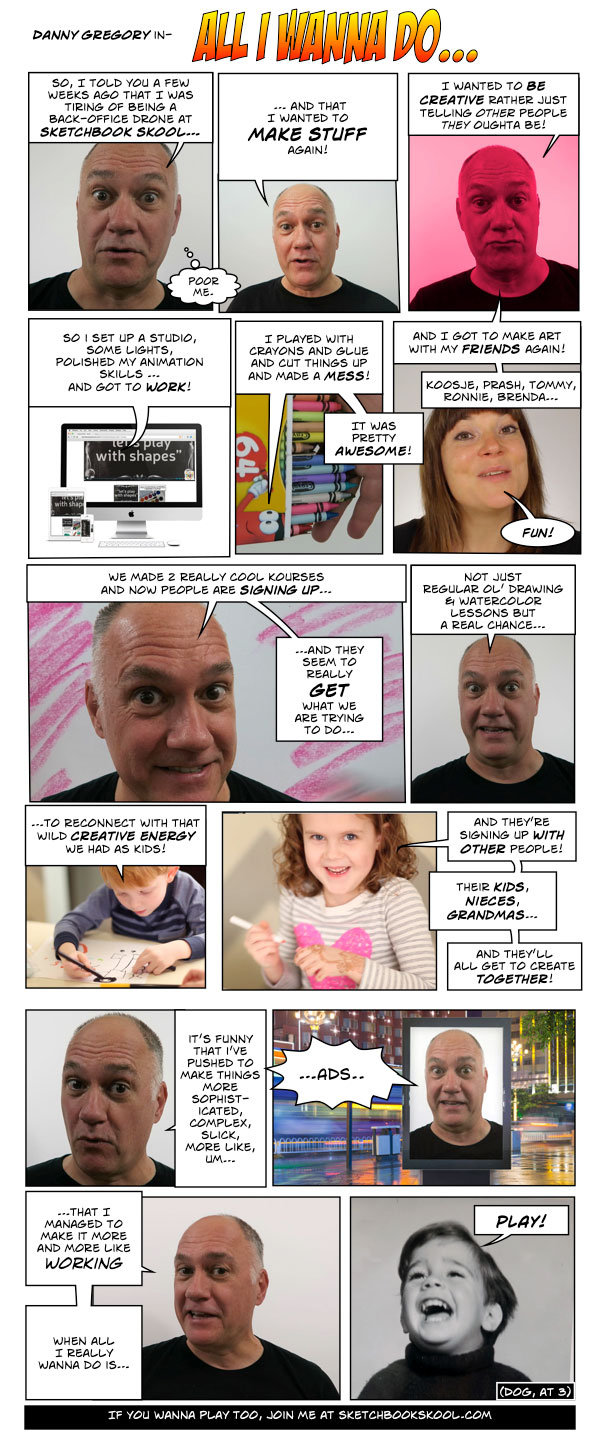
These videos were the foundation of a new set of lessons that I plan to take with me to Switzerland and Dubai these fall, to work with kids and show them some new ways to play. But they are also a new kourse we created for Sketchbook Skool because playing is something that’s not just for kids, it’s for the kids in all of us. I’ve seen time and again that when grow-ups are given permission to mess around with cheap art supplies, they reconnect with their original creative impulse, that impulse that fuels even the most sophisticated art and professional creative projects. Without that wild child, art becomes business, stiff and academic and overthought, and driven by fear and judgment. But unleashed it can produce anything.

I also liked the idea of creative projects that kids and grownups could take together and inspire each other. And that kids, out of school for the summer, could do on their own to keep their creative flames a flickering.

The monkey fought me a lot as I put these lessons together. What if adults resented being treated like children, felt patronized? What if I looked foolish? Unprofessional? Lost my ‘authority’?

Aw, screw it. I had fun and I think anyone watching the lessons will find some fun in them too — or might want to ask themselves why not. They gave me the same sort of comfort I find in childish things and my drawings and writing have been a lot looser since I started, more open to experimentation, less filled with consequence. I can’t wait to work with schoolkids again this fall. And to see what you make of our new kourses, Playing and More Playing at Sketchbook Skool. Here’s a little preview of the kourse if you’re interested:

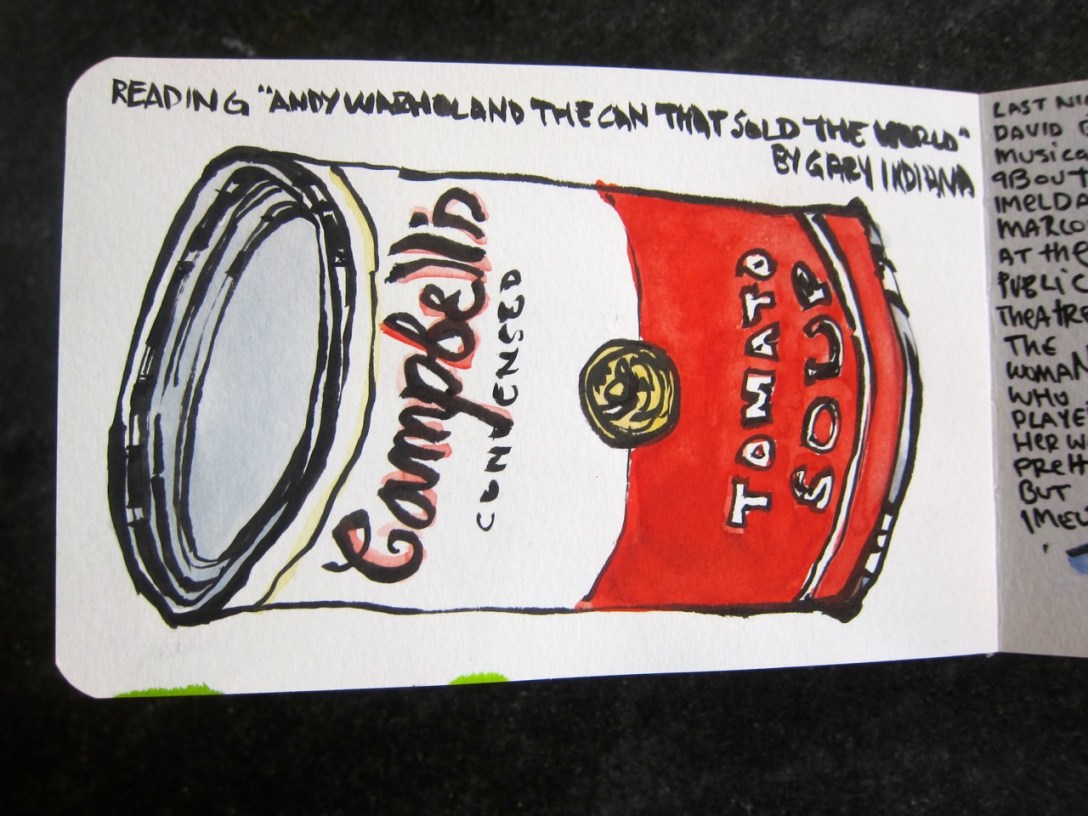
Soup.

I’m a big, fat vat of soup.  Deep below my surface, I am roiling, ingredients churning, interacting, breaking down to add flavor and texture.  Sometimes I’m hot and bubbling, giving off a delicious aroma. At other times, I’m tepid and lifeless, the gas off, a greasy film forming, unappetizing, dull.

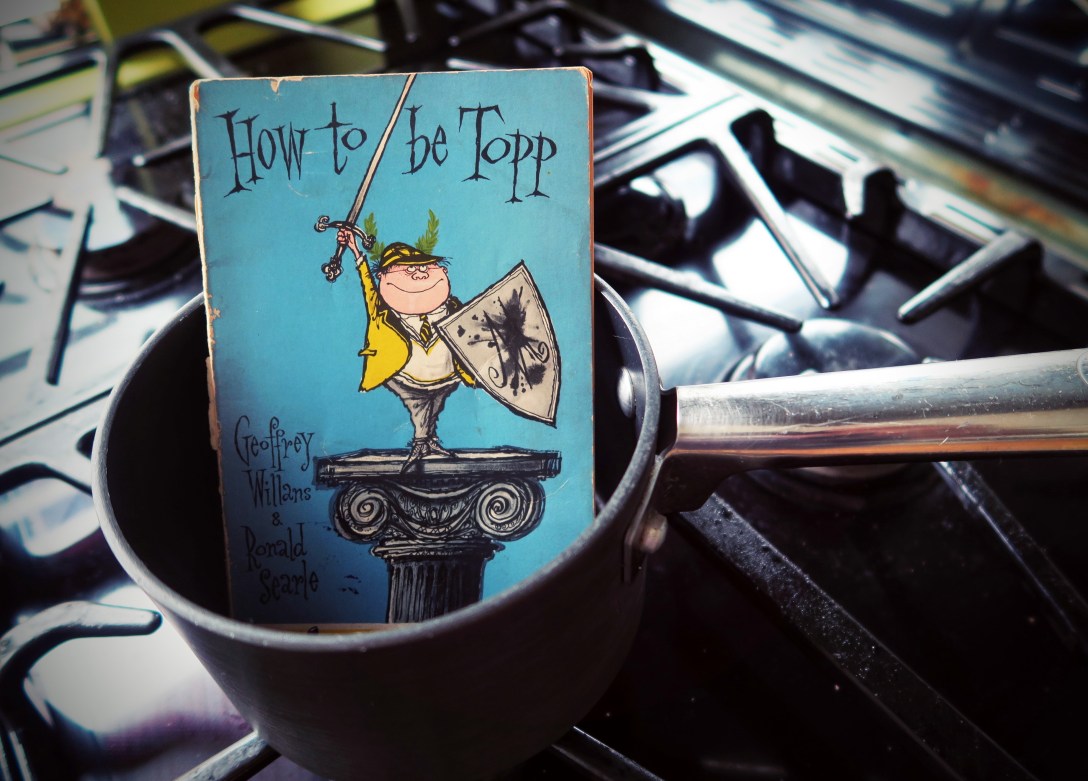
What’s in the soup? Well, let’s dip in the ladle and fish out an ingredient. Ooh, it’s a book I’ve owned since I was eight, dog-eared and well-thumbed, its browning pages loose in the binding. How to be Topp is a satire about success written by a fictional school boy. It’s a fairly silly book and I don’t think I’ve ever read it all the way through. But it was illustrated by Ronald Searle and its pages are full of splatters, spidery calligraphy and loose, scratchy drawings. I may not look at this book for years but it’s in the soup, adding its flavor.

When I was eight I read a lot, several books a week. It’s a pattern I have kept up ever since. Each of the many books stacked on many bedside, in my Kindle, on my phone, and my desk, all end up sliced, diced and scraped into the soup. Many of them break down completely, their pages diluted, vanishing from memory. But each sentence, like a single granule of salt or a delicate frond of dill, though disintegrated, has added  a few more molecules to the flavor and body of the soup that is me.

There are the Grove Press books on the top shelf of my grandfather’s study, “grownup up” books I climbed up to purloin and read in private. There are all the Gerald Durrell books that fed my fantasies about raking through the jungles of Borneo and Brazil for aardvarks and toucans, kitted out with a solar topi and a butterfly net.  There are 92 volumes of PG Wodehouse, Professor Branestawm, Raymond Chandler, Geoffrey Chaucer, Spiderman.

There’s the girl I kissed in David Heller’s basement in 1975, the bucket of coffee cooked over a campfire on a patch of Israeli wasteland one dawn, the snow boots my mother made me wear that were too big and made me trip over every hummock of snow in downtown Brooklyn. There’s my dog Pogo’s third litter of puppies, two stillborn. The boss who yelled at me while eating an egg salad sandwich. My first Rapid-o-liner. My second stepfather’s broken toe when he kicked in the door of my mum’s MGB. All are bobbing in the drink, coming up to the surface, then subsiding like Moby Dick into the darkness below. There’s Moby Dick, Holden Caulfield, JJ ‘Dynomite’ Walker, the English Beat, my Latin teacher, Jenny’s stuffed hippos, Jack’s soccer cleats, my Pakistani orthodontist.

My soup is rich and complex and like none other, a unique combination of stuff that has been cooking for decades. It contains some ingredients found in your soup, maybe lots of them, but the way they interact with the rest of the bits and bobs bobbing around is all mine, all me.

This cauldron of soup is the source of all I create. If I write a story, make a drawing, come up with an idea, it’s all because of this big bubbling vat of experiences and influences. If I neglect the soup, forget to add new spices, fail to stir it up and fill some new bowls, let the pilot light go out and the temperature cool, the soup becomes anemic and tasteless, a bland consommé that’s forgettable and without value.  But if I work the soup, it fills me up.

Being an artist or a writer means reading, looking, listening, cribbing, copying, from a zillion sources. That’s much of our job. These slices of inspiration may have disproportionate effect when they first enter the soup, big undigested chunks that are too obvious when they show up in the work. But over time they break down and dissolve, leaving only ripples that intertwine with others to form a new flavor note, subtle and unique.

We are all vats of soup. Make sure you tend yours, stirring and adding new ingredients every day. Keep the hot on medium-high and take the lid off now and then. And don’t be afraid to dish it up to share with others, to pour a few tablespoons into their tureens. I want to taste your soup. Here’s a spoonful of mine.

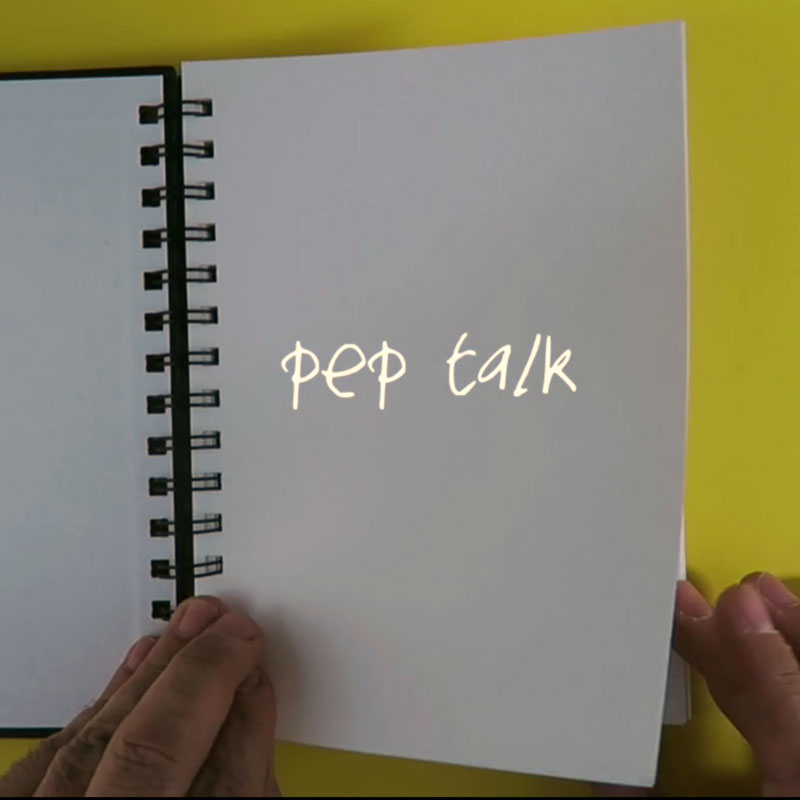
Pep talk.

Having trouble starting your creative habit?
Wrestling with the Monkey in your head?
Here’s a helpful little video I made for you — with some assistance from Shia.

Caution: Contains a little, well, yelling — which may offend those with delicate sensibilities and fragile eardrums.

Living on purpose.

What if success meant living a life of purpose?

What if your high school and college educations were designed to help you do one thing: to discover what you are truly good at and what you love to do? That instead of emphasizing test scores and grades and cutthroat placements in prestigious universities and high starting salaries, the system acknowledged that we are all born with different skills and abilities, needs and wants. And that we all need a mission to guide us.

What if we said you don’t have to be good at math or science if you have no natural aptitude, that you might be better at building something with your hands than constructing a paragraph? That we will help you discover if you are more visually oriented, or more intuitive about people, or better at concrete thinking or abstractions or that you were born to be a great chef or a gardener or a cab driver or a banker. What if that was the whole purpose of your education — to help you lead a life that perfectly fits who you are?

What would a planet full of people working with passion and conviction look like?

What if it was the norm to pause every decade or so and assess whether that purpose still fits you, whether you need some variation or specialization, new skills or new experiences? What if was expected that every major decision you made was measured against the yard stick of your purpose and your mission, not your salary or your retirement package? That each person was expected to be true to their nature and their passion. That each of us did what we did to genuinely be of service to the greater good. Not because it was tax-deductible but because it felt right and part of who we are.

Would things unravel? Would certain jobs never be filled? Or might we discover that some people were genuinely born to enthusiastically empty septic tanks or write parking tickets or run hedge funds, to do things that now people seem to do only for money? Would we still dread Mondays? Or would we work with passion and conviction, doing more and better things than we could conceive of today.

What if everyone in our society did what they did because they loved it, were born to it, were passionate about it would do it just as a hobby? What if we all lived authentically according to our talents and drives? What would a planet full of people working with passion and conviction look like?

What would it take for that to happen? An act of Congress? An act of God? Or a commitment made by each of us as we lay in bed and pondered the road ahead. A commitment to who you truly are.

Could you make one?

What rhymes with “Danny’s drawings?”

I am so honored.

The poet Isabelle Barry invited a group of her colleagues at dVerse to write poems based on my drawings.  She also interviewed me to give some context for my work.

The interview is here.

Links to the poems are here.

Enjoy them — I did!

Can you take a compliment?

What happens if someone says you did a great job?

Do you bask in their admiration? Or do you redden with embarrassment?

Do you mumble and shuffle while inside you are rationalizing away their acclaim?

Do you suspect their motives?

Do you question their taste?


Praise is a gift. Will you accept it with grace?

Or are you more comfortable with criticism?

Pass it on.

Think of all the people who’ve inspired you. The authors you love, the directors whose movies have moved you, the musicians who kept you company in the studio, all of them. And now think of your creative work as payback. Rather than being intimidated by the greatness of the people you admire, see your work as a way to pass on the favor.

Maybe your mentors will see your work and be inspired by it (I’ve had that experience and it is one of the most gratifying there is). Or maybe your work will inspire a total stranger, someone in need of your help. That is the greatest kind of gift —  to give anonymously — and do your work has the potential to do that.

Think about these things next time the monkey is trying to squash your productivity. Think of those who will not benefit from your unborn work.