Brain — on.

My brain has been whirring this weekend. I now have loads of things I want to make — but only one life to make ’em in.

• I am thinking of new daily projects I want to pursue. My 30-dogs-in-30-days iPad drawing project eventually reached 110 dogs, which was great fun for a while, but it’s feeling forced now and for the first time have missed several days. I am thinking of doing a series of drawings and long-text Instagram posts about my family’s history and my childhood. I spent some time yesterday looking at old photos and had a bunch of ideas. I have thought about writing on this topic before but always flamed out under the weight of it all, worrying more about how to wrangle several generations of dysfunctional people into an ongoing narrative but the idea of doing something bite-sized and episodic seems more doable and fun.

• I want to start up a podcast again. It’s been over a year since I did an episode of Shut Your Monkey and the podbug is nibbling at me again. I am thinking I’d like to do a chatty podcast about art making, probably under the Sketchbook Skool umbrella, kinda of like an audio version of the Zine we’ve been doing. A great new issue of the Zine comes out next week, by the way. I wrote a lot of it. (If you haven’t subscribed yet, get on it.)

• I just signed up for a mysterious creative camp for this summer and I am excited and super curious about that.

• There are only a couple of weeks till Illustration Nation begins at SBS and I have been thinking alot about what project I want to spend a month on. I like the idea of making prints or a book or magazine but am not sure what to do with the things I make. Maybe I’ll give them to you.

• I am very excited about a conference we are planning and keep thinking of more and more ideas about what to do there. Ideas that will get people together, ideas about all the people I want to have speak, ideas about how to promote it, ideas about little videos to show and ideas about what I will wear.

• I have been working on a short-film series on and off for the past year and I think I am now ready to release it. I’ll do so episode by episode. They’re gonna be short and autobiographical. I’m not sure why it’s taking me so long to get them done.

• I would like to do some new episodes of Sketchbook Club and now have an entire shelf of books set aside. I’m thinking of finally tackling Maira Kalman, Lynda Barry, Lapin, Eric Sloane and a few others. I’ll try to get one done in the week to come.

• I have three new shoots with artists scheduled for the next month and I’ll be travelling to Atlanta, then Charlotte and finally Nashville starting in ten days. I have been preproducing these for the last couple of months and I can’t wait to get out there, work with some new artists and film crews, and make some cool stuff.

• Koosje and I have been working on a new kourse that we are calling “Zillion” for short. We have begun filming and it has been so fun to work on a new kourse and to collaborate creatively with my partner.

• I was invited to do two keynotes in Washington DC — and they are major. The audience is super-important and not the usual sort of folks I talk to so I am eager to do something interesting. I am contractually not allowed to say who it is, alas, but let’s just say they are in Washington and work in a large building with flags on it.

Weekends are meant for relaxation so I tried turning my brain off last night by watching a movie. But The Square was the most amazing, brilliant, hilarious, thought-provoking film I maybe have ever seen and so it filled my dreams with monkeys, piles of gravel, and angry children. What an incredible work of art!

Today, I will make some stew and probably not watch the Super Bowl. Maybe the Puppy Bowl instead.

Confessions of a rueful geek.

I was just reading an article about the developments in cryptocurrencies (which is really worth checking out — but is not what I want to write about today) and was struck by a section on how the immense power of open systems to spawn creativity and community have been increasingly stifled since those systems were co-opted by big corporations. All of which led me to think about my sketchbook.

At the time I started to draw in a sketchbook — in the pre-dotcom-bubble-burst of the early mid ’90s — I was also exploring the early Internet. Back then, most people were as unaware of the transformational power of networked computers as they were unaware of the idea of illustrated journal keeping or sketchbook art. Now, of course, we all spend hours a day on the Web but, 20 years ago, it was a lot geekier place to hang out.

I loved that geekiness — because geeks are interesting and passionate. They know a lot and they care a lot. The early Internet wasn’t just the playground of tech geeks. I found wheelchair geeks there when I started curbcut.com, a community for disabled people like my wife, Patti. And I found sketchbook geeks too, like Richard Bell and Roz Stendahl.

In those days, the Internet was turning out to be a wonderful place to find people who shared niche interests like old record collecting or fishing gear or classic car restoration or knitting. These sorts of geeks gushed with knowledge that had been long bottled up because no one around them in the real world was even vaguely interested in the passions that consumed them.

But when geeks meet geeks, decades of stored up arcana comes pouring out of their basement lairs and garage workshops and people spend hours and hours talking about minor Star Wars characters or Jane Austen subplots or the best way to pickle kimchi or fill a fountain pen with waterproof ink. What seemed eye-glazing to the rest of the world was endlessly fascinating to some other geek, previously burrowed in obscurity in Croatia or North Dakota or the Bronx.

The first book I wrote, Hello World, was about an intense geek sub-species, the ham radio operator.  In the 1920s, when radio was a hot emerging technology, hams were super cool, but eighty years later, they were just geezers who wore pocket protectors, Vitalis and white socks with black shoes.

But I loved their passion, their willingness to stay up all night trying to reach a fellow ham deep in Siberia or put together dangerous expeditions to literal desert islands lost in the Pacific just to be the first to transmit from a new location. Hams loved the Internet too, helped birth it in fact, but it was ultimately the last nail in their coffin. Why hand build a radio to bounce Morse code off the moon when you could just send a text message from your phone?  Their obscure hobby was now just a silly waste of effort made redundant by Twitter and Google and Facebook, the megacorps their efforts actually spawned.

Anyway, as I read this article, I thought about my own long-time passion for keeping a sketchbook and how it has changed over two-plus decades. What started as a solitary therapeutic activity grew into a network of new geek friends, then into this blog (I wrote the first post over a fourteen years ago just to share thoughts with my pal Richard in Yorkshire), then into a series of books, and then into talks, teaching, and a full-time job and business hiring several people. My geekdom has become as increasingly mainstream as my network has expanded. When you are surrounded by an army of tens of thousands of like-minded folks, you aren’t an outsider anymore. Or a geek.

There have been lots of advantages to this mainstreaming process, both for me and for technology. Back in the day, if I had a tech problem, there were maybe three other dorks I could call on to help solve the problem. Now I can just Google an answer or walk two blocks to the Apple Store.

But all this mass-produced convenience has polished away the magic. My computer, which used to be like a hand-carved wizard staff, carefully assembled and tweaked, is now as personal as a rental car.

And my sketchbooking process, which has become an essential part of who I am, can also get diluted and homogenized if I don’t remain vigilant and true to my origins. It’s essential to hold on to what has made my art process intimate and personal, even if it needs to be shared now and then.

It’s also crucial to remind myself of what has always given the process its power and excitement. That it is an ever-changing creative lab, that it gives me a fresh perspective on the world around me, and that it never become rote.  And equally important, that it remain authentic, made by me for me, that it stays honest and unswayed by others’ wants and expectations, that I am filling pages for their own sake.

There’s a real danger in refining a method, in becoming too polished, and devolving into generic illustration, in being infected by commercialism, by some projected audience, that it goes from a passion, a hobby, an exploration, into a job. I’ve seen it happen to a lot of artists who used to excite me and are now just undistinguished self-promoters questing for likes, Etsy sales  or freelance gigs,

Amateur doesn’t mean second rate or unskilled. It’s derived from amare, to love, an activity fueled by passion — by geekery, if you will. But it can be so much more raw and exciting than the predictable, manicured path that professionalism and corporatism mandate. Just as Facebook grows duller by the day, just as my corporate agency job chafed me, striving for professional standards will dull one’s art and leach it of the passion that makes it moving.

The wild west frontier days of the Internet are now just fodder for TV shows which do no justice to the headiness of random discovery I remember. But every blank page in my sketchbook still has that power to shock and excite me, so long as I remember to stay free and explore.

How do you stay authentic?

Someone’s been monkeying with my sketchbooks.

Yesterday I had to pick out a few representative watercolors from my sketchbooks to share with a magazine editor who asked to include my work in an upcoming issue. I didn’t have a scan that was high enough resolution, so I decided to go through my sketchbook archive and shoot some new ones.

But something odd happened.

After going through the first few books, I started to wonder why they all looked so dull. The colors were washed out. I turned on more lights in my darkened living room but they still looked lifeless. But there was more to it than just the vibrancy.  The brush work seemed primitive and half-finished.  And the lines were dreadful and crude. Page after page, the drawings I knew so well looked just, well, bad.

How could I send any of these things to a magazine devoted to watercolor art? It was laughable. How had I ever had them published in books? How had I dared share them on the Internet? Had I ever done a single drawing that was any good at all?

I flipped through more books. Nope. They were all dreadful. Every last one.

Maybe they had faded over time? Nope. They were all stored, closed, in a light-proof cabinet, closed. Maybe the iPad was affecting my ability to look at analog colors? I looked through my Instagram page. Nope, they were all dreadful too. I clearly do not know how to draw and have been pulling off some massive con on the universe and myself. This magazine editor was clearly deluded in thinking she should include me in her publication and would soon lose her job.  Hmmm.

Today, Something has happened to them again.

I went back, looked through the images I’d picked, then flipped through a few of the books on the shelf, then looked at my Instagram. Not so bad. In fact, I liked quite a lot of them. Wonky, sure, but with style and a POV. I’m glad I made them. Whew.

A cautionary tale. Maybe it’s because it’s so stupidly cold. Or because I haven’t been sleeping terribly well. Or because, well, I’m me. But I can’t always rely on my judgement of the given moment. I need to trust myself, and others over the long run, and meanwhile just keep my head down and keep making stuff. It doesn’t matter if it sucks. Especially if I’m going to think it sucks so much I stop making anything altogether.

Does this ever happen to you?

How to make learning to draw a whole lot easier.

Why do you want to start drawing?

Wait, let me rephrase that — you probably don’t want to start drawing. You want to be be really good at drawing.
To pick up a pen, grab some paper, and effortlessly draw anything, perfectly, beautifully, dazzling your friends and confounding your enemies. You want to be the next daVinci, to knock out portraits indistinguishable from photographs, to replace your vacation snapshots with breathtaking watercolors, to have gallerists, collectors and reviewers clamoring outside the doors of your sunswept Tuscan studio.  And you have to start somewhere.

But deep down, you fear that you’ll never get to be great. It’ll be too hard, you’ll just give up, and instead of pride, you’ll be besieged by self-recrimination. Your dust-covered sketchbook will be just one more reminder of your failed attempts to achieve your dreams.

It doesn’t have to be that way. Seriously. Here’s how I know. I’ve been helping folks to start drawing for ages but more importantly, I have helped myself to start drawingAnd by teaching myself, I have learned a few things that could help you to get past those first few challenging steps. So this story is less about drawing techniques than it is how to incorporate drawing into your life, how to keep yourself motivated, and how to learn to learn.

How to accurately measure progress: So many fledgling artists focus on the horizon, then trip over their own feet and fall flat. They began by focussing on the end result of learning, that perfect drawing, then despair when each line they make fails to achieve that goal. What they are overlooking are all the individual steps they are making towards that objective, the small but crucial  improvements they are making every day. I know this because it happened to me too. Early on, I’d flip through my first handful of pages and grimace. They all sucked. I sucked. And I’d never get any better.

But, had I been paying attention, had I been willing to be objective instead of brutally critical, I would have noticed how much actual progress I’d been making. That my lines were more confident. That I’d tackled complex new subjects. That I was starting to see how to really see. When I look back on my early sketchbooks now, I can see that, even after a month or two, I was getting better and better. But at the time, all I could think was: “I will never get there.”
Why? Because instead of comparing me with me, I was comparing me with da Vinci, with my friend the professional illustrator, with all the artists who’d inspired me to want to start to draw. The first bar was way too high. I’d just started to jog and was beating myself up for not running a marathon in under three hours.

It’s essential to recognize that your judgement of your own progress is far from accurate. I guarantee you are doing better than you think you are because again, your perspective is distorted by the dream you have of where you want to get to. And because you feel like an impostor who’s pretending to be an Artist but can’t draw a stick figure. So stop obsessing on on how far you have yet to travel and check out the ground you’ve already covered. Spend less time on self-criticism and more on your next drawing.

How to draw like a natural: Another crucial lesson: don’t skip ahead. Keep working on the basics. Draw simple objects. Draw your lunch. Draw a shoe. Just stick to using a black pen. Don’t plunge into portraiture or three-point perspective or advanced watercoloring. Develop your confidence in the building blocks of drawing: lines, angles, measurements (I explain more in my kourse,  How To Draw Without Talent).

And if you can’t quite capture what you’re seeing yet, write down your observations. Draw an arrow to the drawing that explains how the shadow looks, point out the highlight, record what you are learning. Just the act of writing information down, helps your memory retain it. Then look for other examples of what you have observed.

The more actively you engage, the more the lessons become second nature.  And that’s really where you want to be, to draw without having to think, to intuitively translate what you see into line son the page.  But, like learning to walk, to tie your shoe, to throw a ball, to drive a car, it takes lots of repetition to build the neural connections that make a new skill feel natural.

How to motivate yourself:  And of course, if you don’t want to practice, you won’t. It’s crucial to stay motivated, even if you’re not on the verge of a career retrospective at the Guggenheim.

One way is to set yourself small goals that you know you can achieve. For instance, do a drawing every day. Even if it’s just for two minutes, pick up that pen. Or commit to filling an entire sketchbook in the next month. Then celebrate by buying a new art tool. I spent a year drawing with one type of black pen. Then I allowed myself one grey brush marker. A month later, I added a different grey, and slowly worked my way up to a bag full of color markers over a year. The next year, I bought myself a cheap watercolor set. The year after that, a really good watercolor set, and so on.

Try focussing on a single daily subject for a month. Pick a subject you find interesting but don’t try to make an “art statement”. It’s just a theme to practice variations upon. I drew my teacup every single morning. I drew a selfie every day. The view out my kitchen window. Cars on my block.  A photo from the front page. Now I draw a dog every day.  I get a sense of accomplishment when I see how much I am drawing, not just how “well” I am drawing.

Whenever you complete a sketchbook, spend some time with it. Look back at each page, study what you did, how your work has changed.  Get out your phone and make a video as you  flip through the pages.  Share it online with friends you can trust. Their support and encouragement will help keep you going.

Three facts to write in the inside cover of your sketchbook:

1. Never compare yourself to other artists. Don’t compare your first drawing to their reproduction in a coffee table book. Let their progress inspire but not intimidate you. Compare you to you. That’s all that counts.

2.  You’re making more progress than you think. You may not see it but it’s happening with every page. Guaranteed.

3. Everyone struggles at the beginning. Check out early van Gogh drawings. Awful. Struggle is normal, inevitable, a positive sign that you are working things through. Your early drawings are zero indication of what you will achieve in time. Zero.

I hope this helps. Remember, you can do it.


This post was originally written for the Sketchbook Skool Zine. If you liked it, consider subscribing. It’s free and full of interesting stuff.

The Color of Money

When you grow up in New York City, weeks can go by with your ever getting into an automobile. Generally, the only cars you travel in are subway cars. That’s how I managed to reach the ripe old age of twenty five without ever getting a driver’s license.

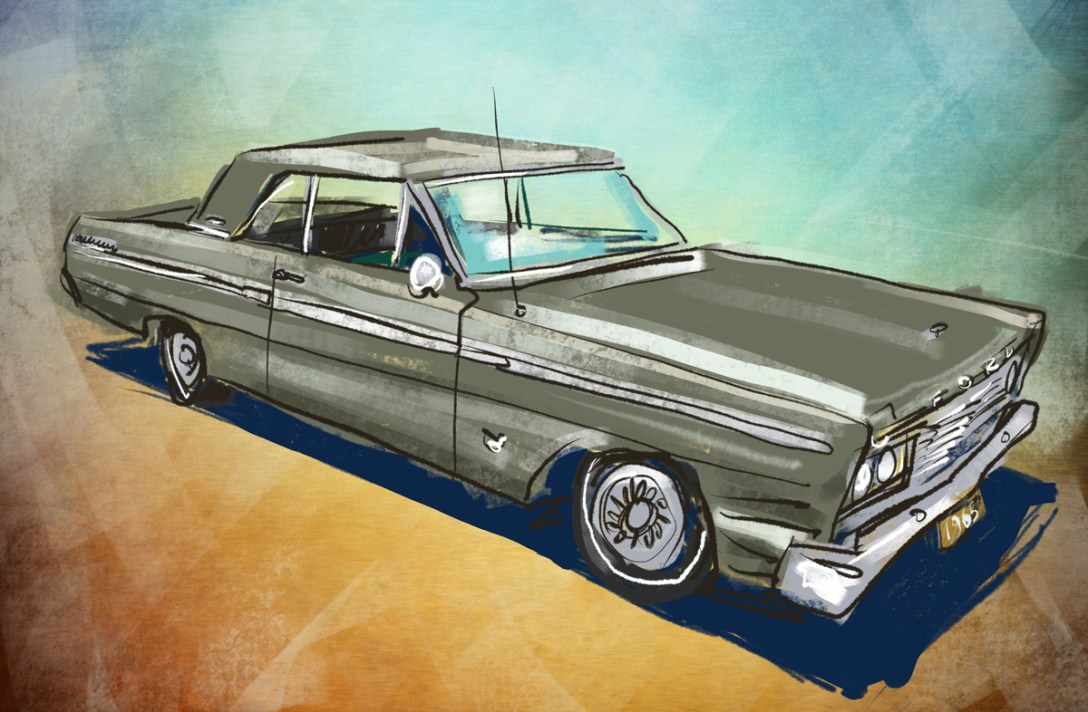
I’ve always loved cars though. I can identify most makes, models, and years from a distance. Particularly those made when cars were still cars and not just interchangeable silver blobs. I read somewhere that people love the cars most that were manufactured the year they first became aware of cars, usually around five or six.  That’s why my very first car was a 1965 Ford Fairlane. I bought it for $800 in a used car lot under Route 1 overpass in Jersey City, when I was 25 and still a month or two away from taking my driving test. I’d moved out of Manhattan to live in Jersey City with a friend and for the first time actually needed a car to go buy a carton of milk.

Despite its age, the Fairlane had about 40,000 miles and its original paint which was a buttery bronze color. Patti (who managed to go to her grave without ever getting a driver’s license) dubbed the Fairlane “The Color Of Money” after the Scorsese movie which also came out that year. It was big and boxy with a fat stripe down its side. It had a manual transmission, “three on the tree”, and suited my old-mannish driving style. The thing was perfection.

Patti and I would take it around town but were always a little nervous about taking it on a road trip. It ran fine and I was obsessed about looking after it. I bought maintenance manual and endless tools. I’d change the spark plugs and oil myself and way more than necessary. I would hand wash, then wax it, buffing the bronze till it glowed like a Marine’s buttons. Perfection.

I let my roommate Simon drive it occasionally. One bleak day he came back from running errands and casually mentioned that he’d accidentally dinged the driver-side door in the supermarket parking lot. I rushed down to survey the damage. The door looked like a moose had run into it. It was crumpled like one of Simon’s empty cigarette packs. As I pulled open the door, it emitted a pitiful screech and a groan.

I was bereft. Sure, we could probably have gone to a body shop and had the door undinged. But The Color of Money was now  imperfect, soiled, sullied. Instead of a classic, it was just an old beater. A few weeks later, I moved out of the Jersey City house  and into an apartment with Patti. I gave the car to Simon and never saw him or it again.

I thought about The Color of Money today because I was listening to Episode Six of The Unmade Podcast, one of my current favoritest indulgences.  This podcast is about podcasts which is rather meta but deeply entertaining. Actually it’s about podcasts that have never been made (hence the name) but could conceivably be one day if anyone could be bothered.

In each episode, two Australian chums swap ideas for potential podcasts, then delve into what they might be like, and whether they’d be any good. Then they move on to the next idea.  Some of the ideas are great and unspool into hilarious explorations, while other are dead ends which are equally amusing to demolish like the door of a 1965 Ford Fairlane.

I love this podcast because it is all about creativity. These two blokes come up with ideas on the fly, then bat them back and forth, twisting and shaping them then tossing them aside. There’s no obligation to prove the ideas, just the raw pleasure of invention and problem solving.

It really gets my wheels turning as it did this week when they discussed another unmade podcast idea called “My First Car.” In this nonexistent podcast, guests would come on to describe their first vehicle and tell stories about what it meant to them, what adventures they had,what memories it provoked — and that would be it. Simple, dumb, and wonderful.

I’ll never be a guest on My First Car — because it doesn’t exist. But I wanted to share my memory of the Fairlane somewhere.  What stories would you tell if you were a guest on the show?

Letter-pressed.

When I was about six, I started making books. There were so many aspects of bookmaking that intrigued me and I wanted to make them mine.

My first books were stories, with a drawing filling the left page, words filling the right. I made them with crayons and pencils, writing as neatly as I could.

At ten, I wrote a book on dogs, with drawings listing the different breeds. I had sections on dog care, and took photos of my long-suffering dog Pogo to demonstrate how to clean her ears with cotton balls and how her teeth were laid out in her long snout. When they came back from the photo lab, I pasted the pictures into my binder and wrote captions in italics beneath each one. Fig.I. Fig IIa, etc.

Throughout my childhood and adolescence, I wrote diaries, plays, short stories, novellas, and was fetishistic about the manuscripts, making carbon-paper copies, putting each one into a file folder or a plastic sleeve , then archiving them in cardboard boxes or ring binders.

I had my own library, with a card catalog I carefully typed onto index cards, scotch-taped Dewey decimal labels on each spine, and checkout cards in little sleeves on the final endpapers to record who had borrowed each one. I re-arranged my books by height, by color, by author, subject, date of publication, publisher.

He taught me the correct place for an author sign a book, not on the end paper but on the half-title or title page.

My mother sort of understood it. None of my friends did. But for me, there was something very comforting in making books, even if they were lopsided, incomplete, lumpy with glue and typos.

My uncle was very authorial — he had a beard, a Selectric, smoked a pipe, played Schubert lieder.  A shelf in his library held his six books in a row, his name on each spine, his author photo on each flyleaf. He taught me the correct place for an author sign a book, not on the end paper but on the half-title or title page.

In high school, I worked on the newspaper and saw my name and words in print for the first time. I have vivid recall of what each article looked like — the number of columns, the placement of the illustration, the size of my byline. I took home stacks of each issue and added them to my archive.

My undergraduate thesis was the first properly bound book I produced, three hundred or so pages on the power of group psychology of student radicals in the 1960s. It was a manuscript bound in plain white cardboard with a black taped spine and a typed label on the cover but, to me, it was a real book and I have it still.

In my mid-twenties, desktop publishing became commonplace and I delighted in setting pages of type, making faux-newspaper layouts, printing out little booklets all written, designed, and printed by me. It was a thrill to see anything I wanted set in type in columns and pages.Then I got access to a scanner and I could make images and wrap text around them. I loved the ker-chunk and thwack of pages extruding from a laser printer, crisp and sharp. I printed out booklets and faux newspaper articles for my family, then my girlfriend, then my wife.

Twenty years ago, I took some courses in bookbinding. There was something so magical about making a case-bound book. Sure, I’d made pamphlets, center stapling the pages together, and filled ring binders with loose-leaf paper, but they weren’t real books. A real book had a spine and pages that were sewn in. But on my own, I could never figure out how to make one, how it all stayed together in a neat box with a rigid spine. Soon the secrets were revealed and I cranked out perfect-bound sketchbooks. Perfect-bound, yes, but not perfectly bound. My bindings were, like everything I make, wonky, ink-stained, lumpy with adhesive, far from perfect, mine.

A couple of years later, my first book was published and soon, I too had a shelf with a row of spines with my name upon them. I would spot them in bookstores and libraries or being read by strangers on a train.  In time, as my publisher sent paperback editions and stacks of foreign editions, my books became more commonplace but they are never ho-hum. They are my books.

This last week, I finally wandered into the one uncharted territory left in my book-making realm: the actual printing of words. My sister is a commercial printer and I’d been on press before when I worked in advertising, watching ads and brochures roll of big industrial presses, but I’d never been involved in the actual setup, especially not in a pre-digital way, so this was very exciting — and scary.

It was another area half-filled with shadow. I had a vague sense of many parts of the process: that type was set, that it was put on a press, that ink came off rollers, that blank sheets slipped in one end and pages came out the other, but I knew I didn’t know the half of it. Actually the quarter of it. Maybe even a smaller fraction.

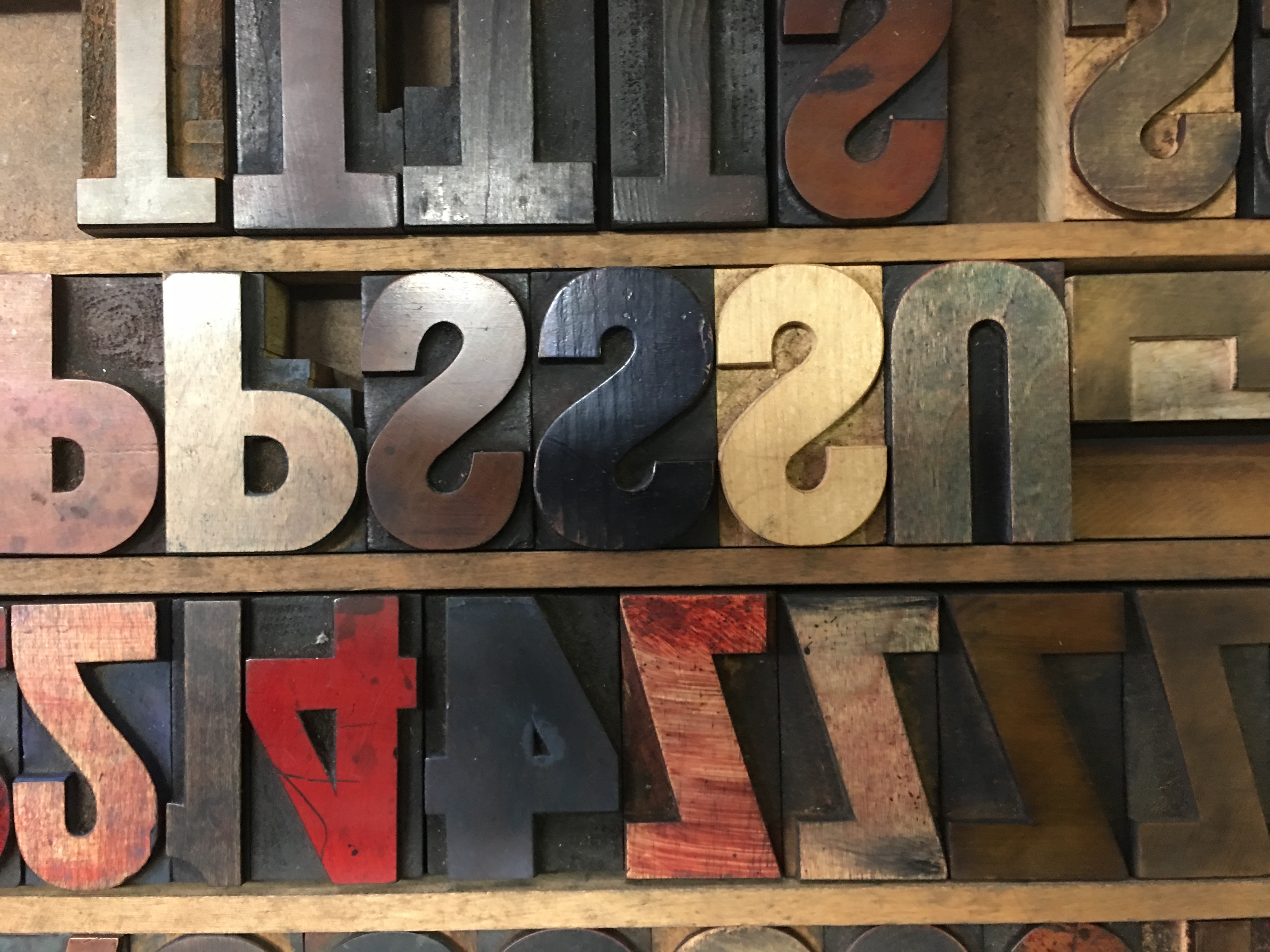
I took my week-long workshop at the Center for Book Arts in the Flatiron district of Manhattan, the same place I studied bookbinding back in the 20th century. The CBA has about ten old presses, six Vandercooks and a few other platen presses that look like Ben Franklin bought them second-hand. They also have dozens of cabinets filled with typefaces, each heavy drawer full of lead containing one face in one point size.
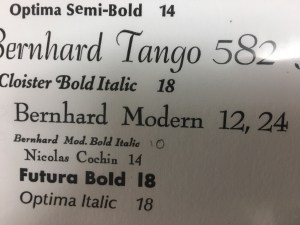
So that’s the first lesson: unlike with a computer, real type only comes in a limited number of sizes and many of the faces may only exist in one size. You can’t just scroll through a bunch of fonts until you see something you like. You have to pick one face from a big ring binder of samples (and the samples don’t contain every letter, just the name of the face set in itself). Then you have to find the drawer with your typeface and that could be anywhere in the stacks of cabinets, each with a tiny label, arranged in no coherent order. Then you slide half open the drawer below the one you want to support your drawer (each drawer weights a helluva lot — it’s full of steel and lead after all), and pear uncomprehendingly at the little compartments containing each letter. Uncomprehendingly, because they are not laid out alphabetically or even according to QWERTY. You have to get a map to the drawer and these maps aren’t universal, so you have to pull out each letter one at a time, a letters that’s backwards and sometimes minuscule, then arrange it right to left on a stick.

This sort of nightmare is even more likely if you’re the sort of butterfingered, ten-thumber who has spend his whole life making wonky, ink-spattered things.

Next you have to decide how big the space should be between each word and locate the appropriate spacer. Then you put down some leading to separate the first line from the next, leading being a strip of lead which comes in different lengths and thickness. You determine the length by setting your longest line of copy and, if that line is in the middle of the page, you’ll need to measure it, then dismantle it so you can begin again with the first line of copy. You determine the thickness by deciding how much space you want between lines and how many lines you want on the page over all.
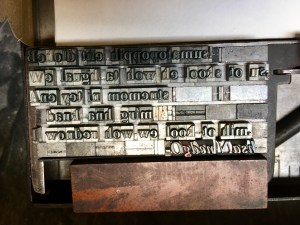
Now, the ‘stick’ that you are arranging the letters on is just a little metal bracket with no adhesive or magnetic qualities. If you don’t hold it at the correct angle, the letters will topple over and may even slide off and end up in a jumble on the floor. This sort of nightmare is even more likely if you’re the sort of butterfingered, ten-thumber who has spend his whole life making wonky, ink-spattered things. Not naming names, just saying.

And that nightmare is compounded by the constant sense that the tools you are working with are not available on Amazon but are all artifacts from long-defunct manufacturers and if you screw anything up, you’ll be trashing part of our cultural history. No pressure, numbnuts.

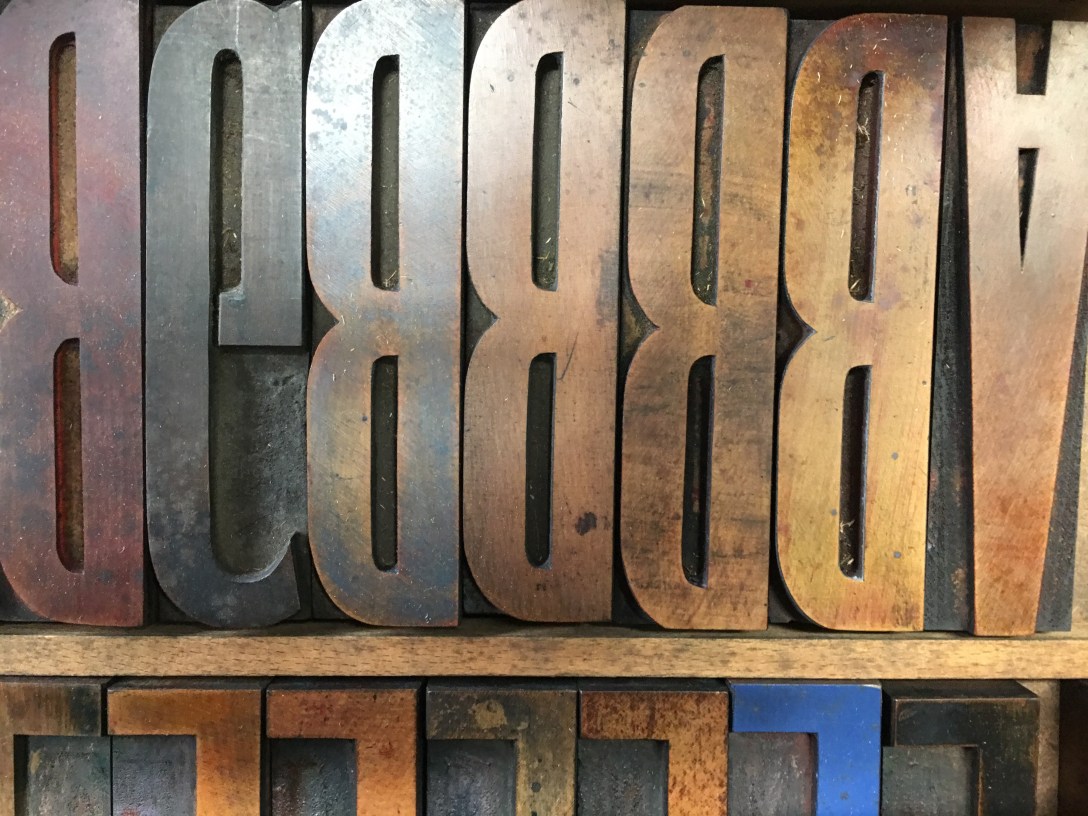
There are also drawers full of even more magical objects: wooden type, some of it letters the size of my hand. They all bear a luminous patina from decades of ingrained ink, a rich sheen of mysterious layered color. These faces are often incomplete, missing letters, punctuations, that you need to compensate for with creative improvisation.

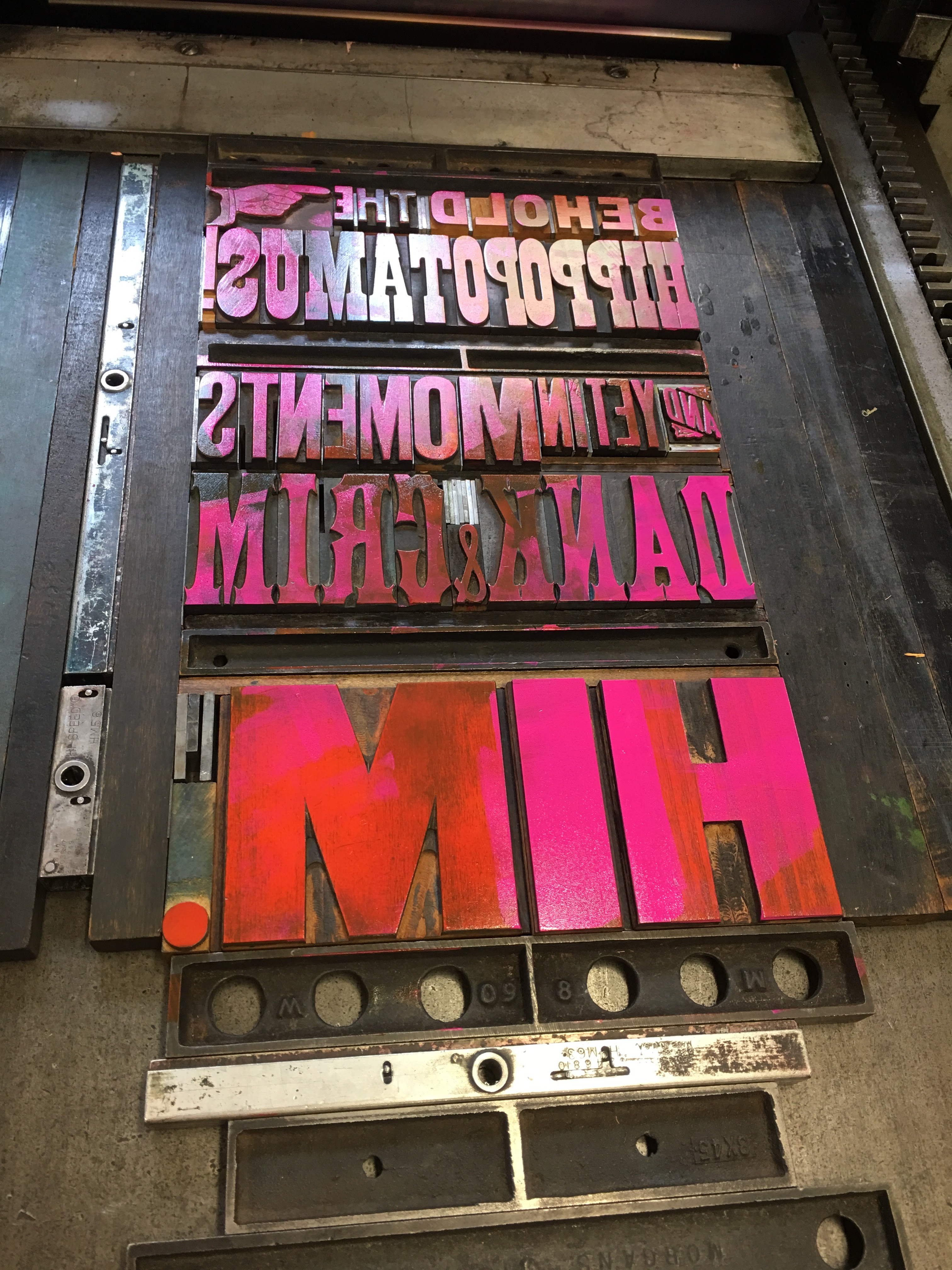
Once you have your type picked and assembled, you lay it on the bed of the press, then surround it with strips and blocks of metal and wood called ‘furniture.’ These all need to be measured and arranged like Tetris till they fill in each direction of pressure. Finally, you slip in a quoin which is a sort of expanding strip with a hole in it which you tighten with a key.

[Printing is the source of so many common phrases. For example, “to quoin a phrase” comes from locking some words into a form. “Mind your ps and qs” refers to a common mistake in setting type where you mix up backwards letters in the form. “Wrong end of the stick” comes from arranging the letters the wrong way. “Upper-case” and “lower-case” describe where in the drawer of type (or case) each letter  can be found. “Get the lead out” means get a move on and set the next line. There are scores of others.]

With furniture in place, you next have to make the final adjustments to the type lockdown. That requires tweezering increasingly thinner sheets of copper and brass between the letters so they won’t wobble or slide. Next you pick your inks. There are dozens of vibrant colors available, each in a can with a tight lid which you have to screwdriver open and then pray it isn’t dried up or contaminated. Then you scoop out a tablespoon or so onto a sheet of Plexiglass, stir it about with a putty knife and either apply it to the roller of the press or brayer it onto the type by hand.

You pray again (no wonder printing used to be done exclusively by monks) and examine your print.

Next you do some tests on newsprint which reveal all the adjustments you have yet to make. You discover letters that are backwards or upside down or the wrong face. You discover that one of your Gs is actually a C. You adjust kerning with more little strips. You realize the whole damned thing looks like hell and is the wrong typesize and have to wipe it all down and reset it. In between skirmishes, you have to wash your hands repeatedly with orange-scented pumice soap.

Finally, you are ready to print — oh, wait, not yet. First, you have to go to the store and buy paper (250+ gram weight)  which comes in big sheets, usually 22″ x 30″. Then you have to determined the direction of the grain and how best to cut up the sheet to get the least waste. Then you go to the giant papercutter, a black steel guillotine with a foot pedal, and when you swing it up, try not to slice open the back of your head or sever many fingers.

Okay, now you’re ready. You start up the press, which activates the rollers. Then you make sure the press is in ‘trip mode’ and you ink the rollers (unless you brayered them by hand — don’t do both). Then you line up your paper, make sure it’s gripped by at least three points of contact, then hold the paper down on the platen while you turn the crank and walk down the length of press then catch the print as it comes up from the depths, pull it out with one hand, while rolling the mechanism back to the starting point. You pray again (no wonder printing used to be done exclusively by monks) and examine your print. If all went well, you put it on the drying rack and print again.

So far, so good. Now the trickiest part which is registering the second color. You have to clean and take apart all the type you have on the press and slip in whatever you wanted printed in the second color. You also need to do this if you combined wood and metal type because they are slightly different heights on off the bed). If you were organized and took your time, you kept all the furniture in the same order as you rebuilt the form, so the registration should work fairly well. Or, if you’re me, you’ll have to do a dozen alterations and adjustments and waste most of your test prints in the process.

Then you have an edition of prints and have to figure out what you will do with them. Mine will probably end up in a drawer but the lessons they revealed will stick with me.

First, after five decades of making things, from books to model planes to shirts to Ikea furniture, I remain a super-consistently hasty slob. Clearly, I can’t change.

Two: I like making stuff with my hands, even if it’s slower and shittier than doing it on a computer. I like the physicality, even the back-breaking parts, and all the many serendipities that happen with analog production, the mistakes that occur and the ingenuity needed to correct or compensate for them. I like the beauty of the brass rollers, the copper slivers you slip between letters, the burnished old wood type, the lumpy mouths of the ink pots.

Three: I like the historical thread that weaves through the press. The awareness that each of these bits of type was handled by generations of people before me, that the processes I’m working on are fairly unchanged back to Guttenberg.

This year, I learned a teeny bit about hockey, botany, canine dentistry, constitutional law, shark migration, and a loads of other inessential but fascinating things.

Four: I like to appreciate how hard it can be to make something well, how that appreciation of craftsmanship is is lost when I can just open InDesign, click my mouse and and push ‘Print.’

Five: I liked the vacation from so much of my usual days, sitting at this desk in front of this computer, the world of digital creation with its endless options, easy undos, and immediate gratifications. I spent a lot of this summer on another project —learning how to go from drawing in ink on paper to making art on an iPad. An exploration in the opposite direction with its own frustrations and satisfactions.

Six: I had to break free of the aesthetics and conventions of digital design. Initially, I was struggling with the design and concept of my letterpress project and then I realized why. I (and frankly many of my classmates) were creating designs that frankly could have just as well been made (and better) with a computer. When I realized this, I decided to use the medium for what it is, to make something I couldn’t make with a computer or a pen, something that was quintessentially an analog print. I drew my inspiration from circus posters and wild postings, chunky, loud, oversized, with rich colors my Epson couldn’t dream of.

Seven: I like learning something new. So much of this week was mystifying, and much remains cloudy, but it was also filled with revelations. And even though I am not good at printing, I can see how, with time, I could be. I don’t know that I want or need to be good at this, but, from completely opacity, I have discovered a path and it is nice to know I could follow it if I chose rather than being afraid or overwhelmed by my ignorance. I’m not a native, but at least I know the basic language now and can find my way about with a map.

It’s important to me, as a creative person and as a human in this world,  to periodically shake up my assumptions and learn something, anything new. To understand a bit about things I like or things I am completely oblivious to. This year, I learned a teeny bit about hockey, botany, canine dentistry, constitutional law, shark migration, and a loads of other inessential but fascinating things.

After last week, I am a jack of yet one more trade.

A Springular pep talk

Spring is here. Nature’s making stuff. So should you.

Here’s a pep talk to motivate you.

Now even more art teachers will hate me. 

In their April issue, Phi Delta Kappa Journal has reprinted my blog post, Let’s Get Rid of Art Education In Schools.  Gulp.

If you like my blog, you’ll like this too. 

When we launched our first Sketchbook Skool kourse, someone asked, “Is this self-help? I thought it was a drawing class!” 

Fair question. But the fact is, making art starts with self-expression, so we tend to talk a fair amount about issues that impact creative people and get in the way of that expression. Things like motivation, habits, blocks, expression, and the inner critic. If you are just starting to make art as an adult, you may want to understand why on earth it took you so long.
I love to draw. But drawing is far more than a technical exercise for me. It’s meditation, it’s connection, it’s appreciation, it’s awareness. It’s a way to make sure that I stay connected to the things that matter to me, every day. In fact, one of my first books was called Everyday Matters because drawing helped me appreciate my life in ways both big and small.

When people find out I’m an author, their next question is “What do you write about?” I usually say I write about art and creativity, but I think what I really write about is the problems I face and how I can solve them in a way that helps others solve them too. That’s led me to write about everything from my childhood to how to get ink stains out of laundry. Which leads me to our new Kourse, Exploring.

I decided to explore two very different but essential things in the week that I teach in Exploring: creativity, and how to make drawings pop off the page. 

First, the latter.

A problem you certainly wrestle with early in your drawing life is how to represent lighting, texture, and dimension, to help bring your work to life. So I share my years of exploration through dozens of examples in my sketchbooks. And rather than just flip pages, I really discuss each one, why it works (or doesn’t) and how you can apply those lessons in your own work.

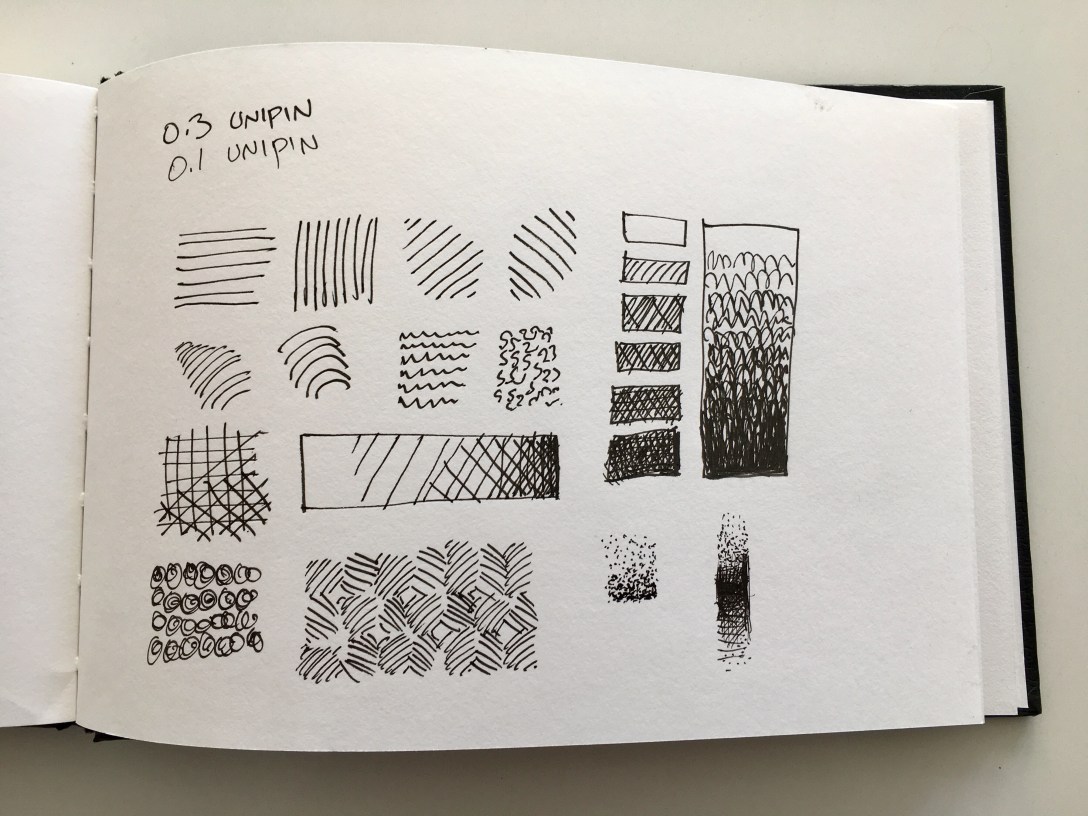
Then I do some experiments to show you how light changes mood and meaning, and how you can represent shades and colors using plain old black ink on white paper. Also how to indicate different materials, from glass to grass, skin to bricks, using just lines and dots.
Okay, that sounds a bit technical, but I think I manage to make it pretty fun.
Your most important art tool: your brain

I created a bunch of videos for this klass that delve deep into the creative process:

  • What makes you creative?
  • How do you get good?
  • How do you deal with criticism?
  • Where do ideas come from?
  • Why are you afraid to draw?
  • How do you keep motivated?

If any of these questions intrigue you, you’re ready to start Exploring. It’s not all self-help, but it will certainly help you help yourself to expand in new directions, enjoy your creativity, and have a wonderful five weeks with me and our other teachers, Lynne, Nina, Brian, and Felix.

Watch the video, then come find out even more about the klass on our website. And finally — sign up and start Exploring with us! We start on April 17.

See you in Klass.  


This email was sent to sketchbookskool@gmail.

I’d rather draw you than shoot you.

As we relaunch “Seeing” at Sketchbook Skool, I did some fresh thinking about the nature of seeing and how cameras do it differently.