I’m starting off each morning by coming up with 10 ideas. Today’s topic: Ten classes I could teach.
Idea machine : how to come up with 10 ideas every single day
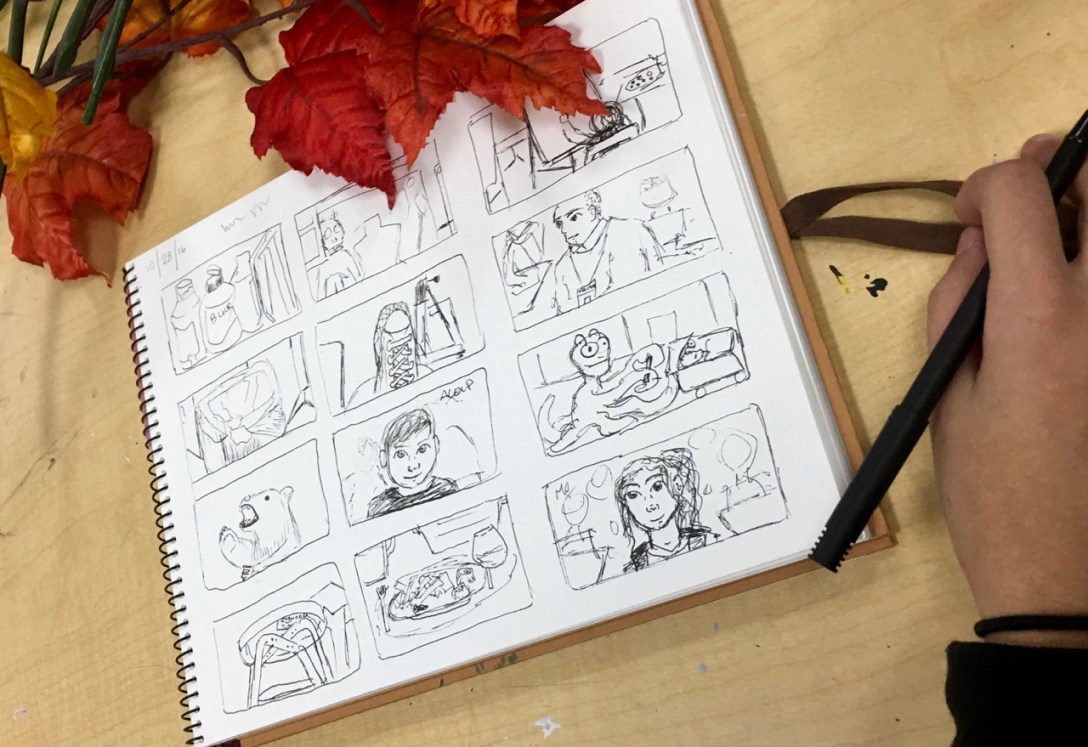
Life in pictures. How to write an illustrated memoir
An Illustrated Journey. How to keep a travel journal
Those who can, teach. How to teach an online art class
The creative process: how it works
How to draw without talent
Yum! Eating and drawing. Drawing in restaurants, drawing the steps in a recipe, keeping a food, journal, wishful drawing: draw it it instead of eating it
Drawing the line. Making art to face life’s challenges
Pow! Telling your stories in graphic novel form
Shut Your Monkey: How to control your inner critic and get more done
Count your blessings: using art to appreciate the world around you
The deadly sins. 7 things we do to sabotage our creativity and how to stop doing them
Eating the whale. Techniques to get creative projects done.
I was in Berlin on 11/9. I woke up at 3:30 am, picked up my phone, read the election results, and discovered that the world had changed. The world has changed a number of times in my lifetime, and often it pivots in minutes. I was halfway through my first cup of coffee on 9/11 when things were completely different than they’d been when I poured it.
My world has changed in a heartbeat too. At 9:15 on 6/9, I was working on the biggest photo shoot of my career. Five minutes later, policemen were taking me to the hospital to see if my wife would ever walk again. At 10:20 on 3/18, I was in a meeting in my office. Five minutes later, I learned I was a widower.
Sometimes change is like a slowly melting icecap. Sometimes it’s a tsunami.
Whatever its pace, change is inevitable. You can’t build a wall to keep it out. You can’t hide from it by cancelling your newspaper subscription. You can’t run from it by moving to Canada.
You can soothe yourself by filling your basement with canned goods or stockpiling shotguns or ranting on Facebook. But that sort of denial won’t protect you from the next change, just the last one.
Change is the one thing you can count on. It’s always around the corner. Sometimes it’s good. Sometimes it’s awful. But it’s coming.
The scariest thing we can tell ourselves is “this changes everything.” Nothing does that. Nothing changes our need for meaning, for beauty, for connection, for love. The world may change but we have control over how much of us it changes. When my life was rocked by change, I retreated into darkness. But then, in time, I merged again and took my place on the shifted ground. And I could still draw a line from the me that is to the me that was. I still loved books and dogs and my family. I was still Danny and eventually the wounds would turn to fading scars.
One of the things that has meant the most to me in the past ten days was a discussion I came upon in the Sketchbook Skool group on Facebook. An ever-expanding group of people talked about what the group meant to them after the election. Some of these people no doubt voted one way others probably voted another, but all agreed, that this group was the place they felt safe because the things that had drawn them all together in the past still mattered an awful lot to them: art, creativity, encouragement, a sense of commonality. Many members of the group have told me that they wanted us to keep the group closed because they didn’t feel comfortable sharing their art in their usual social media feeds — they worried that relatives and colleagues would sneer at their burgeoning creative efforts, but in this group they felt like they were among friends.
Reading my newspaper today, abrim with flailing and fear, I couldn’t help but think of the model we have found in this Facebook group. Looking at what unites us rather than what divides us, at what we love rather than what we hate, at what we can create together rather than what we can destroy. I want to live my life like that. I want to see other people like that.
And I can’t help thinking that it is the very thing that has drawn us together, our creativity, that makes this attitude possible.
Creativity helps us adapt to inevitable change. To make something new to fix something old. To see through other eyes. To discover that what is truly beautiful in the world around you may not fit the standard definition. When you find how wonderful it can be to draw a dented garbage can, a wrinkled old face, a rusting truck, you transcend the obvious, the dogmatic, the rigid, the doctrinaire, the popular, the commercial, and you face the world on new, real terms. You learn to be in the moment, rather than dwelling in some futuristic hell of your own invention.
Drawing helped me escape the prison that fears about my wife’s health had built, helped me be a bit more imaginative in constructing a wonderful though different life for our changing family. It saved my sanity and my life.
When I was little, my world changed many times. My mother’s divorces, moving from continent to continent, a dozen and a half schools in a handful of languages, and yet, I emerged okay. I was adaptive because, at that age, I was at my most flexible, most imaginative, most creative.
It didn’t last. The calcification of age always threaten to make me more brittle. But sitting down and drawing my breakfast or doodling with crayons or spending time with other artists who are creating beauty, helps me to adjust. Creativity is far healthier and more calming and ennobling than gibbering in the dark, alone with my monkey brain.
On Sunday, November 6 at 5 PM, Koosje Koene and I will be hosting a meetup in Berlin at Hops & Barley, Wühlischstr 22/23, 10245Treffpunkt Berlin, Alt-Berliner Kneipe: Mittelstraße 55, 10117 Berlin, Germany
Join us if you’re around for chinwagging and beerswilling.
I am thrilled to be traveling to Berlin to deliver a keynote talk at the amazing design and technology conference, Beyond Tellerand. I am also excited to attend the conference which is full of amazing speakers, designers, technologists and human beings of all stripes.
I’ll be speaking next Tuesday but, alas, the conference has been sold out for a while. But there is a waiting list….
My SBS co-founder, Koosje Koene, has been experiencing a bit of a creative block of late so she has been asking for strategies on how to get past it. We did a Skype chat in which I gave her a few ideas to help her reshuffle the deck and get back to work.
This chat is part of a series for the Sketchbook Skool blog which has lots of other ideas for improving your creative life. If you sign up for the SBS newsletter, this sort of advice will find you and kick your monkey’s butt.
—————————————
P.S. Please excuse my unshaven, pimply appearance. I am going through a second adolescence and my usual hair and makeup person is on sabbatical.
Last week, I did an artist-in-residency at the United Nations International School here in New York. I haven’t spent time in a school since my trip to Vietnam last spring and it was nice to hang out with young creative minds again.
I talked with a few groups of high school students, kids who were serious about art and preparing their portfolios for college. I told them about Jack’s experience at RISD and let them page through a big pile of my sketchbooks. But most of the time I worked with 6th-8th graders — doing fun drawing exercises, talking to them about the purpose of art in their lives, showing them how to make comics out of their everyday lives, explaining how they could use journals to explore the world.
This age is a crossroad for creativity as tweens (ages 10-12) change so quickly from children into teenagers. In 6th grade, they are still interested in drawing and imagining and reading comics, still unselfconscious enough to plunge into any new activity with enthusiasm. A few months later, as puberty begins to roil their brains, they are focussed instead on how others see them, entwined in group dynamics, masking a loss of confidence with cynicism. It’s harder to get through to kids at this age, to get them to sink into the pleasure of drawing without constantly kibitzing with their friends, to listen to directions and suggestions, to avoid self-flagellation and choruses of “I’m no good at drawing.” When the dust of preadolescence clears, former crayon artists will have divided into those who will continue to paint and draw and those who will never try it again.
I try to step into that fray to show that drawing can still be fun, still matter, still have a degree of cool and that it’s not just for a select few who think they have talent. I ask the kids who say they can’t draw if they do draw. How often do they draw outside of art class? I ask them if they can remember drawing with crayons every day when they were 4 or 6. I tell them drawing is like learning to play a video game or shoot a basket, that failing is part of how you learn your way. I show them my own failures, how I improved, and all that drawing has brought to my life.
It’s an interesting challenge and increases my respect for middle-school teachers all the more.
Oddly, this was the first time I had ever worked with kids in New York, but many shared my perspective as a “third culture kid” who had grown up in lots of different countries. I explained that living on four continents and going to a dozen and a half schools before I was thirteen had shaped me into the person I am and had forged my perspective as a writer and an artist, my interest in investigating the things most people take for granted. Growing up as an outsider is the best perspective for an artist to have. New York is a city of outsiders, the perfect place for an internationalist to put down roots.
I have visited a dozen schools in the past year or two. I always come home exhausted and a lot smarter.
I never took driver’s ed in high school. It just wasn’t that important when you were a city kid —at least that was the prevailing wisdom in our house. My mother and my stepfather did have a car, but they felt that if I had a driver’s license I’d just want to drive the car which was their car, not mine. I could take the subway.
In college, I walked or bummed rides and, after graduation, picked my first apartment based on its proximity to the train station. Then, when I was twenty-five, I moved for a year to Jersey City and finally had an excuse to buy a car.
Don’t get me wrong — I love cars, especially the cars that came out when I was a kid. So my first car was a 1965 Ford Fairlane, bronze paint, space-age styling, and gorgeous. I bought it for $800 and then started studying for my permit test.
Jack went through a similar issue. When he was in high school, we didn’t own a car and he had no interest at all in taking driver’s ed. I figured that every day he wasn’t licensed was another day he wouldn’t be killed in a drunken joy ride so I was fine with the delay.
But when he decided to move to Los Angeles after graduating from RISD, there was no more stalling. He took lessons this summer, and then we drove to the Bronx where Jack, full of nerves and self-doubt, nonetheless aced his road test. We drove together a few times in the city after he was licensed, me gritting my teeth as he slalomed past taxis and ground to a jerky halt at each red light.
The question that loomed on the horizon (well, one of a dozen questions about his West Coast transplantation, others to be addressed later) was how would he get around the city once he moved there. I know from my own history in LA that you quickly adjust to never walking anywhere; even two blocks to the grocery store for milk soon seems an impossible effort. One of Jack’s friends suggested Uber, which seemed a ridiculous indulgence. Another said he was going to buy a motorbike because it was cheap. I pointed out that putting steel plates in your head was not cheap.
We talked about buying him a cheap used car but worried it might break down and cost even more in the long run.
Two years ago, when Jenny and I came back to New York from our own LA sojourn, we came in our 2013 Ford Focus. Ever since, it has languished in a very expensive garage on E. 9th Street and we only take it out for a spin once a month or so, and we have been stalling on a decision on its ultimate fate. This July we finally made one. We would give the car to Jack to use in LA.
Next question; how to get it there? I researched car transporters: that’d cost us a grand or so, plus Jack’s plan ticket and shipping costs for his belongings. The obvious solution seemed to be for someone to drive the car there. But who? Jack, with his seven or so hours of experience behind the wheel, wasn’t the ideal candidate for a solo cross-country drive. Fortunately, he has a flexible dad.
So last Tuesday, with rain clouds amassed on the horizon, Jack and I loaded up the Focus and drove out of the gilt-edged garage for the last time. Miraculously, we were on schedule, hitting the road at 6:58 am and driving against the first wave of morning commuters surging into the Holland Tunnel.
I’d had anxiety dreams for the previous week. Frankly, I didn’t trust myself and, of course, I trusted Jack even less.
Would this be my fate?
I had visions of the car exploding in the desert, of searching YouTube for videos on how to change a tire on the edge of rain-soaked highway somewhere east of nowhere. I mentally replayed every road scene in every horror movie I’d ever seen from Duel to The Texas Chainsaw Massacre. I imagined running out of gas, having no phone signal, diarrhea from dicey road food, being assaulted in a truck stop by a maddened alt-Right trucker, bedbugs in a cheap motel, bad radio reception, earthquakes, tornadoes, and wild hog attacks.
Despite the enormous dangers, we made it half way through the Holland Tunnel before an alert went off on the dashboard. We were almost out of gas. I hadn’t thought of this particular scenario, running out of gas and blocking the Tunnel at rush hour. We might even make the local news!
Cousins in Columbus.
We didn’t get on the news or run out of gas, just puttered into a gas station on the Jersey side, then kept going till we were in Pennsylvania. It was a lovely day, lovely ride, and even though Pennsylvania seems to be the most enormous state of the Union and is encrusted with Trump lawn signs, we made it across to the Ohio border by mid afternoon.
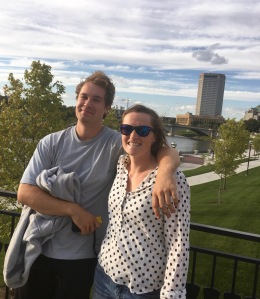
We rolled into Columbus at about 4 PM and made it to my niece Morgan’s house. We met her four dogs, her new husband, and her roommate, then had a nice stroll through Bicentennial Park and a nice dinner at The Walrus. I had one Columbus landmark on my bucket list: Jenni’s Ice Cream parlor. I have made most of the recipes in Jenni’s first ice cream cookbook and wanted to try the real thing. I had a coneful of Goat Cheese and Cherries and it was almost as good as when I made it.
We crashed out on Morgan’s couches then awoke at the crack of dawn for homemade waffles and the next leg of the journey.
The skies were dark and it soon began to bucket down rain. It poured all day. Before lunch, a new alarm went off on the dashboard. Tire pressure low! My heart thundered, adrenaline squirted and I pulled into the next gas station. In the pouring rain, I showed Jack how to use the tire pressure gauge and inflate the two tires that were a little low. It was only the second time I’d ever done that but I handled it okay, I think.
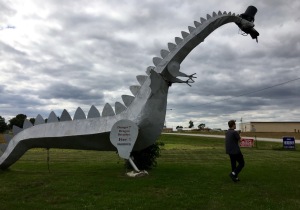
The Vandalia Dragon.
We drove through Indianapolis, then stopped at the Shell gas station in Vandalia, IL to see their fire-breathing dragon. Ten hours and 633 miles later, we pulled into the Comfort Inn in Springfield, MO.
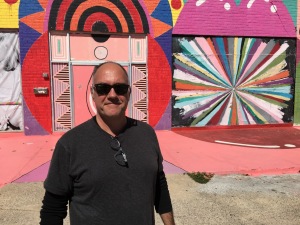
Outside the WOMB Gallery, OK City.
On Thursday, we had lunch in Oklahoma City, which proved to be full of pleasant surprises. We ate some great barbecue, saw some psychedelic murals at the WOMB Gallery, then went to the OK City Museum of Art which has a nice collection of 1960s op art paintings and a Chihuly show.
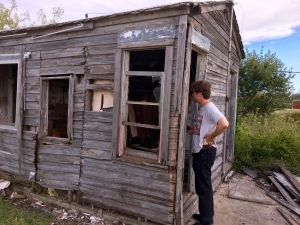
Evaluating real estate in Texacola, OK
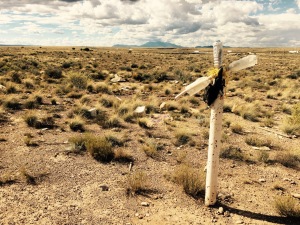
We stopped at Texola, a tiny, crumbling town on the Oklahoma/Texas border and met two dogs and the guys who stand around on the only crossroad.
Jack had done most of the day’s driving, putting another 550 more miles on the odometer. He’d grown more and more confident on the highway, sometimes too confident, grumbling loudly when trucks pulled in front of us, trucks driven by people who insisted on adhering to the 75 mph speed limit. Several times, I had driven my fingernails deep into the armrest as he pulled perilously close to their tailgates.
Finally, we pulled into Amarillo, Texas, the town we were to grow to hate. The sun was setting and we were bushed. We tried to check into one motel but they only had smoking rooms. We secured a decent room in another but had a hard time figuring out how to get into the parking lot.
I walked back to the room and told Jack to pull the car into the last slot, next to a huge pickup truck. Another car was tailgating him, so he pulled to the side to let it by. He was now at a ninety degree angle to the parking spot and way too close to the truck. He inched forward and scraped our car’s fender along a bolt sticking out of the truck’s license plate. He jammed on the brakes and the vehicles locked together. In a bit of a panic, I got between and wrestled them apart.
Once Jack parked, I saw a line across the fender, the first damage the car had ever sustained. I swallowed my agitation because Jack was clearly very upset. It told him it was okay, it wasn’t that big a deal, that if something bad had to happen to us, I’m glad it was so minor.
We went to our room and then, unable to help myself, I started to lecture him, that I thought he’d been driving too fast all day, that he had to be more carful, blah, blah, dad stuff.
I described his reaction and my feelings in my diary:
I see I have scared him with my assault.
He blinks back tears and I feel sickened by my heavy-handedness, adding to his anxiety just to teach him a lesson. It’s the nuclear option and I loathe myself for using it.
I have never ever struck Jack. It’s not something to boast about, though the lessons of my childhood were often delivered by slaps, pinches, fists, hairbrushes, shoes, finger nails, belts. I vowed I’d never do the same. I would never curse or raise my voice in anger. I would rather raise a spoiled, entitled brat than sink into that vulgar, crimson swamp.
But being a parent means wielding great power, as a large person facing down a small one, as an arbiter and authority, and as the one who can give love or withhold it. Learning to wield that power wisely and fairly is an ongoing challenge. Even after all these years, I can let my own weakness carry me away.”
The joy of parenting.
We decided not to drive the car any more that night. We walked past the hotel dumpsters, the Jack in the Box and the Taco Bell, till we reached La Fiesta, and downed a few Mexican beers and picked at our burritos.
Overnight, in my dreams, the scratch grew bigger and bigger, the entire front end of the car became crumpled and undriveable. I tossed and turned, making plans to sell the Focus for scrap in Amarillo and rent another to drive to LA.
In the morning, somewhat refreshed, I went out to reexamine the damage. It was trivial. I told Jack, this wasn’t nearly as bad as I’d thought. He replied, ‘Really? I think it’s pretty bad. How much worse did you think it was?’ I explained that it was limited to one small panel and that he could probably fix it with touch up paint. It wouldn’t affect the car’s performance. Worst case, a body shop could repair it for a couple of hundred bucks. My prognosis was based on zero experience, but it felt reasonable.
I did all the driving that day. It was a short-haul through the rest of West Texas, then on to Santa Fe. We passed through some lovely country straight out of a John Ford Western and our dark moods lifted under the big skies.
Grayson Perry is so clever and funny in his musings about the nature of art and how ridiculous the art world can be, thoughts that came right out of essays I have written on this blog and conversations Jack and I have had many times since he was a teenager.
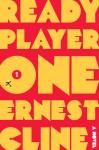
Ready Player One is a novel about the highest levels of nerddom and online gaming, something Jack and I shared since he was little. Jack is far too cool for most people to know this side of him, that he loved to play World of Warcraft and read comics, that he still plays video games with his childhood besties.
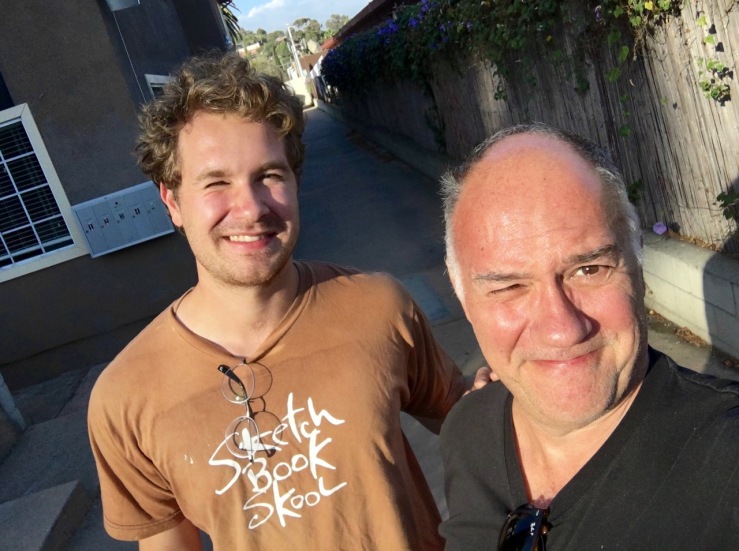
Spending this week sitting 18 inches apart, reminded me of how much Jack and I are alike, how much history we share, how much we have gone through together. There are large chucks of my life that no one will every understand like he does, and vice versa.
But we are also quite different and our relationship makes that even more so. There are times, many of them, when he rolls his eyes at what I say and do. There are times that I cringe at myself for being the know-it-all-dad, swift with pronouncements that I’d be embarrassed for you or my other peers to hear me make, those do-as-I-say-not-as-I-do moments that are an inevitable part of being a parent. Jack isn’t always 100% forthcoming with his feelings, and I am overly self-conscious so I wonder what he thinks of me at times, whether I seem like a complete asshole or if he is actually taking in my priceless wisdom on how to change your oil, look for a job, or brush your teeth.
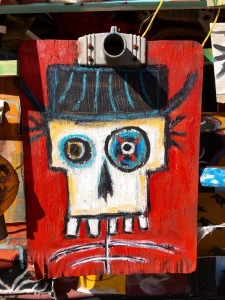
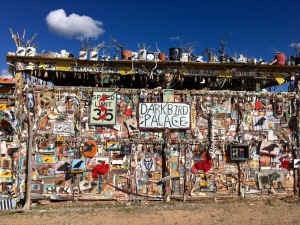
Santa Fe was relief from the long stretches of Texas and Oklahoma. We met a painter who worked in a flea market, we went to some mediocre galleries, we ate some artisanal food. The highlight for me was the Folk Art Museum.
Flea market art in Santa Fe.
Jack said he really liked the town, that it as the first place on the route he could imagine settling. I found it a little precious, the art was pretty mediocre, and there were too many crusty, grey-haired couples wandering around with Merrills and sunbonnets for my liking. I still preferred OK City, which at least had some hipsters under the age of thirty.
Two Guns, AZ.
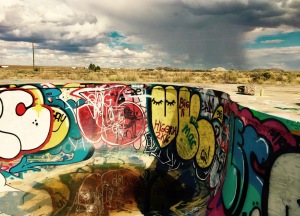
We ate more Mexican food, overdid it with green chiles, and played Casino in the hotel bar. On Saturday morning, we had a late departure and zoomed past Albuquerque, Gallup and the Apache Sitgreaves National Forest. We had to make a quick visit to my favorite abandoned campgrounds in Two Guns, AZ, a ghost town covered with murals and graffiti.
Then onto my mother-in-law’s house in Phoenix. Margie has had a rough summer health-wise and it was nice to have a quiet dinner with her and just sit and play King’s Corner.
Palm Springs, CA.
On Sunday morning, we started the final leg of the trip, six hours on the I-10 . We stopping once, for lunch at a great old deli in Palm Springs where we shared a corned beef sandwich and some dill pickles.
We got to Jack’s new home in Echo Park by midafternoon. Ironically, we ended the trip as we’d begun it, down to fumes once again as we pulled into his ‘hood, barely making it to the Arco down the street.
We made it!
I spent 24 hours in LA, helping Jack get some furniture at IKEA and start to get oriented. On Monday afternoon, he drove me to the Burbank Airport for my flight to San Francisco.
Here’re some snippets I wrote in my journal on the short flight north:
“Is he relieved as I walk into the terminal? To see the back of me and to finally be free to go where he wants, how he wants?
“I think this is why I’m here. Not to work or write blog posts. But to love Jack and Jenny. To love them as they should be loved. To do all I can to make them happy and fulfilled. I don’t do it perfectly but I try to do it better every day.
“I can tell him I believe in him, that I’m proud of him, that I love him — and I do. But those words are just icing on our twenty-two years together. What matters more is that I stand back and let go. That what I think and feel matters less and less to him.
For weeks, I have been telling myself that this trip represents the final chapter in my parental odyssey, that I’ve paid the last bill, fulfilled the last obligation, taught the last lesson, passed on the last morsel of experience, and now Jack will ride off to find his fortune while I wave feebly from a dusty window in the ancestral hovel, then recede into the gloom.
But of course this not the end of the story. It’s just one more chapter in Jack’s life and I shall continue to play a role in it, albeit a new one. I look forward to sharing in what he does so many miles from home because I know he’s not that far, that I brought him there, that his journey is an extension of my own, that we will always be connected in a way that can’t be severed and that neither of us wants it to ever be.
No matter where we each live or work or park or buy egg sandwiches, I shall always be Jack’s dad and he’ll always be my boy.”
That’s a bit maudlin for the wrapup of the trip. Here’s a better ending:
Repeatedly in the weeks leading up to the trip, jenny had told me I should show Jack where the spare tire was stowed in the car and demonstrate how to jack it up and change the tire. I kept meaning to, sort of, but never got around to it.
The fact is, I have only ever blown a tire once. I was driving across the busy Williamsburg bridge and it completely freaked me out. Jenny was with me, she called AAA, and a man in a tow truck came and helped us deal with it. Other than that, I had never changed a tire and my only idea of how to do it came from the movies.
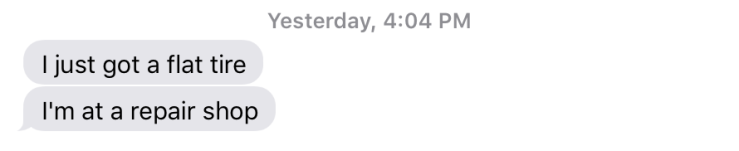
The next day, I saw I had missed a text from Jack.
By the time I called him, he had driven over a nail, gone to a gas station, re-inflated the tire, then, when it went down again, found a place to get it fixed for $15 and was back on the road. He’d dealt with the problem on his own.
Now, I imagine if you are at all a normal person you are scoffing at this story — big deal, he dealt with a flat tire — but to me it was, of course, a symbolic and fitting end to our transcontinental odyssey.
Jack is on his own now. He’s living his life. He’s doing his thing. He’s fixing flat tires. And he’s gonna be okay.
I love making money. And it’s easier than it seems. Just crumple up a bill or spread it out — and then open your workbook and dive deep into the details with your pen.
The way I approach this little bit of counterfeiting is the same way I draw anything complex. I’ll take you through the steps in this video.
It’s a lovely subject for meditation. Spend a half hour doing this and you’ll emerge much richer. And so will your workbook.
As you know, I am rather lazy and always eager to get out of work. So don’t be deceived by the plethora of seemingly-fresh videos below.
Last year, when the original Art Before Breakfast came out, I made a bunch of quick videos to explain the principles behind the week of drawing lessons. As I have a similar week of instruction in the workbook, I am resharing those videos for you to follow here. Lazy, but effective.
Despite their vintage, the lessons still work.
Spend a week watching the videos and doing the exercises in the workbook, and, by the weekend, you’ll be ready for your first one-person show at the museum of your choice.
BTW, I filmed these in the winter and I think I was sick with something during a couple of them, so you’ll notice turtlenecks, sweater vest, pale skin and a red nose. Don’t be alarmed. I’m better now.


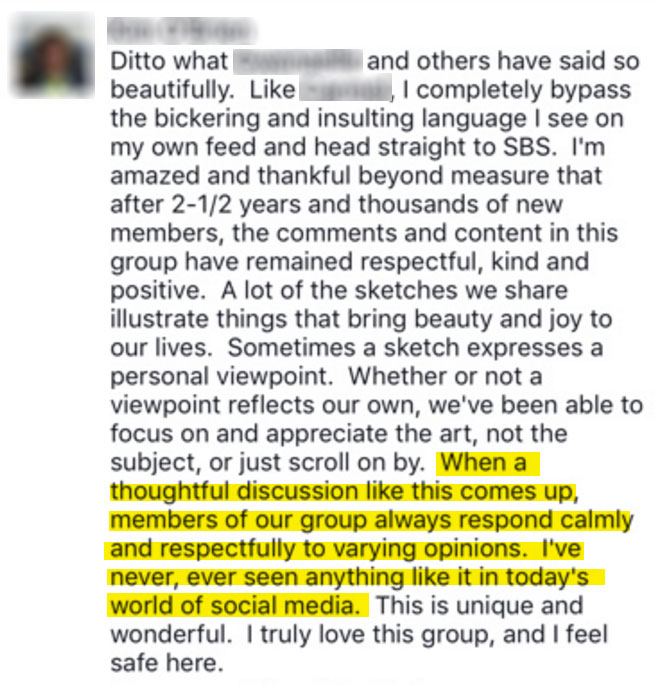 An ever-expanding group of people talked about what the group meant to them after the election. Some of these people no doubt voted one way others probably voted another, but all agreed, that this group was the place they felt safe because the things that had drawn them all together in the past still mattered an awful lot to them: art, creativity, encouragement, a sense of commonality. Many members of the group have told me that they wanted us to keep the group closed because they didn’t feel comfortable sharing their art in their usual social media feeds — they worried that relatives and colleagues would sneer at their burgeoning creative efforts, but in this group they felt like they were among friends.

 I walked back to the room and told Jack to pull the car into the last slot, next to a huge pickup truck. Another car was tailgating him, so he pulled to the side to let it by. He was now at a ninety degree angle to the parking spot and way too close to the truck. He inched forward and scraped our car’s fender along a bolt sticking out of the truck’s license plate. He jammed on the brakes and the vehicles locked together. In a bit of a panic, I got between and wrestled them apart.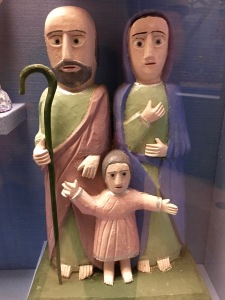

 By the time I called him, he had driven over a nail, gone to a gas station, re-inflated the tire, then, when it went down again, found a place to get it fixed for $15 and was back on the road. He’d dealt with the problem on his own.
 Danny Gregory