Art Before Breakfast: My Cabinet pts.1 & 2

Before the holiday season began, I started sharing some videos of drawing exercises, drawn (as it were) from my book, Art Before Breakfast. What with drinking too much holiday punch, trying on too many new socks and sweaters, and launching the new term at Sketchbook Skool, I abandoned the series — but only temporarily. Let’s keep going, shall we?

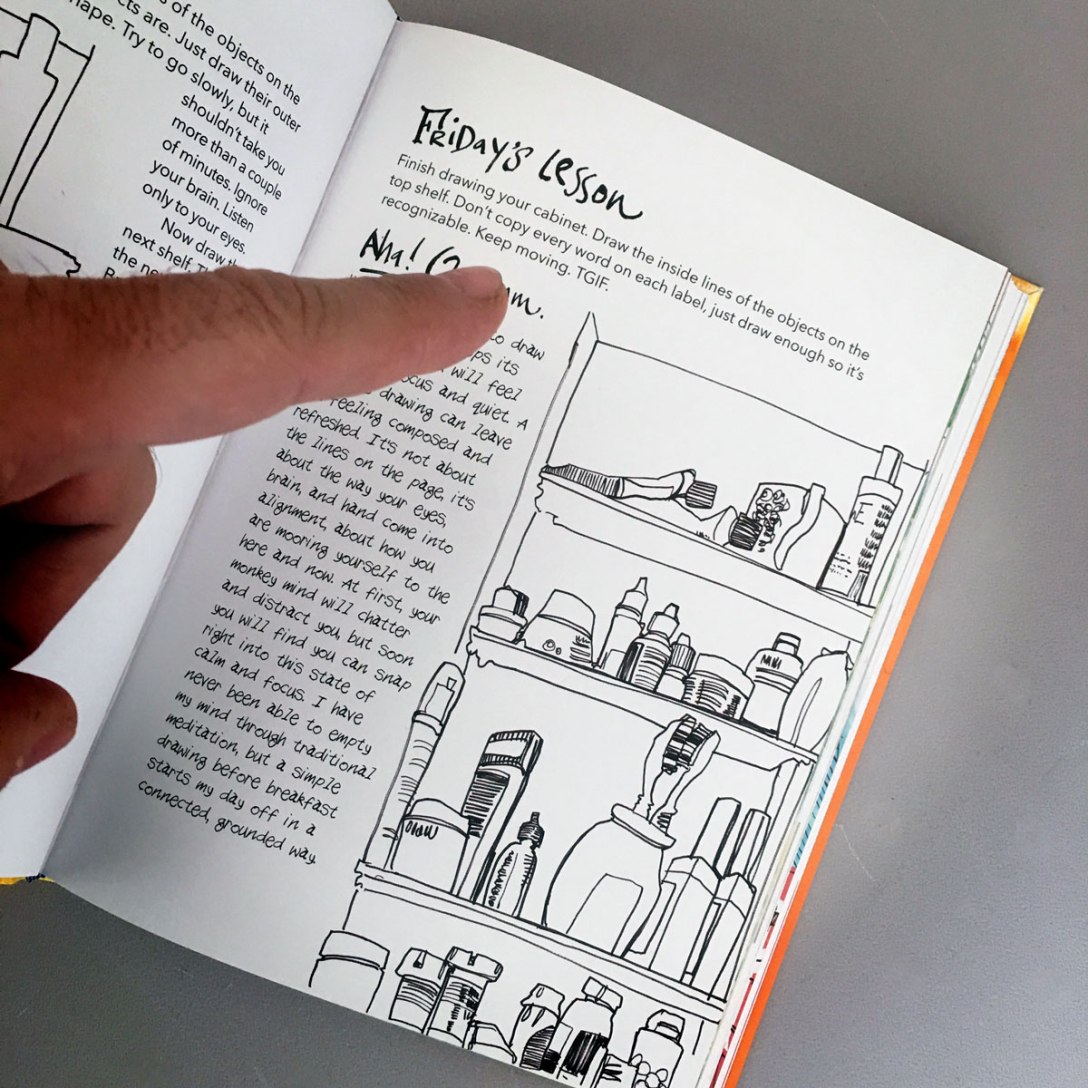
Today, let’s return to my bathroom. Last time, I started a contour drawing of the contents of my bathroom cabinet, all those unguents, potions and salves that keep me looking so boyish and fresh. If you’ve forgotten, here it is again:

Now, let’s fill in all the information that sits within those contours. This is made a lot easier by the shapes we already drew. I’ll show you how to use them as guides to add detail. Open your eyes and uncap your pens!

If you’re new to drawing or are struggling with the basics, I hope this series will be helpful. (Here’re the past episodes, in case you missed any.)

On Fridays, I work through an idea from Art Before Breakfast. It would be lovely if I could imagine you out there drawing along with me. This particular exercise comes from page 31. If you decide to do it too, please share with me how it turned out! (Share the results on your own blog or on Facebook and post a link in my comments section. Use #artb4bkfst on Twitter or FB).

Do-ha!

I’m heading to Qatar tonight to spend a week working with children in a lovely school in Doha. I hope to report from the road.

Inspiration Monday: handlettering

I love handwriting, lettering, and calligraphy. Here’s a little video of some of my favorite practitioners.  It was prompted by the new kourse at Sketchbook Skool which you are either enjoying as well or kicking yourself for missing.

Oh, and happy Dr. King Day!

Planting one more seed.

I know, I know. You are good and tired of me nudging you about the new kourse at Sketchbook Skool. Message received.

But I want to just give you another taste of what has me so worked up about Expressing, how inspired I have been in making it and working with these new artists. And how you — even though you have never taken an art kourse and never will (yes, yes) — will be fired up too if you join us.

I won’t say any more I just want you to watch this.

Did it melt your frozen heart? Good. Now, click to enroll.

How to watercolor: In under 3 mins.

People often ask me, “Oooh, you use watercolors! Isn’t that really hard?” Short answer: No, silly. Slightly longer (2:40) answer: watch this video from Felix Scheinberger.

He lays out all you need to know succinctly and clearly. And in German! And it ends with him putting a flame to his painting!

Felix, BTW, is one of the world’s greatest masters of watercoloring. And even though he gives you all the basics in this video, he has sooo much more to teach. It took me over a year to get him, but now he’s finally on the fakulty at Sketchbook Skool. Starting tomorrow!

We have a few seats left but enrollment ends on Friday. Get a brush, some paints, and join us!

More inspiration: from me and others

House of Muses just published an inspiring bunch of suggestions from various creative folks. Including me.

Inspiration Tuesday: Michael Nobbs

My pal Michael Nobbs suffers from Chronic Fatigue Syndrome and yet is a creative and productive artist. We had a chat recently about how he does it and how we can all use his techniques to get more done each day.

Michael is also a teacher in the newest kourse at Sketchbook Skool. If you would like to more tips, suggestions and perspectives from him and our other new fakulty, check out Expressing at SBS.com.

Happy New Kourse!

One of the many fun parts of my job is that I get to meet cool people and work with them on films about their art. We have long in-depth conversations, I’m allowed into their studios, hear their ideas and histories, and watch them make beautiful things. Today, after several months of traveling and filming, I get to share those experiences with you and all the other people who enroll in Sketchbook Skool.

The real idea behind SBS is that each week’s klasses are an opportunity to share that experience of hanging out with fascinating creative people for a day. Each Friday, you watch a dozen or so films that capture all the aspects of this experience. The result is that you learn some new techniques and tools but also that you are inspired to make art of your own by rubbing up against other great creative spirits.

The new kourse we are launching today is called “Expressing.” It’s about how art conveys not just pretty pictures but deep feelings, information, experiences and sentiments that can’t be captured just in words.

Here’s a little taste of what the kourse will be like. I hope you’ll join me in the audience for six weeks of art, inspiration, wisdom and fun. Roll film!

Click here for more information about Expressing

Here are some of the wonderful people who Koosje and I have brought to join the fakulty:

There’s Felix Scheinberger who I first met several years ago when I was working on An Illustrated Journey. Felix is one of Germany’s top illustrators and an art professor in Berlin. He’s the author of one the most inspiring watercolor books in my library with the deceptively prosaic title, Urban Watercolor Sketching. His work is witty, expressive, a little grotesque, and watching him work makes you itch to grab a brush and join in. I recorded a great conversation with Felix a while ago and you can watch it here.

I have known Michael Nobbs for even longer. I think we first start corresponding more than ten years ago when he was first starting to draw and joined the Everyday Matters group on Yahoo!. Michael has Chronic Fatigue Syndrome but, in spite of that, he has a strong creative habit and has published a lovely book on drawing and created a daily podcast and a special, subscription based creative community, called sustainablycreative.com. He is an inspiring and lovely fellow and shares my passion for tea drinking.

Penelope Dullaghan is another of my old pals and I featured her work in An Illustrated Life. I met Penny when she was getting ready to quit her career in advertising and step out as in independent illustrator. I love her work, her bravery, and her long-term creative community project, Illustration Friday. Her weekly creative assignments have encouraged thousands to draw regularly and many of them have gone on to become professional illustrators too. I think she’ll be equally inspiring to the folks at SBS.

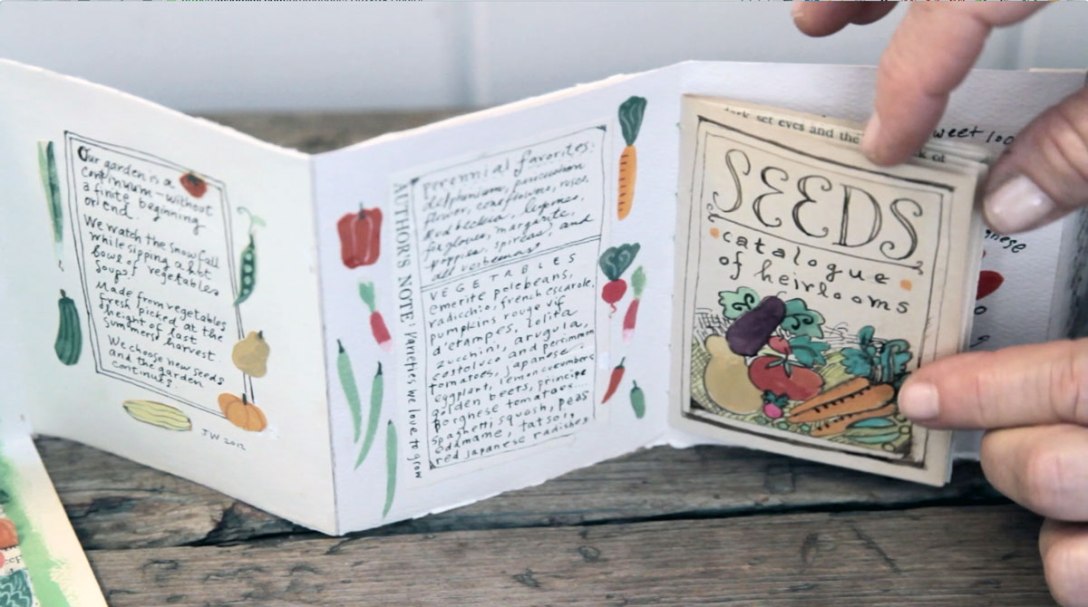
I met Jill Weber when she illustrated several books written by my old friend, Julie Salamon. The Christmas Tree was a huge international bestseller, then they went on to write Cat in the City (which includes a character based on my late wife, Patti) and their newest, A Mutt’s Promise. Jill grew up in a creative family, then went to RISD, worked in the New York publishing world and lived in Bohemian SoHo in the ’70’s, then moved to a self-sustaining farm in New Hampshire. She is full of wisdom and stories and talents and we captured many of them in our films.

Sabine Wisman is Dutch, a writer who started to draw and soon became a full-time illustrator. I love the way she combines simple line work with witty text. She packs a lot of meaning and feeling into light whimsy. I look forward to learning how I can make my own work more effortless, clear and direct.

And the final teacher is my partner and pal, Koosje Koene. KK is going to focus on lettering and how to make it a part of your journal pages. I think this is a crucial lesson — I see all too many beautiful drawings and watercolors in peoples’s sketchbooks that are marred by hasty captions that seem like afterthoughts. I love the way drawings and calligraphy reverberate off each other and Koosje is a master.

Anyway, this is a long, round-about way of telling you that our new kourse is finally ready for you. You can sign up right now and the first lessons begins on Jan 15.

Happy New Year! See you in klass.

Inspiration Monday: Fäviken

Magnus Nilsson is a chef in a remote part of Jämtland. His restaurant seats only 14 people each night but it is regularly voted the best in Sweden and among the top two dozen in the world. I’ve never been to Magnus’s place or even to Scandinavia but it has a rare grip on me these days.

I first learned about Magnus in the Netflix series, Chef’s Table (I keep recommending this series here on this blog but no one ever seems to comment on it. Your loss; I think is is so inspiring for artists of all palates and palettes.) but have enjoyed a much deeper dive into his mind since buying his first book, Fäviken. I’ve been meaning to write about it here for several weeks but have waited because I can’t easily distill its pleasure into the few paragraphs I allot myself here.

Magnus, like many of the finest chefs, is an artist. But his art is not in virtuoso classical cooking or conversely in wild experimentation. Rather he is an artist who celebrates a deliberate, careful observation of the world around him and creates work that makes us experience life more vividly.

His restaurant typically serves up to thirty courses per meal, courses made up primarily of ingredients found in the surrounding forest. He uses burnt stumps, sheets of moss, and last autumn’s leaves. Most of his game he himself hunted and recently. His beef comes from old dairy cows, hung and aged for many months. He raises his lambs alongside his children, then weeps as he slices their wooly throats (the lambs, not the kids).

His dishes include:

  • A little lump of very fresh cheese, floating in warm whey with one petal of lavender
  • Very light broth of pig filtered through moss
  • Leeks picked just minutes ago, sheep’s cream whisked with mead, grated cod’s roe
  • Pine tree bark cake, pudding of milk and cream, acidic herbs and frozen buttermilk, grated hydnellum suaveolens
  • A tiny slice of top blade from a retired dairy cow, dry aged for nine months, crispy reindeer lichen fermented green gooseberries, fennel salt

Does this sound precious and effete? Not to me. Hearing him speak or write about his process is to realize what it means to be 100% in tune with one’s surroundings, to appreciate the bounty of the surrounding land, to recognize the difference that a few minutes makes to an ingredient’s flavor, to be absolutely present and to believe in doing things well or not at all.

…is the guy just an anal, Nordic lunatic?

My favorite page is called “Giving a Carrot the Attention It Deserves” and covers how to grow the right variety for your climate and soil type, what the weather should be like when you pull it, how to correctly pare one’s fingernails before handling the carrot, how cool the rinsing water must be, how to hold the carrot when rinsing, the right type of peeler to use and how old it should be, the right angle to wield it, down to which way to lay the peeled carrot on the plate. I first read this page, out of context, and thought, is the guy just an anal, Nordic lunatic?

But when I read it again, after reading all the pages that preceded it, I realized the purpose of his obsession. It is about care, about doing things the right way, about recognizing the essential, a kind of honor that Hemingway would have recognized. Doing things right is very hard, but the purpose is not to be exclusive or judgmental. It is to celebrate life by living it well. And it is to show the rest of us that each day can be gulped down whole or savored thoughtfully.

He concludes this page by saying: “The questions you must ask yourself about every detail are these: does this make the end result better, and do I have the time and capacity to do it at the moment? If the answer to either of these questions is no, do it in a different but equally thought-through way that better suits the needs and possibilities available to you. The important idea is not always to do things without compromise, but with thought-through attention and decisions that lead, little by little, towards creating a better result.”

The recipes in this book are uncookable unless you have 10,000 acres of Swedish wilderness and a very special mind. But I can taste their wisdom on the page, can learn from their philosophy, and apply it to the bowl of Raisin Bran I’m about to make. And the drawing I’ll do right after.

Art Before Breakfast: My Cabinet pt.1

Today, come with me into my inner sanctum: my bathroom cabinet. Therein, you can marvel at the many powerful medications I take and the unguents, potions and salves that keep me looking so boyish and fresh. Open your eyes and uncap your pens.

It’s Friday and time for the next in my series of simple videos on how to see and draw, based on my latest book, Art Before Breakfast. We will use all of the tools I have given you so far — proportions, contours, and negative space — to draw a scene that is complex and varied. I do this exercise regularly to build my powers of observations and work on my fundamentals.

If you’re new to drawing or are struggling with the basics, I hope this series will be helpful. (Here’re the past episodes, in case you missed any.)

Every Friday I work through an idea from Art Before Breakfast. It would be lovely if I could imagine you out there drawing along with me. This particular exercise comes from page 30. If you decide to do it too, please share with me how it turned out! (Share the results on your own blog or on Facebook and post a link in my comments section. Use #artb4bkfst on Twitter or FB).