Over the years, I have narrowed my bag of tricks to a select few: watercolors, ink, a dip pen to write with. Sure, I vary it a bit with some gouache and an occasional brush pen — but my arsenal is limited and comfortable as old, very scuffed shoes.
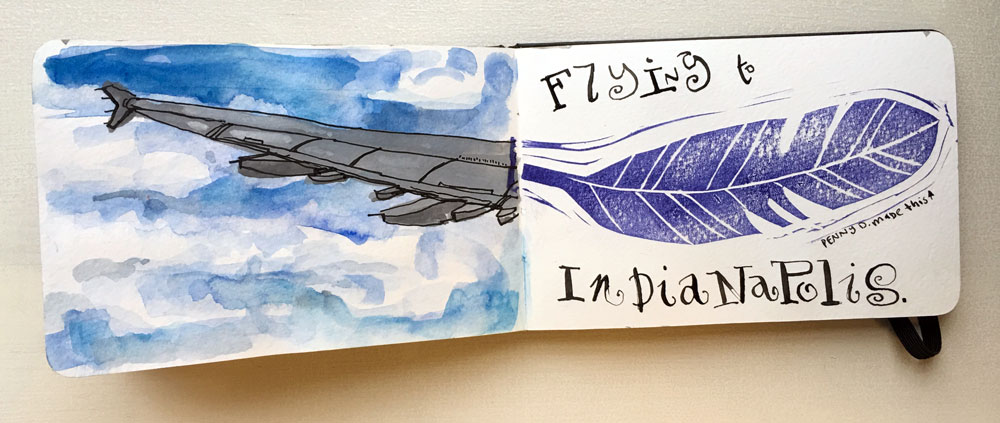
Last week, when I hung out with my pal Penny Dullaghan in Indianapolis, I realized the price I pay with this lack of imagination. She opened drawers and pulled out screen prints, monoprints, pages of pattern blocks, , then drawings she had collaborated on with her 7-year-old daughter. I watched her create stencils to define shapes and then pound color through them with ink pads. I marveled as she created carbon paper with oil paint and scribed spasmodic, fractured lines with a special transfer techniques. She whittled a stamp out of soft linoleum and created graceful repeating patterns. She layered ink, watercolor, gouache and colored pencil over the textures she’d made and turned simple drawings and designs into rich, organic textures that made her images come alive.
I left town with my head full of ideas and a long list of things I wanted to try. Then I caught up with my pal Tommy Kane and he showed me new techniques he’s doing by layering drawings on top of each other, by drawing on marbleized paper, and by painting and drawing on ceramics.
My friends fired me up to get radical, to experiment in a way I haven’t in ages, to learn new techniques, and to build myself a proper studio once again so I can spread out and play.
If you’ve ever wondered how to figure out the proportions of something you want to draw, you’re in luck today. It’s Friday and time for the next in my series of simple videos on how to see and draw, based on my latest book, Art Before Breakfast.
If you’re new to drawing or are struggling with the basics, I hope this series will be helpful. (Here’re the past episodes, in case you missed any.)
Every Friday I work through an idea from Art Before Breakfast. It would be lovely if I could imagine you out there drawing along with me. This particular exercise comes from pages 28-9. If you decide to do it too, please share with me how it turned out! (Share the results on your own blog or on Facebook and post a link in my comments section. Use #artb4bkfst on Twitter or FB).
Ah, Vienna! I cracked open the trusty travel journal, uncapped the old brush pen and began to draw the Hofburg Palace. Soon, I realized that I needed to be creative, resourceful, and as resilient as a Hapsburg to tackle the task.
And speaking of travel, I am flying to Indianapolis today to shoot the next class for Sketchbook Skool. I’ll try to report in from the road.
Here’s the third of a series of simple videos I’ve made to walk you through the steps of seeing and drawing from my latest book, Art Before Breakfast. This one builds on the previous lesson with a different exercise in how to see negative space. That’s the space between things that helps us understand better what we are seeing and hence better how to draw.
If you’re new to drawing or are struggling with the basics, I hope this series will be helpful. (Here’re the past episodes, in case you missed any.)
Every Friday I work through an idea from Art Before Breakfast. It would be lovely if I could imagine you out there drawing along with me. This particular exercise comes from pages 26-7. If you decide to do it too, please share with me how it turned out! (Share the results on your own blog or on Facebook and post a link in my comments section. Use #artb4bkfst on Twitter or FB).
Here’s the second of a series of simple videos I’ve made to walk you through the steps of seeing and drawing as I outline them in the first section of my book, Art Before Breakfast. This one describes an initially tricky concept — drawing what isn’t there so you can do a better job of drawing what is. If you’re new to drawing or are struggling with the basics, I hope this series will be helpful. (Here’s the first one, in case you missed it.)
Every Friday I work through an idea from Art Before Breakfast. It would be lovely if I could imagine you out there drawing along with me. This particular exercise comes from pages 26-27. If you decide to do it too, please share with me how it turned out! (Share the results on your own blog or on Facebook and post a link in my comments section. Use #artb4bkfst on Twitter or FB).
I am writing this on a train traveling from Prague to Vienna. The trip is very comfortable, the day is sunny, and the Czech countryside unfolds all around us. However, the wifi service is kaput and so I will probably upload this bit of Monday inspiration closer to Tuesday morning. I hope you have been able to hang on, uninspired.
Kids: I’ve spent the past week in Prague, working with students from kindergarten to twelfth grade, and their energy and creativity has inspired me deeply. I don’t pretend to be an art teacher when I visit schools. Kids, especially 2nd to 4th graders are so enthusiastic about drawing and they have so many interesting ways of tackling drawing from observation. I show them a bunch of my own sketchbook pages for inspiration, give them some minimal direction, and then stand back.
I drew with several hundred kids over the week and I think we were all surprised at what they made. Kids are perfectly willing to draw from reality, even kindergartners. They are capable of noticing enormous detail and of the discipline to sit quietly with pen in hand for up to an hour. It’s pretty amazing to see a room full of 7 year-olds staring at their shoes with wrapt attention.
Their creative energy and fearlessness inspired their teachers and parents too. I heard lots of stories of little kids insisting their entire families draw together, of unused sketchbooks being taken down and filled up, of ancient fears being addressed and overcome. Having an entire community start to express their creativity together is powerful and infectious.
If you haven’t drawn with a kid recently, give it a go.
Terezin: In 1941, the Nazis set ups a transit concentration about 30 miles from Prague. Terezin was a propaganda project, a “model ghetto,” used to con the Red Cross into believing all was well, that the Jews enjoyed self-government and idyllic conditions. The reality was different — a way-station en route to the death camps that processed 140,000 Jews from all over Europe, many of whom were children.
The Jewish self-government tried to create an alternate reality for the children, shielding them from awareness of their fate, and turned several of the dormitories into recreation centers. The Nazis forbade organized education of Jews, but the inmate were able to offer drawing lessons which they believed were key to knowledge and communication skills.
Rather than be drilled with formal drafting skills, the children were encouraged to express themselves, their memories, fantasies, and fears. They explored morality, the battle between good and evil, folk tales and biblical stories that could serve as moral examples. They documented their personal histories, their experiences in the camp, their visions of the future. Drawing was their only therapeutic outlet, the only way to cope with the unimaginable situation they and their families were in.
Friedl Dicker-Brandeis, a Viennese painter and inmate of the camp, became the primary driver behind this art program. She later volunteered to go to Auschwitz to join her husband, first hiding 4500 drawings made by the children of Terezin. She and most of the children did not survive the war, however their art lives on in the Jewish Museum in Prague. It’s a fairly awful museum, poorly presented and documented, but the children’s art outshines this dismal presentation.
For me, seeing this work, after a week spent with healthy, happy, free children, was a transformative experience. This was the most powerful example I’ve seen of the power of art to shine light on the darkest corners, to provide meaning, education, and hope, despite calamity.
Art is not a luxury, a ‘nice to have’ — it’s central to what it means to be human. If your children or grandchildren are not getting enough encouragement to make art in school, find a way to keep their imaginations alive, not just on the screen of an iPad but with a pen, a box of crayons and a sketchbook of their own.
Praha: Prague was the only major city in Europe not to be bombed during WWII. So, thankfully, a thousand years of wonderful architecture has been preserved there for me (and you) to draw. I didn’t have nearly enough time to draw all I would have liked but I did get a chance to record some of the amazing cathedrals, the castle, and the rooftops sprung fresh from Tim Burton’s imagination.
If you are any sort of urban sketcher, I urge you and your pen to hop on a flight to Prague, especially when the weather is nice (as it was, unseasonably so, much of the time I was there). The views are great and the beer is cheap.
Flaesh: Most of the museums of Prague were frankly a disappointment. They featured huge slabs of dry explanatory text in microscopic fonts, undistinguished objects mixed in with very occasional treasures, and staff that were trained in the Moscow DMV sometimes in the early 1970s.
However in the Galerie Rudolfinum, we saw a wonderful show of a half dozen contemporary women artists, including favorites like Marlene Dumas, Kiki Smith and Lousie Bourgeois.
Two artists that are fairly new to me were Tracey Emin and Berlinde De Bruyckere. Emin’s work is strongly autobiographical, confessional and sexual. She’s an extraordinary craftsman — there are pieces made of neon, several of the drawings were stitched into the canvas, others that seemed to be watercolors were actually woven tapestries.
De Bruyckere makes work that is monumental and grotesque. My favorite is what seemed to be a collapsed, flayed horse stuffed into a large wooden cabinet with an old Dutch label, evoking the recurring butchery of war, colonialism, suffering, loneliness and death. The work is unapologetic and blunt. Seeing it in this spacious, baroque museum, so unexplained and stark, moved me almost as much as that of the children of Terezin.
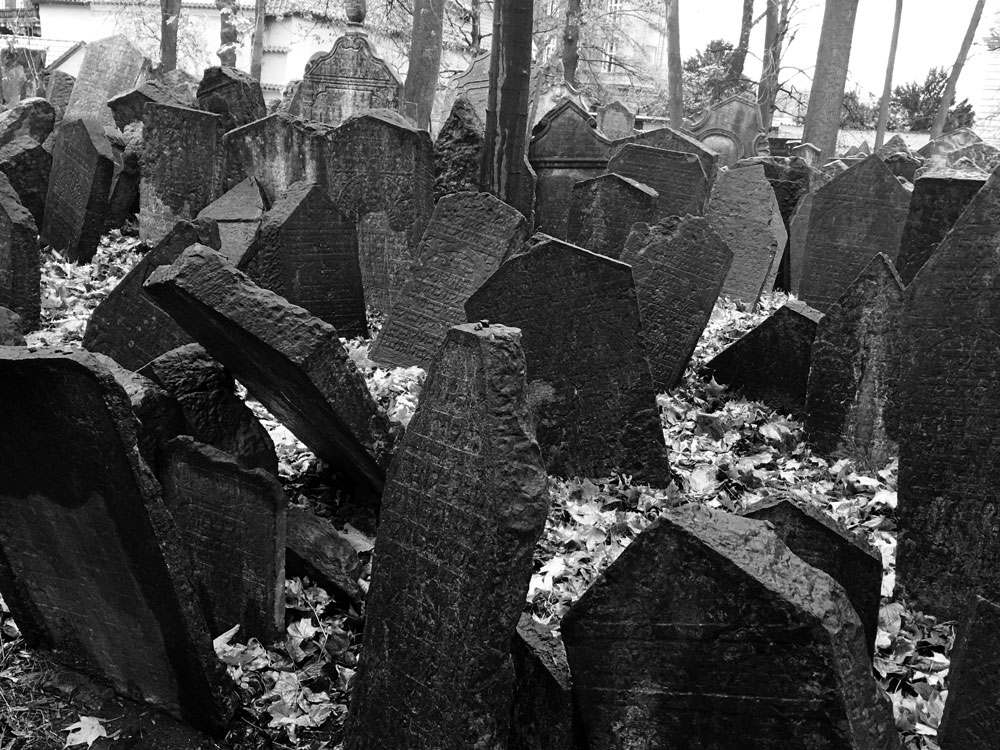
My inspiration this week is admittedly dark. Maybe it’s being in this Medieval city, surrounded by magnificent but unattended churches, the specters of WWII and the Iron Curtain still so present. Maybe it’s the autumn skies, the collapsing Jewish cemetery, an excess of Pilsner Urquell, the profusion of consonants in the Czech language. I am having a wonderful and inspired time — but my palette is indigo and umber.
I’ve made some simple videos to walk you through the steps of seeing and drawing as I outline them in the first section of my book, Art Before Breakfast. This first one is about why you don’t need talent to get started, just a couple of simple ideas that might jog your brain, including a demonstration of contour drawing. If you’re new to drawing or are struggling with the basics, I hope this series will be helpful.
Every Friday I work through an idea from Art Before Breakfast. It would be lovely if I could imagine you out there drawing along with me. This particular exercise comes from page 25. If you decide to do it too, please share with me how it turned out! (Share the results on your own blog or on Facebook and post a link in my comments section. Use #artb4bkfst on Twitter or FB).
My partner, Koosje just went to Wales to film one of the next Sketchbook Skool klasses with my old pal, Michael Nobbs. She made a little video behind the scenes of the trip to give you a taste of what’s to come.
You’ll also get to meet a member of the SBS team you may not know — our fantastic European cameraman Brian who has filmed many of our videos.
Anomalisa: I love everything Charlie Kauffman touches. Being John Malkovich, Eternal Sunshine, Dangerous Mind, and, most of all, Synecdoche, which I have watched over and over till my BluRay skips. His inventions are endlessly fresh, rule breaking, and, despite the inevitable twinge of melancholy about them, inspiring and life-affirming to me.
This week, he dropped the first trailer for his new film which is a stop animation feature. I can’t wait to see the whole thing.
Chef’s Table: Technically speaking, I didn’t discover this Netflix series this week. I rediscovered it, probably for the eight time. If you come to my house for any length of time, I am going to make you sit on my couch and watch at least east one episode of Chef’s Table. It is sumptuously shot and will make your mouth water. But it’s not really about food. It’s about art, personal expression and demons, breaking rules, discovery, and the non verbal. It’s about art. It will inspire you in the kitchen and in the studio.
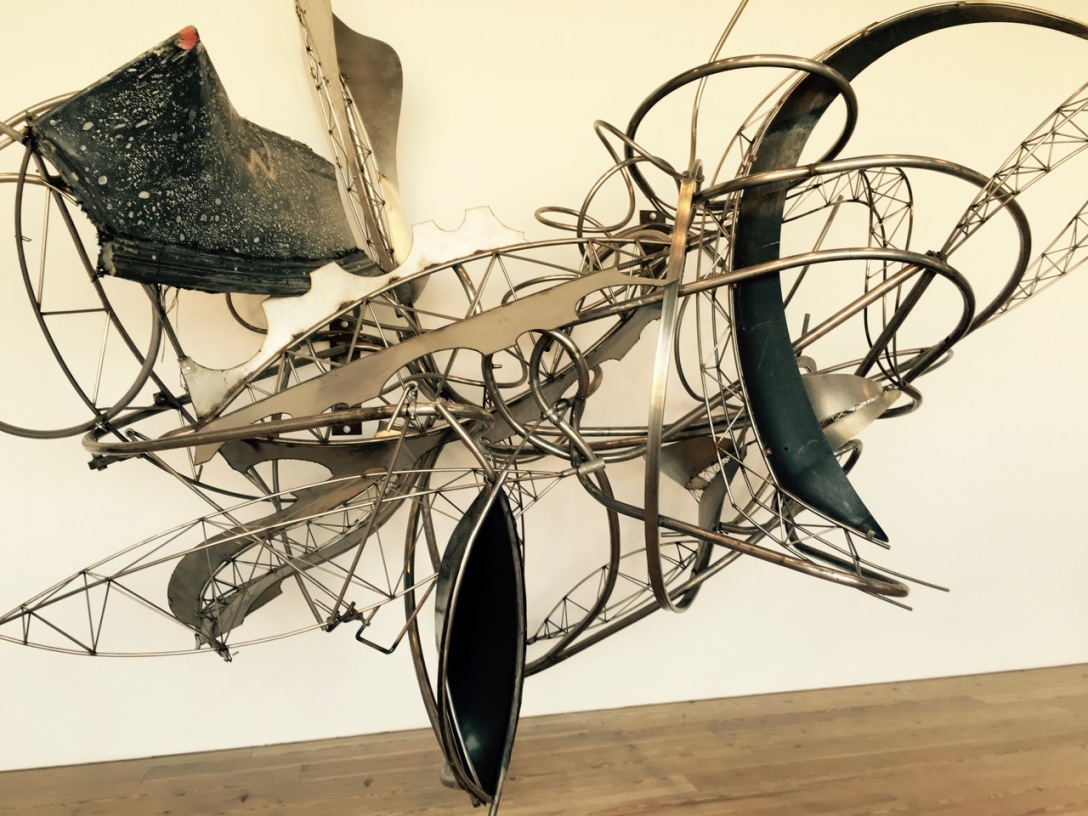
Frank Stella at the Whitney: I didn’t love most of this show but parts of it were fantastic. His later sculptures in metal and some of the painted surfaces with wild electric colors that vibrate and hum with fluorescent zest.
The most inspiring part was just being in the Whitney. I have three different museum memberships but this is the one I use. The new Whitney is such a great space, manageably-sized and walking distance from my house. That means I have been here three times in the last month or so. I can revisit the works I like and reconsider the ones I passed over. And best of all, I get access on off-hours when the hordes are still penned outside the member’s entrance.
Museum membership does obvious good things like support the arts but, selfishly, it also means permission and encouragement to see art more often and more deeply.
S.H.A.M.E.: Apparently this is a common phrase in the recovery world but I encountered it for the first time this week. It stands for Should Have Already Mastered Everything. If you are any sort of perfectionist, you will recognize this cudgel the Monkey uses to flail us.
Shame at not always exceeding expectations. Fear at screwing up. Inability to realize that we aren’t meant to be perfect, but human.
S.H.A.M.E. may not qualify as inspiration, but, if I can affix this label to self-destructive demands and make me see them for what they really are, it will be a useful tool indeed.
What have you read, seen, experienced, or thought of recently that could inspire me and others? Please share your discoveries and help fill my well with inspiration.








 Danny Gregory