Donald Trump. Ben Carson. Bernie Sanders. Microbrews. Artisanal pickles. Documentaries. Memoirs. Ukuleles. Normcore. Etsy. Real Housewives. YouTube. What do they have in common?
A claim to authenticity. Their appeal is a rejection of the cynical, corporate polish of the 21st century and a willingness to show it like it is.
Granted that behind a lot of these ‘authentics’ is the same old cold calculation, cynical manipulation, and ancient biases — but our hunger for them is real.
When everything seems to have passed through Photoshop, Autotune, TelePrompTers, 3D printers, Instagram filters, product placement and GMOs, we come to crave authenticity. We tire of bullshit and hidden agendas. We have all seen the DVDs extras and know how special effects can easily manipulate the truth. And so we prefer politicians who don’t seem like they are. We reject Spiderman VI and Billboard charts and McDonalds breakfasts. We hunger for the truth.
So why is authenticity at such a premium? If people want to wind back the clock, why not just let ’em? What’s the big deal?
Well, authentic authenticity is hard. It’s hard because it’s naked and vulnerable and exposing your warts can cost you dearly. Because you can’t delegate authenticity to consultants. Can’t guarantee its outcome through past success. Can’t slash its costs, can’t ship it overnight, can’t outsource it. Authenticity doesn’t fit neatly in a box so it sends shock waves through the system.
It’s easier to keep to the status quo which gleams and glistens and reflects back a shinier, faster, cheaper world.
But you have a choice. How could committing to authenticity effect your art? Your creative goals? How can you replace perfectionism and self judgement with honesty? How can you avoid succumbing to the artificiality that technology makes easy and instead reveal your soul, share the truth, make something interesting and fresh and honestly you?
Here’s the second of a series of simple videos I’ve made to walk you through the steps of seeing and drawing as I outline them in the first section of my book, Art Before Breakfast. This one describes an initially tricky concept — drawing what isn’t there so you can do a better job of drawing what is. If you’re new to drawing or are struggling with the basics, I hope this series will be helpful. (Here’s the first one, in case you missed it.)
Every Friday I work through an idea from Art Before Breakfast. It would be lovely if I could imagine you out there drawing along with me. This particular exercise comes from pages 26-27. If you decide to do it too, please share with me how it turned out! (Share the results on your own blog or on Facebook and post a link in my comments section. Use #artb4bkfst on Twitter or FB).
I am writing this on a train traveling from Prague to Vienna. The trip is very comfortable, the day is sunny, and the Czech countryside unfolds all around us. However, the wifi service is kaput and so I will probably upload this bit of Monday inspiration closer to Tuesday morning. I hope you have been able to hang on, uninspired.
Kids: I’ve spent the past week in Prague, working with students from kindergarten to twelfth grade, and their energy and creativity has inspired me deeply. I don’t pretend to be an art teacher when I visit schools. Kids, especially 2nd to 4th graders are so enthusiastic about drawing and they have so many interesting ways of tackling drawing from observation. I show them a bunch of my own sketchbook pages for inspiration, give them some minimal direction, and then stand back.
I drew with several hundred kids over the week and I think we were all surprised at what they made. Kids are perfectly willing to draw from reality, even kindergartners. They are capable of noticing enormous detail and of the discipline to sit quietly with pen in hand for up to an hour. It’s pretty amazing to see a room full of 7 year-olds staring at their shoes with wrapt attention.
Their creative energy and fearlessness inspired their teachers and parents too. I heard lots of stories of little kids insisting their entire families draw together, of unused sketchbooks being taken down and filled up, of ancient fears being addressed and overcome. Having an entire community start to express their creativity together is powerful and infectious.
If you haven’t drawn with a kid recently, give it a go.
Terezin: In 1941, the Nazis set ups a transit concentration about 30 miles from Prague. Terezin was a propaganda project, a “model ghetto,” used to con the Red Cross into believing all was well, that the Jews enjoyed self-government and idyllic conditions. The reality was different — a way-station en route to the death camps that processed 140,000 Jews from all over Europe, many of whom were children.
The Jewish self-government tried to create an alternate reality for the children, shielding them from awareness of their fate, and turned several of the dormitories into recreation centers. The Nazis forbade organized education of Jews, but the inmate were able to offer drawing lessons which they believed were key to knowledge and communication skills.
Rather than be drilled with formal drafting skills, the children were encouraged to express themselves, their memories, fantasies, and fears. They explored morality, the battle between good and evil, folk tales and biblical stories that could serve as moral examples. They documented their personal histories, their experiences in the camp, their visions of the future. Drawing was their only therapeutic outlet, the only way to cope with the unimaginable situation they and their families were in.
Friedl Dicker-Brandeis, a Viennese painter and inmate of the camp, became the primary driver behind this art program. She later volunteered to go to Auschwitz to join her husband, first hiding 4500 drawings made by the children of Terezin. She and most of the children did not survive the war, however their art lives on in the Jewish Museum in Prague. It’s a fairly awful museum, poorly presented and documented, but the children’s art outshines this dismal presentation.
For me, seeing this work, after a week spent with healthy, happy, free children, was a transformative experience. This was the most powerful example I’ve seen of the power of art to shine light on the darkest corners, to provide meaning, education, and hope, despite calamity.
Art is not a luxury, a ‘nice to have’ — it’s central to what it means to be human. If your children or grandchildren are not getting enough encouragement to make art in school, find a way to keep their imaginations alive, not just on the screen of an iPad but with a pen, a box of crayons and a sketchbook of their own.
Praha: Prague was the only major city in Europe not to be bombed during WWII. So, thankfully, a thousand years of wonderful architecture has been preserved there for me (and you) to draw. I didn’t have nearly enough time to draw all I would have liked but I did get a chance to record some of the amazing cathedrals, the castle, and the rooftops sprung fresh from Tim Burton’s imagination.
If you are any sort of urban sketcher, I urge you and your pen to hop on a flight to Prague, especially when the weather is nice (as it was, unseasonably so, much of the time I was there). The views are great and the beer is cheap.
Flaesh: Most of the museums of Prague were frankly a disappointment. They featured huge slabs of dry explanatory text in microscopic fonts, undistinguished objects mixed in with very occasional treasures, and staff that were trained in the Moscow DMV sometimes in the early 1970s.
However in the Galerie Rudolfinum, we saw a wonderful show of a half dozen contemporary women artists, including favorites like Marlene Dumas, Kiki Smith and Lousie Bourgeois.
Two artists that are fairly new to me were Tracey Emin and Berlinde De Bruyckere. Emin’s work is strongly autobiographical, confessional and sexual. She’s an extraordinary craftsman — there are pieces made of neon, several of the drawings were stitched into the canvas, others that seemed to be watercolors were actually woven tapestries.
De Bruyckere makes work that is monumental and grotesque. My favorite is what seemed to be a collapsed, flayed horse stuffed into a large wooden cabinet with an old Dutch label, evoking the recurring butchery of war, colonialism, suffering, loneliness and death. The work is unapologetic and blunt. Seeing it in this spacious, baroque museum, so unexplained and stark, moved me almost as much as that of the children of Terezin.
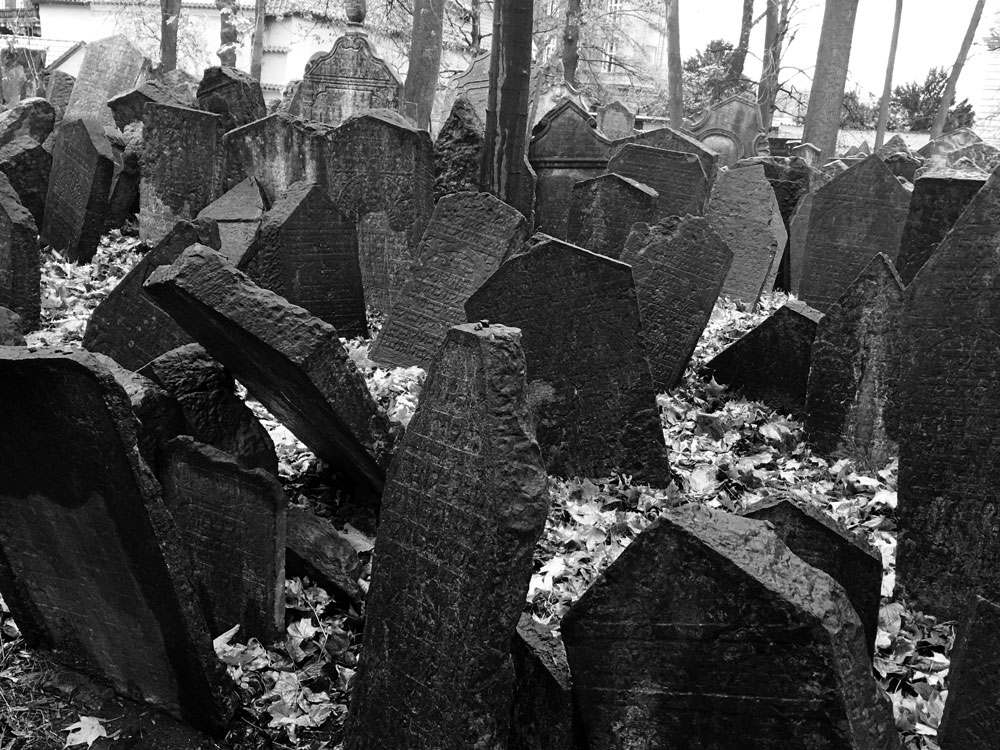
My inspiration this week is admittedly dark. Maybe it’s being in this Medieval city, surrounded by magnificent but unattended churches, the specters of WWII and the Iron Curtain still so present. Maybe it’s the autumn skies, the collapsing Jewish cemetery, an excess of Pilsner Urquell, the profusion of consonants in the Czech language. I am having a wonderful and inspired time — but my palette is indigo and umber.
I’ve made some simple videos to walk you through the steps of seeing and drawing as I outline them in the first section of my book, Art Before Breakfast. This first one is about why you don’t need talent to get started, just a couple of simple ideas that might jog your brain, including a demonstration of contour drawing. If you’re new to drawing or are struggling with the basics, I hope this series will be helpful.
Every Friday I work through an idea from Art Before Breakfast. It would be lovely if I could imagine you out there drawing along with me. This particular exercise comes from page 25. If you decide to do it too, please share with me how it turned out! (Share the results on your own blog or on Facebook and post a link in my comments section. Use #artb4bkfst on Twitter or FB).
I’m spending this week in school. Surrounded by teenagers, I am transported back to my own school days, back to a time when cool was the rule. I came into high school decidedly uncool, with my charcoal smear mustache, fresh off the boat from three years in a small Israel town. I knew nothing about pop culture, sports, music, how to dress or swear. My mother still cut my hair.
By the time I graduated, I was cool—ish. By day I was a good student. I starred in the school play, I edited the paper, I illustrated the yearbook. At night, my friends and I were automatically waved past the velvet rope at Studio 54. We were regulars at CB’s, Mudd Club, Area, Heat, Danceteria, and the Roxy. We hung out with junkies in Alphabet City and smoked dope in the theatre balconies of Time Square. We went to outlaw parties on the High Line, thirty years before it became a tourist attraction, climbing the rusty pylons to drink from brown bags on the crumbled tracks. New York in the ’70’s, it turned out, was cool as hell and some of it rubbed off on me.
When I graduated from college and came back to New York to enter the work world, I was the new kid all over again. I soon discovered there was hierarchy of cool among ad agencies. Ally, Scalli, Della Femina, Lord Geller and Ammirati ruled the early ’80’s only to be eclipsed by newcomers like Riney, Hill Holiday, Kirshenbaum, Deutsch, and the coolest of the cool, Chiat Day and Weiden & Kennedy.
I just assumed I wasn’t cool enough for any of these top shops and worked for the intellectual agency instead, Ogilvy & Mather. Still, I always looked with dorkish yearning at the cool guys. It seems that to work on Apple or Nike required some chromosome I was missing. I didn’t call people ‘bruh’, didn’t have any tattoos or a soul patch or a pony tail, hadn’t backpacked through Morocco or Burma, didn’t own a black lab with a bandana or a Harley. Some magic was working these super-cool places, magic I wasn’t privy too.
Recently I met a bunch of people who worked at Weiden in that period, thanks to my girlfriend, Jenny — who’s one of them. Nice guys, smart enough, but not another species. They may have felt little more empowered to take risks, more likely to see off-center ideas, more free in some ways, but they put their black Levi’s on one leg at a time, same as me.
I’ve had the same experience with artists I admire. People who I thought had drunk some magic elixir, or carved their own pens out of logs of Brazilian Zebra wood which they’d felled themselves, people who seemed to be gods but were just marginally cooler and freer and looser and are confident than I was. With a little effort, a little willpower, I could see that I could be as cool as Robert Crumb or James Jean or Lapin or Tommy Kane.
I look at the high schools kids I worked with this morning. The coolest ones aren’t the ones with silly haircuts or eyeliner or extreme clothing or the outline of cigarette packs in their pockets. They’re the one who are open, confident, curious … themselves. Assuming you are style handicapped, ungifted, uncoordinated, hopeless, backward, well, that’s just your monkey being uncool.
Grace and aplomb can be yours. Just take a deep breath and walk into the room like everyone’s your pal. Draw that same way. With clear eyes and an open mind. With confident strokes, no matter how wonky. With a willingness to fail and an eagerness to learn. Laugh at yourself, take a chance, keep coming back, and, lo and behold, you’ll be super-cool.
My partner, Koosje just went to Wales to film one of the next Sketchbook Skool klasses with my old pal, Michael Nobbs. She made a little video behind the scenes of the trip to give you a taste of what’s to come.
You’ll also get to meet a member of the SBS team you may not know — our fantastic European cameraman Brian who has filmed many of our videos.
For the first half of my career in advertising, I would often have irrational feelings of anger during a creative briefing. I would resent being given the assignment. Then I would be pissed off that I had to sit in a conference room with loads of other creative people while the strategists took us through the brief.
I simmered with impatience. I would ask critical, acerbic questions. I would strain against the deadline.
The monkey would tell me that the people briefing us were idiots, that their insights were lame or wrong, that I already knew more than they did about the subject, that it was wrong that we creatives had to compete for the assignment, the playing field wasn’t level, that the whole project was a waste of my time, blah blah and blah.
It was pretty crazy — and incomprehensible.
With time, I became sufficiently self-aware to identify this pattern and dampen it. But I can still feel the impulse when it comes time to get creative feedback or in the final days before a big presentation — a frothing resentment with no legitimate cause.
This reaction maybe in the minority but it’s not unique to me, alas. I often hired great creative people who would have explosions of rage at the most inappropriate times.
What is the fear that drives it? Vulnerability at having to show one’s ideas where they might be rejected? Of being misunderstood? Of losing control somehow?
Recently, I read of a study in The Journal of Experimental Social Psychology that examined the effects of anger on creativity — and found that it could actually be helpful to the creative process.
Anger provides two benefits: an energy boost in the form of an adrenaline rush which focuses the mind on the problem at hand. Secondly, anger makes your thinking irrational — which can jolt you out of creative ways of thinking. In a paroxysm of rage, you may spit out some crazy truth that makes a wild and fruitful association.
Another study found that many creative people begin their days with negativity and then shift to positive feelings. By channeling the negative energy into their work, they find sharper focus and productivity. If you wake up on the wrong side of the bed, try channeling your bad mood into energy to solve a creative problem.
But proceed with caution for anger is still a sin. Its benefits dissipate fairly quickly. And once the red mists blow away, you may find you’ve alienated potential partners, wasted time and resources, derailed the process, and damaged your reputation. And if people dislike and fear you, they are a lot less likely to be objective about the merit of your ideas.
Being a genius doesn’t excuse being an asshole.
The last in a series on the seven deadly creative sins.
Anomalisa: I love everything Charlie Kauffman touches. Being John Malkovich, Eternal Sunshine, Dangerous Mind, and, most of all, Synecdoche, which I have watched over and over till my BluRay skips. His inventions are endlessly fresh, rule breaking, and, despite the inevitable twinge of melancholy about them, inspiring and life-affirming to me.
This week, he dropped the first trailer for his new film which is a stop animation feature. I can’t wait to see the whole thing.
Chef’s Table: Technically speaking, I didn’t discover this Netflix series this week. I rediscovered it, probably for the eight time. If you come to my house for any length of time, I am going to make you sit on my couch and watch at least east one episode of Chef’s Table. It is sumptuously shot and will make your mouth water. But it’s not really about food. It’s about art, personal expression and demons, breaking rules, discovery, and the non verbal. It’s about art. It will inspire you in the kitchen and in the studio.
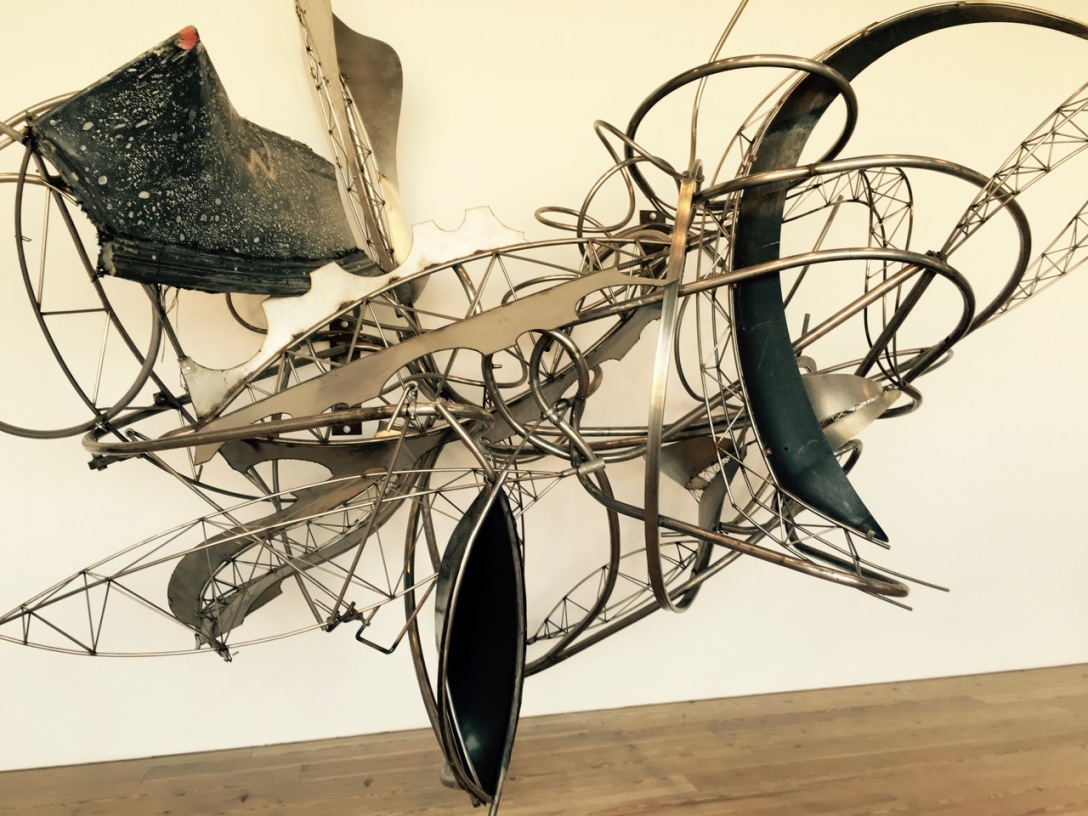
Frank Stella at the Whitney: I didn’t love most of this show but parts of it were fantastic. His later sculptures in metal and some of the painted surfaces with wild electric colors that vibrate and hum with fluorescent zest.
The most inspiring part was just being in the Whitney. I have three different museum memberships but this is the one I use. The new Whitney is such a great space, manageably-sized and walking distance from my house. That means I have been here three times in the last month or so. I can revisit the works I like and reconsider the ones I passed over. And best of all, I get access on off-hours when the hordes are still penned outside the member’s entrance.
Museum membership does obvious good things like support the arts but, selfishly, it also means permission and encouragement to see art more often and more deeply.
S.H.A.M.E.: Apparently this is a common phrase in the recovery world but I encountered it for the first time this week. It stands for Should Have Already Mastered Everything. If you are any sort of perfectionist, you will recognize this cudgel the Monkey uses to flail us.
Shame at not always exceeding expectations. Fear at screwing up. Inability to realize that we aren’t meant to be perfect, but human.
S.H.A.M.E. may not qualify as inspiration, but, if I can affix this label to self-destructive demands and make me see them for what they really are, it will be a useful tool indeed.
What have you read, seen, experienced, or thought of recently that could inspire me and others? Please share your discoveries and help fill my well with inspiration.
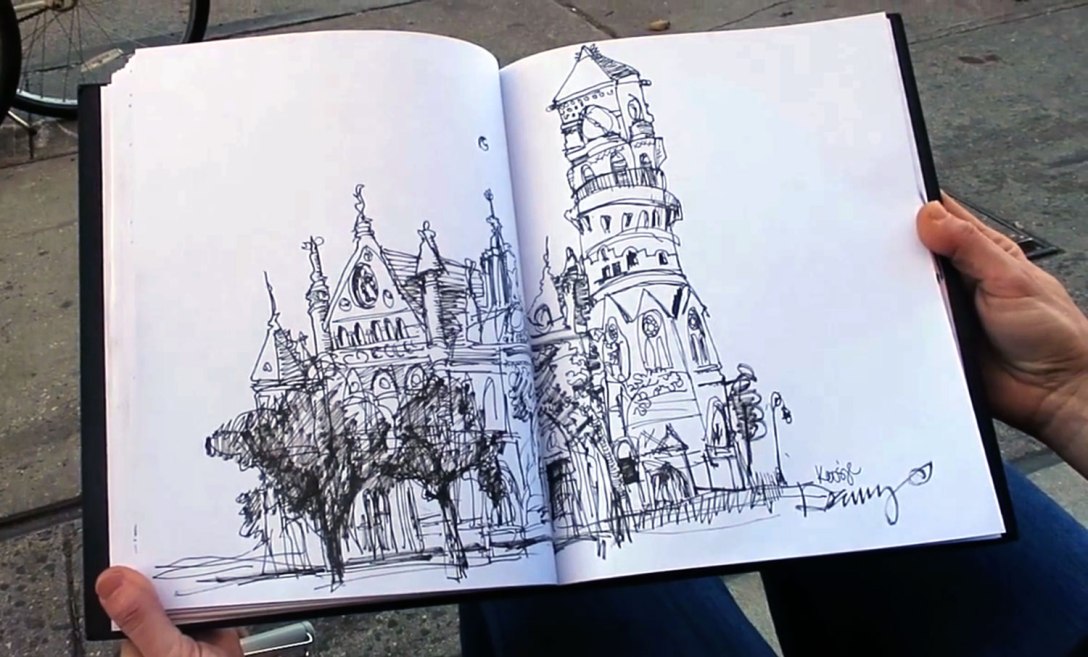
My friend Koosje Koene has been staying with us this week. Koosje is a wonderful artist and teacher so we spent a lot of time talking about drawing and sharing our sketchbooks. The weather was great so I showed her around the Village and then we sat down to draw the Jefferson Market Library.
We decided to do a fun exercise— working on a single drawing together. We sat side by side with a sketchbook on our laps and worked back and forth across the spread. As you’ll hear in the video, we strategized a bit before we began, discussing how to lay out the building across both pages. Then we put our pens together and worked out from the center. Throughout, we jumped back and forth across the drawing, adding to each other’s lines, and discussing the drawing as we went.
It was a blast and the whole exercise took us less than twenty minutes. Get a friend and give it a try this weekend!
Every Friday I work through an idea from my latest book, Art Before Breakfast. It would be lovely if I could imagine you out there drawing along with me. This particular exercise comes from the Art Before Breakfast Workbook, to be published by Chronicle Books early next year. If you decide to do it too, please share with me how how it turned out! (Share the results on your own blog or on Facebook and post a link in my comments section. Use #artb4bkfst on Twitter or FB).
PS Sorry if the video is a little noisy — we shot it on a busy morning in New York City!








 Danny Gregory